Pocket Leadership口袋领导力

Persuading Others

Persuade with Logic and Emotion 查看中文版

第 1 节

Have you ever listened to someone make a case for an idea and found the facts and data they presented compelling? Did you also experience a stirring of emotion as they shared a story as part of their pitch?

If so, you’ve discovered a key principle of persuasion: In most situations, you need to win both minds and hearts. That is, you’ll want to appeal to your audience’s sense of reason and emotion to help convince them that your idea deserves their support.

But knowing how to win hearts and minds isn’t enough. To be convincing, determine which of these two strategies you should lead with when you present your proposal to different people.

How do you decide whether to lead with reason or emotion when you make your case? Consider what you know about your audience and what will resonate most with them.

If you don’t know whether your potential supporters will respond better to logic or emotion, think about what you’re trying to accomplish. Sometimes the situation can help you determine which tactic to use."Focus on Winning Either Hearts or Minds" oy Lisa Lai. Harvard Business Review, May 20, 2015. For example:
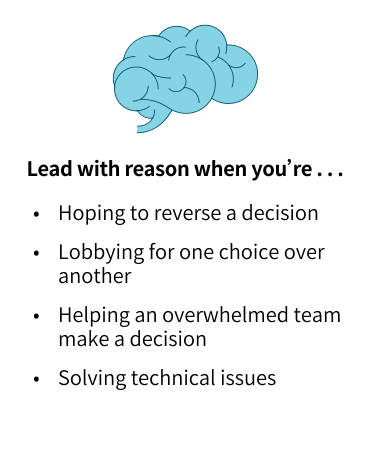
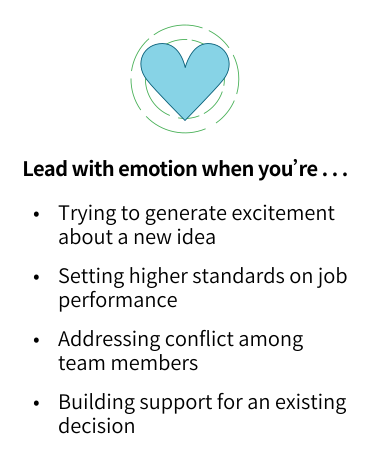
Regardless of which of the two strategies you start with, you’ll want to bolster your argument with the other tactic. For instance, if you’re making a business case for a new product launch and you know the decision maker relies on facts, lead with data on market trends and customer needs. But support your pitch by also including a narrative about how customers would benefit from the product.

Make a Connection

1. Identify an idea or proposal you want another person to support. When you make your pitch, will you lead with an appeal to reason or emotion? Why?

第 2 节

What’s the best way to win people’s minds? Employ a fact-based approach that emphasizes data and analysis. Start by clearly stating your position, and then present evidence to back it. Types of evidence you can use include:

After you share your ideas and supporting evidence, be sure to spotlight the benefits of your proposal. For example, if you want to implement a new software tool, emphasize how it can save time and increase productivity on your team by automating tedious tasks. Explain why your audience should accept your idea over others.

Ayame uses data to convince her boss

Ayame uses data to convince her boss Ayame is the product owner of an online platform called HomeGorgeous, which allows customers to visualize and purchase home furnishings. Ayame feels strongly that the platform needs to provide customers with better training on self-service features, but her boss is hesitant to invest any more time or resources in the platform. Ayame knows she’ll need to provide evidence that her proposal will ultimately save the company money to convince her boss. Ayame tells her boss, “Customers like the new self-service features but find them difficult to use, so our customer service costs have increased by 12% each quarter. A recent report from our data analytics team shows that improving the self-service training will help us lower our support costs over time. The plan I’m recommending will cost 25% less than the alternatives and can be implemented in just two months versus the four months needed for other options.” Ayame uses data to convince her boss

Try it Out

1. Think of an idea you want to persuade others to accept. What evidence will you use to support your position? What are the benefits of your proposal?

How to Win Minds

附件:how_to_win_minds1742896640112.docx(docx · 249 KB,本地副本)

第 3 节

Storytelling is a powerful tool for winning hearts. Good stories can help you:

Craft a narrative about your idea that hooks your audience. To make your pitch relatable, memorable, and engaging:"Storytelling Can Make or Break Your Leadership" oy Jeff Gothelf. Harvard Business Review, October 19, 2020.

Put your audience at the center Tell a story that speaks to your listeners’ specific concerns, fears, or hopes. Provide context Communicate the rationale behind your proposal. Share something personal A real-world example can add humor and clarify your viewpoint. Include a clear call to action Lay out the actions your listeners must take to adopt your idea.

Use Stories to Win Hearts

附件:use_stories_to_win_hearts1742896990723.docx(docx · 249 KB,本地副本)

Here, Jonathan Allen, co-founder of Leadership Brainery, shares how telling stories helped his organization gain its first corporate sponsorship.

故事是赢得他人情感认同的钥匙 The Persuasive Power of Storytelling

哈佛教授讲授视频逐字稿
Storytelling is powerful. In fact, stories are the gateway to winning over hearts. That is then, I believe, the pathway to really be able to transform a no into a yes. I think about this all the time in my work at Leadership Brainery, which was co-founded by myself and my partner, Derrick Young, Jr., to really help accelerate the pathway to management and leadership roles for underrepresented communities by way of master’s and doctoral degrees. And in the very beginning of our journey founding Leadership Brainery, we were trying to figure out how to secure our initial corporate sponsors. And we ended up submitting a written application to State Street Corporation, which is one of the world's leading financial service institutions. And unfortunately, we got a no. Instead of giving up, throwing in the towel, we continued to persist and because we truly believe in the work of Leadership Brainery. Some time had passed, and I got an invitation to host and be the emcee of the Massachusetts Black Lawyers Association Annual Gala. And in that room was the Chief Diversity Officer of State Street, Paul Francisco. And one of our mutual connections introduced us to Paul really quickly and said, “These are some awesome gentlemen that you need to know.” And in that introduction, we got a chance to do what we didn't necessarily get to do in the written application, and that was tell more of our story. The fact that we went to graduate school and were the few Black men in our respective programs, and how that lit a fire under us to figure out how we can get more people from similar situated backgrounds into competitive graduate schools. And Paul really connected with that. And he asked the question, he said, “Are you doing this full-time, or are you doing it part-time?” And Derrick said, “I'm doing it full-time. I'm all in. I'm grinding trying to make it happen. And it's not easy.” And Paul was really captivated and really related to that because he saw himself in us, the young Paul Francisco who was ambitious and who wanted to change the world. And it really underscored this notion of real recognizes real. And it does. That's such a true statement. We initially had submitted something in writing. But it was that interpersonal, that in-person experience that I truly believe made all the difference on top of obviously the story itself, our experience. Conveying that message was game-changing and allowed us to truly connect with Paul in a way that the written application just did not. And so, stories. Stories. Your story is so powerful. And it will be the key to unlock hearts, to be a part of the movement that you're on. And the reality is it will help you turn noes into yeses.

第 4 节

In values-driven organizations, employees who talked about company values when advocating for an idea were 24% more successful at winning support.

In values-driven organizations, employees who talked about company values when advocating for an idea were 24% more successful at winning support. In values-driven organizations, employees who talked about company values when advocating for an idea were 24% more successful at winning support."How to Sell Your Ideas Up the Chain of Command," by Ethan Burris. Harvard Business Review, January-February 2022.

The language you use when you’re trying to persuade someone can influence whether they see your idea as worth pursuing. When you select the right words, people will conclude that your idea makes logical sense and feel an emotional connection to your proposal.

Choose straightforward yet evocative language that your listeners can easily relate to and understand. Here’s how:"Find the Right Words to Inspire to Your Team,"" by Joel Schwartzberg. Harvard Business Review, April 13, 2021. "How Great Leaders Communicate," by Carmine Gallo. Harvard Business Review, November 23, 2022.

Persuade with Big-Impact Words

附件:persuade_with_big_impact_words1742897299510.pdf(pdf · 66 KB,本地副本)

Try it Out

1. Which statement is more persuasive?
答案与解析

This effective approach will alert our most important and relevant audiences to appreciate and value our brand.
Try using straightforward yet evocative language.

This approach will inspire our most profitable customers to treasure our brand.(正确)
This statement is straightforward and uses evocative words (“most profitable” instead of “important and relevant” and “treasure” versus “appreciate and value”).

2. Which statement is more persuasive?
答案与解析

We faced some real challenges brought by this new entry in our industry.
Use positive, action-oriented verbs to capture your listener’s attention.

We overcame the toughest challenge this new competitor threw at us.(正确)
This statement uses the action word “overcame” versus “faced” and uses visually compelling words (“toughest” and “threw at us”).

3. Which statement is more persuasive?
答案与解析

Our new operating model has allowed us to protect our supply chains and market leadership in a fast-changing business world.
Try using metaphors to simplify abstract concepts and make your point more memorable.

Our new operating model has created a vast web that links us to the best suppliers at every point around the globe.(正确)
Use action-oriented words (“created” versus “allowed”) and metaphors to evoke a compelling image in listeners’ minds.

Knowing how to create a persuasive pitch using compelling language can boost your chances of winning hearts and minds.

第 5 节

Using logic and emotion to persuade others is an important strategy, but you’ll need to do more than that to convince others that you—and your ideas—are worth supporting. Before you craft your next pitch, follow these key steps:

Get to know your audience Gather information about your potential supporter’s interests so you can tailor your pitch to resonate with their specific needs. Establish credibility Earn people’s trust and establish your expertise to show that you’re a credible source. Spotlight the benefits Frame your message as a win-win by highlighting the advantages of your idea or proposal. Anticipate objections Consider potential concerns your audience may have and proactively address them. Use data and evidence Back up your claims with evidence such as statistics, research, testimonials, or expert opinions. Tell stories Share relevant anecdotes or examples to evoke emotions and make your message more memorable. Follow up After making your case, be sure to answer questions, provide more information, or address doubts.

Your Persuasion Checklist

附件:your_persuasion_checklist1742897590798.pdf(pdf · 45 KB,本地副本)

Here, Babson College professor Vini Onyemah shares how taking steps to connect with your audience can help you build the trust you need to win their minds and hearts.

想要说服某人?坐到他们身边去 Want to Persuade Someone? Sit Beside Them

哈佛教授讲授视频逐字稿
I worked for the IFC, the private arm of the World Bank, in a multi-year project to increase women's access to banking and finance. In one of these projects, I succeeded in persuading one of the largest banks in the Middle East to make their bank the bank of choice for women in the region. I didn't know at the beginning this was going to be successful because of what happened right in the first five minutes of my presenting the idea in the workshop, in front of 40 executives, there was only one woman in the audience. Because a man yelled from the back of the room something aggressive about women and said this was nonsense, was dismissive of the idea, and said, “The whole workshop, the whole idea is going to be a waste of time.” I was shocked, but I stayed calm and said, “We'll see.” Because I didn't know who this person was, but I know for him to have the gall to say that, he must have a lot of clout in the audience. So, I was very careful. Now, during some of the breaks, I decided to go sit next to this person. Not behind him, not in front of him, but just beside him so that I'm trying to see what he's seeing. And I ask questions and listen very carefully, and then he shared with me a lot of stories. I share with him some of my stories. He discovered that I was from Nigeria. He asked me a lot of questions about Africa and what I've been doing in the context of this project in Africa. And he was surprised that I had been successful with this in Africa. When I got back to my presentations, I decided to weave many of my data and content into the perspective and stories that I was hearing. The following day, this person walked up to me in the morning and said, “I'm sorry. I was wrong. You were right. Count on me and my colleagues to make this project work.” In persuasion, you do not need to confront your audience. Rather, go to where they are. Meet them where they are. Sit next to them, beside them, ask questions, listen. By doing so, you gain more connections. You win more trust. And since trust is a currency in persuasion, you will end up moving more hearts and minds.

When you listen to how people respond to your ideas, you position yourself to overcome any resistance they may have to your pitch.

第 6 节

  • To be persuasive, you’ll need to appeal to both minds and hearts. To determine whether you should lead with an appeal to reason or emotion, consider the audience, your goals, and the situation.

  • Use a fact-based approach that emphasizes data and analysis to win minds. Provide evidence to support your claim and explain the benefits of your proposal.

  • Tell stories to win hearts. Put your audience at the center, set the context for your idea, share something personal about you, show your humility, and include a clear call to action.

  • Communicate for impact and influence by using clear and simple language, sharing metaphors, humanizing data, choosing positive and action-oriented verbs, and focusing on your mission.

第 7 节

Test your understanding and reinforce what you’ve learned.

Try it Out

1. You work in the renewable energy industry and want to persuade a decision maker in your company to fund a large-scale, solar-energy project. You know that logical arguments resonate most with this stakeholder. Which strategy would you lead with to make your case?
答案与解析

Elaborate on the specific steps needed to implement your idea.
It’s premature to elaborate on the specific steps for implementation when you haven’t provided evidence to make your case. Instead, start by clearly stating your position and presenting data and research to appeal to the decision maker’s sense of reason. Then, you can use storytelling to bolster your argument and appeal to their emotions.

Spotlight the benefits of your idea and present data and research to back up your proposal.(正确)
By first spotlighting the benefits and making a logical argument using data and research, you appeal to the decision maker’s sense of reason. Then, you can use storytelling to bolster your argument and appeal to their emotions.

Tell a story that speaks to the decision maker’s concerns.
While storytelling can be a powerful tool for persuasion, it’s most effective to lead with when you want to appeal to someone’s emotions. If you know that logic resonates most with the decision maker, start by clearly stating your position and presenting evidence to back it.

Try it Out

1. You're an advertising sales manager who wants to convince your team to adopt a new digital strategy that relies on data to tailor advertising campaigns for specific audiences. How might sharing a personal story of how your family business once used a similar strategy successfully help you get team members on board?
答案与解析

A story will allow you to strengthen your case with compelling data and research.
Stories don’t have to include data and research to be compelling. A good story can help make your case more relatable and memorable by creating an emotional connection with your audience.

A story can grab your audience’s attention, simplify complex ideas, and make your pitch more relatable and memorable.(正确)
Good choice! Storytelling is a powerful tool for winning hearts. A good story can help make your case more engaging by creating an emotional connection with your audience.

A story can help you appeal to your audience’s sense of reason and prompt them to take action.
Stories don’t need to appeal to your audience’s sense of reason to be effective. A good story can help make your case more relatable and memorable by creating an emotional connection with your audience.

第 8 节

Reflecting on your learning helps you apply relevant concepts to your job.

Take a Moment

1. 1. What new insights do you have that could benefit you or others in your workplace?
2. 2. What are your biggest opportunities for applying concepts from this Lesson in your workplace?

Further reading

别再因客户举棋不定而丢单
所有销售人员都会告诉你,比起竞争对手,他们更有可能因为“还没决定”而丢单。我们针对 250 多万份销售对话的录音,包括交…
意义解读型销售
B2B 客户可获取的产品及服务信息数量实在太多,令人应接不暇。分析师报告、企业播客、展示广告、电子邮件营销、信息图表、播…
说服他人与你合作的 6 种方法
关于合作所带来的益处,已有许多论述,但如果你并不确定该如何说服潜在的合作伙伴与你携手,你该怎么办?在这篇文章中,作者介绍…

Top 3 in the source platform's original order