
It’s important to constantly bolster your skills so you can guide your team in applying these tools. Make sure you have a working knowledge of gen AI terms and concepts, including these basics:
Help Your Team Harness Gen AI 查看中文版
第 1 节
Research shows that generative AI will enhance, automate, or transform a substantial portion of work activities across the economy.
Research shows that generative AI will enhance, automate, or transform a substantial portion of work activities across the economy. Research shows that generative AI will enhance, automate, or transform a substantial portion of work activities across the economy."Embracing Gen Al at Work," by H. James Wilson and Paul R. Daugherty. Harvard Business Review, September-October 2024.
Generative AI (gen AI) is revolutionizing how we work, reshaping industries, and creating previously unimaginable opportunities. Teams in all functional areas are leveraging these tools to increase efficiency, reduce costs, and enable innovation.
As a leader, you play a pivotal role in empowering your team to use gen AI while aligning with your organization’s policies and goals.
If your team isn’t continually exploring and applying AI, you and your organization are at risk of falling behind your competitors—potentially never to catch up.
Fortunately, you don’t need to become a software engineer or data scientist to leverage the power of gen AI. But you do need to know:"Embracing Gen Al at Work," by H. James Wilson and Paul R. Daugherty. Harvard Business Review, September-October 2024.
What is AI?
Artificial intelligence (AI) refers to systems that analyze data, recognize patterns, and predict outcomes by learning from data rather than following programmed commands.
How is generative AI different from AI?
Generative AI is a type of artificial intelligence designed to create new outputs—such as text, images, music, computer code, and processes—by learning from examples. Rather than mimicking existing data, it generates novel content based on learned patterns.
How do gen AI tools work?
Gen AI tools are powered by various types of models, including large language models (LLMs), which generate text, and generative adversarial networks (GANs), which generate images. These models are trained on extensive datasets, allowing them to produce creative, contextually relevant outputs.
How do you use gen AI tools?
To use gen AI tools, you prompt them to produce outputs tailored to your needs. These might include automating routine tasks, writing formulas, debugging code, creating art or written content, simulating scenarios for training or strategy planning, optimizing workflows, and personalizing content.
What are agents?
Generative AI agents are automated systems designed to execute sequences of actions in response to your instructions. They can independently manage tasks such as retrieving information, executing code, interacting with software, or answering questions. Unlike basic AI tools, these agents can adapt and make decisions, enabling more flexible and efficient workflows.
What’s your mindset about gen AI? Identify which category you fall into and then use the tip to take your skills to the next level.
No matter your current level of proficiency with gen AI, one thing is certain: The technology and its impact on work will keep evolving. Commit to ongoing experimentation and skill building—for you and your team.
Take a Moment
1. What’s one thing you’ll do this week to boost your gen AI skills?
第 2 节
The potential of artificial intelligence is exciting, but because it represents a massive departure from the status quo, it can be intimidating.
Some team members may eagerly embrace gen AI, taking risks by experimenting with tools that haven’t yet been approved by your company. Others may lack confidence in their ability to employ this technology effectively. Common concerns include job security, lack of clarity around how AI works, reduced human interaction, and doubts about the ethical and accurate use of gen AI."7 Strategies to Get Your Employees on Board with Gen Al" by Tomas Chamorro-Premuzic. Harvard Business Review, February 15, 2024."Why People Resist Embracing AI," by Julian De Freitas. Harvard Business Review, January-February 2025.
To lead effectively, navigate your team members’ varied reactions by leaning into your emotional intelligence.
Emotional intelligence is the ability to understand and manage your own emotions as well as recognize and influence the emotions of those around you. This skill is particularly important in times of rapid transition and uncertainty, when leaders need to coach others, navigate interpersonal dynamics, and drive meaningful change."3 Human Super Talents Al Will Not Replace," by Tomas Chamorro-Premuzic and Reece Akhtar. Harvard Business Review, May 28, 2023. "Research: Using Al at Work Makes Us Lonelier and Less Healthy" by David De Cremer and Joel Koopman. Harvard Business Review, June 24, 2024.
Your emotional intelligence enables you to meet team members where they are, address their concerns, and build trust as you guide them through the changes and opportunities that gen AI brings.
For gen AI enthusiasts, channel their excitement:
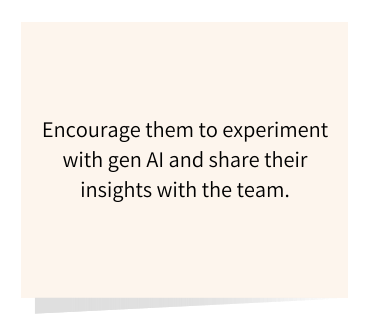
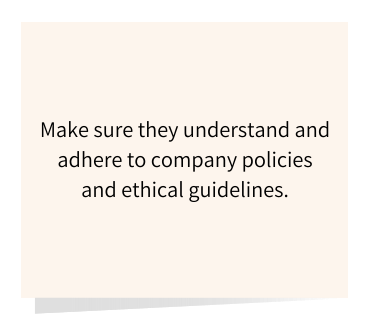
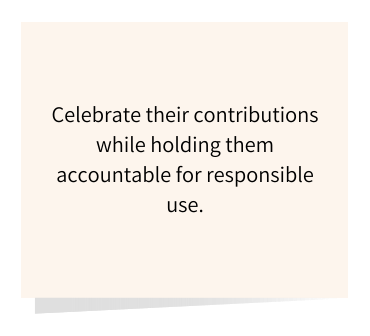
By empowering enthusiasts to demonstrate how AI can enhance your team’s work, you’ll inspire others and foster a positive, informed adoption of the technology.
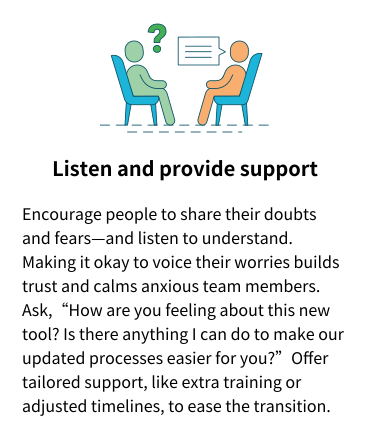
For skeptics, overcoming resistance starts with addressing their concerns directly."For Success with Al, Bring Everyone on Board" by David De Cremer. Harvard Business Review, May-June 2024. To reassure your team:
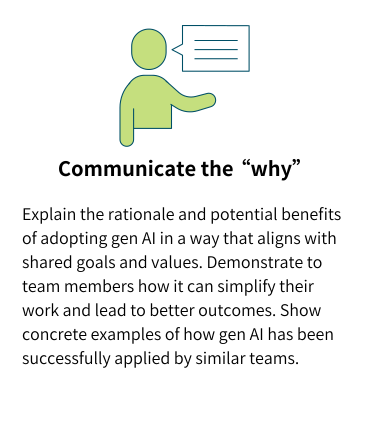
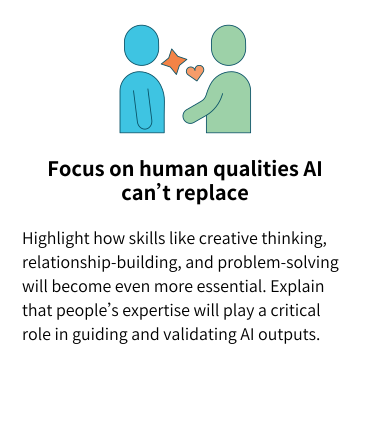
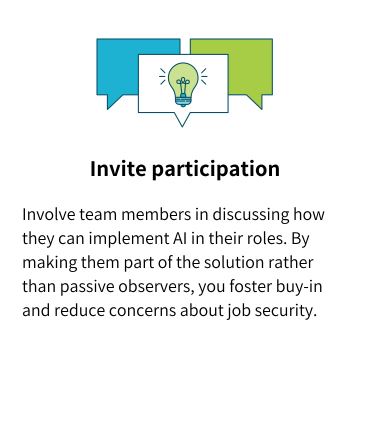
Help Your Team Embrace Gen AI
Here, Northeastern University professor David De Cremer explains the importance of putting people first in a time of technological change.
以人性化的方式推动 AI 的应用 AI Adoption with a Human Touch
哈佛教授讲授视频逐字稿
We all know that AI has immense potential. But how can we leverage that potential? And also, how can we make sure that it's us humans who benefit from it?
I once was invited for a town hall meeting at a company where the CEO was very proud to say, we're going to change things. We're going to introduce AI. And the CTO was introduced to make clear what this AI adoption was all about. And he focuses on growth, efficiency, on reducing errors.
The CEO says to him, “Great job about the technology, but I'm not sure it's going to help our cause.” He says, “Why? I mean, did I do something wrong?” Well, you didn't do anything wrong in terms of content, but I'm not sure people really connected to the story and people really know what it means to them.
So what happened here is something that we see in change management all the time. We introduce a change, and we forget that the people who make the company work, they need to be persuaded. People today need to understand what AI means for the organization, the purpose and the goals of the organization, and especially what it means to their job. And that's where the CTO failed.
Any change management project, we want to connect with people. So AI adoption by default is and should be human-centered. You need to understand the needs of your people. Although you may think about technology, it's more important than ever that you invest in your emotional intelligence. You need to be able to take perspective of the people who are going to be affected by your AI adoption, including all your stakeholders. So you need to have that sense of perspective and that sense of empathy.
You also need to be able to induce collaboration. Your empathy needs to help you in bringing tech experts and business experts together. You need to have a narrative that brings your understanding of AI and how you see it related to the strategy of the organization, how that aligns with what's in it for your people and your organization. By investing in your own emotional intelligence, you'll be able to leverage AI and create value for you, your team, and your organization as a whole.
第 3 节
Managing people’s emotions isn’t your only task when it comes to supporting your team's application of gen AI. You also need to provide them with plenty of time and opportunities to explore and implement the tools.
As gen AI continues to evolve, it’s crucial for the people you manage to take charge of their own learning. But you can support them. By striking a balance between guidance and independence, you help them build new skills and learn to adapt to a fast-changing world.
Start by encouraging team members to:

To create an environment where your team can build expertise, make it a priority to:
-
Ensure they have access to any tools and training your organization offers.
-
Encourage team members to set aside time each week for exploring AI tools and experimenting with their capabilities.
-
Schedule regular meetings where they can share insights, discuss challenges, and ask questions as a group.
-
Empower them to contribute to best practices.
When you allow people to drive implementation of these tools, you boost their confidence and give them a sense of ownership. You also reassure them that generative AI is meant to complement their work—not replace them.
Here, Northeastern University professor David De Cremer talks about leading your team by example when it comes to learning about gen AI.
作为团队共同学习生成式 AI Learn About Gen AI as a Team
哈佛教授讲授视频逐字稿
What do you do as a business leader? What do you do as a manager? What do you do as an organization to make sure that you can use generative AI in a way that makes your people better, rather than letting them go?
First of all, you need to lead by example. Show how you're using gen AI. How is it helping you? How have you benefited from it? And make that clear to people.
Once you've done this as a team leader, you throw it in the group and you ask, “How do you use it? How do you want to use it? How do you think you can use it?” And you listen.
Your soft skill of listening is important here, because you have asked the questions. Now, you want to get the feedback. Here, we're going to see the opportunities that gen AI is creating, but you do so in an inclusive manner.
You see the jobs changing in front of your eyes, if you can create that kind of culture. People will see ways where they say, I benefit from it in this way, so we don't have to do this anymore. Now, I want to do this.
When they're actively participating here, you can see on the horizon already the new kind of jobs you will have to be thinking about as a leader. So it's a collective learning process, but it's also a continuous process, because of course, generative AI will improve, and that will accelerate all the time. So you have to stay updated. But again, you do this collectively. It's a collectively lifelong learning project.
Isabella helps her team build their AI skills
Isabella helps her team build their AI skills
Isabella, a clinical operations manager at a pharmaceutical company, notices that her team is hesitant about using gen AI in their work. She schedules biweekly meetings, where she recounts her own experiences and challenges with using AI tools. She also invites team members and other guest speakers to share their insights.
At the end of each meeting, Isabella commits to trying out a new tool or technique herself, encouraging her team to experiment with her. By modeling curiosity and hands-on learning, Isabella inspires her team to explore gen AI with greater confidence.
Isabella helps her team build their AI skills
Take a Moment
1. What three actions will you take to make sure your team stays current on the latest gen AI tools and their applications?
第 4 节
Making the most of gen AI isn’t just about learning new tools. To continually transform your team’s work, you need to articulate a clear vision for leveraging this technology to redefine how you deliver value.
Describe not only what gen AI can do but also how it can drive meaningful business results. By linking the opportunities gen AI offers to your team’s and organization’s goals, you create a shared purpose that motivates and inspires everyone."How Al Can Make Us Better Leaders" by Rasmus Hougaard and Jacqueline Carter. Harvard Business Review, June 6, 2024.
To identify your vision and bring it to life:
Develop a strategy
Focus on crafting a strategy that outlines your long-term vision for integrating gen AI in your team’s work.
Identify key areas where AI can add the most impact and help your team contribute to broader organizational goals and objectives.
Revisit your strategy regularly as the technology evolves and new opportunities arise.
Inspire your team
Show enthusiasm for the possibilities gen AI brings.
Help your team to see it not as a replacement for existing roles, but as a powerful tool that can amplify their creativity, skills, and influence.
Look to the future
Stay abreast of AI trends, anticipating their effects on your team, organization, and industry.
Look beyond immediate applications and prepare for future developments.
A clear vision inspires your team to embrace gen AI as a catalyst for growth and innovation. By thoughtfully integrating this technology, you’ll position your team to thrive in a rapidly evolving landscape.
第 6 节
Test your understanding and reinforce what you’ve learned.
Try it Out
1. Your team members have mixed reactions to integrating generative AI into their work. How can you best lead them through this necessary change?
答案与解析
A. Require team members to include successful gen AI integration in their performance goals.
Simply mandating gen AI use and holding people accountable without addressing their worries isn’t going to convince all members of your team. Instead, listen to people’s concerns and offer support, involve them in decisions, communicate why using gen AI is important, and highlight human qualities AI can’t replace.
B. Focus on the enthusiasts on your team, as they’re more likely to implement gen AI effectively.
While enthusiasts can lead the adoption of this technology and inspire other team members to do so as well, you won’t win over skeptics unless you address their worries directly. Instead, listen to people’s concerns and offer support, involve them in decisions, communicate why using gen AI is important, and highlight human qualities AI can’t replace.
C. Encourage skeptics to voice their concerns and provide tailored support to address them.(正确)
You can guide your team through the challenges of adapting to AI-driven change by listening to people’s concerns and offering support, involving them in decisions, communicating why using gen AI is important, and highlighting human qualities AI can’t replace.
第 7 节
Reflecting on your learning helps you apply relevant concepts to your job.
Take a Moment
1. 1. What new insights do you have that could benefit you or others in your workplace?
2. 2. What are your biggest opportunities for applying concepts from this Lesson in your workplace?