Do you ever find yourself sharing project updates with stakeholders in your organization? Trying to persuade people to buy your company’s product or service? Explaining to your team how a process or system works?
These are just a few examples of presentations. And as part of your job, you probably give such talks—virtually or in person, formal or informal—at least occasionally.
Being able to give effective presentations pays big dividends. Research shows that great presenters:
Get more done, for example, by persuading their teams to adopt new and better ways of working
Gather support for their ideas and win the resources needed to carry them out
Gain influence among their bosses, peers, and team members
Get noticed by decision makers in their organizations and, as a result, advance in their careers
Plus, studies show that as you practice presenting, it becomes easier—and less stressful.
Make a Connection
1. What are one or two ways that being a skilled presenter can help you succeed in your role?
第 2 节
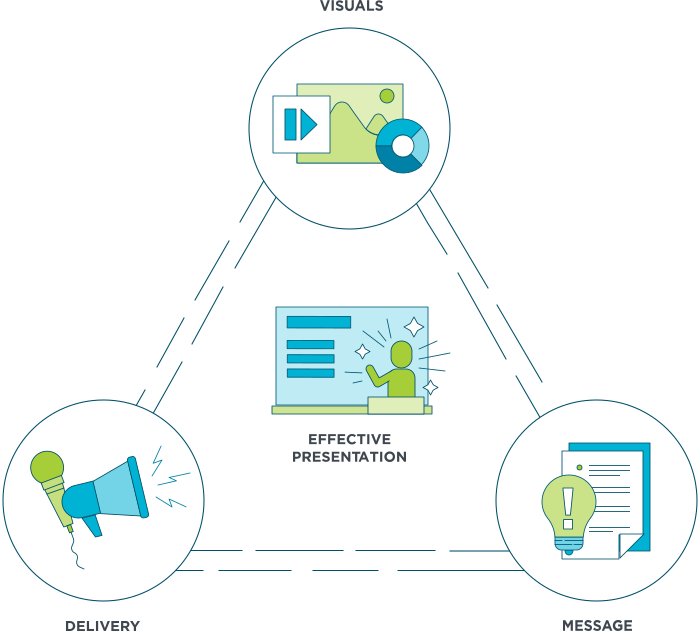
A great presentation can be broken down into three elements:
A clear, compelling message
Visuals that support and enhance the message
Top-notch delivery by a speaker who is competent, comfortable, and confident
Learn more about each of these pillars and how they add up to a successful presentation:
出色演讲的三大支柱 Three Pillars of a Great Presentation
哈佛教授讲授视频逐字稿
When preparing your next presentation, consider the three pillars that will need to stand tall: your message, your visual story, and your delivery. You need to commit time to working on all three pillars. If one is weak, your presentation may wobble a little or collapse. But if your pillars are sound, your presentation will have a solid foundation and make a real impact with your audience.
The first pillar is the message. What is the goal of your presentation? What are you trying to say, and why does your audience need to hear it? The message and your audience are inextricably bound. Approach the message from their perspective.
As you develop your presentation, continually ask yourself, what's in it for them? Your message should clearly identify and attempt to solve a problem for your audience. Take it one step further by addressing potential questions or resistance they might have in response to your solution.
The next pillar is the visual story you want to tell. Start by thinking about what your audience will actually see. An effective visual story involves more than just text on slides. Consider sketching out a storyboard, creating diagrams, or reinforcing key points with images and other types of media.
Make sure the story you're telling is visually compelling. It's worth taking the time to consider how images, colors, fonts, and backgrounds all contribute to the presentations overall design. When presenting without the use of traditional slides or a screen, your visual story may take the shape of a prop or even a handout you pass around to your audience ahead of time.
The third pillar is how you deliver your presentation to your audience. For many, delivering a presentation can be daunting, especially when speaking in front of a large group. Try to envision how the presentation and audience interactions will unfold ahead of time. Hold eye contact. Consider when to shift your tone of voice.
Use gestures to keep the audience engaged, and watch your pacing. Be aware of your audience and be particularly aware of their responses. A disengaged audience member might mean it's time to move on to a new point or grab their attention with a question. Additionally, the volume and sound of your voice should be dynamic and sometimes dramatic, but don't overdo it.
With all three pillars, but especially delivering. Soliciting feedback from others can make all the difference. Honest feedback from co-workers you trust is essential for growth. You can even consider practicing ahead of time in front of others so that you can incorporate any feedback into the final presentation.
The next time you prepare a presentation in front of a few people or a few thousand people, think of the three pillars of a powerful presentation: message, visual story, delivery. When you consider these three principles, you'll be ready to address your audience with an impactful presentation.
Take a Moment
1. Recall a presentation you attended that struck you as especially effective. What made it so great?
In this lesson, we’ll focus on the first pillar: the message you want to convey. That’s typically where you would begin when planning a presentation. The second pillar, the visual story, comes into focus as you start organizing your content ideas and designing slides. Finally, you move to the third pillar as you practice and then deliver your presentation.
To ensure that your idea is clear, effective, and relevant to everyone who views your presentation, consider the following four questions:
第 3 节
Begin by clarifying your objective—the outcome you want to achieve. For example, do you want to:
Close a sale with a prospective customer or client?
Persuade your boss to support a new approach for how your team does its work?
Report progress on a project to a group in charge of its funding?
If you’re not sure what your objective is, ask yourself:
How do I want my audience to feel at the end of the presentation?
What do I want them to think or believe?
What action do I want them to take?
Once you articulate your objective, you can more easily see which types of content (e.g., data, stories, and examples) best support your goal. This helps you avoid an all-too-common mistake of trying to cram too much material into your presentation.
第 4 节
Your core message is the one critical idea you want your audience to walk away with after listening to your talk. As with your objective, clarifying your core message helps you decide what information to include in your presentation—and what to leave out.
When you communicate your core message clearly, your audience will be far more likely to remember it. And that boosts the odds that they will feel, think, believe, or do what you want them to.
A well-developed core message:
Consists of a concise, complete sentence. Brief core messages are much easier for your audience to remember than long-winded ones.
Expresses your unique perspective on the presentation’s topic, not a vague generalization.
Communicates what’s at stake. Your core message clarifies why your audience should care, such as what benefits they’ll gain or what risks they’ll avoid.
Gloria clarifies her objective and core message
Gloria clarifies her objective and core message
Gloria’s planning a presentation she’ll deliver to Frank, her boss. Her objective is to persuade Frank to approve a new team process for tracking and analyzing customer data.
She thinks about how to articulate her core message. She realizes that when she presents her idea to Frank, he’ll want to know what benefits the new process will generate for the department and why it’s better than the current process.
She decides that the core message she wants to communicate to Frank is: “This new process will generate insights from customer data that will help our team develop higher-quality products more quickly.”
Gloria clarifies her objective and core message
Try it Out
1. Which of the following core messages is most effective? Select one.
答案与解析
A:“By updating its customer service software, our department will be able to accelerate response times to customer queries.”(正确) Good choice! This core message is effective because it’s concise, it expresses the presenter’s perspective on the topic, and it communicates the benefits to be gained from updating the software.
B:“This software will enhance your team’s productivity significantly and boost revenues over the next year by at least $50,000. It also has a lot of important advantages over the applications that your competitors are using, as well as new features that make it so much easier to use.” Not the best choice. While this core message has some strengths, it’s so long and complicated that audience members may have difficulties remembering it.
C:“When I look at the data, I can see that we’re losing our competitive advantage.” Not the best choice. This core message doesn’t specify anything that’s at stake related to the notion of losing competitive advantage, like declining profitability or lost jobs.
第 5 节
When you make a presentation, it’s easy to feel like you’re the central figure or “star.” After all, you’re addressing people who came to hear you speak.
Butyou’re not the focus of the presentation; your listeners are. It’s up to them to decide whether to embrace the ideas you’re presenting—or to reject them.
“Designing a presentation without an audience in mind is like writing a love letter and addressing it ‘to whom it may concern.’”
For this reason, gaining clarity about who your audience will be and what they’ll expect from you is an important step as you plan your presentation. These questions can help you get started:
What do your listeners need to know?
How informed are they about your topic, and what don’t they know about it?
What do they expect from your presentation?
What level of detail will they want you to provide? What types of content (e.g., demonstrations, data, videos) will they expect to see?
How can you best connect with them?
Will attendance at your presentation be mandatory? If so, perhaps your audience members won’t be too enthusiastic about the topic. How might you spark their interest and keep them engaged?
Responses to these questions can help you tailor your presentation for your audience. And the more you tailor it to their interests, the more likely they’ll embrace your ideas. The result? You stand a greater chance of achieving your objective.
In this video, facilitator Michael Duarte explains how you can better understand your audience and use their needs to shape your presentation.
更好地了解观众的需求 Consider Your Audience
哈佛教授讲授视频逐字稿
It's easy for ourselves as presenters to really value what we bring to look at ourselves as the most important part of a presentation. We look at ourselves almost as the hero. And what I want you to know and understand is that you're not the hero of that presentation. Your audience is the hero. And here's the reason why.
When we look at story structure, the hero is the person who is changed over the course of that story. In our presentations, our audience, they're the ones who are changed over the course of that presentation. It's up to us to defer to their needs. So whether you know that audience well or you're just meeting them for the first time, treating them like the hero is important. And there are six questions that we can ask that will help us to better understand our hero, that audience.
The first question, and where we always like to start out with, what are they like? This might include characteristics, demographics, other news and information about them -- things that we can find online. And in this process, we often realize that there are really multiple components in the audience, and it's helpful to ask these questions for all of them -- component by component, but really for the audience as a whole as well, because we're always looking for those commonalities.
Next we ask, why are they here? What brought them together? We really want to gauge their interest level: Do they want to be there? Do they not want to be there? Was the meeting mandatory? Are they hoping to learn something? Maybe you asked for a meeting and they're simply being generous with their time. Answering this question can help provide insight into their own interest level in your presentation.
And that leads us to the next question -- really, a chance to get to the hero's pain point by asking what keeps them up at night. This might be things that are happening in the real world or with their jobs, problems they're trying to solve, perhaps, obstacles that they're facing, or even challenges that they're trying to overcome. And knowing that helps us to answer the question, how can you solve their problem? Is there a solution you can offer? A product, a service, et cetera, something that can alleviate those concerns? Well, those are great ways for us to build those connections. But we don't always have that, so we can at least empathize with what they're going through in that moment.
Another important question to ask -- what do you want them to do? It kind of seems obvious, but what's the outcome or the action they should take as a result of having listened to your message? We often neglect this one simple fact. This is probably tied directly to the goal of your presentation as well. And also, if you struggle answering this question, it usually tells me you don't need a formal presentation. And then lastly, an important question to ask is how might they resist? How are they going to push back on your idea? Perhaps you haven't gained their trust yet. Maybe they've tried something similar in the past. They're not quite ready to move forward. And really, in general, we don't like to change. We love to be comfortable. So you have to make the reward worth it for your hero.
So, before your next presentation, grab a notebook, grab some post-it notes, and start answering these questions, these six different audience analysis questions. Doing so is going to help you to defer to the needs of your hero, remembering that they're the most important part of that conversation. And it's going to help you to craft a more compelling message for them.
Try it Out
Think of an audience you’re going to present to in the future or have presented to in the past. With them in mind, answer the following questions suggested by Michael Duarte to learn more about them and their needs.
1. What are they like?
2. Why are they here?
3. What keeps them up at night?
4. How can you solve their problem?
5. What do you want them to do?
6. How might they resist your ideas?
What if some audience members are familiar with my topic, but others know little about it?
Give those who are new to your topic a quick overview before you conduct the larger presentation. Or consider doing two separate presentations.
What if some audience members are familiar with my topic, but others know little about it?
What if I’ve never met the members of my audience?
Find out the names of the people who will be there and look up their profiles online. If you’re presenting to people from an organization other than your own, learn as much as you can about the organization, for instance, through press mentions and the company’s website.
What if I’ve never met the members of my audience?
What if some members of the audience aren’t fluent in the language I’m presenting in?
Speak more slowly than you normally do. Articulate your words clearly, and make sure your listeners can always see your mouth so they can more easily understand your words. Avoid complex sentences and phrases as well as jargon and cultural references that won’t have meaning to listeners who aren’t fluent in your language.
What if some members of the audience aren’t fluent in the language I’m presenting in?
第 6 节
Where, when, and how you’ll deliver your presentation are crucial aspects of your presentation’s setting and will strongly impact how your audience receives it. And setting drives how you’ll deliver your talk, including your tone of voice, the technology you’ll use, and the clothing and accessories you’ll wear.
So, as you plan your presentation, spend a bit of time wrestling with these setting-related questions:
80% of English-speaking Americans and 55% of British people don’t speak a second language. Therefore, they may not realize how hard it is to listen to a speaker who’s speaking quickly and using metaphors or puns from their own culture.
80% of English-speaking Americans and 55% of British people don’t speak a second language. Therefore, they may not realize how hard it is to listen to a speaker who’s speaking quickly and using metaphors or puns from their own culture. 80% of English-speaking Americans and 55% of British people don’t speak a second language. Therefore, they may not realize how hard it is to listen to a speaker who’s speaking quickly and using metaphors or puns from their own culture.
Timing
How much time will you have? Will you need to adjust your presentation to fit the time slot?
What time of day will you be giving your presentation? How will that affect your listeners’ energy levels—and how can you address challenges such as fatigue or lack of alertness?
Timing
Degree of formality
Is the situation formal or informal? How can you adapt your tone of voice and dress accordingly?
Degree of formality
Other speakers
If other presenters will be speaking before or after you, how might that affect your audience’s response to your talk?
Other speakers
In-person versus virtual
For an in-person presentation, what factors—such as lighting or interactive tools—will you be able to control?
For a virtual presentation, how will you keep your audience engaged despite challenges such as possible audio delays, video glitches, or videoconference fatigue?
In-person versus virtual
Follow-up
Will you do a Q&A session at the end of your presentation, or will you answer questions as they come up?
Will you provide audience members with copies of slides or other materials, or with a recording of your presentation?
Follow-up
Make a Connection
1. Think of a presentation you’ll be giving in the future. List two or three factors you should consider given its setting.
Congratulations! By completing this lesson, you’ve learned a lot about how to plan a presentation. That puts you in a strong position to determine how to structure your talk and what materials you’ll gather to create your presentation.
Test your understanding and reinforce what you’ve learned.
Try it Out
1. 1. You’re planning to present a proposal to your boss to increase your marketing budget for TikTok, because that’s where your customers spend a lot of time. Which of these is a good articulation of your presentation’s core message?
答案与解析
A. “We spend too much of our marketing budget on search engine optimization.” Although this might be one of your views, it’s not specific enough to help you craft your presentation and make good decisions about what to include and exclude from your slides. Aim to articulate a core message that expresses your point of view on the topic and communicates what’s at stake.
B. “Allocating a larger proportion of our budget to TikTok will increase revenue from a key customer segment.”(正确) This statement concisely articulates your point of view and communicates the benefits of your proposed action. Writing a good core message is time well spent. You can use it to guide the structure and content of your presentation and make decisions about what to include and exclude from your slides.
C. “We need to reassess our budgets and approvals.” This phrase is too generic to help you create a sharp and focused presentation. Your core message statement should communicate the one critical idea your audience will walk away with. This can help you craft your presentation and make good decisions about what to include and exclude from your slides.
Try it Out
1. 2. You’re presenting to an audience with different levels of understanding of the context for your topic. What can you do to ensure your presentation is relevant and engaging for all of them?
答案与解析
A. Begin by acknowledging that your presentation might be redundant in parts for some people, then spend time bringing everyone up to speed. This wouldn’t be a good use of time for people who already know your content. Instead, consider sharing some material in advance or conducting a separate session for those who are new to your topic, so everyone in your audience has the same level of understanding.
B. Call on members of the audience who know about your topic to help support your point of view. Your presentation should be valuable for every member of your audience. To ensure everyone has the same level of understanding, consider sharing some material in advance or conducting a separate session for those who are new to your topic.
C. Share some material in advance or conduct a separate introductory session for those who are new to your topic.(正确) By sharing some material in advance or holding a separate introductory session, you can ensure that all members of your audience derive value from your presentation, and you improve your chances of meeting your objective.
第 9 节
Reflecting on your learning helps you apply relevant concepts to your job.
Take a Moment
1. 1. What new insights do you have that could benefit you or others in your workplace?
2. 2. What are your biggest opportunities for applying concepts from this Lesson in your workplace?