Pocket Leadership口袋领导力

Difficult Interactions

Respond to Conflict with Confidence 查看中文版

第 1 节

In a 2021 survey of nearly 500 U.S. respondents, 89% reported experiencing conflict at work. But only 39% reported having any training or coaching in how to handle workplace conflict.

In a 2021 survey of nearly 500 U.S. respondents, 89% reported experiencing conflict at work. But only 39% reported having any training or coaching in how to handle workplace conflict. In a 2021 survey of nearly 500 U.S. respondents, 89% reported experiencing conflict at work. But only 39% reported having any training or coaching in how to handle workplace conflict."Managing a Polarized Workforce," by Julia A. Minson and Francesca Gino. Harvard BustnessReview, March-April 2022.

It happens to everyone: You find yourself in a disagreement with a colleague at work over something you both feel strongly about. Just as in your personal life, differing perspectives and approaches in the workplace can cause tension. Conflict, while uncomfortable, is an inevitable part of any relationship.

The good news is that learning to manage disputes well can lead to positive results, including: HBR Guide to Dealing with Conflict, by Amy Gallo. Harvard Business Review Press, 2017.

Improved relationships By becoming proficient at holding productive conversations, you can better understand what matters to others. Opportunities to learn and grow When you open yourself to feedback, you improve your skills and invite more creative solutions to problems. Higher job satisfaction Being able to manage disagreements constructively can boost your performance and feelings of accomplishment.

And teams that have good conflict resolution skills tend to have better work outcomes, too. When people respectfully engage in open debate and let go of the need to “win,” they often generate new ideas and produce breakthrough solutions.

“For good ideas and true innovation, you need human interaction, conflict, argument, debate."

—Margaret Heffernan, entrepreneur, CEO, and writer

Karthik’s team turns conflict into solutions
Karthik’s team turns conflict into solutions Karthik’s engineering team was tasked with identifying a workable solution for an internal cloud expansion initiative. Early brainstorming sessions quickly divided team members between two different approaches. As each side gathered additional data, team meetings turned into a rigorous debate where people challenged each other’s ideas. But by focusing their disagreement on solving the problem, they avoided personal attacks. The result? Their senior VP adopted one approach as a short-term answer while developing the other as a long-term solution.Adapted from "Collective Genius," by Linda A. Hill, Greg Brandeau, Emily Truelove, and Kent Lineback. Harvard Business Review, June 2014. Karthik’s team turns conflict into solutions

Here, Harvard Business School professor Linda Hill talks about how teams can overcome the fear of conflict to harness its benefits.

辉瑞公司:鼓励冲突、激发创新 Why Conflict Can Be Good for Innovation

哈佛教授讲授视频逐字稿
So many of us are uncomfortable with conflict. We avoid conflict. But you rarely get innovative problem solving without diversity of thought, and when you have diversity of thought you have the potential for conflict. So, we all need to learn how to embrace conflict, not avoid it. One of the organizations I have studied for a number of years is the team that runs the vaccine trials for Pfizer. When I first met the team, they explained to me that they weren't so comfortable with conflict. Why weren't they comfortable? They had a very polite culture, and they deeply respected expertise. So, even when they found themselves on a cross-functional team, they didn't really want to say what they thought if it was going to hurt someone's feelings or make someone look like they didn't know what they were talking about, particularly a person who was an expert. After some time, some of the middle managers decided they needed to tackle this, they needed to get better at dealing with conflict. And the team did a number of things. One thing they did is they put in place a norm, which they all practice, that whenever you made a statement, you had to also say what was your evidence for your point of view. So, you could say, “My expertise tells me this is the right decision, or my experience tells me.” But another person, another norm was they could ask you a question and say, “Well, how do we know that your expertise or your experience is really relevant to what we're talking about right now?” Now, you couldn't get offended by that, you had to explain it. Now, perhaps the most powerful tool they put in place was they adopted something that was being used in other parts of the organization as well, and that was the so-called "straight talk coin." Everyone had a coin, and if you felt people weren't really saying what they needed to say, or what they really believed, you could put your coin down on the table and say, “Are we really doing straight talk? Are we really talking about what matters most to the patient?” And when you did that, that was a signal for everyone to stop, sit back, and say really, is it the polite thing to do, not to say what I'm really thinking, are we really going to be able to mitigate risks if I don't raise my concern? And they all got into the practice of doing that. So, in 2017, when we assessed their capacity to embrace conflict on a scale from green, yellow, red, where red is not so good, they were red. By the time 2020 came along and they faced the crisis of COVID-19, they were actually yellow, almost green. And frankly, it was a good thing they were, because as they all reported, if they hadn't got better at embracing conflict there is no way they could have run those trials in 266 days and made the impossible possible and saved so many lives.

第 2 节

Well-managed conflict can have positive outcomes and lead to innovation. But, unfortunately, many of us are unprepared to manage disputes at work. And we may also be subject to misconceptions that prevent us from resolving disagreements productively."Managing a Polarized Workforce," by Julia A. Minson and Francesca Gino. Harvard Bustness Review, March-April 2022.

Try it Out

Can you recognize the myths versus the realities in the following statements?
1. People who disagree with me just don’t have the right facts.
答案与解析

Reality
Just because a person disagrees with you doesn’t mean they’re uninformed. We tend to seek out information that supports our beliefs, so we often struggle to understand how others can hold views that contradict our own.

Misconception(正确)
Just because a person disagrees with you doesn’t mean they’re uninformed. We tend to seek out information that supports our beliefs, so we often struggle to understand how others can hold views that contradict our own.

2. Disagreement always makes people defensive.
答案与解析

Reality
When two people strongly disagree, both parties tend to believe that the other person is feeling threatened or anxious. This perception may not always be accurate.

Misconception(正确)
When two people strongly disagree, both parties tend to believe that the other person is feeling threatened or anxious. This perception may not always be accurate.

3. Disagreeing with others is bad and should be avoided.
答案与解析

Reality
While disagreements can be unpleasant, well-handled conflict can lead to creative solutions, stronger relationships, and great learning opportunities.

Misconception(正确)
While disagreements can be unpleasant, well-handled conflict can lead to creative solutions, stronger relationships, and great learning opportunities.

When we believe these and other myths, we tend to avoid conflict. A better approach is to increase your comfort with it. To do so, it helps to first recognize how you tend to approach difficult interactions.

第 3 节

Knowing how you naturally respond to conflict can help you be better prepared when facing a difficult interaction. When dealing with disagreements, people tend to be either conflict avoiders or conflict seekers. HBR Guide to Dealing with Conflict, by Amy Gallo. Harvard Business Review Press, 2017.

Amy Gallo, podcast host and contributing editor at Harvard Business Review, explains these styles and how they affect our interactions with each other.

基于冲突风格处理冲突 What’s Your Approach to Conflict?

哈佛教授讲授视频逐字稿
When it comes to conflict, there are generally two types of people, those who avoid it and those who seek it. Avoiders tend to shy away or even hide from disagreements. They care most about harmony with their coworkers. Therefore, they try to placate people or change the topic because they're afraid of hurting others' feelings or disrupting team dynamics. Seekers, on the other hand, seem eager to engage in conflict or even find ways to create it. They tend to care most about directness and honesty, and they don't mind ruffling feathers. They will strongly advocate for their own perspective, and often lose patience when others aren't direct. Neither style is better or worse, and your style will depend on a lot of things, like your past experience with conflict and the organizational context. If you're not sure which style you gravitate toward, ask a trusted colleague or a mentor or even a friend or partner. You might ask, “Do you see me as someone who shies away from disagreements, or do you think of me as someone who enjoys digging into an argument?” Although each of us generally has a preferred approach, it's rare for a person to seek or avoid conflict all the time. For example, you might be a seeker with your peers but an avoider with your boss. You likely adjust your style based on the context. And knowing which style you gravitate toward will help you make a conscious choice about how to address a disagreement. If you're an avoider, for example, there are instances where you may need to overcome your resistance to addressing a conflict. On the other hand, knowing that you're a seeker may cause you to pause before jumping into a heated conversation. Reflecting on your approach is only half the battle. You also need to get a sense of the other person. Are they an avoider or a seeker? Knowing your style and theirs will help you decide how to best approach the conflict.

Try it Out

How would you describe your feelings about conflict?
1. I care about being direct and honest.
2. I feel anxious when I need to confront someone about an issue.
3. I’m not afraid to confidently share my perspective, even when others disagree.
4. The last time our team disagreed, I didn’t contribute to the conversation.
5. I don’t mind upsetting or offending others when explaining my views.
6. I prefer not to hurt anyone’s feelings.

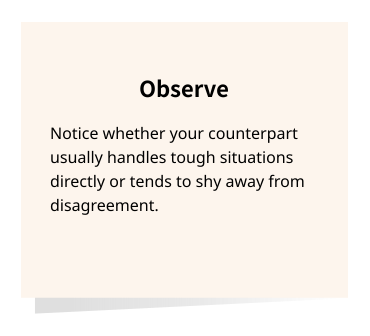
Knowing your preference—and being able to recognize the other person’s inclination—allows you to plan a strategy for responding to a disagreement. How can you get a sense of your counterpart’s conflict style?
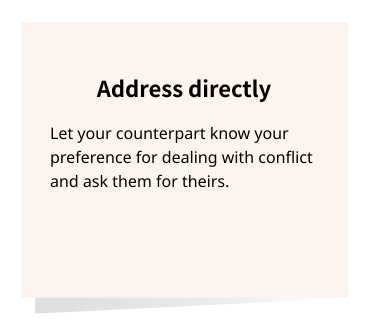
How can people with different conflict approaches work together? Here are tips for interacting with others, depending on your style:

You and your counterpart are avoiders. When both of you lean toward doing nothing, consider taking the lead. Acknowledge that although neither of you like conflict, the issue needs to be discussed. Engage the other person with sensitive and thoughtful questions. You’re an avoider and your counterpart is a seeker. When you’re an avoider speaking to a seeker, beware of the temptation to simply go along with the other person’s perspective. Tell them what you need in order to have a productive conversation, such as calm dialogue at a reasonable volume. Be direct and to the point, while remaining respectful. You’re a seeker and your counterpart is an avoider. When you’re a seeker interacting with an avoider, recognize that your natural tendency may be to persuade them into agreeing with you. Be patient, and ask the other person to share their opinion. You and your counterpart are seekers. Two seekers will be impatient to get into the discussion, with negative results. Instead, consciously take time to prepare your argument. Neither of you will be afraid to speak your mind, so if the discussion gets heated, suggest taking a break.

Make a Connection

1. Think about the last difficult interaction you faced at work. How did you respond?

第 4 节

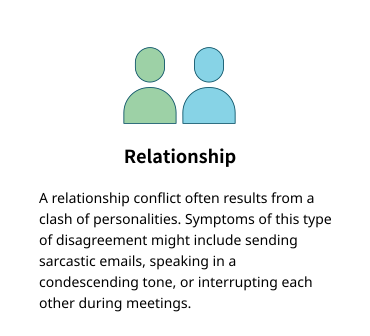
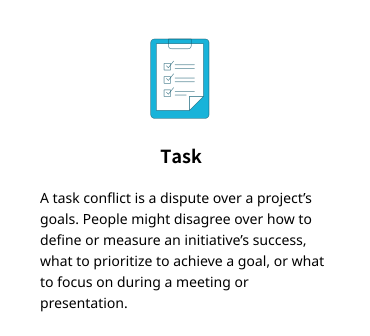
Whatever your style, conflict can be difficult to address if you don’t understand what’s driving it. A good place to start is to identify the root cause of a disagreement. The four most common types of conflict are:HBR Guide to Dealing with Conflict, by Amy Gallo. Harvard Business Review Press, 2017.
Try it Out

Can you recognize the type of conflict in each of these examples?
1. Kai wants the procurement team to follow a set of steps without deviation, while Dale wants the team to have more flexibility when placing orders. What type of conflict is this?
答案与解析

A. Relationship
A relationship conflict is usually a clash of personalities, not a disagreement about how to best do something.

B. Task
A task conflict is usually a disagreement over the intended goal, not a conflict over how to do something.

C. Process(正确)
Process conflict is a disagreement over how to do something.

D. Status
A status conflict occurs when two people can’t agree on who’s in charge, not when they disagree about how to do something.

2. Amanda, a recruiting director, wants to lead a new messaging initiative to promote the organization and attract job applicants. However, Nico, the marketing director, thinks he should oversee all external messaging. What type of conflict is this?
答案与解析

A. Relationship
A relationship conflict is a personal disagreement that results in one or both parties feeling disrespected or hurt.

B. Task
A task conflict is usually a disagreement over the intended goal, not a conflict over who’s in charge.

C. Process
A process conflict is a disagreement over how to do something, not a conflict over who’s in charge.

D. Status(正确)
A status conflict is a disagreement over who’s in charge and who gets credit for the work.

3. Greg takes every conference call on his speakerphone, which frustrates Anna, who sits next to him. She’s asked him to use a headset or move into another office, but he ignored her requests. What type of conflict is this?
答案与解析

A. Relationship(正确)
A relationship conflict is a personal disagreement that results in one or both parties feeling disrespected or hurt.

B. Task
A task conflict is usually a disagreement over the intended goal, not an interpersonal conflict.

C. Process
A process conflict is a disagreement over how to do something, not an interpersonal conflict.

D. Status
A status conflict occurs when two people can’t agree on who’s in charge.

4. Luis, a sales director, wants his team to close new sales contracts by the end of the month to meet the company’s financial goals. Jessica, the company’s internal legal counsel, advocates for more time to review the contracts to ensure they’re accurate. What’s the root cause of this conflict?
答案与解析

A. Relationship
A relationship conflict is a personal disagreement that results in one or both parties feeling disrespected or hurt, not a dispute over the goal of a task or project.

B. Task(正确)
Task conflict is a dispute over the goal of a task or project.

C. Process
A process conflict is a disagreement over how to do something, not a dispute over the goal of a task or project.

D. Status
A status conflict occurs when two people can’t agree on who’s in charge, not when they can’t agree on the goal of a task or project.

Not surprisingly, people usually attribute conflict to a clash of personalities. But the most common disagreements at work are over tasks, or what you’re trying to achieve. Conflicts over processes are also common.

Keep in mind that disagreements may start as one type and escalate into another. Understanding what's at the root of the conflict helps take some of the emotion out of the situation so you can focus on problem solving.
Poll

Poll

第 5 节

When you’re considering how to manage any of these types of conflict, addressing the situation directly is usually the most effective route—but it’s not the only one. Different situations require different approaches.

There are four options.HBR Guide to Dealing with Conflict, by Amy Gallo. Harvard Business Review Press, 2017.You can:

Address the situation directly To be effective, this option requires explaining your side of the disagreement, respectfully listening to the other’s perspective, and mutually arriving at a resolution. Done well, this approach strengthens a relationship. But managed poorly, it could damage your connection. Address the issue indirectly This option involves talking about a situation without directly naming it or by inviting a third person to intervene discretely. This tactic is valuable when preserving your dignity or that of the other person is important. It may not work if the other person completely misses your indirect message. Do nothing You choose not to engage and to move on. This is a low-effort, relatively easy option used when the risks of addressing an issue exceed the rewards. If you can truly let go of the dispute, then doing nothing can help to maintain the relationship. But it doesn’t work if you continue to harbor strong feelings about the issue. Exit the relationship Exiting either a situation or a work relationship is a risky option used as a last resort. It gives you a clean break but could damage your reputation. Think carefully before taking this route.

While addressing a conflict directly can feel daunting, it’s usually the most effective route to resolving conflict. Building your skills in this area is well worth the effort. With practice, you’ll gain confidence to engage in difficult conversations with coworkers and even people in your personal life.

第 6 节

  • Conflict is inevitable but, managed well, it can lead to opportunities for growth, improved relationships, and higher job satisfaction.

  • Awareness of your natural tendency to avoid or seek conflict—and that of someone you’re in conflict with—will help you understand how to approach difficult conversations.

  • There are four common sources of conflict: relationship, task, process, and status. Recognizing whether the conflict is over one of these or some combination of them can help you figure out how best to address the issue.

  • Your best option for responding to a conflict is often to address it directly, but that isn’t your only choice. You can also act indirectly, do nothing, or choose how to exit the situation.

第 7 节

Test your understanding and reinforce what you’ve learned.

Try it Out

1. You and a colleague take opposing views during a team meeting. Suddenly, you find yourself in the middle of an escalated argument. After the meeting, you’re not sure how to address the issue with your team member. What should you do first?
答案与解析

A: Talk with another team member and get their perspective on what happened.
While asking another team member for their perspective can be beneficial, the first thing you should do is consider what’s driving the conflict. Recognizing whether the disagreement is a relationship, task, process, or status type will help you decide on the best way to resolve it.

B: Identify the root cause of the disagreement.(正确)
Conflict can be difficult to address if you don’t understand what’s driving it. A good place to start is to identify whether the disagreement is based on a relationship, task, process, or status. Knowing what’s causing the issue will help you decide on the best way to resolve it.

C: Approach your colleague and let them know they don’t have the right facts.
Just because a person disagrees with you doesn’t mean they’re uninformed. Conflict can be difficult to address if you don’t understand what’s causing it. Recognizing whether the disagreement is a relationship, task, process, or status type will help you decide on the best way to resolve it.

第 8 节

Reflecting on your learning helps you apply relevant concepts to your job.

Take a Moment

1. 1. What new insights do you have that could benefit you or others in your workplace?
2. 2. What are your biggest opportunities for applying concepts from this Lesson in your workplace?

Further reading

化干戈为玉帛的 7 个锦囊——冲突年代的领导力必修课
随着全球范围内社会动荡不断加剧,职场中的冲突也日益频繁。工作中的不文明行为愈演愈烈,每天都因生产力下降和员工缺勤给企业造…
走心倾听有多难
研究表明,当员工感到自己的声音被倾听时,他们的投入度会提升,工作表现也会随之改善,从而为企业带来显著的收益。然而,对职场…
如何与团队谈论“房间里的大象”
如果你的团队感到“卡住了”,问题很可能涉及一些难以讨论的话题,比如两位团队成员之间的冲突,或者某位员工表现不佳。要正面应…

Top 3 in the source platform's original order