
Manage Group Decision Making 查看中文版
第 1 节
Groups can be the source of bold and brilliant decisions. But team dynamics can also be frustrating or pose obstacles to determining a clear course of action.
When you know how to guide a group in making good decisions, you boost the team’s productivity and its ability to move quickly to accomplish key goals. And working with a group can help you to:


You can foster productive collaboration by inviting team members to share diverse perspectives and managing discussions to ensure that all voices are heard. This collaboration helps generate more or better options to consider and improves your final results.
Listen as Harvard Business School professor Amy Edmondson shares tips for helping teams make effective decisions.
做出明智的团队决策 Make Good Team Decisions
哈佛教授讲授视频逐字稿
Try it Out
第 2 节
With any group decision, it's important to clarify how the decision will be made and who will have the final say. Common decision-making approaches include:
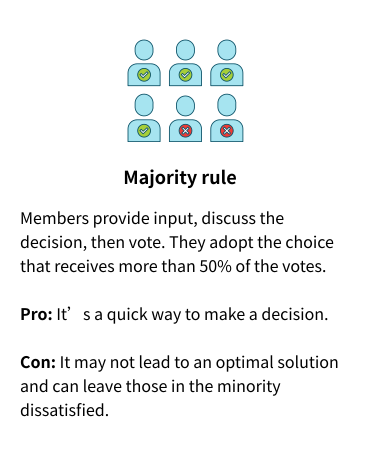
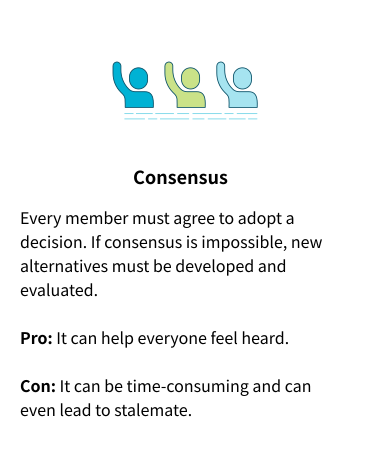
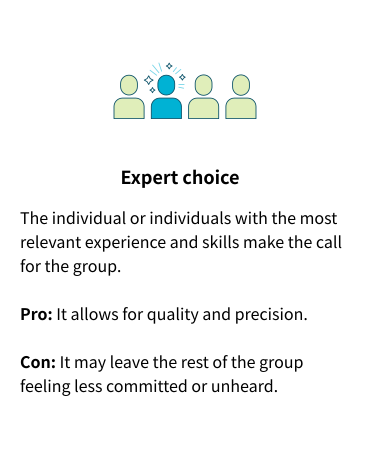
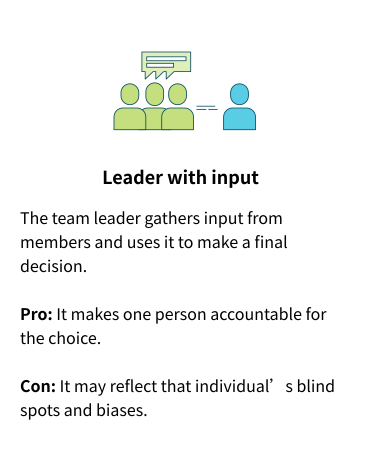
From the start, be sure everyone also understands their roles."Who Has the D?: How Clear Decision Roles Enhance Organizational Performance," by Paul Rogers and Marcia W. Blenko. Harvard Business Review, January 2006. Communicate who will:
-
Make the final decision
-
Be accountable for it
-
Provide input during the process
-
Execute or be impacted by the decision
By being clear upfront, you help group members better understand the process as a whole and prepare everyone for implementing the decision when the time comes.
Take a Moment
Common Decision-Making Approaches
第 3 节
It takes more than clarifying roles to lead a team to a good decision. You also need to pay attention to how people interact within the group. One common challenge is that groups are less effective when members place getting along above all else.
Excessive group harmony can stem from a number of factors, including:
When group harmony is the overriding concern, participants choose not to share their thoughts or they compromise quickly rather than engaging in productive debate. The group often simply defers to the team leader or a member with particular expertise."Drive Innovation with Better Decision-Making," by Linda A. Hill, Emily Tedards, and Taran Swan. Harvard Business Review, November-December 2021.
As a result, decisions may seem to go quickly and smoothly. But an efficient decision isn’t always a sign of success. Decision making often benefits from creative abrasion(The productive tension and debate that helps spark new ideas), where people share ideas that contradict and complement each other, resulting in more innovative thinking. "The Board’s New Innovation Imperative," by Linda A. Hill and George Davis. Harvard Business Review, November-December 2017.
To determine if your group is showing signs of excessive group harmony, ask yourself:



Use these strategies to encourage a robust exchange of ideas:
Make a Connection
第 4 节
While too much group harmony can stifle debate and creativity, the same is true when individuals intensely argue their own positions and disregard others’ opinions. Group decision making can veer off track when one person, or a small subgroup, dominates the conversation.
Try it Out
The signs of excessive individualism are similar to the signs of excessive group harmony: fewer people contribute, and fewer ideas are shared.
To keep a small group of people from dominating the discussion, use these tips:

Some people are simply more comfortable speaking up during discussions than others. To make sure that the debate is productive and that you are getting input from all group members:
Try it Out
Tips for Guiding a Group Discussion
Lead Your Group to Better Decisions
第 5 节
Promoting productive discussion and debate helps you lead your group to better decisions. You also want to create an environment that removes some of the pressure that comes with making decisions.
While your goal is to come to the best possible decision, you can’t know for certain how a decision will turn out until you implement it. To lead effective group decisions:
-
Acknowledge that there’s risk with every decision.
-
Set up your team to respond quickly to challenges that arise as you put the decision into action.
-
Encourage and model a learning mindset for your team, where people can offer new ideas and learn from mistakes.
Here, Harvard Business School professor Linda Hill describes how one leader frames every decision as a working hypothesis, creating space for their team to adjust its thinking as needed.
帮助团队从决策中汲取经验教训 Help Your Team Learn from Decisions
哈佛教授讲授视频逐字稿
When a decision doesn’t turn out well, be ready and willing to pivot quickly and try a new approach. This requires reflection and a willingness to identify the flaws in the decision, without blaming or criticizing the people who generated the ideas that didn’t turn out well. Focus on how to shift courses and what the team can apply to future decisions.
Anjali’s team changes course
When you adopt a learning orientation, you ensure group members feel safe enough to speak up and try new approaches. And it means that your group can iterate as needed, with a focus on solutions.
第 7 节
Test your understanding and reinforce what you’ve learned.
Try it Out
答案与解析
A. Keep the group as small as possible and meet often until you reach a consensus.
Although you should be thoughtful about group size and scheduling meeting time, these strategies alone won’t have much impact on getting balanced contributions from all group members. To ensure that people with different personal styles feel comfortable weighing in fully, use a variety of oral and written communication methods.
B. Use a variety of oral and written communication methods.(正确)
To get robust participation from all group members, ensure that people with different personal styles can weigh in. For example, some people prefer preparing their thoughts before sharing them, while others do best exchanging ideas in a meeting. Using a variety of oral and written communication methods helps to ensure that everyone is able to contribute ideas.
C. Explain that there is not much risk involved and that you want to champion new ideas.
While it can be helpful to try to take the pressure off a group making a decision, there often will be risk involved. Showing that you’re open to new ideas can help group dynamics, but to get the most out of your group you should ensure that people with different person styles all weigh in fully. Use a variety of written and oral communication methods, so that everyone can contribute ideas.
Try it Out
答案与解析
A. Ask questions to clarify what the data shows about key metrics, like profitability, and what it doesn’t show.(正确)
To get the most out of data, start by asking questions that will help you understand and analyze available data, and figure out whether more or different data is needed. When possible, collaborate with data experts for guidance with interpreting and collecting data.
B. Use the data to find which product is the least popular and retire it so your team can put effort into making a better product.
It might ultimately make sense to retire the least popular product, but you may need more information, such as which products are most profitable. To get the most out of data, ask questions to clarify what you want to know and what your data does and doesn’t show.
C. Consult with the sales team to understand what makes the best-selling product popular with customers.
While it’s wise to consult with your colleagues in sales, this is just one piece of the puzzle. The sales team may not have a complete view of what makes products popular. And you may need information beyond popularity, such as which products are most profitable. To get the most out of data, ask questions to clarify what you want to know and what your data does and doesn’t show.
第 8 节
Reflecting on your learning helps you apply relevant concepts to your job.