Pocket Leadership口袋领导力

Decision Making

Overcome Decision-Making Traps 查看中文版

第 1 节

Good decisions rely on good judgment."The Elements of Good Judgment," by Sir Andrew Likierman. Harvard Business Review, January-February 2020. At our best, we consider a range of ideas and weigh them thoughtfully in order to come to a logical, effective, or innovative choice.

But there are common barriers to making good decisions. Our thinking is not always as clear as we believe it to be. Even when we’re working hard to figure out the right course of action, cognitive biases often influence our perceptions—and ultimately our decisions.

Cognitive biases are prejudices, distortions, or errors in thinking.

These hidden flaws in thinking stem from strategies our brains have developed to operate efficiently. We take various mental shortcuts, such as relying on common sense and making educated guesses."The Hidden Traps in Decision Making," by John S. Hammond, Ralph L. Keeney, and Howard Raiffa. HBR Guide to Making Better Decisions, Harvard Business Review Press, 2020. This reduces the effort our brains have to put into tasks like solving problems, making judgments, and drawing conclusions. But while these mental shortcuts benefit us in many ways, there are drawbacks too:
Cognitive biases are powerful because you don’t usually notice them. That's why it’s so important to learn how to take them into account when making decisions.

Try it Out

Try it Out

Make a Connection

1. Think of a recent decision you’ve made. Which strategy or strategies from the above list did you use, and how did it help—or hurt—your decision-making process?

第 2 节

Our thinking can go astray in many ways as we make decisions. This video introduces some of the most common cognitive biases that can impact decisions.

决策中的隐藏陷阱 The Hidden Traps in Decision Making

哈佛教授讲授视频逐字稿
We all want to make the right decisions. But making smart choices is harder than we think because, well, the way we think is not always rational. Professors John Hammond, Ralph Keeney, and Howard Raiffa have explained that our brains are hard-wired to be susceptible to hidden traps in decision-making. For instance, you may be overly influenced or "anchored" by arbitrary information such as the initial price proposed in a negotiation or a statistic you saw in the morning paper. By learning to recognize these anchors, you can guard against them, and prevent yourself from creating anchors for others. Our thinking can also be clouded by the magnetic pull of the status quo. We often default to "not rocking the boat" even when it's illogical or harmful. However, if you are conscious of this trap, you can avoid it by clarifying your objectives -- and making the choices that best suit them, regardless of the status quo. There are plenty of other traps that can muddy our thinking: We make investments of time and money, and then let these "sunk costs" tether us to prior decisions, even when we should change course; We might prioritize information that confirms our assumptions and avoid information that challenges them; We might over-emphasize memorable events; Be too confident in our own forecasts; Or be too wary in the face of the unknown. Even the way we frame the decision can lead us down a path we should avoid, or obscure a path we ought to take. Framing can establish the status quo or introduce an anchor. It can highlight sunk costs or lead us toward confirming evidence. And as one trap leads to another, the dangers are amplified. But there is hope. The best defense against these traps is awareness, so that you can correct errors in judgment before they derail your decisions. Your thinking can become less prone to distortion with greater discipline and clearer objectives. Try re-framing the question, or seeking out contrary opinions. From day-to-day matters to high-stakes business decisions, no choice should be treated as a "no-brainer."

Sometimes we fall into traps related to what we already know or have done, such as:"The Hidden Traps in Decision Making" by John S. Hammond, Ralph L. Keeney, and Howard Raiffa. HBR Guide to Making Better Decisions, Harvard Business Review Press, 2020.

In the following example, notice how cognitive bias influences decision making.

The status quo means missed opportunities for Ousmane

The status quo means missed opportunities for Ousmane Ousmane directs the procurement department at an environmental consulting company. Having been in his role for several years, he’s got a lot of experience. He trusts the vendors he’s worked with over time and is comfortable with their processes. Ousmane thinks of himself as open to new ideas and he does briefly consider different service providers, but he always decides to stick with those he knows. Because he thinks the current vendors are doing a good enough job, he doesn’t explore other options closely enough to realize that others offer much better pricing and innovative ideas. In this case, the status quo doesn’t provide the maximum benefit for Ousmane’s organization. And that also means his job performance isn’t as strong as it could be. The status quo means missed opportunities for Ousmane

Decisions can also be influenced by perceptions or emotions we’re not conscious of. Learn to check yourself for these flaws in thinking:"The Hidden Traps in Decision Making," by John S. Hammond, Ralph L. Keeney, and Howard Raiffa. HBR Guide to Making Better Decisions, Harvard Business Review Press, 2020

In this example, notice how Annick’s confirmation bias shapes her decision to push for creating more color choices for consumers.

Confirmation bias directs Annick’s focus

Confirmation bias directs Annick’s focus Annick is a strategist at an appliance manufacturer. She’s a fan of modern design and thinks the company can sell products at a higher profit margin by offering more interesting colors. In reviewing consumer research, she focuses on enthusiastic comments about refrigerator colors from several focus group participants. She uses this information to make the case that her company should invest to create appliances in multiple colors. However, she discounts survey data that suggests consumers aren’t willing to pay significantly more for color choices. Confirmation bias directs Annick’s focus

Your experiences, beliefs, and perceptions help you succeed in your job—but you need to be aware of how they can trip you up. The good news is that you can learn to counteract cognitive bias and reduce its impact on your decisions.

第 3 节

When you understand the many ways your thinking can get off track, you can try to steer clear of flawed reasoning. As you frame a decision and move towards a course of action, ask yourself what cognitive biases might be at play. This will help you make better decisions that stand up to scrutiny.

Here, Professor Michael Roberto of Bryant University gives an example of the sunk-cost trap and explains strategies you can use to prevent getting caught in it.

避免决策陷阱:波音错误决策的启示 Flawed Decision Making and How to Avoid It

哈佛教授讲授视频逐字稿
Several years ago, Airbus surprised the aviation industry with the announcement of a new, much more fuel-efficient jet. This worried management at Boeing, its chief rival. Here was a competitor leapfrogging them and potentially going to take big market share. Boeing decided to invest heavily in a new research and development project. They called it the 737 Max, and they brought it to market. Unfortunately, Lion Air Flight 610 departing out of Jakarta, Indonesia crashed soon after its ascent. Management at Boeing blamed the pilots. They blamed human error for the crash. They didn't acknowledge that there might be a malfunction and a design flaw in a key system that would be used during takeoff. Tragically, five months later, we had another crash. Ethiopian Airlines Boeing 737 Max jet crashes in Africa. Everyone on board dies. And now, the decision about grounding the fleet is taken out of Boeing's hands. Governments around the world decide the plane shouldn't fly. Now, soon, we learn that, in fact, there was a problem with a key system on the 737 Max. Now, as it turns out, engineers at Boeing had been concerned about this for some time, predating the original crash in Indonesia. But, of course, Boeing was desperate to get to market in time to compete aggressively with the Airbus jet that was so fuel efficient. So here, we have an example of the sunk cost bias. What's a sunk cost? It's an investment of time, money, or other resources that we can't get back. The sunk cost bias is this problem where we just can't bring ourselves to ignore the prior investments we've made, both financial investments and emotional investments. Not only we do not cut our losses, we make it worse at times. And to some extent, this is what happened with Boeing. Rather than grounding the fleet, they continued flying. Now, what can we do to prevent or protect ourselves against the sunk cost trap? I'd like you to consider two strategies. The first is to appoint someone on your team to play the role of devil's advocate, to argue against proceeding with a particular project. Having that dissenter on the team can often help protect against that natural bias to throw good money after bad. And the second strategy is to explicitly ask, “What are the opportunity costs of continuing down this path? What opportunities are we foregoing because we're throwing so many resources and so much effort at trying to make this path work as is?” And I think if Boeing could use some of those techniques perhaps, it would help protect against the sunk cost trap. Fortunately, the Boeing 737 Max is flying again, but I think it is an example of how the sunk cost bias can really lead us to make some highly flawed decisions.

To avoid falling into cognitive traps, pause and look for them before taking action. Don’t make the mistake of assuming you’re too busy to carefully consider multiple options. While some business decisions require quick action, more often than not you can devote some time to thinking through your choices. Being productive is important—but if you rush to a decision, you’re often less effective in the long run.

“Important decisions benefit from prying open cognitive space to allow for new information and insight."

So how can you recognize and push back against potential cognitive biases? These strategies will help:
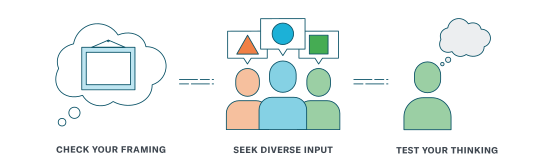
Check your framing Ask yourself questions about the decision itself and what’s shaping your thinking about it. By doing so, you’ll be more likely to recognize potential flaws in your framing or the assumptions that lie beneath the alternatives you’re considering. Seek diverse input Get opinions and advice from multiple sources, including people whose perspective is different from yours. This helps ensure that you have complete information and that you’re thinking about the decision from multiple angles. Test your thinking Actively look for new or contradictory information. Ask someone to take on the role of pushing back against ideas that are raised. Bringing in others to discuss the decision or challenge your thinking can help you identify points you wouldn’t notice on your own.

Avoid Common Decision-Making Traps

附件:Avoid-Common-Decision-Making-Traps-EN1701324327168.pdf(pdf · 60 KB,本地副本)

Develop your question habit

Develop a set of questions that you ask yourself and otherswhen making decisions."The Surprising Power of Questions" by of Alison Wood Brooks and Leslie K. John. Harvard Business Review, May-June 2018. You might include: What are my emotions around this decision and thee various alternatives in front of me? Have I considered all the alternatives equally? Am I drawn to one in particular? What are arguments against the alternative I prefer? What type of information could help me make this decision? What have I not considered? Develop your question habit

Stepping back and taking time to think, question, and debate is vital. It helps you detach from the decision, both intellectually and emotionally."Better Brainstorming" by Hal Gregersen. Harvard Business Review, March-April 2018.

Here, Harvard Business School professor Francesca Gino suggests finding people who aren’t like you and getting their opinions and perspectives when you're making an important decision.

不同的观点会促成更好的决策 Different Perspectives Lead to Better Decisions

哈佛教授讲授视频逐字稿
Having broad and diverse networks is critical to our professional success in many different ways. One of them is when it comes to improving our own decision making. Having a broad and diverse network allows us to reach out to people outside of the friends or colleagues who are close to us in the office. It might mean getting out of the office, walking down to a different department or unit, talking to people who are going to have a different background, a different role, who can provide a different perspective, a different opinion on the problem and decision that we are facing. But it doesn't come naturally to us. We are all different, but at the same time, we share the fact that we are human beings, and we like people who are similar to us. So when it comes to making decisions, we tend to go to colleagues who are usually very much thinking the same way as we do. That's why it's so important to go to people that are a little bit more distant, a little bit more different from us and our team members, to make sure that we really exploit that diversity in opinions, that diversity in perspective, and be more creative when we solve problems and better at making important decisions in our work.

Try it Out

Try it Out

When you’re aware of your cognitive biases and how you can counteract them, you’ll improve the quality of all your decisions.

第 5 节

Test your understanding and reinforce what you’ve learned.

Try it Out

1. What step should Jiro take next before making a decision?
答案与解析

A. Invite team members to offer arguments against renewing the contract and discuss them.(正确)
It’s a good idea to pause and look for cognitive traps before you take action. Inviting others to challenge your thinking can help you identify flaws in your reasoning or find innovative options that hadn’t occurred to you. And stress-testing your ideas can affirm that your decision is strong.

B. Negotiate with the vendor to get costs reduced in exchange for a quick contract renewal.
negotiating for reduced costs is often a smart move, you should first pause and look for cognitive traps before you take action. For example, you can stress-test your ideas by inviting others to challenge your thinking. This can help you identify flaws in your reasoning or find innovative options that hadn’t occurred to you.

C.Ask the team members who work closely with the vendor to provide you with highlights from the last project the vendor worked on.
To avoid falling into cognitive traps, it’s a good idea to stress-test your ideas before you make a decision. For example, you can invite others to challenge your thinking. This can help you identify flaws in your reasoning or find innovative options that hadn’t occurred to you.

Try it Out

1. 2. Your team has the capacity and budget to develop one new product in the upcoming quarter. There are several promising ideas on the table. What’s the first step you should take in your decision-making process?
答案与解析

A. Analyze sales of existing products to help you forecast how profitable each idea is most likely to be.
Analyzing sales numbers may be important for some decisions. But starting your decision-making process by asking lots of questions helps you explore ideas and find innovative solutions to problems.

B. Focus only on the two strongest ideas and explore which one your team can develop most efficiently.
At some point, you may have two strong ideas to pick from. But before identifying your strongest options, start by asking open-ended questions about the decision itself. This helps you explore ideas and find innovative solutions to problems.

C. Brainstorm questions about each idea to help clarify your objectives and support creative thinking.(正确)
Starting your decision-making process by asking questions helps you explore ideas and find innovative solutions to problems. Try brainstorming for questions, rather than answers, in the first stage of your process.

第 6 节

Reflecting on your learning helps you apply relevant concepts to your job.

Take a Moment

1. 1. What new insights do you have that could benefit you or others in your workplace?
2. 2. What are your biggest opportunities for applying concepts from this Lesson in your workplace?

Further reading

用 3 个问题检验你的优先事项
当下的领导者正处于一种“环境性紧迫感”(ambient urgency)之中——不断的变化、优先…
当员工需要为 AI 生成的决策承担责任时
各类组织正加快步伐,将 AI 嵌入核心决策之中,但一线员工却被要求解释那些并非由他们生成、且他们也未能完全理解的输出。在…
设计能够切实增强人类推理能力的 AI 系统
来自管理学、认知科学以及人机交互领域的研究显示,用户往往会不加批判地接受 AI 生成的结果,这会导致认知卸载、情境化专业…

Top 3 in the source platform's original order