Pocket Leadership口袋领导力

Decision Making

Make Better Decisions 查看中文版

第 1 节

What influences decisions?

Everyone wants to make good decisions—it's important for doing your job effectively and for succeeding in your career. Yet decision making can be challenging, whatever your level or role. The good news is that you can learn to make better decisions, on your own or as part of a team.

The first step is to understand why decision making can be so tricky.

Decisions are influenced by human nature, complex situations, and cultural expectations.

It can be difficult to recognize how these factors impact your decisions. But it’s crucial to learn to analyze them so they don’t steer you in the wrong direction. When you take the time to understand and analyze the factors that affect your decisions, you uncover hidden assumptions and influences. And that means you’re better positioned to make choices that help you achieve your goals.

第 2 节

Human nature

Why can making good decisions be so complicated? Part of the reason is that, whether you’re aware of it or not, your decisions are shaped by:HBR Guide to Making Better Decisions, py Harvard Business Review. Harvard Business Review Press, 2020.

Emotion Positive and negative feelings can shape how you make decisions. These can include fear of failure, tension among stakeholders, excitement about the work, an eagerness to prove talent, or a sense of commitment to an issue. Habit Habits let you leverage past experience but can also limit your perspective, preventing you from seeing the benefits of a new approach. A company or team can also develop habits that shape decisions. For instance, it may be the norm to defer to one person or group or to stick with processes or tools that are familiar. Personal characteristics You may prefer quick action or thoughtful deliberation. Perhaps you’re confident—or overconfident. Or you may lack self-assurance despite your knowledge and skills. Other traits, like being an extrovert or introvert and being neurotypical or neurodiverse, also impact decision making. Unconscious bias People often have certain set patterns of thinking and unconscious prejudices in favor of or against a thing, person, or group compared with another. Without you realizing it, these preconceptions can drive your decisions.

All these factors come into play even when you use research and data to guide your decisions. Increasing your awareness of how they shape your thinking is key to preventing flawed decision making.

Poll

Poll

第 3 节

Complex situations

Another challenge is that you often need to make choices under complex circumstances. Certain situational factors can complicate decisions, including:

If you don’t acknowledge and address these factors, they can contribute to bad decisions or affect how confident you are after settling on a particular choice.

Try it Out

Try it Out

Take a Moment

1. Which of the factors in the list above do you consider most important in making decisions? Why?

第 4 节

Cultural expectations

Cultural values and expectations can also play a role in how decisions get made.Around the world and across organizations and teams, people have different perspectives on how decisions should get made and what counts as a good decision.

Organizations and teams develop their own cultures. For example, your company culture may include an unspoken rule that senior leaders should make most decisions. Or it may encourage employees at all levels to make many decisions on their own. Similarly, your team culture may favor a particular approach to decision making. When you join a team or organization, look for guidance about how decisions are made. And if you see room for improvement, be sensitive to team or organization norms when discussing potential changes.

To start analyzing your expectations around decision making, you can ask questions about who’s in charge, what beliefs shape behavior at work, what concepts are valued, and why."How Authority and Decision-Making Differ Across Cultures," by Erin Meyer. HBR IdeaCast, Episode 584, July 6, 2017.

Gain perspective on your team’s norms and expectations by thinking about:

Listen to entrepreneur and Babson University professor Vincent Onyemah talk about how bringing in diverse perspectives can enrich decision making.

文化多样性造就更好的决策Cultural_Diversity_Leads_to_Better_Decision_Making

哈佛教授讲授视频逐字稿
When you have a decision that benefited from multiple perspectives, not only do you end up with a stronger decision but customers out there, or any stakeholder for that matter, they identify with the impact of that decision. I worked in Nigeria for a very large pharmaceutical company. Nigeria is a multicultural society, very heterogeneous. We have over 200 tribes, each tribe with its own religion, culture, philosophies. It's so diverse that many companies to get around this heterogeneity, they prefer to have management teams or members of decision-making units to come from almost the same cultural groups. I think it makes decision-making feel easier because they would not have to navigate cultural stereotypes. In my work with this company, I had the opportunity to sit in many decision-making sessions. This CEO had a very interesting approach. He will recruit not only into top management but also among his employees, people from different cultural groups and religious groups. And he felt by doing so, he will end up enriching the quality of decisions that they make. In many of the meetings that I attended, he was quiet most of the time. He will only intervene by asking some questions and seeking clarifications. For many cultural groups, they believe the CEO has to be heard and very loudly. I asked him why was he quiet in many of the decisions. He said he was silent because he didn't want his cultural biases to dominate the conversation. He wanted others to be part of decision making. He wanted their voices heard. So, for him, it was also a way of trying to educate everyone, including himself, the different ways, philosophies that people from different cultures handle issues. And given that the country, their market is full of people from different cultures, it will be helpful if they make decisions that reflect that. And when everyone feels that by sharing their views not only do they contribute to the conversation, but also, they learn from what others are saying as well. They feel part of that decision. So having this different perspective makes for a better, richer decision-making outcome. If you find yourself in a decision-making setting, you can always ask yourself, “What can I do to open a space for more perspectives and more opinions?” because that will lead to better decision.

Make a Connection

1. What are some of the norms that influence decision making on your team and in your organization?

第 5 节

Navigate ethical dilemmas

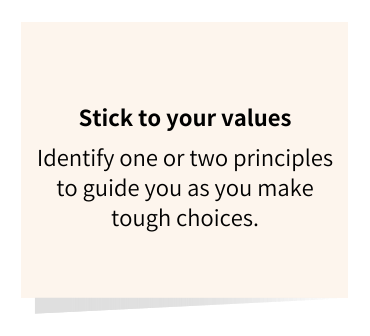
At times, you may struggle to figure out the most ethical choice in a situation. You may even find yourself under pressure to pick an unethical option. How can you navigate this kind of thorny situation while choosing a course of action?

While there may not be a clear or easy path, these strategies can provide some direction:
Yiru’s dilemma

Yiru’s dilemma Yiru is a product manager at a tech firm. Just before her team rolls out a new wellness app to consumers, testing shows that certain privacy settings aren’t working properly. Yet earlier tests had not shown this problem. Yiru is under pressure to release the new app but thinks it's unethical to do so. Yiru decides to brainstorm possible technical solutions with the programming team, such as turning off certain features until the bug is clearly fixed. She also meets with marketing and sales to discuss messaging to consumers if the app is released with the bug. Yiru makes the case to her manager that this is an opportunity to show customers that the organization is transparent and has customers’ best interests in mind. Yiru’s dilemma

Want to learn more about how to manage ethical questions in the workplace? Check out the HMM course Ethics at Work to dive more deeply into how to resolve ethical dilemmas and build a culture of integrity.

第 6 节

Cultivate critical thinking

Given these challenges, what’s the best way to ensure that you consistently make smart and informed decisions? One key is to continuously develop your critical thinking.

Critical thinking means examining ideas deeply, from multiple angles, to come up with creative ideas that can stand up to healthy debate.

Critical thinking involves numerous skills and habits that you can develop throughout your life. Some of the most important are:
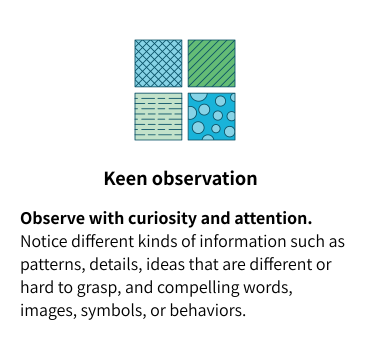
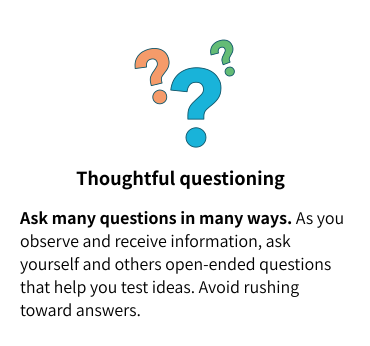
Key Critical Thinking Skills

附件:Key-Critical-Thinking-Skills-EN1739957678355.pdf(pdf · 62 KB,本地副本)

There are many ways to develop and engage in critical thinking. In this video, Harvard Business School professor Ranjay Gulati describes a parallel concept that he calls diagnostic thinking. Listen as he explains how effective leaders pause, consider, and question before taking action.

诊断性思维 Diagnostic Thinking

哈佛教授讲授视频逐字稿
One of the essential qualities of effective leaders is diagnostic thinking. And by diagnostic thinking, I mean the ability to look at a problem and not to go from problem to solution, but engaging in an intermediate step of going from problem to diagnosis, and then solution. And this idea of pausing for a second, and then figuring out, and then moving forward that way, just doesn't come naturally to some people. I'll give you a personal example of this. A few years ago, I was on a flight from Utah, coming back. I was going to Chicago. And I skied all day. And I was catching the last flight back. So I got up in the morning. I hadn't eaten breakfast. I just went straight to the slopes, skied, didn't really drink much water, either, I think. I dash and make it to the flight. I'm on the flight, feeling a little dizzy and lightheaded. And I asked the flight attendant, “Can I have a glass of orange juice?” She's probably having a bad day and she says, “No, until we level off and the seatbelt sign is off. I'm not going to give it to you.” A few minutes later, I'm feeling so sick that I'm looking like I'm going to pass out. I tell my neighbor. I can't even speak. I said, “Listen, tell her I'm really feeling weak. I need it.” She refuses. I pass out. It's a very strange kind of passing out because I'm immobilized, but I can hear everything. Three doctors descend on me. One guy is-- They've got a blood pressure machine. They've got a stethoscope. One guy is checking my pulse, says, “Pulse is really weak.” Other guy checked my blood pressure. Blood pressure is dropping. Third guy immediately says, “He's having a heart attack.” Calls for the paddles, the defibrillators from the air flight attendant. So all this has happened within like 20, 30 seconds. And I'm, of course, completely baffled. I have no way to respond because I'm just not able to respond. Meanwhile, a fourth doctor, I can hear him, has kind of walked up. And he's talking to the neighbor who was sitting next to me. He says, “Listen, did this guy complain of any symptoms before he passed out?” He said, “Yeah, he complained about feeling dizzy and lightheaded and kept asking for orange juice, which they didn't give it to him.” He said, “Did he say chest pains or anything?” He said, “No, no, just dizzy and lightheaded.” At this point, this doctor intervened and screamed at the three doctors saying, “This guy is not having a heart attack. This guy needs some orange juice. He's probably dehydrated and has low blood sugar. He's having,” what I guess is called, “a hypoglycemic attack. Get some sugar in him. Get some orange juice in him.” So this thing all is happening within like 2 minutes. And of course, they bring some orange juice and I'm back to normal again. The lesson of the story I want to show you is that, in the heat of the moment, it's really tempting to go from the problem to saying, aha, here's a solution, rush to judgment. And I think we need to kind of step back, look at the information, understand it, and diagnose it. So sometimes, the causes are here and the problem is here. And you have to look beneath the problem to understand what's really behind it, and then propose a solution. So diagnostic thinking, I think, is the key to leadership success.

When time allows, it’s helpful to research, question, discuss, and consider a decision from different points of view. But when you’re crunched for time, you can improve your decision making by drawing on your critical thinking skills.

Poll

Poll

You’ve considered the many reasons why making decisions at work can be challenging at times. While there’s no single way to improve your decision-making abilities, you can start by looking out for the human, situational, and cultural factors that can influence decisions. Once you’re more aware of these considerations, you’ll be better prepared to avoid some of the common traps you might fall into when making choices.

第 8 节

APPLY

Test your understanding and reinforce what you’ve learned.

Try it Out

1. 1. Which of these habits will help you develop critical thinking skills to improve decision making?
答案与解析

A. Using a clear and efficient process.
While it’s important to use a clear process and strive for efficiency in decision making, other habits are more effective in building your critical thinking skills. Examining ideas from multiple angles helps you question your assumptions and analyze arguments.

B. Carrying out decisions with confidence.
Once you make a decision, you want to move forward with confidence. But other habits are more effective in building your critical thinking skills. Examining ideas from multiple angles helps you question assumptions and analyze arguments.

C. Examining ideas from multiple angles.(正确)
Examining ideas from multiple angles helps you develop critical thinking skills like questioning assumptions and analyzing arguments.

Try it Out

1. Which statement describes the cognitive bias that influenced Paula’s decision?
答案与解析

A. Her first conversation anchored her thinking, leading her to give more weight to the finance team’s perspective.(正确)
The first piece of information you encounter can become an “anchor” that holds your thinking in place and prevents you from considering other information when making a decision.

B. Her positive feelings about the current platform clouded her analysis of how well it meets the organization's needs.
Becoming emotionally attached to an idea or product can cloud your thinking. But in Paula’s case, her emotions didn’t play a major role. Her first conversation with the finance team anchored her thinking, leading her to give more weight to their perspective and to dismiss input from the design team.

C. Her personal relationships with colleagues on the finance team led her to ignore the design team’s ideas.
Becoming emotionally attached to a collaborator can make it hard to weigh information neutrally. But in this case, Paula's personal relationships didn’t play a major role. Her first conversation with the finance team anchored her thinking, leading her to give more weight to their perspective and to dismiss input from the design team.

第 9 节

REFLECT

Reflecting on your learning helps you apply relevant concepts to your job.

Take a Moment

1. 1. What new insights do you have that could benefit you or others in your workplace?
2. 2. What are your biggest opportunities for applying concepts from this Lesson in your workplace?

Further reading

用 3 个问题检验你的优先事项
当下的领导者正处于一种“环境性紧迫感”(ambient urgency)之中——不断的变化、优先…
当员工需要为 AI 生成的决策承担责任时
各类组织正加快步伐,将 AI 嵌入核心决策之中,但一线员工却被要求解释那些并非由他们生成、且他们也未能完全理解的输出。在…
设计能够切实增强人类推理能力的 AI 系统
来自管理学、认知科学以及人机交互领域的研究显示,用户往往会不加批判地接受 AI 生成的结果,这会导致认知卸载、情境化专业…

Top 3 in the source platform's original order