If you're like most people, you probably keep track of your own or your household’s financial health. For instance, you monitor how much money you’re making, saving, and spending; what you typically spend it on; and what you can afford to buy. To do all this, you likely maintain financial records and review your bank statements every so often.
Your organization does much the same thing. There are many considerations that go into assessing an organization’s financial health. By learning about some of the tools that tell your organization’s financial story, you can better understand overarching business needs and goals—and how your work fits into them.
"In the same way a doctor uses certain measurements ....to help diagnose your health, an organization's financials can help you diagnose the health of your company-or any company."
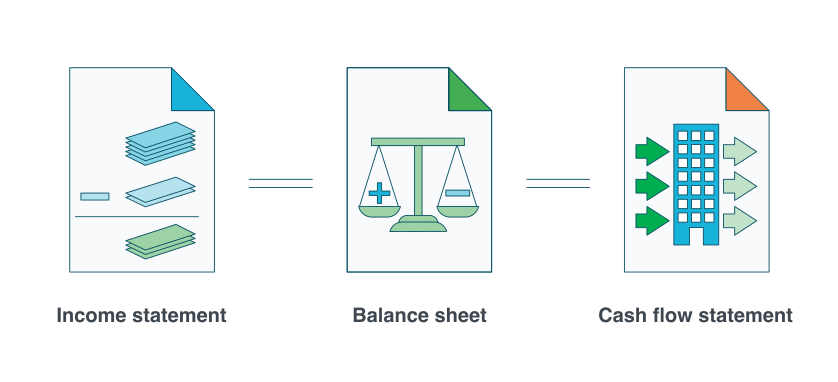
Three key financial reports help show an organization's financial health:
Income statement
How much profit or loss your organization has generated over a specified period
Balance sheet
What your organization's assets, liabilities, and equity are at a specific point in time
Cash flow statement
Where the organization's money is flowing in from and flowing out to
If you're not a numbers person, maybe you're tensing up at the thought of having to learn about these financial statements. Relax: It's actually not that complicated. Interpreting and using the information in the statements involves simple logic, not complex calculations.
第 2 节
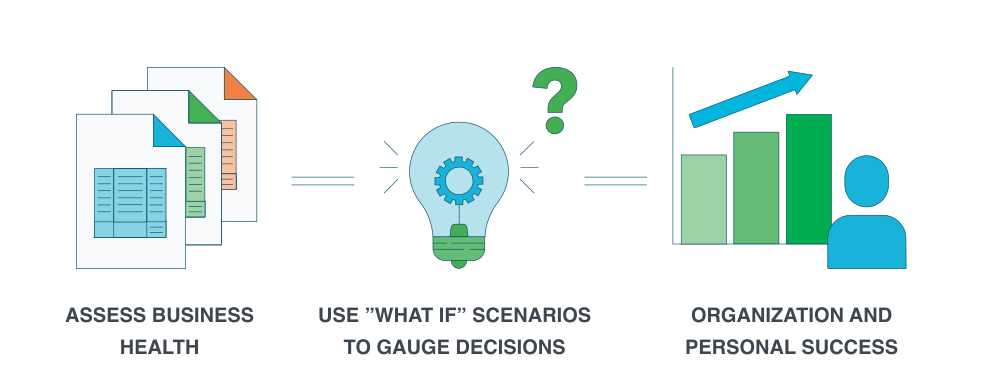
Your organization's income statement, balance sheet, and cash flow statement all contain clues to how healthy your organization is from a business standpoint. The healthier your organization is, the more it can manage important activities, such as paying its bills, serving its customers, and developing new offerings.
When you know how to understand those financial statements, you can begin to answer important questions, such as:
How are sales? Are revenues growing? Declining? Staying steady?
Is there enough cash on hand to pay expenses and invest in growth opportunities?
Is the organization taking on or paying down debt?
Is the organization growing profitably?
The answers to these questions don't come from just the numbers on financial reports. After all, different industries operate in different contexts, so it's important to understand targets your company sets for revenue, profit, growth, and other metrics.
With this information in mind, you can use financial data to generate “what if” scenarios to gauge how decisions you make in your own role might affect your organization's business health. For instance, what would the impact be if you:
Launched a new product or service?
Switched suppliers or negotiated new terms with existing ones?
Defined a new marketing strategy?
By making decisions with your organization's overall financial health in mind, you can be more effective in your role and help your company succeed.
Let's take a closer look at the three financial statements.
第 3 节
Your organization's income statement tells you whether it has made a profit (positive net income) or incurred a loss (negative net income) over a specified time period, such as a month, a quarter, or a year. Not surprisingly, the income statement is also called a profit and loss statement, or P&L.
Important numbers that people look for in an income statement are usually the “top line,” which is the revenue, and the “bottom line,” which is the net income. The net income is the money left after the organization has paid all its business expenses in that time period. Gross profit (what’s left when you subtract the cost of sales from total revenue) helps you understand how profitable the organization is relative to what it spends to make its product or service, is another key metric.
Revenue
$255,780,000
Cost of sales
-$117, 450,000
Gross Profit
$138,330,000
Operating Expenses
-$72,350,000
Earnings Before Interest and Taxes
$65,980,000
Tax Expense
-$14,112,000
Net Income
$51,868,000
This example shows that the cost of sales was less than the total revenue. That means the organization made a gross profit. Even after subtracting other operating expenses and taxes, the company had a positive net income—it was profitable for this period.
But there's a lot more information in the income statement that can offer interesting insights into an organization's health. Let's take a closer look at an income statement from a company we'll call Tech Giant.
损益表:探究公司的损益情况 The Income Statement: Tracking Profit and Loss
哈佛教授讲授视频逐字稿
So, you want to know about a company's financial health. Maybe you're considering a new position there, or you're thinking about buying some stock. Let's say the company is a computer products and services firm called Tech Giant. One thing you can check is Tech Giant's latest income statement. This is also called a profit and loss statement or a P&L.
Income statements show whether a company made a profit or incurred a loss during a specific time period. Should you join Tech Giant or buy some Tech Giant shares? Probably not, since it's a made-up company. But let's look at their income statement anyway. A good place to start is the income statement's bottom line. That's its income after taxes. Tech Giant's income statement for last year shows a net income of $17,325,000. Good news, that's a profit.
Let's look a little closer to see what else income statements can tell us. Under revenue, you can find out how much money customers paid for goods or services. Tech Giants customers paid over $165 million for its products and services last year. Now, let's look at the cost of sales. These are Tech Giant's expenses, also known as cost of goods sold. Cost of sales refers to things like raw materials and direct labor that go into making products.
Next, there are operating expenses, which are the overhead costs associated with running the business-- like technology, marketing, and general administration. Then, there's interest that a company pays for loans and taxes, of course. Subtract all those expenses from the revenue line and you get Tech Giant's net income of $17,325,000 for the year. By looking a little closer, you can understand more about the company and its business strategy.
You can learn how efficiently Tech Giant uses its labor and supplies in producing its goods or services by looking at its gross profit. That's what's left of the revenue, if anything, after subtracting the cost of sales. Divide this number by the company's revenue, and you have the company's gross profit margin, represented as a percentage. You can compare the gross profit margin against other year's results, a competitor's results, or the industry average.
Gross profit margin is also an important number because it's here that Tech Giant's managers can make a difference by considering variables that make up the cost of sales, like product design, pricing, materials, and distribution channels. Improving this percentage can give Tech Giant even more cash to fund operations and fuel further growth. Wait, can gross profit margin ever be a negative percentage? Yes.
If the cost of making and selling a product or service is higher than the revenue, the gross margin will be negative, which means the company bleeds money every time it makes a sale. Luckily, that's not the case with Tech Giant. Now, let's come back down to the bottom line. Tech Giant made a profit last year, but it's not huge given its revenues. What could explain this?
Take a look at its expenses on technology and marketing. The big numbers here could indicate that Tech Giant is spending strategically on artificial intelligence, which can help the company's future. They're also likely spending a lot to reach their customers through marketing initiatives, an important lever for that high-revenue figure in the top line.
Of course, last year could have been a fluke. So it would be a good idea to compare several consecutive years to get a full picture. And if the income statements from earlier years also show a strong growth trend, Tech Giant would be a great place to work or a great stock investment if it were a real company.
The numbers on financial reports aren't the whole story—but they're a good starting point for learning about your organization's financial health.
Try it Out
Try it Out Find your organization’s income statements from the past three years, or find another company’s statements. Answer the following questions:
Unlike the income statement, your organization's balance sheet is a kind of snapshot, showing key information at a given point in time:
Assets
Forms of value that the organization owns, such as: Buildings and equipment Inventory Cash; stocks and bonds Accounts receivable
Liabilities
Money owed to employees, suppliers, and creditors, such as: Accounts payable Short- and long-term debt
Equity
What’s left over for the owners (the founders, if the organization is privately owned, or shareholders, if it’s publicly owned) after total liabilities are deducted from total assets
The balance sheet provides clues to how well the organization is managing its assets and liabilities. For instance:
Can current assets cover current liabilities?
Does the business have a lot of unsold inventory sitting in a warehouse that it should try to convert into cash?
If current debt is higher than current assets, is that part of a strategy or does it signal a problem?
Is the organization taking on so much debt that it can’t keep up with interest payments?
The kinds of questions you can ask vary by industry and by your organization’s plans and priorities. Keep that context in mind as you ask and answer questions about assets and liabilities. Listen to financial analyst Udit Gandhi explain how he uses balance sheets:
资产负债表能说明什么? What Can You Find on a Balance Sheet?
哈佛教授讲授视频逐字稿
So in my role at EY, I review balance sheets, along with other financial documents, all the time as I work with my clients who are considering whether to buy or sell specific businesses. We're a bit like detectives trying to solve a case and verify what our clients are hearing about a particular business that they might be considering buying or selling.
So what is the balance sheet? A balance sheet is actually a really simple and logical document that sets out what a company owns-- the assets on the left side-- and what the company owes-- the liabilities on the right side. And the balance, the difference between the two, is what's called owner's equity. Let me give you an example of how I've used a balance sheet at work.
So a few years ago, one of my clients, a telecoms company, wanted to buy a fiber network. We'll call that Fiber Co. And this company had built a fiber network, and they provided internet services. What they told my client was that they had grown the network quite quickly over the period of several years, that they had borrowed money to grow the network, and they believed that the network could be grown further by borrowing more money to build it out and to get more customers.
So we wanted to verify these things because in a sale of a large business, you do want to be sure that you can trust the information you're being given. So we looked at a few years' worth of balance sheets to check that the asset side, the network of the business, had actually grown in the way that the seller was telling us it had grown. We were also then able to confirm that the loan balance on the liability side of the balance sheet have been growing consistently with the asset side, which was good. So that confirmed that they had been borrowing money to grow the network, as we were being told.
And then, lastly, we needed to check whether there was capacity to continue to grow the business. And we did that by comparing the balance sheet of this company, Fiber Co., to the balance sheets of other companies that were similar and maybe a bit bigger, so that we could get comfort that there was room for them to borrow more money, grow the network, get more clients, and make more money. We were able to verify that that was the case. And in that instance, happily, our client was able to buy the business, and our detective work paid off.
So even if you don't buy businesses for a living, a balance sheet can still be a really useful tool. It can help you understand the financial position of your company and whether the assets that they own and the liabilities that they owe are consistent with the operations of the business and the strategy of the business-- whether it's poised to grow, whether there might be trouble on the horizon. So, hopefully, I've given you a sense for how easy it is to use a balance sheet, and you can go out and do some detective work of your own.
Balance sheet numbers are especially helpful when you compare them with numbers from one or more previous years.
Here are some key numbers from balance sheets for one firm over three years:
The balance sheets offer clues about how the company is doing. Let's look at a few examples:
Accounts receivable and accounts payable
The company’s accounts receivable (what its customers owe) has remained much smaller than its accounts payable (what it owes suppliers) over the past three years. This suggests two things: The company’s customers tend to pay quickly and the company has likely negotiated relaxed payment terms with its suppliers. As money comes in, the company can hold on to it for a while before paying its suppliers, and in the meantime use the cash in whatever way it wants.
Accounts receivable and accounts payable
Cash
The company’s cash on hand includes not just customer payments, but also cash equivalents that can be liquidated easily, such as money market funds and treasurer bills. The steady increase in the amount of cash suggests that the company is growing.
Cash
Owner’s/shareholders’ equity
The total assets continually exceed its total liabilities, meaning that owner’s/shareholders’ equity has steadily improved. That’ll please this company’s investors.
Owner’s/shareholders’ equity
Try it Out
Get copies of your organization’s balance sheet for the past three years or three years of balance sheets from another organization. Use what you see to answer the following questions:
1. What conclusion might you draw by looking closely at the organization’s accounts receivable vs. accounts payable?
2. Is the percentage of debt high relative to the capital invested by owners? If so, what does this suggest to you?
3. What do the numbers in the balance sheet suggest to you about the organization’s overall financial health?
4. What did your review of these statements help you understand about your organization?
Are employees an asset?
Many executives say, “Our employees are our most valuable assets.” But from a financial accounting standpoint, employees aren’t assets. That’s because companies don’t own them and don’t have control over them the way they do over the assets that are tracked in financial reports. Companies account for employees by reporting their salaries and bonuses as expenses. Certainly, employees are valuable resources—they just aren’t considered assets in terms of financial reporting.
Are employees an asset?
第 5 节
Your organization’s cash flow statement gives you a peek into what its income and spending look like during a particular period. Like a bank statement, it tells how much cash was on hand at the beginning of the period and how much was on hand at the end. It also describes how the organization got its cash and spent it.
These numbers from a home services company show that cash came in from operations and from financing (a loan.) But the company spent money to invest in equipment. At the end of this period, the company had less cash on hand than at the beginning.
Cash Flows: 6/30/21 to 8/31/21
Cash on hand
$60,300
Cash flow: operations
$46,000
Cash flow: investments
-$77.000
Cash flow: financing
$26,000
End of period
$55,300
This video shows more about how and why businesses must manage cash flow carefully.
必须了解的现金流知识 What to Know About Cash Flow
哈佛教授讲授视频逐字稿
Everybody wants their company to make a profit. When your business makes a profit, that means everything's on track, right? Not quite. Profit is great, but it isn't the same as cash. Even a company that's profitable can fall into a cash flow trap and go out of business. It's all about the flow of cash.
Businesses use a cash flow statement to identify the cost of equipment, supplies, monthly expenses, investments, and finance payments. Let's see how one bakery got into a sticky situation. Miam-Miam Bakery launched in January with 10,000 euros in the bank. In its first three months, the bakery saw 20, then 30, and then 45,000 euros in sales. That seemed like a good start.
But to really capture profit, we need to subtract the cost of making the products from the sales, in this case, Miam-Miam costs were 57,000 euros or 60% of their sales. If their monthly operating expenses, like renting the bakery space, paying staff, and paying utility bills were 10,000, then the bakery would see a profit in just a few short months.
In March after three months in business, Miam-Miam Bakery should have ended with 8,000 in net profit, right? 45,000 in sales in March. Take away 60% or 27,000 for cost of goods sold. Take another 10,000 in expenses. That leaves 8,000 on an income statement. But Miam-Miam sold a lot of its baked goods to specialty stores that take 60 days to pay them. Miam-Miam paid its own bills within 30 days. So in January, the initial 10,000 was spent on expenses. Even though it made 20,000 in sales, the bakery won't see that cash for 60 days. Cash flow was already a major problem.
When February, came around the bakery owed 12,000 ingredients on top of the monthly 10,000. February ended with Miam-Miam 22,000 in the hole. In March, the bakery finally received its 20,000 from January, but they finished March owing 30,000.
As the bakery's sales grew, they needed more money for ingredients. But waiting 60 days for every payment and paying their own bills every 30 days meant they could never catch up, and that's the way the cookie crumbled.
Many businesses fail because they're short on cash. The bakery needed someone with financial know-how who could line up a business loan. They also needed to make better decisions about timing. When to pay out and when to collect. Knowing how your decisions affect cash flow can help you advance in your career. It can also help you understand your organization's financial health. It's a piece of cake.
Your organization's cash situation reflects what the enterprise’s priorities are now and what they might be in the future.
No matter what your role, you can affect cash flow through your everyday decisions. For example, think about how you can bring an understanding of cash flow to your work:
Sales
Work on selling to customers who pay their bills on time and negotiating payment terms that bring in cash on a steady basis. That helps your company manage paying its own bills on time.
Product development
Keep in mind that special, highly customized products can take a longer time to sell. Your organization might prefer to be able to convert inventory into cash quickly.
Procurement
Seek to negotiate payment terms with suppliers that enable you to defer payments for as long as possible. This helps ensure you have cash on hand to pay salaries and other operating costs.
Try it Out
Get a copy of your organization’s cash flow statement for the past three years or ones from another organization, then answer the following questions:
1. Where is most cash flowing in from (e.g., business operations, lenders, investors)?
2. Where is cash flowing to (e.g., operating expenses, paying long-term debt, investing activities)?
3. Are cash flow patterns steady, or do they change over time? What might the changes reflect about the organization’s financial health or long-term priorities?
You've seen how three key financial statements—the income statement, the balance sheet, and the cash flow statement—work. And you've seen how the numbers in each financial statement can reveal insights into your organization's business health.
Continue to use that information to support your organization by making smart, strategic decisions. By doing so, you help it more effectively manage the four building blocks essential for success:
When you bring an understanding of finance basics to your work, you can do more to help your organization thrive and to strengthen your own career.
第 7 节
To ensure its financial health, your organization manages revenue, expenses, cash flow, and profit.
Three key financial statements provide different views of an organization’s financial performance.
The income statement shows net profit or loss over a given period, and includes other important data, such as revenue, expenses, and gross profit.
The balance sheet is like a snapshot of a certain point in time and shows how an organization is managing its assets and liabilities and the amount of owner equity.
The cash flow statement provides details about an organization's income and spending during a particular period.
By reviewing these financial statements, you can better understand your organization's financial health and apply your knowledge to support the organization as a whole.
第 8 节
Try it Out
1. You lead the graphic design team at your organization. Based on your role, why would it make sense for you to dig into financial reports?
答案与解析
When you focus on revenue and net profit, you understand how to make the right decisions for your organization. This is ultimately the most effective way to support your team. Not the best choice
Revenue and net profit are important metrics, but financial reports include other important information that can help you understand your organization’s overall financial health and longer-term plans. This helps you align your work with your organization’s broader financial picture, positioning you to better support the business and advance in your own career.
After spending some time focusing on financial data, you’ll appreciate your graphic design role more. Not the best choice
Reviewing financial data may give you a renewed appreciation for your role, but the real reason to look at financial reports is that this can help you understand the bigger picture and align your work to better support both the organization and your career.
With a better understanding of the organization’s financial health, you can propose new ideas that align with the company’s goals and spending capacity.(正确) Correct Answer
Financial reports provide data that help you understand your organization’s current finances and longer-term plans and priorities. When you align your work with the organization’s financial health, you support the organization and your own career success.
第 9 节
Reflecting on your learning helps you apply relevant concepts to your job.
Take a Moment
1. 1. What new insights do you have that could benefit you or others in your workplace?
2. 2. What are your biggest opportunities for applying concepts from this Lesson in your workplace?