Attracting and Cultivating Talent
Hire and Onboard Team Members 查看中文版
第 1 节
You’ve created a job description and worked with human resources to attract and select candidates to consider. Now it’s time to develop your interview process. Just as you’re evaluating applicants’ qualifications, candidates are interviewing you to determine whether they want to be part of your group and organization, so preparation is key.
Take these steps to structure your interview process and prepare to apply it consistently:
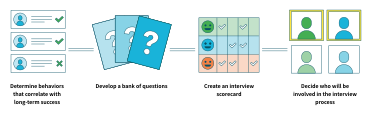
Determine behaviors that correlate with long-term success
Your job description identified the skills needed for this position. Before the interview, think about how you’ll assess whether candidates can apply their skills to the role, now and in the future.
Develop a bank of questions
Prepare questions that engage interviewees and draw out details about their skills and experience. When you and other interviewers consistently use these same questions for each candidate, you ensure equitable treatment during the interview process.
Create an interview scorecard
Use a scorecard to assess applicants’ responses to each question. For example, you may award a good response 3 points, an adequate one 2 points, and a poor one 1 point. This will help you to be consistent and transparent in your final review of candidates.
Decide who will be involved in the interview process
Invite key team members to participate in the process, whether they conduct one-on-one conversations with candidates or are part of an interviewing team. Avoid including so many people that the process bogs down or overwhelms the applicant. Other stakeholders who will interact regularly with the new employee can also bring valuable insight to the process.
To set interviewers up for success, share all necessary information and tools to guide them through the process. Make sure everyone knows what you expect from their participation, emphasizing consistency and timeliness.
Take a Moment
1. If you aren't taking all these steps, what will you do to better prepare for your next interview?
第 2 节
You’re now ready to meet the candidates. To provide a positive experience for each applicant, start the interview off right. Whether you’re meeting in person or virtually, be sure to:
Prevent interruptions
Start on time and don’t take any calls or visits from colleagues during the interview. If you are interviewing virtually, make sure your camera is on and you’re located in a quiet place with no distractions.
Greet the candidate
Put candidates at ease with a friendly greeting. Introduce yourself. Smile and make eye contact. Include the candidate’s name in your greeting. If you’re unsure how to pronounce it, ask.
Establish rapport
If you’re face-to-face with the candidate, start with a neutral question, such as asking about their commute. Or if you’re meeting virtually, ask where the candidate is calling from.
Hakim puts an interviewee at ease
Hakim puts an interviewee at ease
Hakim manages a marketing team at a large pharmaceuticals company. He’s interviewing candidates for a position on his team that will focus on developing TV ad campaigns. Yolanda, a candidate whom he’ll be interviewing virtually, joins the Zoom meeting. Hakim smiles, looks into his camera, and says, “Hi Yolanda! It’s good to meet you. I’m Hakim. I lead the marketing team for our company’s cardiovascular therapeutic area, and the person we hire for this position will report to me. So, where are you calling from today?”
Yolanda replies, “Hi Hakim—it’s good to meet you too. I’m in Barcelona.”
Hakim says, “I’ve heard it’s a beautiful city. What’s the weather like there today?”
“Well, it’s colder than usual,” Yolanda notes, “but I’m still hoping to do some surfing later today!”
“Sounds great,” says Hakim. “I’ve always wanted to try that, but there’s not much opportunity here in New York! . . . So, why don’t we get started.”
Hakim puts an interviewee at ease
Make a Connection
1. How do you put a candidate at ease and establish rapport when you are conducting an interview?
第 3 节
Once you’ve put the candidate at ease, it’s time to dig deeper. The key to a successful interview is asking the right questions. You’ve prepared questions built around the skills needed to perform the job. But it’s not enough for the candidate to be able to do the job; you want someone who will thrive in your organization.
In addition to asking about specific skills, you’re looking for the candidate to demonstrate:
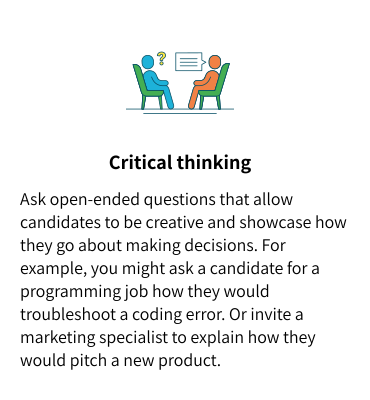
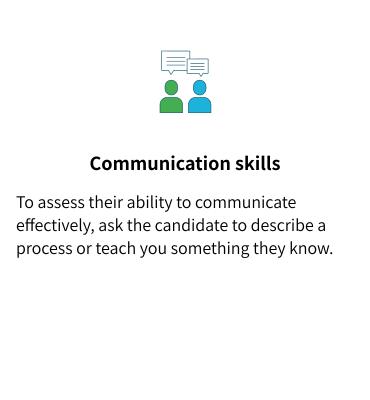
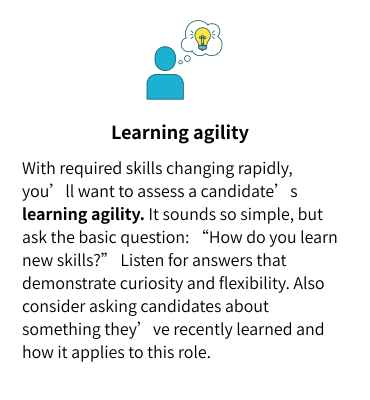
As you listen to candidates’ answers, take notes for completing your interview scorecard. The best time to score candidates is immediately after the interview.
Hakim learns more about Yolanda
Hakim learns more about Yolanda
During Hakim’s conversation with Yolanda, he poses a number of open-ended questions aimed at learning more about her skills. For instance:
“If you were about to start working on a new ad campaign, what questions would you want answers to before you began?”
“How do you go about selecting the best voice and acting talent for a new ad you’re developing?”
“What have you learned most recently about trends in television advertising? How would that influence your approach to this job?”
Hakim learns more about Yolanda
Interviews aren’t the only way to gauge people’s potential. Consider requesting additional material to help you assess a candidate’s skills:
Writing sample
If the open job requires extensive writing, request samples before the interview.
Mini presentation
For roles that demand strong speaking skills, provide candidates with a topic or question before the interview and ask them to deliver a short presentation.
Trial project
Ask candidates to complete a brief sample project to get a sense of their work output. Have a web developer do a bit of coding or a communications candidate edit a few paragraphs of a blog post that won’t be published. Keep it small; the goal isn’t to get free work out of a candidate!
In addition to giving you a stronger sense of what candidates have to offer, these exercises allow prospective hires to experience the kind of work you do on your team.
Here, KeyAnna Schmiedl, global head of culture and inclusion at Wayfair, provides tips on how to get a good sense of a person’s talents and potential.
在面试中挖掘人才潜力 Level Up at Work: Interviewing Job Candidates
哈佛教授讲授视频逐字稿
Hey there, it's Isa. Small confession, I've actually never conducted an interview before. That's why I'm so happy to be meeting with KeyAnna Schmiedl, Global Head of Culture and Inclusion at Wayfair.
Isa: KeyAnna, I'm really pleased to be able to speak with you today. What's your overarching goal when you are conducting an interview?
KeyAnna: Not enough time is spent on thinking about how you set up the interview to get the best out of that candidate. So ideally, you're going to make them feel comfortable. I like to kick things off with a “Hey, how's it going today?” So sometimes, it's nice to just like kick the nerves out for some people.
I'm just looking for things like how you collaborate with others. Do you naturally default to over communication, or under communication? Just some things that will give me a sense of how you'll work on the team.
Isa: A big thing about my job I know for me is having those critical thinking skills. How do you pick up on someone's ability to critically think?
KeyAnna: I think if you're not using behavioral based interview questions, you're probably setting yourself up for failure. And so what I mean by behavioral based interview questions are getting a sense of can you tell me about a time when you've had to change the opinion of a senior leader, or get a group to align on moving forward in one way versus another. There's not necessarily a right or wrong answer, but it gives you a sense of how do they think about framing whatever the challenge is so that they can start to build a coalition of support around a decision to be made.
Isa: You know, something that's really important to me, and something that's really important to my company is our workplace culture. And I've heard a lot about having the best fit. But how do I communicate workplace culture to a potential candidate?
KeyAnna: I think you can start with, what are you looking for in a workplace, right? When you think about showing up at work every day, what are some of the things that you hope happen? When you start to ask those questions, what you can get from candidates is a little bit more on what are the things that they value, and where does that align or not align with where your culture is at now.
And then the consideration becomes, well, will they be a culture add for us? Will they break up some of the homogeneity in how we think, or how we tend to get together? And will that ultimately help us in terms of business results, whether that's connecting with other clients, or even just thinking about how we work on our own teams a little bit differently that just makes us a bit better at what we do.
Isa: This is great. I was really nervous coming into this. But you definitely eased a lot of my anxiety.
KeyAnna: So it seems like we're ready for the interview to start.
Isa: We're ready for the interview to start. Yeah.
OK. Here's my takeaway. Put candidates at ease. Ask, tell me about a time questions to get to their problem solving skills. Find out what's meaningful to candidates, and share what my organization can offer.
第 4 节
After you interview all candidates, meet with the other interviewers and review your notes. To avoid any misunderstandings, be clear how the final decision will be made. By consensus or simple majority? Will the hiring manager have the last word?
During the meeting:
-
Compare candidates’ scores on each competency.
-
Discuss any rankings that differ significantly from others.
-
Rank the candidates by total scores.
-
Review scorecards to ensure everyone was treated consistently.
-
Determine whether there’s a consensus on one candidate.
Hiring decisions are important, so take time to review the information you’ve gathered. Work with human resources to follow their processes to extend an offer to the candidate you’ve selected.
第 5 节
Research shows that when onboarding is successful, employee sense of belonging increases by 70% and their engagement increases by 50%.
Research shows that when onboarding is successful, employee sense of belonging increases by 70% and their engagement increases by 50%. Research shows that when onboarding is successful, employee sense of belonging increases by 70% and their engagement increases by 50%.
Once a candidate has accepted your offer, it’s up to you to welcome the new employee and provide them with the tools and information they need to be productive and successful.
Think back to your first day at your current job. You probably felt apprehensive, wondering what to expect and how you were going to fit in with the team. As a manager, your preparation and attention determine whether your new hire feels welcome and included.
Here, a customer success manager shares two very different onboarding experiences he’s had at new jobs.
入职当天的不同体验 How Was Your First Day?
哈佛教授讲授视频逐字稿
On my first day I arrived at the office at the time HR had specified only to find out that my manager wasn't there yet. And my laptop was locked in his office for the next two hours. Once my manager did arrive, I was set up with my laptop and email. And that concluded my onboarding.
I've also had the pleasure of a good onboarding experience, where I felt supported throughout the entire process. My manager provided onboarding material for me to read, and training documentation for me to review, such as workflows, company hierarchies, and the commonly used acronyms in the organization. Because I was set up for success, I was ultimately able to grow with the organization.
Here are tips for making the first day a great one:
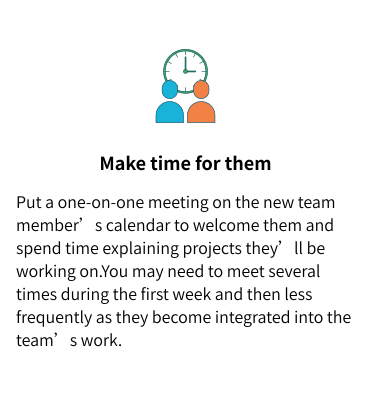
Your new hire will bring fresh perspectives to your team, so invite their questions and observations. Build rapport by regularly checking in with them. You’ve spent a lot of time and resources filling this new position! Make sure you onboard the person to your team with care.
第 6 节
-
Create a structured interview process using questions that measure the necessary skills and competencies you seek. Promote equity in hiring by applying it consistently.
-
Ask questions that reveal critical thinking skills, ability to learn and grow, and leadership potential.
-
Consider practical methods to assess candidates beyond the interview questions, such as writing samples and trial projects.
-
Meet with interviewers to review notes, compare candidates’ scores, and choose who to hire based on the information you gathered.
-
Welcome new people by setting them up for a productive and successful first day and beyond. Build team connections, assign mentors, and regularly meet with them.
第 7 节
第 8 节
Reflecting on your learning helps you apply relevant concepts to your job.
Take a Moment
1. 1. What new insights do you have that could benefit you or others in your workplace?
2. 2. What are your biggest opportunities for applying concepts from this Lesson in your workplace?
Further reading
你需要了解员工的照护责任员工们经常需要在工作和照顾家庭成员的责任之间进行平衡,无论是照看孩子、赡养老人,还是照顾其他家庭成员。然而,许多组织并不…
Top 3 in the source platform's original order
