Pocket Leadership口袋领导力

Change Management

Lead a Change Initiative 查看中文版

第 1 节

You never know when or how change will hit your team—but it will. Reorganizations, mergers, technology rollouts … the list can seem endless.

As a leader, your role is to make the case for change and let your team know how it will affect them.

Begin by sharing:

Why the change is taking place Lay out the business reasons. What the change is and its goals Explain how it will benefit your team and improve the organization. What the scope of the change is Describe how long it will take and who will be involved in implementing it.

Before you spread the word, be sure you fully understand the initiative yourself. Armed with this understanding, you’ll be able to address any questions or concerns that may come up.

Susana introduces a new initiative

Susana introduces a new initiative Susana is a clinical nurse manager. Her hospital’s executive team wants to introduce new practices for reducing medication administration errors and improving patient health outcomes. This means big changes for how nurses and other medical staff do their jobs. Susana’s story begins as many change efforts do—with lots of questions from her team about their role in implementing this initiative. Susana introduces a new initiative

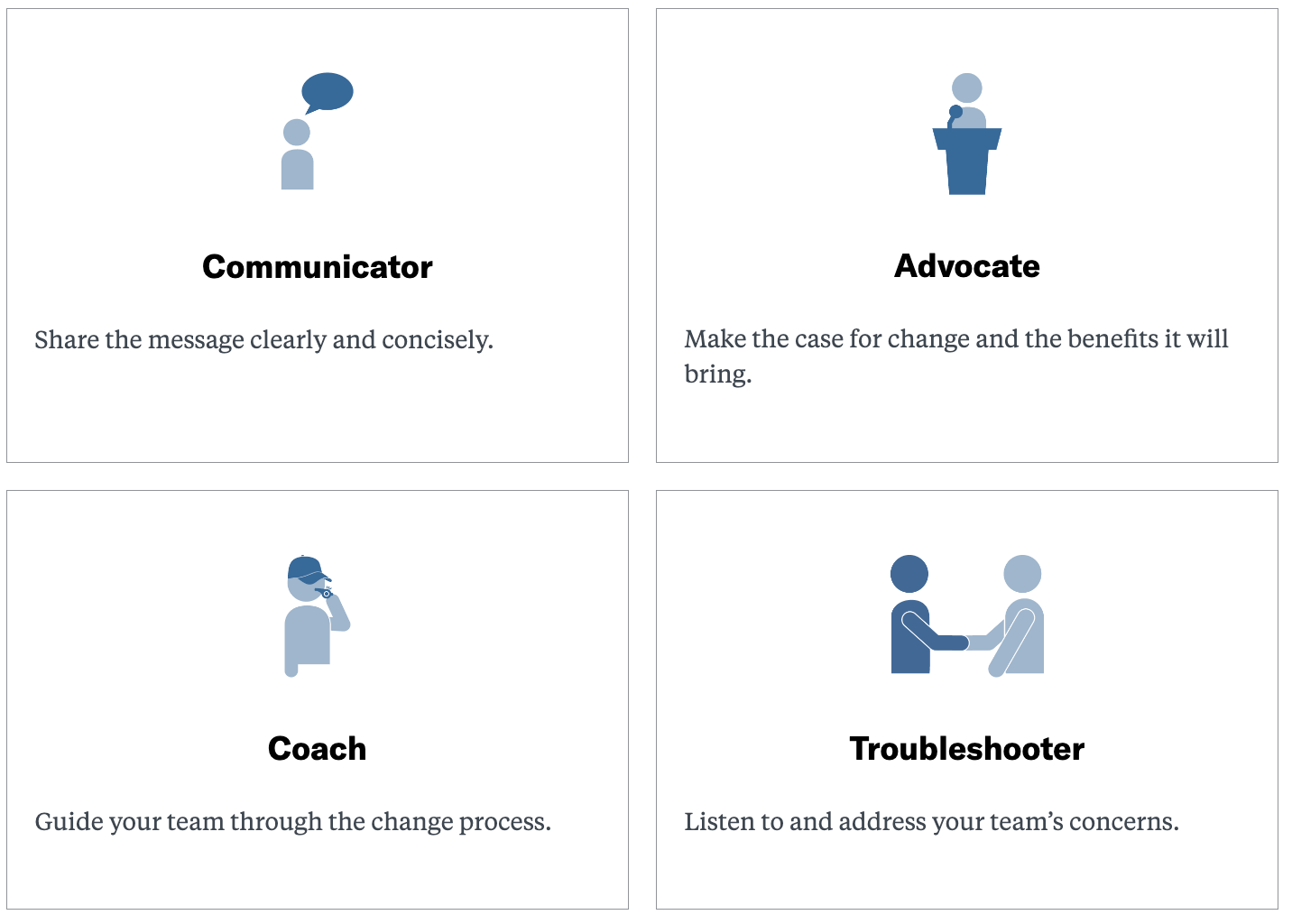
As you engage your team in a change effort, you’ll play different roles at different times, including:
“Don’t just tell your team changes are coming—engage them in the process.”"Don’t Just Tell Employees Organizational Changes Are Coming-Explain Why" by Morgan Galbraith. Harvard Business Review, October 5, 2018.

—Morgan Galbraith, change management expert

Harvard Business School professor Amy Edmondson shares how a hospital CEO got her team on board with a crucial improvement initiative.

如果人们并不认为现状有问题,如何发起变革? Engage People in Change Through Inquiry

哈佛教授讲授视频逐字稿
When Julie Morath, the chief operating officer of Children's Hospital and Clinics in Minneapolis, announced that she was going to lead a major change initiative on patient safety, one possibility would be that everybody would stand up and cheer. It's actually not what happened. Most people in the hospital said, we don't have a problem with safety. We're a Children's Hospital. We're great as we are. What she did instead was say, maybe you're right. After all, I just got here. Maybe there isn't a problem. So let me ask you to reflect on your experience last week with your patients in the wards. Was everything as safe as you would like it to be? And then she said, my office became a confessional. So if I think about that, what happened there is instead of just pushing back on the resistance and saying, come on everybody, get on board, she said, a, maybe you're right. Honor their experience. Two, inquiry. Let me ask you to reflect on your experience—very concrete: last week with your patients. And then the aspirational question—not was it unsafe, but was everything as safe as you would like it to be. And then everybody started coming forward thinking, you know what, it isn't. I think there's several reasons why leading change is surprisingly difficult. One is that most people don't fundamentally feel that the way they're doing things now is wrong. So in order to agree that we have to change, I have to agree that what I'm doing now is deficient in some way. So it's quite a lot for people to take. And so people have to accept the idea that the new way is going to be better, not just for us, but for me, and that can be a tough challenge. The other reason why leading change is surprisingly difficult is because of the complexity of changing so many things at once. In an organization, everything is interconnected, and when you change a part over here, it has unintended implications for a part over here. And so, that implies a very high level of thoughtfulness and planning and figuring out how we're going to move forward so that we don't create more problems than we solve. And at the same time, recognizing we can't plan it all out in advance. Nobody can effectively see into the future, and so we have to move forward into this uncertainty that's the future and the even greater uncertainty that's change. And to some extent, allow people at the front lines of the organization and throughout to figure out and solve problems on their own without being told exactly what to do.

Each team is unique. The key is to adjust your approach to meet your group’s needs.

Together, answer questions such as:

  • What will we need to change to make this initiative a success?

  • What will stay the same?

  • How will we know we’ve been successful?

Poll

Poll

第 2 节

Some people are likely to be more receptive and enthusiastic about the change than others.

Identify the biggest supporters and mobilize them first.

They will naturally spread enthusiasm for the initiative.

The most effective change influencers:

  • Understand and support the goals of the change

  • Have diverse viewpoints and areas of expertise

  • Demonstrate strong leadership skills

  • Can set aside their personal interests in favor of the larger goal

Make a Connection

1. Change influencer #1
2. Change influencer #2
3. Change influencer #3

Once you’ve identified your change influencers, support them in making the case for the change.

Innovation expert Thomas Wedell-Wedellsborg shares how one company did just that.

利用“社会认同”影响他人行为 Use "Social Proof" to Change Behavior

哈佛教授讲授视频逐字稿
One particular problem that I've seen quite often in companies is when managers, they have come up with a new initiative, and they need the employees to try it. How do you get people to test out a new thing that you're doing internally? And in the research that my colleague Paddy Miller and I did for our book “Innovation as Usual,” we saw some different stories or examples of how managers tried to approach this challenge. The first thing we saw was in a company, they had come up with an internet initiative. And they created a really beautiful poster that had a lot of verbiage, “This offers an unprecedented, unique employment experience. Be the first to try it and help shape it for the rest of the company.” That message was really telling people that none of their colleagues was using the service. And not surprisingly, not a lot of the employees were actually willing to be guinea pigs for this new thing. So that approach kind of failed. Nobody used it. The same management team then tried a second approach. They said, “OK. Well, if we can't convince them, we can try to force them.” So they decided to install this on everybody's computers. So when you came in the first thing in the morning, when you booted up, there it was. You couldn't help run in to it. Only then, of course, they started getting a lot of irate calls about, “How do I get this stupid thing off my computer?” That created so much antagonism that at the end of the day, they actually had to stop the initiative. Forcing people to try to do new things, that rarely works. But then we saw, inside Pfizer, a third and different way of doing it. They had to try to make people use another internet initiative called pfizerWorks. But what they did was, when they came into a new business unit, they first got a couple of people to try it and found somebody who really liked it. And then they asked that person, “Can we put you on a poster? It's just going to be shown here in this business unit or in this office.” And the poster basically showed the person saying something like, “Ach, I have to have these documents ready in 18 hours. How do I do that? pfizerWorks can help.” This is the notion we call “social proof.” And the core idea is really that if you're trying to make people change their behavior, whether it's adopting a new process or using a new product internally, how can you demonstrate that somebody they know and trust is already using it and that it works? That's really the core challenges for communication. First, get somebody on board like that. And then broadcast that person and that person's approval to the people you want to get on board. Use social proof. That'll massively increase the chances that people will start changing their behavior.

Make a Connection

1. How can you use the idea of “social proof” to gain support for a change initiative?

第 3 节

Make a point of engaging people who are skeptical about the change. Use their input to detect weaknesses and suggest improvements for your plans. You’ll strengthen the initiative and help doubters feel heard."How One Health System Overcame Resistance to a Surgical Checklist," by Kate Hilton and Alex Anderson. Harvard Business Review, May 20, 2019

Who knows—the biggest skeptics might become the most influential supporters!

Susana builds momentum

Susana builds momentum Susana’s first step is to find effective “change influencers” in her department. She identifies several team members who clearly see the vision for the change and are excited to try it out. Together, they think about what the change means for their team and how to engage others in the effort. As they begin to feel ownership for the change, the influencers share their enthusiasm for the new process with others. Within a few weeks, all members are actively contributing to planning the roll-out. Susana builds momentum

Make a Plan

1. How can you involve the change influencers you identified earlier in engaging others in an initiative?

第 4 节

When implementing a change initiative, good planning lets you use time and resources efficiently. The best plans lay out what needs to be done, when, and how.

So where do you start? By identifying a clear goal.

Susana’s team’s goal

Susana’s team’s goal Susana and her team set a goal of reducing medication administration errors in their area by 90% during the roll-out phase. Susana’s team’s goal

To make your plan manageable:

Break it into chunks Overly ambitious plans often fail. Build a plan that your group can tackle in manageable pieces. Clarify team members' involvement Decide who needs to actively participate and who just needs to be kept informed. Specify roles Clearly define who will do what to implement the required change, and when they will do it.

Make a Connection

Make a Connection In addition to a flexible project design, to support your team during change:

Change programs don’t always go according to plan. Build in flexibility to accommodate the unexpected—like personnel changes, new work processes, or delays.

Poll

Poll

Listen to how Dr. Peter Pronovost, a critical care specialist and researcher at Johns Hopkins Hospital, implemented change in his organization.

如何成功发起一场变革? How to Successfully Implement a Change Initiative

哈佛教授讲授视频逐字稿
Change. Sometimes it can be unwelcome and uncomfortable. But positive changes can save time, money, and even lives. Consider Dr. Peter Pronovost, a critical care specialist and researcher at Johns Hopkins Hospital. Dr. Pronovost wanted to end central lineinfections, a deadly type of bloodstream infection. His weapon against the infections? A simple checklist--and it worked. How did Pronovost do it? He energized his community to embrace change using four practices. Your change initiative can be modest or enormous, like Pronovost's. But if you really need change to take hold, include these practices. To successfully implement the checklist, Pronovost began by making his case. He had nurses observe and record doctor's steps when inserting central lines. The results were shocking. Doctors skipped at least one step a third of the time. No wonder infections were so prevalent. When Pronovost shared the data, everyone agreed that a change was needed. Staff members started using a checklist when putting in central lines. To make the new approach stick, Pronovost needed to get influencers on board. He persuaded hospital administrators to empower nurses to stop doctors from skipping any steps in the checklist. This change to longstanding protocol was a major culture shift. All staff had to adopt a new mindset. Pronovost made sure everyone understood the process. Staff members received training and materials. Each team was free to decide how to store supplies and collect data. This flexibility made it easier to carryout the plan. Once teams began to use the checklist regularly, they assessed their effectiveness at bringing about change, and the results were undeniable. At Johns Hopkins Hospital, the infection rate dropped down from 11% to 0% in one year. This was a game changer. Zero mainline infections. Zero lives lost to mainline infections. To sustain this success, checklist training became a clear priority. These four practices aren't a one-size-fits-all blueprint. Instead, they're guideposts that can support a change initiative, redefining change from something that happens to teams to something that teams can accomplish together.

第 5 节

Companies that are highly effective at managing change are more than three times more likely to outperform their industry peers.

Companies that are highly effective at managing change are more than three times more likely to outperform their industry peers. Companies that are highly effective at managing change are more than three times more likely to outperform their industry peers."Don’t Just Tell Employees Organizational Changes Are Coming - Explain Why," by Morgan Galbraith. Harvard Business Review, October 5, 2018

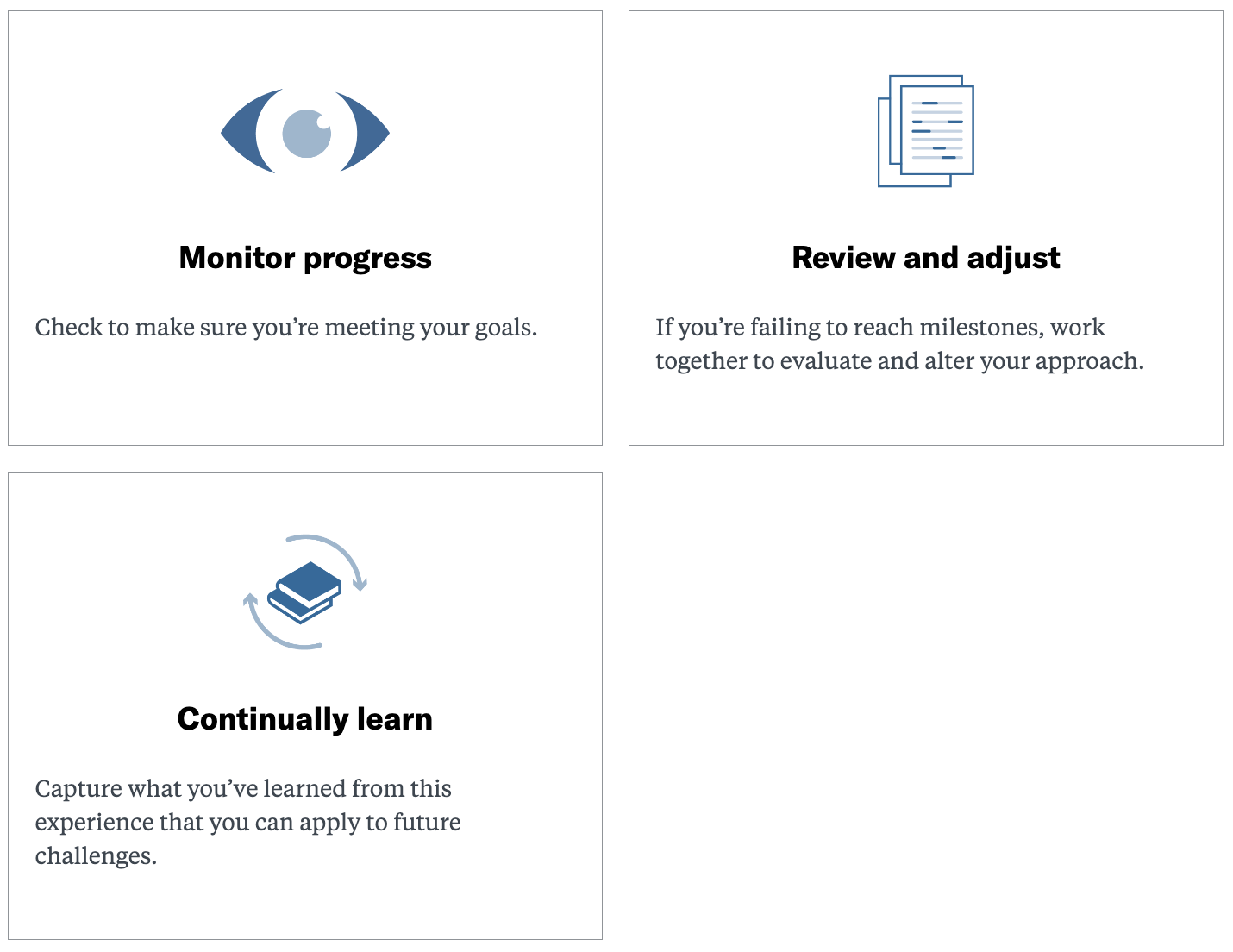
It’s not enough to go through the motions of change. You also need to:
Susana and her team make adjustments

Susana and her team make adjustments As Susana‘s team continues to roll out the new process, they make adjustments. For example, they realize they need to communicate with the pharmacy staff about the new approach. As they refine the process and see positive results, they feel a sense of pride in what they’ve accomplished together. Susana and her team make adjustments

To evaluate the success of your change effort:

Pick critical indicators You don’t need to measure everything. Focus on a few data points, such as increased sales or improved collaboration. Decide how to measure progress You might look at customer surveys, focus groups, interviews, or performance data such as sales figures or turnover rates. Test your assumptions While you may think your change project led to a certain outcome, when you look at the data more closely, you may discover another cause.

Take a Moment

1. How can you and your team evaluate the success of a change effort?

You and your team will inevitably experience setbacks.

As a leader, you set the tone for your group.

If you approach a setback as a chance for learning, so will others. Work together to troubleshoot problems.

Change can take a long time to produce results. Celebrate milestones along the way to help people:

  • Feel good about their hard work

  • Maintain momentum for change

  • Neutralize any skepticism about the change effort

Your work isn't over once your group has generated the gains promised by your change initiative.

Develop new processes and systems to sustain your progress. You’ll create lasting value for your team and organization.

Evaluating a Change Project

附件:worksheet_for_evaluating_a_change_project1697017353421.docx(docx · 989 KB,本地副本)

第 6 节

  • When change happens, your role is to make the case for it and let your team know how it will affect them.

  • Start by identifying and mobilizing change influencers.

  • Lay out a clear and concise action plan that leaves room for flexibility.

  • Sustain your team’s results by developing new processes and systems.

第 7 节

Reflecting on your learning helps you apply relevant concepts to your job.

Take a Moment

1. 1. What new insights do you have that could benefit you or others in your workplace?
2. 2. What are your biggest opportunities for applying concepts from this Lesson in your workplace?

Further reading

HCLTech 首席执行官谈企业如何在 AI 时代实现战略转向
生成式 AI 出现后,HCLTech 意识到,这项技术将从根本上重塑 IT 服务的经济逻辑,打破收入增长与员工规模扩张之…
中层管理者将决定 AI 采用的成败
生成式 AI 项目之所以常常陷入停滞,原因往往不在于董事会、供应商或培训,而在于中层管理者决定了 AI 应该如何真正落地…
AI 转型需要对工作进行重新设计,而不是裁减岗位
AI 开始重塑企业的人员决策,但许多公司的行动速度已经超出了现有证据能够支持的程度。早期因 AI 而进行的裁员往往未能带…

Top 3 in the source platform's original order