Change Management
Inspire Your Team to Initiate Change 查看中文版
第 1 节
Do you spend more effort pushing change out … or unleashing it from within your team?
If you answered “pushing it out,” you may be trapped by these common myths about change.
Myth 1: Successful change starts at the top.
Not the case. Initiating change is the responsibility of everyone in the organization. Frontline teams are often best positioned to understand what customers want and what processes work—or don’t.
Myth 1: Successful change starts at the top.
Myth 2: If a change initiative fails, it's leadership's fault.
Nope—set this one aside. It's easy to place blame on top executives for change initiatives that falter. But fixating on blame only delays learning throughout the organization.
Myth 2: If a change initiative fails, it's leadership's fault.
Myth 3: Junior employees don't know enough to contribute ideas for change.
Think again. To thrive in competitive environments, companies need all employees to initiate change. Newer team members often bring in fresh thinking and creative ideas.
Myth 3: Junior employees don't know enough to contribute ideas for change.
The truth is: You and your team are powerful forces for change.
Your group has unique information about work processes and customer needs that puts it in a pivotal position to:
-
Identify gaps and come up with innovative ways to close them
-
Experiment with new ways of doing things
-
Continually improve procedures and practices
To encourage your team to suggest areas for ongoing improvement:
Look for opportunities
Pose questions like "What new trends do you think will affect us in the coming year?" to send the message that the future is just as important as the present.
Communicate urgency
People it find it difficult to do the work associated with change unless they are convinced that maintaining the status quo is riskier than striking out on a new path.
Bring together a range of voices
Improve the quality of the exploration by including people from diverse backgrounds and areas of the organization.
Make a Connection
Make a Connection
Executive coach Frank Saucier offers tips for creating change by exploring opportunities and obstacles.
主导变革是一门有趣的艺术 Learn into Change
哈佛教授讲授视频逐字稿
The art of being a change agent is kind of interesting, because you do always have to be on the lookout for opportunities. Both obstacles and opportunities provide you a chance to create change, or to harness change. For managers, there’s a lot of ways in which we need to learn into change, as opposed to just lean into change.
When I’m working with them, I try to help them understand the difference between how you’ve worked in the past and how you work in the future. They’re really comfortable saying that the problem I have can’t be solved because it belongs to somebody else. And that’s kind of the end of curiosity at that point. Opportunities and obstacles work best when we get a group of people in the room to discuss them.
The right people in the room isn’t always the people at the same level. It’s often a collaboration of people from different levels and different perspectives. We need to listen. We need to engage people in conversations. We need to ask open questions, rather than dictate answers. We need to remember that options—not just answers—are important, and that it’s very important to get to next steps, where we can actually start to take action.
What teams can often need to do, as a result, is create an experiment. What are we trying to prove? Who’s going to be involved? How long is it going to run? And then, when can we start the experiment? We would be guessing without involving the customer, but we would also be guessing if we only listened to just the customer. The experiment will allow us to go get a little bit more data that we can go off, and then find out if what we assumed or what we detected is right for pursuing.
Take a Moment
1. What problem can your team take ownership for as a first step toward creating needed change?
第 2 节
Research shows that when employees feel a sense of ownership toward their companies, they are more engaged, productive, and satisfied with their jobs.
Research shows that when employees feel a sense of ownership toward their companies, they are more engaged, productive, and satisfied with their jobs. Research shows that when employees feel a sense of ownership toward their companies, they are more engaged, productive, and satisfied with their jobs."How to Make Sustainability Every Employee’s Responsibility," by CB Bhattacharya. Harvard Business Review, February 23, 2018
As a leader, it’s your job to enable team members to spot and initiate needed changes.
How? Start by making them feel valued. Invite team members to propose potential changes and design experiments.
Above all, create an environment where people can take risks.
When team members feel confident trying new things, their levels of engagement, productivity, and creativity rise. On teams where mistakes are valued as sources of learning, looking for problems can be invigorating, not threatening.
Harvard Business School professor Amy Edmondson shares four ways to create the kind of environment that supports positive change.
营造心理安全的四项策略:SAFE Psychological Safety at Work: SAFE
哈佛教授讲授视频逐字稿
Many, if not most, work environments are characterized by just a low level of interpersonal fear. People are reluctant to bring their full selves to work because they’re worried about what others might think of them—especially worried about what the boss might think of them. That gets in the way of learning. It is not possible to have fear when you want to be a learning organization.
So one of the most important jobs of leaders, at all levels, is creating a climate of psychological safety that promotes learning. And how do they do that? I’m going to give you a simple acronym: SAFE. There are four tactics, four behaviors, that leaders can exercise that help build an environment of psychological safety.
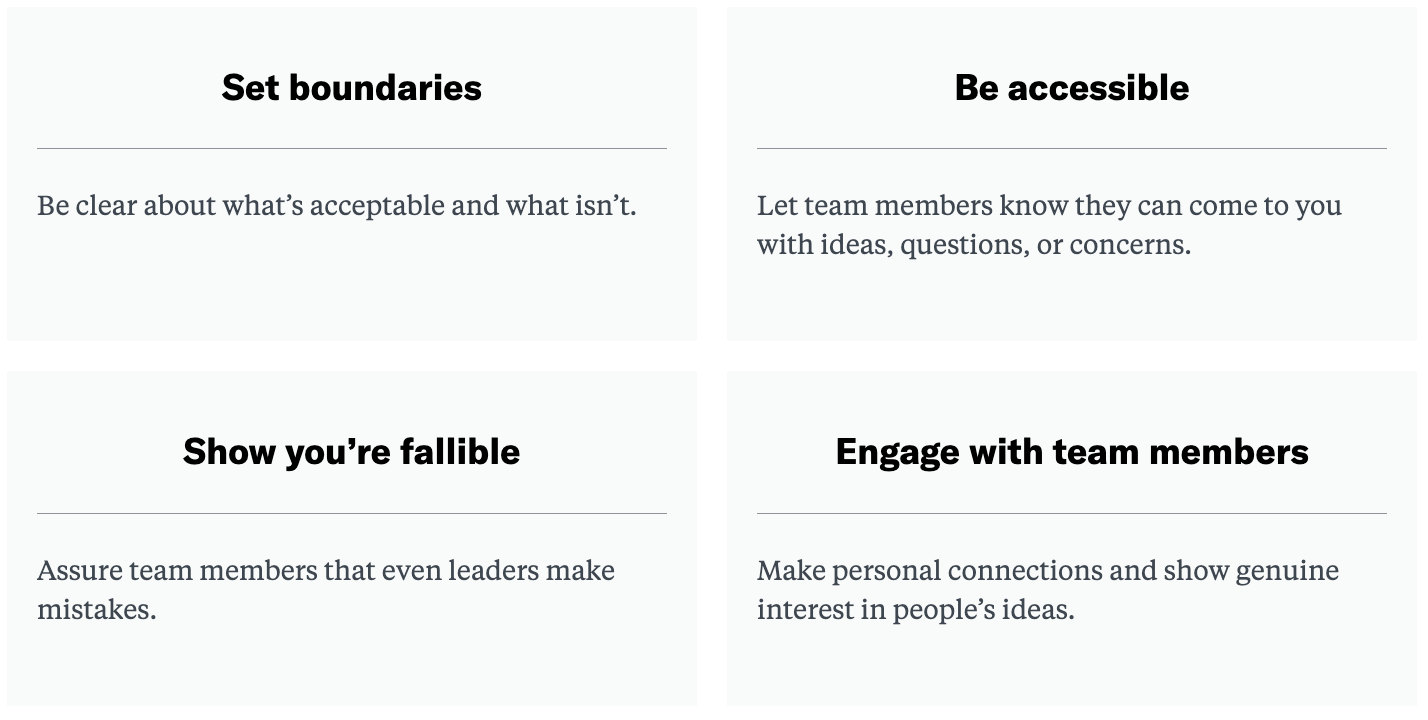
The first thing, paradoxically, that leaders have to do is set limits. It’s very hard for someone to feel psychologically safe if they don’t know where the boundaries are. They have to know and feel comfortable and confident that there are some behaviors that are off limits, that are out of bounds. It’s got to be clear what is and isn’t acceptable in this workplace for me then to feel comfortable to experiment and try new things within those boundaries.
The second is A: Be accessible, be approachable. Leaders have to do everything they can with their body language, with their curiosity, with their passion for the nature of the work to be approachable and accessible, so other people know they can come to them with ideas, with questions, with concerns, and yes, even with mistakes.
The third thing is fallibility—to model fallibility, to show fallibility, to let other people know that you know you’re a fallible human being. We all are. That means saying things like “I may miss something. I need to hear from you.” “Oh, I wasn’t on shift last night. What did you see?” “I’m not an expert in X. Tell me your thoughts.” These very simple but very powerful behaviors let other people know that you’re open, and create a culture of psychological safety.
Finally, E stands for engage. You’ve got to proactively engage people to create psychological safety. Use their names. Ask them questions. Let them know in countless ways that you’re here to hear from them, and we’re all interested in learning from their experiences and creating a learning organization together.
Edmondson recommends four actions you can take to boost team members’ confidence in taking risks:
第 3 节
According to a study at Google, the highest-performing teams share a sense of psychological safety—the belief that people won’t be punished for making mistakes.
According to a study at Google, the highest-performing teams share a sense of psychological safety—the belief that people won’t be punished for making mistakes. According to a study at Google, the highest-performing teams share a sense of psychological safety—the belief that people won’t be punished for making mistakes."High Performing Teams Need Psychological Safety. Here's How to Create It," by Laura Delizonna. Harvard Business Review, August 24, 2017
How do the most successful teams come up with ideas for improvements?
They spend time identifying performance gaps, such as wasted resources or bugs in products, and opportunity gaps, such as ideas for better meeting customers’ needs.
Use these four practices to spot—and fill—key gaps:
Ask probing questions
For a performance gap, this may mean soliciting employees’ observations or talking to customers. For an opportunity gap, it could involve tapping your networks to learn about trends or observing what competitors are doing.
Operate in “learning” mode
We tend to see what we want to—even in the most objective data. Seek out information that challenges your assumptions.
Design the future
Unleash excitement and energy by looking at what you want to create rather than what you need to fix.
Decide where to invest
Identify the most promising areas for improvement—the ones most likely to have impact—and let go of the rest.
Digging into declining sales
Digging into declining sales
Amina’s team notices a drop-off in sales compared with the same quarter the previous year. A small task force researches possible causes for the gap. The team finds that their main customer’s sales have plummeted. With this knowledge, Amina and her team approach the customer about ways they might partner to boost sales for both companies.
Digging into declining sales
Make a Connection
1. Identify a performance or opportunity gap in your area. How can your team start to address this gap?
第 4 节
You and your team have homed in on some promising ideas. How do you put them into action?
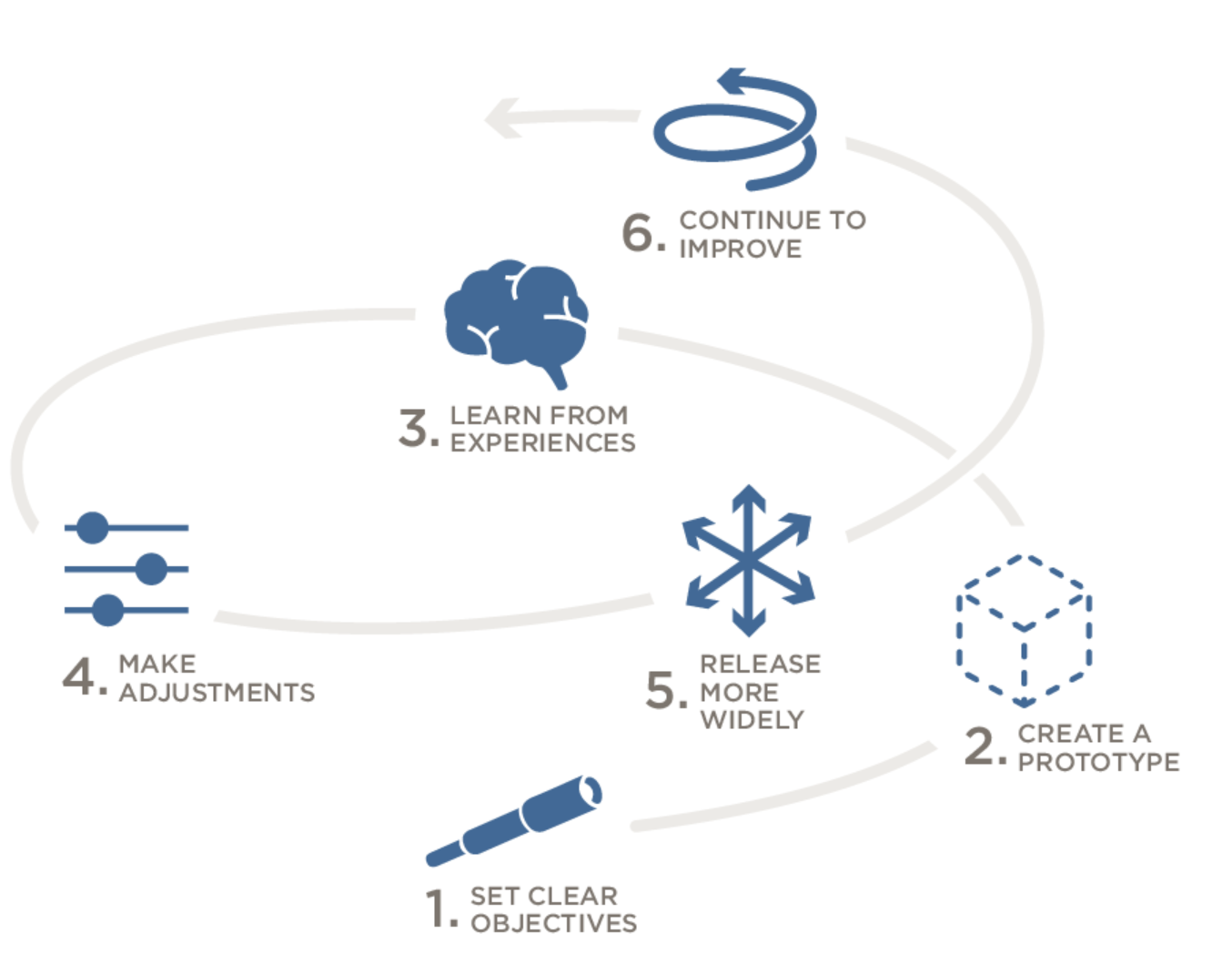
Before you fully commit to a certain direction, create a prototype of the new product or process.
What's a prototype?
A prototype is an early model of a concept or process. It can be as simple as a paper mock-up or as sophisticated as a fully functional proof-of-concept product, process, or service. Use prototypes to test new ideas with a relatively low investment of time and resources.
What's a prototype?
Set clear objectives
The focus at this point should be on learning, not perfection.
Create a model
Build or draft a prototype for customers to test. Keep it simple, and test one variable at a time.
Learn from experiences
To reveal any flaws in the design, ask customers to try to cause the prototype to fail.
Make adjustments
Tweak the prototype and continue to experiment.
Release more widely
Test the new practice or product on a larger scale.
Continue to improve
Adapt the practice or product as needed.
Too many customers at a time
Too many customers at a time
Michelle, the manager of a car dealership, has a problem: Customers are waiting for special sales before purchasing vehicles. During those periods, sales representatives and the finance team are buried in paperwork—leading to stress, delays, and unhappy customers.
Michelle and the team come up with an idea for easing the burden during busy periods: Give three free oil changes to customers who purchase their cars through a secure online portal. Two sales reps develop a prototype of the process. The team tests it and learns that purchasers respond to just one free oil change. They make the change and launch the process more widely.
Too many customers at a time
Make a Connection
1. Think about an idea your team has for an improvement. How could your team prototype and test this idea?
By continually looking for and experimenting with improvements, your team can make a big difference for your organization.
第 5 节
-
You and your team are powerful forces for change and improvement.
-
To unleash key insights, create a safe environment for employees to take risks.
-
Identify performance gaps, such as wasted resources or bugs, and opportunity gaps, such as ideas for better meeting customers’ needs.
-
Create prototypes to test new products or processes.
第 6 节
Reflecting on your learning helps you apply relevant concepts to your job.
Take a Moment
1. 1. What new insights do you have that could benefit you or others in your workplace?
2. 2. What are your biggest opportunities for applying concepts from this Lesson in your workplace?
Further reading
Top 3 in the source platform's original order