Coaching
Listen and Question Effectively 查看中文版
第 1 节
In a coaching conversation, once you’ve confirmed someone is ready to talk, your goal is to begin a dialogue in a nonjudgmental way—with curiosity and an open mind.
At different points in a conversation, good coaches:
- Encourage reflection
- Listen
- Inquire
- Offer input
Why? Because these practices help you:
- Keep the focus on the person you’re coaching
- Build rapport and trust
- Avoid giving too much direction or advice
You may assume you already know how to have productive conversations with team members. But research shows that many people tend not to really listen or seek out others’ ideas.
Don't make the same mistakes. Learn how you can begin a coaching conversation by encouraging reflection.
DID YOU KNOW?
DID YOU KNOW? Google has found that the most important trait in a manager is the ability to coach."Why Google’s Managers Are So Wildly Successful Comes Down to These 8 Behaviors," by Marcel Schwantes. Inc., July 27, 2017.
第 2 节
Reflection involves looking back to think deeply about something that happened. Insights, new points of view, implications of certain choices—all of these come to light and lead to improvements moving forward.
Encouraging reflection doesn't have to be hard. It can be as simple as asking "And what else?" or saying "Tell me more."
As you begin a coaching conversation, help your team member reflect on a recent project or situation by asking:
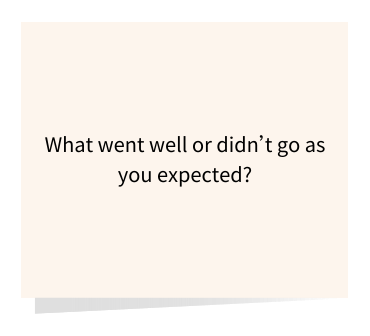


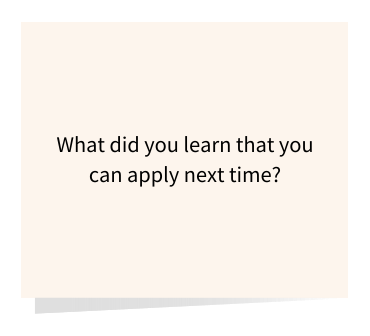
Reflection can move someone who is stuck in a narrow view of a situation to see a broader perspective.
Here, Shubha Shridharan, Head of Learning at Signify, talks about a time when her manager encouraged her to reflect—and how it changed everything.
如何在不打击员工的情况下实现辅导目标?New Perspective Through Reflection
哈佛教授讲授视频逐字稿
Not too long ago, I had this beautiful coaching moment that left a deep impact on me which I often use in my own coaching conversations when I'm speaking to others at work or otherwise. It was a situation when we were introducing our new social learning platform. A lot of work went behind it, the teams had worked really, really hard. And along with the launch, we also wanted to come up with a cool name to go along with the platform.
We did crowdsourcing, focus groups, even engaged an agency to come up with that one perfect name that would symbolize the promise of learning that we wanted to bring forward with this platform.
So here I am sitting in a meeting with the CEO, talking all excited about the launch and even more so about this new name that we had found for the platform. And I went on and on about how we had arrived to that.
So he listens to me patiently and with an unassuming smile he asked me to think, where do you want to invest your energy? Is it on popularizing this new name or the promise of learning that we want to bring in?
As these words rolled into my head, it almost felt like a speeding bullet train coming to an immediate halt. The message, how he delivered it to me, besides the content which was spot on, but the manner in which he gave this feedback and this message to me was, I thought, very impactful and impressive. Not for a minute did he undermine the efforts of the entire team that had been working so hard to get to where we were.
Nevertheless, he brought in a perspective that we had missed to see. I thought it was a fabulous coaching moment. It is finding that right moment where you can help them to think for themselves on the purpose, and yet keep it simple without deflating or diminishing the value that each one would bring for themselves. Then it's beautiful.
Take a Moment
1. For Shubha, how did reflecting on her goals support her success?
第 3 节
Too often, busy managers appear to be listening, but in reality, their thoughts are wandering.
Make a Connection
Make a Connection
Active listening is different. It involves using curiosity and empathy to understand what someone is really saying.
If you are comfortable doing so and if it's culturally appropiate, here are ways to show that you’re actively listening:
Make eye contact
Shows you're focused, interested, and not distracted
Nod
Demonstrates you're engaged
Limit automatic verbal sounds, like “uh-huh”
Allows the person time to fully complete their thought without feeling hurried
Check for clarification
Ensures you understand facts and details
Pause for silence
Allows the employee to suggest their own solution
The goal is to let the other person talk without interruption.
Sometimes the person you’re coaching just needs you to pay attention—to both their words and the emotions behind them. Peter Bregman talks about what it takes to be a good listener.
有效倾听的最佳方式 How to Be a Good Listener
哈佛教授讲授视频逐字稿
I run a consulting company, so problem solving is what I do. When someone describes a problem, I jump in. But what I've discovered is that while problem solving makes me feel good, it's not always what the other person needs. Sometimes, as my wife often reminds me, the person just needs me to listen.
As it turns out, that's at least as difficult as problem solving. Just listening means you have to allow things you might disagree with to hang in the air. But if you're interested in being connected to others, showing them respect, helping them feel better, and eventually solving problems together, then listening is more than worth it—it's essential.
So what's the best way to listen effectively—not only to the words, but also the unspoken emotions and concerns underneath the words? First, actually listen. Which means only listen, don't multitask. And, thinking about what you're going to say next counts as multitasking; simply focus on what the other person is saying.
Second, repeat back. This feels a little silly at first, but it works like magic. If someone says she's angry about the decision you just made, try repeating, “You're angry about the decision I just made.” This shows you're listening, and it communicates to the other person that she's been heard.
Third, ask questions. Explore the other person's thoughts and feelings more deeply. And the question, "You don't really believe that, do you?" is not a good question. You're not trying to prove your point, you're trying to better understand what's going on.
Remember that listening is not the same as agreeing. It doesn't force you to take any particular action. In fact, it may reduce the need for you to do anything other than listen. Because in many cases, all people want is to be heard. In other words, sometimes just listening is problem solving.
Make a Plan
1. List two or three behaviors you will practice this week to demonstrate you are a good listener.
第 4 节
Coaching is a dialogue, and asking questions is an important way to spark additional thinking.
DID YOU KNOW?
DID YOU KNOW? Patients with acute medical conditions who work with a health coach make better choices about treatment options than those who don't."Patients Make Better Choices with Coaches," by Jeff Belkora. Harvard Business Review, November 11, 2016.
Be open to possibilities
Don't unconsciously encourage a certain answer. Allow the person you're coaching to respond freely.
Ask neutral questions
Avoid hinting at your perspective. Ask, “What are some options for next steps?” instead of “What do you think about taking a training class?”
Pause to allow for a response
Don't immediately jump in with a comment or another question.
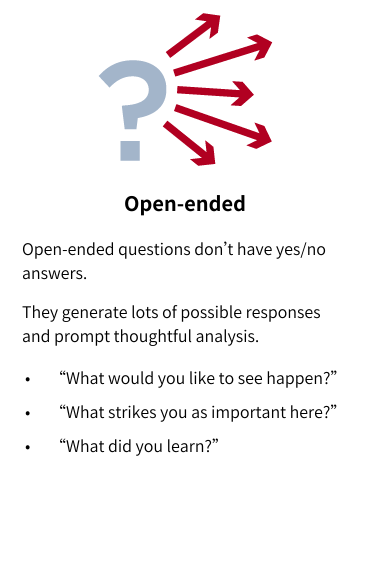
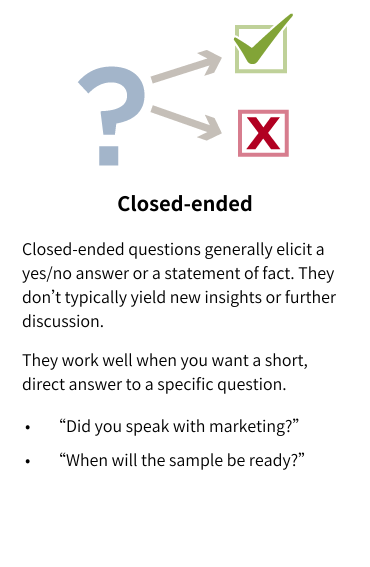
Three types of questions can help you deepen your understanding of a situation:
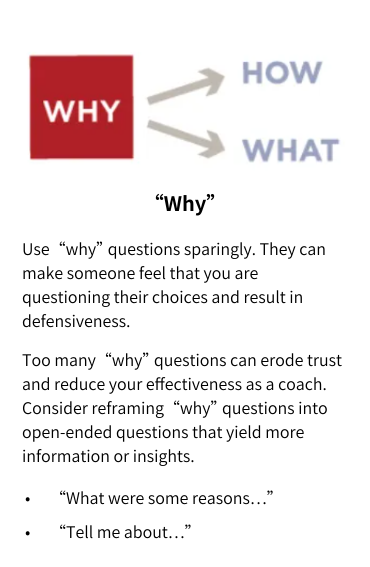
Try it Out
Reframe each of the following “why” questions to be more productive and engaging.
1. Why did you say that during the meeting?
2. Why did you make that decision?
3. Why did you communicate that to the team through email?
Here, digital engagement director Mason Weintraub discusses the power of open-ended questions.
开放式问题更利于解决问题 The Power of Open-Ended Questions
哈佛教授讲授视频逐字稿
One of the most powerful lessons I've learned is the power of asking open questions. Before I learned this skill, I would have check-ins with my staff, and I would hear them tell me their problems, and then I would jump in and try to solve the problems. And that felt like success to me.
And then I learned the power of asking open questions, which you can identify because if you're asking an open question, it can't be answered with a yes or no. I remember in one case with a junior staff member on my team, we were having our check-in and she was describing a problem that she was having--an interpersonal problem she was having with someone on another team. Things were getting confusing about who was responsible for what, and it was causing a lot of personal tension and it was definitely slowing down their productivity.
So, I just started asking open questions. I would ask, "What's the nature of the challenge, and how do you think you could go about solving this?" And she was immediately defensive and didn't necessarily see her role in fixing it. Eventually, she was able to figure out that if she walked over to this person's desk and sat down with them--maybe brought them a coffee and made it a more human, personable experience--and just ask that person open questions about what was going on for them, what challenges they were finding with this issue that they were having together, that they could come to some sort of solution.
I learned in our next check-in--I was very proud of her--that she had handled it well. She asked open questions of this other person. And she described it as also a transformative experience. In trying to get out of that conflict, she was able to really understand what was going on and where this person was coming from. So that was good.
The goal is always to help the person you’re coaching learn, grow, and gain insights.
Make a Connection
1. Think of a recent situation when you offered a team member a solution instead of helping them evaluate the situation. What questions could you have asked instead?
第 5 节
You can “listen” even when someone isn't talking. People also communicate valuable information through body language.
A savvy coach both listens to people's words and tracks their body language.
To tell if someone is feeling engaged and positive, ask yourself:
Taken together, these signals can help you gauge someone's level of receptivity or discomfort.
Make a Connection
Think of a recent conversation you had with a team member and answer these questions:
1. Did they demonstrate they were open?
2. Did they show they were engaged?
3. Did their body language seem aligned with yours?
第 6 节
DID YOU KNOW?
DID YOU KNOW? Effective coaching raises employees’ commitment and engagement, productivity, retention rates, and perception of upper-level leadership—as well as customer loyalty. "Finding the Balance Between Coaching and Managing," by Jack Zenger and Joseph Folkman. Harvard Business Review, June 4, 2014.
You’ve helped your team member reflect on the situation, you’ve listened, and you’ve asked questions to uncover deeper insights. Nice work … but when do you give your input?
90%. That's how much of the talking an employee should do in a coaching conversation.Coaching Skills for Nonprofit Managers and Leaders, by Judith Wilson and Michelle Gislason. Jossey-Bass, 2010.
Your observations and feedback have a valuable place in the coaching conversation, but you should always give them with the intent of helping the person learn and grow. Never force a solution on someone.
When you share your thoughts:
- Make sure your team member is receptive.
- Present your ideas and feedback in neutral terms.
- State your opinions as interpretations of what you observed.
- Stick to what is relevant in this session.
- Check in with the person. Ask, “Is what I’ve shared useful for you?”
Conducting meaningful coaching conversations may be hard at first. But as you cultivate the skills you learned in this lesson, you’ll find it easier to support people’s growth—and make them feel valued and supported.
第 8 节
Test your understanding and reinforce what you’ve learned.
第 9 节
Reflecting on your learning helps you apply relevant concepts to your job.
Take a Moment
1. 1. What new insights do you have that could benefit you or others in your workplace?
2. 2. What are your biggest opportunities for applying concepts from this Lesson in your workplace?
Further reading
走心倾听有多难研究表明,当员工感到自己的声音被倾听时,他们的投入度会提升,工作表现也会随之改善,从而为企业带来显著的收益。然而,对职场…
聪明提问的艺术作为美国芯片制造商英伟达的联合创始人和 CEO,黄仁勋所处的是一个敏捷、创新、高速运转的行业。
在回顾自己领导风格的变…
Top 3 in the source platform's original order
