Pocket Leadership口袋领导力

Career Management

Become an Agile Learner 查看中文版

第 1 节

According to GitHub, software engineers need to refresh their skills every 12–18 months. Professionals in other fields report similar demands.

According to GitHub, software engineers need to refresh their skills every 12–18 months. Professionals in other fields report similar demands. According to GitHub, software engineers need to refresh their skills every 12–18 months. Professionals in other fields report similar demands.Careers and Learning: Real Time, All the Time,"by Bernard Van der Vyver and Bill Pelster. Deloitte, February 28, 2017.

What’s the most important skill you need to succeed in today’s work world? It’s not technical proficiency or leadership competency—it’s the ability to learn.

In today’s ever-evolving workplaces, continuous learning is a must for remaining competitive and providing ongoing value.

Why?

“The half-life of skills is getting shorter.”

Without a concerted effort to continually refresh and renew your skills, you run the risk of falling behind.

But it’s one thing to talk about the importance of learning and another to actually do it.

As children, we spend much of our time in school learning how to learn. As adults, we often get out of the habit.

Poll

Poll

Think about playing a sport or mastering an instrument. Practice, repetition, reflection, and feedback are all key to success. The same is true of learning new job skills.

You don’t need to wait for guidance from your manager to build new skills. But you do need to be sure you’re focusing your learning in the right areas:

  • Consider what’s valuable to your organization

  • Research the skills companies in your industry are looking for

  • Set up opportunities to develop skills where you have gaps

  • Enlist people to provide you with feedback as you try out new skills

Make a Plan

1. What can you do today to find out what skills are valuable to your organization or in your industry?

第 2 节

In the US Navy, instead of specializing in certain functions, sailors are increasingly expected to be generalists who can perform a number of different roles on a ship.

In the US Navy, instead of specializing in certain functions, sailors are increasingly expected to be generalists who can perform a number of different roles on a ship. In the US Navy, instead of specializing in certain functions, sailors are increasingly expected to be generalists who can perform a number of different roles on a ship."At Work Expertise is Falling Out of Favor," by Jerry Useem. The Atlontic, July 2019

Certain barriers can stand in the way of learning—some of which are in our own minds.

Studies show that unless you believe you can grow and develop new skills, all the practice in the world won’t make much of a difference.

Make a Connection

1. Talent and intelligence are static.

Take a Moment

1. Did you mostly agree or disagree with the statements above?
答案与解析

A. I mostly agreed
Your mindset may hinder learning.

B. I mostly disagreed(正确)
You’re likely already an agile learner.

C. My responses were mixed
It’s common to have a mixture of both mindsets.

If you mostly agreed with the statements above, you may have a fixed mindset—a mindset that puts the brakes on learning. There’s good news: You can take actions to adopt a growth mindset—a mindset that is open to new ways of thinking and accelerates learning.

Four steps to adopt a growth mindset:

1. Recognize when you’re avoiding a challenge When you’re afraid you might embarrass yourself or fail, you’re stuck in a fixed mindset. 2. Realize you have a choice You can retreat, or you can reframe the challenge as an opportunity to learn. 3. Have an inner dialogue Use language that reflects a growth mindset—for example, instead of saying, “I’m not interested in learning how to use data analytics because I’ve never been good at math,” say, “Learning about data analytics will help me improve my market forecasting skills, and I can ask my coworkers to help me if I have questions.” 4. Deliberately switch to a growth mindset Take on the challenge, seek feedback, and learn from setbacks.

Make a Plan

1. What two to three actions can you take to grow your mindset?

第 3 节

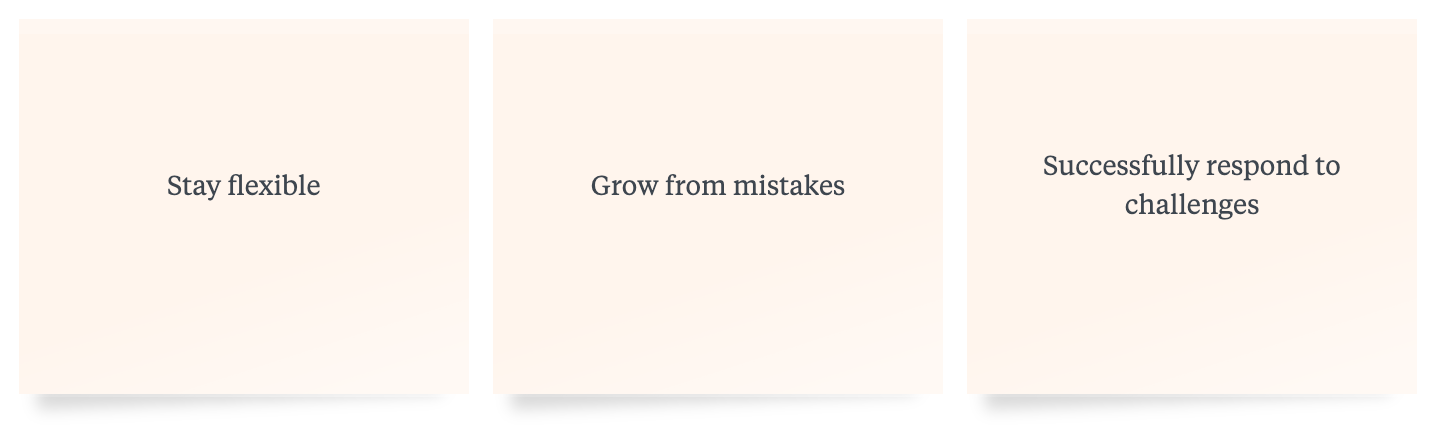
With the fast pace of change, figuring out what to do in unfamiliar situations is crucial. It’s the hallmark of what’s known as learning agility. You’re an agile learner when you can:
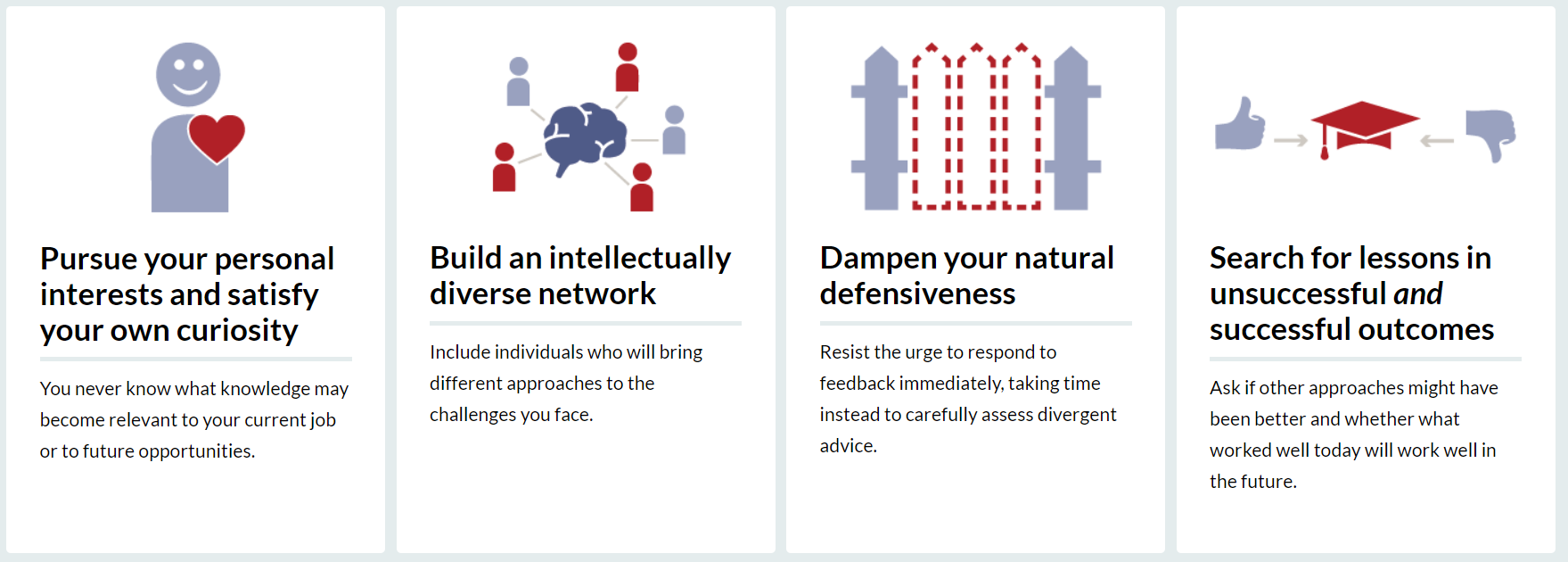
Certain practices can help you improve your learning agility:
Consultant and author Erika Anderson introduces four "mental skills" that great learners practice.

优秀学习者的四种心智模式 Learning to Learn

哈佛教授讲授视频逐字稿
Today in our career, we have to be able to learn new things very quickly and very easily in order to be able to keep up with that rate of change--not only within our existing job but to go from job to job in the way we want to--to have a successful career. Over the years, we've found that people who are great at learning in this way, they use four mental skills. And we call them ANEW: aspiration, neutral self-awareness, endless curiosity, and willingness to be bad first. Aspiration is basically just having the ability to make yourself want to learn things. When we're tasked with learning new stuff, often we focus on how it's going to be hard or time-consuming. If instead you focus on "How is this going to be helpful or beneficial to me?" then often your aspiration will start to rise. The second thing is neutral self-awareness--to get very clear about where you are starting from when you're presented with a learning challenge. Often we're not very accurate about ourselves. We think we're great at things we're bad at and we think we're bad at things we're great at. And then endless curiosity. I love this one because we're all born with it. All children are relentlessly curious--they just have this will to explore and understand. And you can see it in the questions they ask and the way they drop things on the floor to see if they'll bounce. Now, unfortunately, by the time we get to be adults, most of us have that curiosity pretty well socialized out of us. And we're worried that we'll look childish if we ask those kinds of exploratory questions. People who are great learners, they've learned how to re-engage that childhood curiosity. And finally--and this is the most difficult for most adults--great learners are willing to be bad first. They're willing to be novices at the beginning of learning something. They're willing to be bad at it, to go slowly, to make mistakes, to ask questions. And that's essential. Now the underlying skill for all four of these skills is to be able to manage your inner narrative. People who are great learners, they talk to themselves differently than other people, and especially when it comes to willingness to be bad first. People who are great learners focus their internal monologue in two places. They say to themselves, "I'm going to be bad at this because I've never done it before." And "I bet I can get good at it. I'm going to be bad, and then I can get good." Now, if this makes sense to you and you practice these four skills pretty consistently, they are your best and most powerful tool for really being able to thrive through those challenges that will come throughout your career. In a new job, in new responsibilities, to be able to be this kind of a learner and having these four mental ANEW skills will really give you something in your pocket, a toolkit in your pocket, that you can use every day.

Take a Moment

Take a Moment

Build learning opportunities into your daily job activities. For instance, ask your manager for more challenging assignments or pursue formal development opportunities.

Pranticing Learning Agility

附件:practicing_learning_agility1696839853739.pdf(pdf · 54 KB,本地副本)

Worksheet for Building Learning Opportunities

附件:worksheet_for_building_learning_opportunities1696839894589.docx(docx · 1108 KB,本地副本)

第 4 节

Having a growth mindset and being an agile learner are important ways to maintain your value in the workplace. But what do you do when you’re not learning and growing in your current position?

Before you look elsewhere, consider ways to stretch your skills in your job.

Management consultant Rob Markey shares the questions he asked himself at a crucial moment in his professional life.

只有面对选择,你才知道自己真正重视什么 Career Crossroads

哈佛教授讲授视频逐字稿
I've been working at Bain and Company for over 20 years now. And when I first took the job as a consultant right out of Harvard Business School, I really believed that I would only be there for 12, 18, 24 months. And in fact, at many points along the way, I was pretty convinced that I would leave within 24 or 36 months and go take a job as a general manager, as a, you know, business leader in some business unit of a big company, or maybe running a smaller company. And it was actually an important part of my self-image; it was an important part of my motivation. But a few years ago, I had this moment where I realized that this wasn't just a job that I was doing, and it was actually going to be my career. And that moment was prompted by one of my clients offering me the opportunity to run the kind of business I'd always aspired to. It was what I had dreamed of and always thought of as part of my self-image—kind of opportunity [that] doesn't come along very often. And as I contemplated it, as I thought about it, I realized that it wasn't going to be right for me. And the reason was because, as I thought about it, I realized there was this framework that I was using. And, for me, it was really useful for grounding me. First I asked myself, in that other job, Could I add more value, could I create more value in the world than I create today? Second, Would I learn more every day so that I could add more value next year? And third, Do I like and trust the people there as much as I like and trust the people I'm working with now? And what I concluded was, that for me, there really was no place I could be where I'd get the more distilled and clear version of what I was looking for; these three things—the ability to add value, the ability to learn and grow, the, you know, place where I like and trust the people that I'm working with and enjoy the job every day. So, you know, sometimes it takes that moment, where you get tested, to make you really think about what your framework is. And that really, really clear evaluation that helps you figure out, What do I want to be when I grow up?

Take a Moment

1. Think back to the questions Rob asks in the video. In your current role, do you have the opportunity to add value? Are you growing and learning?

Another way to increase your on-the-job learning opportunities is through job crafting.

In job crafting, you alter your job to better achieve a personal or professional objective. For instance, people use job crafting to adjust their work/life balance, to minimize boredom, or to improve their overall job satisfaction.

Poll

Poll

Here are two ways to use job crafting for learning:

  • Task crafting. Change the bundle of tasks you work on or the amount of time you spend on different tasks, so you can devote more time to those with higher learning payoffs.

  • Relationship crafting. Change the patterns of your interpersonal interactions so you can work with people with diverse viewpoints or skills you want to learn.

As part of your quest to build new skills and adaptability, you could also speak with your manager about the idea of job rotation. When you rotate jobs, you take on new tasks in a different role for a period of time before returning to your original position.

If you still don’t feel challenged by your job, you may be tempted to start looking outside your current organization. But before you do, consider other opportunities within your current organization.

Poll

Poll

Video producer and esports pioneer Ariel Horn shares how he took the initiative to propose a new job that ultimately helped grow his company.

创造新的事业方向 Propose Your Own Job

哈佛教授讲授视频逐字稿
There are so many jobs that exist now that never existed before. And that was certainly the case with me at Riot Games. When I first approached Riot, I had a vision for applying storytelling mechanisms of the Olympics and traditional sports and applying it to something totally different—video games. So to convince them that I could do this, I had to have a sharp articulation of what that future state would be like, that there would be all these video games, and there would be this generational move where gamers are celebrities. And we would create the league structure and all of this broadcast globally and competitions that would enable us to take "League of Legends" and turn it into a sport. So for me, I was explaining a role and a future state that didn't currently exist. So it took some ingenuity on my part and a bold belief that this is where we were going to be able to take it. That articulation was incredibly important, because they had to trust me that I could go out and not only produce, broadcast, and set up these big events, but that I could carefully articulate the stories of these athletes, and create trust with gamers around the world. So if you see a gap or a white space, be proactive. Tell people about your vision. Really fight for what you believe, because you may actually end up creating a job that doesn't exist already.

If your job duties don’t align with your career goals, your ideal role might just be waiting for you to create it!

第 5 节

  • The most important job skill today is the ability to learn.

  • A growth mindset is the belief you can grow and develop new skills.

  • Figuring out what to do in unfamiliar situations is the hallmark of learning agility.

  • If you’re not growing in your current position, before looking elsewhere, consider job crafting and other ways to stretch your skills.

第 6 节

Reflecting on your learning helps you apply relevant concepts to your job.

Take a Moment

1. 1. What new insights do you have that could benefit you or others in your workplace?
2. 2. What are your biggest opportunities for applying concepts from this Lesson in your workplace?

Further reading

传奇歌手迪翁·沃里克:做自己,享受过程
传奇唱片艺术家迪翁·沃里克谈从伴唱歌手到独唱明星的经历、与音乐界传奇人物合作、应对种族歧视及其他职业障碍、投身艾滋病防治…
研究:随着职业生涯变得更长,职业中期的工作方式也需要随之改变
随着职业生涯延长到 70 多岁甚至更久,许多组织发现,他们最有经验的职业中期员工,恰好在步入最关键的领导岗位阶段时,却出…
在每个人都不堪重负时,支持员工的职业发展
随着经济压力、地缘政治不稳定以及 AI 驱动的颠覆不断加剧,许多员工在繁重的工作负担下,很难把职业发展放在优先位置。领导…

Top 3 in the source platform's original order