Pocket Leadership口袋领导力

Digital Intelligence

Develop Your Digital Mindset 查看中文版

第 1 节

Technology is continually evolving and reshaping how we work. Many of the tools you use today to collaborate with team members, track projects, gather customer feedback, and perform other work-related tasks are likely different from the ones you used just a couple of years ago.

But to succeed in this era of digital transformation, you and your team need to do more than gain proficiency in the latest programs and gadgets. You need to develop a digital mindset—that is, the ability to see and make the most of the opportunities that digital change offers.

With a digital mindset, you see technology as a means for innovating,solving problems,and creating efficiencies.

Without one, you may end up integrating new digital tools into your workflow without a sense for how they could lead to innovations in your process and offerings.

See how Mark Bonchek, entrepreneur and executive consultant, suggests rethinking your business strategies using a digital mindset.

用数字思维思考 Change How You Think

哈佛教授讲授视频逐字稿
So, Shift Thinking came to me when I was an executive in a company. And we were trying to change things to become more digital. And we were doing the right things when it came to being digital. We were on social media, and we were moving our products online and doing the right things. But it wasn't getting the right results. And then, when I realized that it wasn't enough to just do those things, you had to think about things differently-- that digital wasn't just something to do, it was a way to think and that we had to change our underlying mental models. Now, what's a mental model? Well, a mental model is how we think about how the world works. What's cause? What's effect? What are the relationships between things? You have to first identify what mental model you have, and that's really tricky because our mental models are mostly unconscious. So, you kind of have to catch yourself in what that mental model is. And in that case with digital, the mental model was we were still thinking about digital as a channel to push things out or social as a channel for reaching an audience. But social is much more than just a channel. It's actually a way of people connecting with each other. What happens between customers is as much and as important as what we said to them. So, we had to change how we think, and then we were able to change what we do.

How do you know if you—or others on your team—have a digital mindset? Look for three main traits:

  • An excitement to continuously learn, not just digital skills but also about your business, customers, and industry
  • A desire to make decisions and adopt technology based on data about customer needs, not on wanting to appear tech savvy or use an exciting new technology
  • A habit of staying knowledgeable about emerging technologies, and using this awareness to inform and improve your decisions

Let's explore how to instill these behaviors in your day-to-day work practices.

第 2 节

When you have a digital mindset, you’re always open to new ways of working, solving problems, and thinking about your team and organization. Yet this kind of learning can be tricky in practice. Humans find comfort in tried-and-tested routines, and it takes effort to adopt new habits. 

To tackle the hurdles that keep you from regularly updating your skills and outlook, use this three-step process:
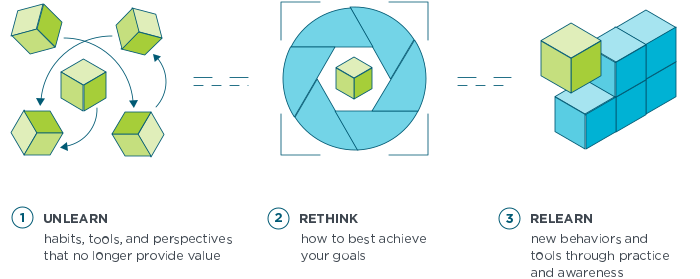
  • Unlearn: Identify and consciously let go of behaviors or perspectives that provided value in the past but are no longer the best approaches.
  • Rethink: Research new practices or ideas that allow you to better achieve your goals moving forward.
  • Relearn: Ingrain new mental habits and practices.

Take a Moment

Take a Moment

After you identify behaviors, skills, or mindsets that slow you down, use these tips to unlearn outdated thoughts and behaviors and adopt new ones.

空杯纳新知 Make Learning Stick

哈佛教授讲授视频逐字稿
In a time of transformation, some of the things that we used to believe are no longer relevant. They've become obsolete. And that means that we actually have to unlearn. We have to unlearn the things that we knew before and put new ones in place. But, we're not very good at unlearning. We're not very good at letting go of the things we already know. And, you may have had an experience of unlearning. For example, maybe you played tennis or golf, and you had to learn a new swing. Or maybe you were learning an instrument and you had to get good at using your opposite hand. And so, you'd practice brushing your teeth with your left hand instead of your right hand, or something like that. You're unlearning a mental habit, and, as a result, the process is the kind of thing where you're going to slip back into the old habit. It's just the nature of things. You keep catching yourself and going back to the old habit, and then you apply yourself and do the new habit. Well, it's the same thing here. It just takes on a different meaning in the complexity of the work environment.

The second step, rethink, involves exploring approaches that bring more value than your current ones. This process might take the form of quiet brainstorming, a discussion with coworkers on your team or in other parts of your organization, or more extensive research.

Once you've homed in on a behavior or perspective you want to adopt, it’s time to take the final step: relearn. This means integrating your new approach into your routine. It’ll take time for it to feel natural. If you find yourself reverting to what’s comfortable, simply take note of the lapse and intentionally shift back to the new practice.

Let's see the unlearn-rethink-relearn process in action.

Unlearn “My department is trying out new task management software and is asking my team to embrace it. But I absolutely love the task tracking program I’ve been using for the last year.” Rethink “If everyone on the team is using the same new system, it will allow us to collaborate more easily, because we can see what everyone’s working on.” Relearn “I'll keep an open mind as I adopt the new software, and I’ll set aside time this week to explore the unique features it offers.”

Make a Plan

1. Pick a practice or perspective that’s no longer as useful as it once was. What’s one action you can take to begin to change it?

第 3 节

Technology opens doors to new ways of doing business, but you have to make sure you're opening the right doors. Focus first on the needs of your customer, team, or organization—not on which exciting new tool you want to use.

Read these two cases and try to spot who best demonstrates this aspect of a digital mindset.

Denis's team is losing its customer base

Denis's team is losing its customer base Denis and their team are facing a challenge: Sales have dropped dramatically over the past year. Denis knows the importance of understanding the reasons for this shift, so they lead their team in analyzing customer purchasing behavior and in holding focus groups to get deeper insights into customer needs. The team uses the collected data to guide the development of new software feature. Denis's team is losing its customer base

Jessica's team is updating its systems

Jessica's team is updating its systems Jessica's team is revamping the operation of its automated customer service system. Jessica is an expert in front-end programming. She's been studying how to develop programs that simulate human conversation in her free time. Jessica decides this project provides an opportunity to apply what she's been learning outside of work and begins integrating a conversational bot into the customer service system. Jessica's team is updating its systems

Try it Out

1. Who better embodies a digital mindset, Denis or Jessica?
答案与解析

Denis(正确)
Leaders like Denis focus first on understanding the business and the possibilities for improving their team’s performance. They look for ways to simplify operations, help customers have the experiences they want, and build collaborative relationships using technology.

Jessica
Jessica—and leaders like her—know a lot about cutting-edge technology. But expertise in a specific program or platform isn’t the same as understanding the business and how to apply technology to achieve its goals. Jessica needs to remember to put the customer, not the technology, first.

Does this mean that new technologies can't spark creative ideas for your team? Quite the opposite! You just need to make sure any ideas serve your customer and not a desire to showcase a new digital tool or process.

Discover how a team at Oral-B, a brand of oral hygiene products, managed this challenge.

A new kind of toothbrush

A new kind of toothbrush In 2016, a team at Oral-B set out to design a new electric toothbrush. Team members saw an opportunity to feature new technology in the product, so their plan included adding sensors to track gum sensitivity, brushing effectiveness, and other behaviors. They even proposed including a music player. Before the plan was finalized, another group provided the team with the results from consumer research. Customers identified convenience and a few specific improvements to the existing model as priorities. In response, instead of music and high-tech sensors, the product team added features like USB charging and a simplified process for replacing brush heads. In the end, the redesigned product was a hit with customers—it boosted sales and earned customer loyalty. A new kind of toothbrush

Take a Moment

1. Have you ever used a product with advanced technology that didn’t meet your needs? How could it have been designed to be more consumer oriented?

第 4 节

So, you're adept at learning new behaviors, and you make decisions based on data about customer and organizational needs. To truly have a digital mindset, though, you need to adopt one final practice: staying up to date on tech trends.

When you're aware of emerging digital tools and see the world through a digital lens, you can make decisions and create new solutions that are informed by the latest technology. Don't worry—you don't suddenly need to become an expert on every app or program. You simply have to have an awareness of what tech is out there and how it might play a role in your business.

As a general guideline, Harvard Business School professor Tsedal Neeley recommends that leaders aim for about 30% competency in technologies relevant to their business. This means having a basic understanding of what the technology is, why it's noteworthy, and what implications it might have for your team. It doesn't necessarily mean having the skills to implement the tools or use them in your day-to-day work.A Digital Mindset, by Tsedal Neeley and Paul Leonardi. HBR Press, forthcoming.

Make a Connection

Make a Connection

Try it Out

Next, choose one of these emerging technologies that you’re familiar with and answer the following questions to cement your understanding of it.
1. 1. What technology did you choose?
2. 2. How would you describe this technology?
3. 3. Why is this technology noteworthy right now?
4. 4. What's one way this technology could impact your work or home life?

Develop Your Digital Mindset_Tips 01

〔图表类内容,图片原件见线上原文〕

As you become more aware of new digital tools, you'll see more and more potential applications. The next time you start a project, consider how you might apply technology to better address the problem you're looking to solve.

第 6 节

Reflecting on your learning helps you apply relevant concepts to your job.

Take a Moment

1. 1. What new insights do you have that could benefit you or others in your workplace?
2. 2. What are your biggest opportunities for applying concepts from this Lesson in your workplace?

Further reading

数字产品新思路:搭建长期团队
2011 年,《纽约时报》面临广告销售和发行量双双下滑的困境,迫切需要寻找新的收入来源。同年 3 月,它逆势而行,决定设…
通用 or 专业,你的企业该如何选择 AI 模型?
在面向专业场景的问题解决类应用中,选对生成式 AI 的架构至关重要。通用型模型凭借多功能性与跨领域信息整合能力,在企业级…
AI 是解决这个问题的合适工具吗?
AI 虽然具备解决重大难题的潜力,但企业在推动相关项目时往往会面临诸多障碍。这些难题包括:高质量数据的缺乏、可选方案数量…

Top 3 in the source platform's original order