
Monitor and Support the Work 查看中文版
第 1 节
Once you've delegated something to an employee, you want to make sure they succeed. Regularly monitoring their progress will help.
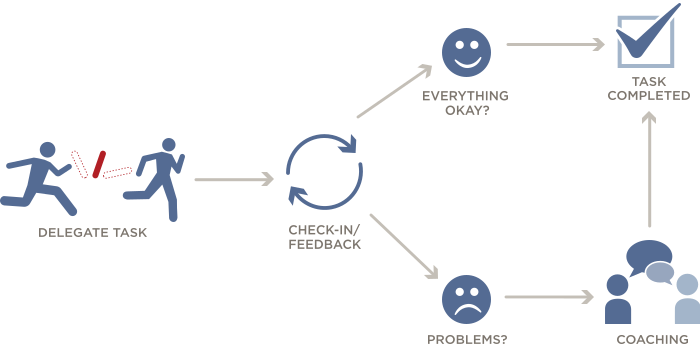
When you say, "I want this done by next Friday. And I'd like to meet with you on Wednesday afternoon to see how things are going," you're monitoring. Monitoring provides you with opportunities to coach the person and provide feedback—two important managerial responsibilities.
Depending on the number and complexity of the assignments you've delegated, you can use one or more of the following techniques for monitoring:
-
Work updates to a project wiki
-
Quick, standing meetings to deliver updates and handle questions
-
Progress updates during regular staff meetings
-
Weekly status reports on the delegated assignment
-
Project management and tracking software
In monitoring, be alert to early signs of trouble—such as missed deadlines or serious mistakes in the work. If your subordinate hits a seemingly insurmountable barrier or starts falling behind, you may have to intervene.
Delegated Tasks Tracking Form
Make a Connection
第 2 节
Once you've delegated an assignment, continue providing needed support—but without micromanaging the person. To strike the right balance:
-
Review resource needs and ensure that resources are available.
-
Continue supplying needed information, such as reference materials or reports.
-
Make clear when you want to get involved; for example, when it looks like a commitment won't be met or when a major problem arises.
-
After work begins, intercede with advice or directions only if the person asks.
-
Point out any difficulties you anticipate based on your experience with similar projects, and offer ideas for handling them.
Remember: Your employee's completion of the task is more important than your idea of how it "should" be completed.
Be a "resource connector"
Effective delegation is a balancing act between giving employees autonomy and ensuring they are supported. In this activity, choose the best way to achieve that balance.
Try it Out
答案与解析
A.A few days after delegating the task to Simon, Thea should set up a series of meetings with him to ensure that he is on track.
Not the best choice. While Thea should be ready to offer advice or direction, interceding without any prompting from Simon will not develop his skills and may make Simon feel that Thea doesn’t fully trust his ability to handle the task. Thea needs to avoid micromanaging Simon.
B.Thea should tell Simon that she completely trusts his ability to tackle the assignment and doesn’t want to be involved unless a major problem arises.
Not the best choice. While trust is a vital part of delegation, employees also need to know they are being supported throughout the task. Thea should not only encourage Simon to inform her if a problem arises, she should also emphasize that she is always available as a resource for him.
C.Thea should make sure that Simon is connected to the people who can help him choose and obtain the right presentation technology.(正确)
Correct choice! Managers should ensure that employees have access to the appropriate people, tools, information, space, and equipment to complete their delegated tasks. Thea should think of herself as a connector who can help link Simon with the resources he needs.
答案与解析
A.Thea should tell Simon to set up training for the remote attendees who have not used the new system.
Not the best choice. Thea should resist the temptation to solve the problem Simon has brought to her. Instead, she should take the opportunity to build Simon’s trust and self-confidence by giving him support he can use to solve the problem himself.
B.Thea should offer Simon a few possible ways that he might resolve the problem and some pointers to get started, but should assure him that she believes he can handle the problem.(正确)
Correct choice! Though she could easily solve the problem that Simon has encountered, Thea should resist the temptation to do so. Instead, she should take the opportunity to build Simon’s trust and confidence by confirming her belief in Simon’s ability to handle the task.
C.Thea should avoid offering any suggestions and assure Simon that she’s confident he can handle the problem.
Not the best choice. While Thea’s response shows how much confidence she has in Simon, it is also her role to make him feel supported. By helping him assess the situation so that he clearly understands the problem and can explore possible solutions, Thea can provide Simon the help he has asked for while still allowing him to solve the problem himself.
答案与解析
A.Thea should treat Simon’s mistake as a growth opportunity, acknowledge his overall excellent performance, and offer him tips for handling similar tasks in the future.(正确)
Correct choice! With some advice from Thea, Simon should be able to handle similar situations in the future. Thea’s supportive response displays trust and builds Simon’s self-confidence. Only in rare cases—i.e., if the problem is major—will Thea want to take back a delegated assignment.
B.Thea should temporarily take the assignment back from Simon and have him work on honing his planning and logistics skills for the next conference.
Not the best choice. Only in rare cases should a delegated task be taken back. Since Simon’s mistake wasn’t major and there are possible solutions, taking the task from him would prevent him from growing and building confidence. Also, if Simon knows he will be penalized for missteps, he will likely bring all problems to Thea rather than trying to solve them himself.
C.Thea should demonstrate her confidence in Simon and avoid providing any support or advice to him.
Not the best choice. Simon needs support in dealing with this misstep. By treating the mistake as a growth opportunity and discussing ways to prevent similar slips, Thea can build Simon’s skills and self-confidence. To promote trust, Thea should reassure Simon that it is safe to make some mistakes while carrying out delegated assignments.
第 3 节
"Reverse delegation" is when someone you've delegated an assignment to wants to return the job to you or expects you to solve problems that come up.
When you see signs of reverse delegation, resist any temptation to take back the delegated assignment or solve the problems your employee brings to you. Instead, take the opportunity to build trust and confidence in your employee:
-
Provide positive reinforcement for the work done so far.
-
Help them assess the situation.
-
Confirm your confidence in the employee's ability to make decisions.
-
Encourage them to come up with a solution.
-
Provide coaching as needed to help them strengthen their new skills.
Develop employees' initiative
To discourage reverse delegation, develop your employees' initiative. You can do so by reminding them of the decision-making authority you've granted.
案例
Try these additional ideas for developing direct reports' initiative:
-
Examine your own motives. Some managers secretly worry that if they encourage their direct reports to take more initiative, they'll appear weak, vulnerable, and not useful. To combat these worries, cultivate an inward sense of security and confidence. You'll free yourself to let go of direct control and support employees' growth.
-
Make appointments to deal with problems. Avoid discussing any problem on an ad hoc basis—for example, when you pass a subordinate in the hallway. You won't convey the proper seriousness. Instead, schedule an appointment to discuss the issue.
-
Agree on a status update. After deciding how to proceed on a problem, agree on a time and place when the employee will give you a progress report.
-
Build employees' skills. Sometimes employees try to reverse a delegated assignment if they lack the skills for handling the work. So use coaching or training to help them develop needed skills. It's initially more time-consuming than tackling problems yourself. But it saves time in the long run.
-
Foster trust. If your employees are afraid of failing, they'll keep bringing their problems to you rather than trying to solve them on their own. To promote trust, reassure them that it's safe to make mistakes.
Creating a Win-Win
哈佛教授讲授视频逐字稿
When to reclaim an assignment

Only in rare cases will you want to take back a delegated assignment. Do so only if you see major problems; for example:
-
Critical deadlines will be missed if you don't take the assignment back
-
Failure to meet agreed-upon goals will jeopardize other important projects
-
Serious mistakes could cause the organization to lose a highly profitable customer or render a product or service unsafe
第 4 节
In most cases, your employees will be able to work through difficulties with delegated work if you provide a little help. To illustrate, you can:
- Complete parts of the assignment to lighten the load.
案例
- Offer additional resources.
案例
- Treat mistakes as growth opportunities.
案例
第 5 节
After an employee completes a delegated assignment, sit down and talk about what went well and what didn't go so well. Identify lessons learned that you and your employee can apply to subsequent assignments.
When you meet with an employee after an assignment is completed:
-
Ask the employee how this delegation worked for them
-
Express appreciation for their achievements
-
Ensure they get recognition for their work from your peers, your manager, and other key stakeholders for the assignment, such as a customer or supplier
-
Compare the actual outcomes of the assignment with the expected outcomes
-
If any problems arose during the assignment, avoid criticizing and blaming the person for them; instead, explore ideas for handling the work better next time
我可以帮你分担工作吗?What Can I Take Off Your Desk?
哈佛教授讲授视频逐字稿
Take Action
第 6 节
Test your understanding and reinforce what you’ve learned.
Try it Out
答案与解析
Intercede with advice on a monthly basis.(正确)
Once work begins, you should give advice and direction only if asked for it.
Review project resource needs and their availability.
It is good to review project resource needs and to make sure that the required resources are available to Bella.
Point out difficulties you anticipate based on your own work experience.
It is good to point out any difficulties you anticipate based on your own experiences with similar projects.
Make a list of situations Bella should bring to your attention.
It is good to clarify the situations you expect to be involved in; for example, the possibility of a missed deadline.
Try it Out
答案与解析
“If you can’t solve it by tomorrow, I’ll give you my take on it.”
Solving your employee’s problem encourages reverse delegation. Instead, encourage Emeril to come up with a solution of his own.
“You’ve done a great job so far. Tell me what you think you should do.”(正确)
When you see signs of reverse delegation, resist any temptation to take back the delegated assignment or solve the problems your employee brings to you. Instead, take the opportunity to build your employee’s trust and confidence.
“Let me give you my assessment of the problem.”
Solving your employee’s problem encourages reverse delegation.
“I’ll get you some more training as soon as I solve this.”
Solving your employee’s problem encourages reverse delegation.
第 7 节
Reflecting on your learning helps you apply relevant concepts to your job.