
Apply Ethics Across Borders 查看中文版
第 1 节
Ethics get even more complex when companies do business across borders. What's perfectly acceptable in one country can, for cultural reasons, be considered unethical in another.
For example:
-
In some countries, it's respectful for businesspeople to exchange gifts. In the other countries, lavish gift giving is viewed as bribery.
-
Very low wages may be considered unethical in wealthy developed countries. But developing nations may accept those wages if they encourage investment and improve living standards.
-
Managers in some countries may have a higher tolerance for bribery than those in other parts of the world. But they consider taking credit for a subordinate's achievement a nearly unforgivable sin.
Such differences—in history, cultural traditions, and level of development—can make it difficult for managers to know how to behave.
Poll
Make a Connection
第 2 节
Managers doing business internationally often take one of two routes when faced with ethical dilemmas:
-
Either they stick rigidly to what's done at home (i.e., "ethical imperialism")
-
Or they embrace the foreign country's norms (i.e., "cultural relativism")
Balancing Two Ethical Strategies
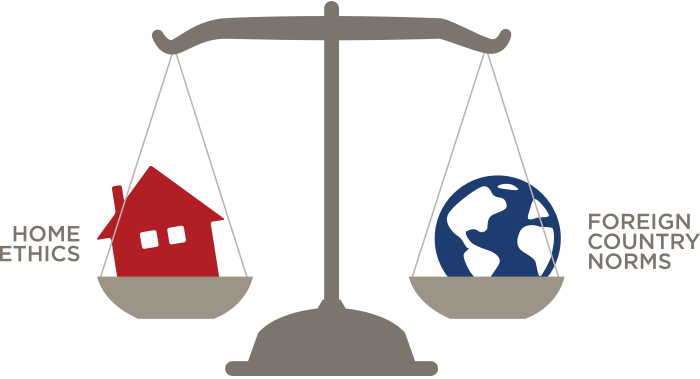
Neither of these strategies is ideal because:
-
If you always do elsewhere exactly what you do at home, you might be at a competitive disadvantage. Showing respect for local customs is an important part of forging business relationships.
-
However, if you adopt wholesale a different country's ways of doing business, you may inadvertently condone unscrupulous practices—such as bribery or child labor.
Instead, it's crucial to find a balanced approach. To do so, adopt the following guiding principles:
Honor core human values
Although business norms differ around the world, research has shown there is strong global consensus about what's fair and right.Paine, Lynn Sharp et al. "A Global Leader’s Guide to Managing Business Conduct." Harvard Business Review Sept. 2011.
Three core human values form an ethical foundation you can rely on no matter where you do business—or what profession you're in:
core_human_values_table
Underlying these three values, there's one time-honored guideline: treat others the way you would like to be treated. This one rule appears in some form in every major religion and global tradition.
通过行善实现企业成功 A Brief History of Doing Well by Doing Good
哈佛教授讲授视频逐字稿
Respect tradition
When you respect local traditions, you'll forge relationships faster and create trust. In turn, that goodwill can help you tackle sensitive ethical dilemmas.
Apply Ethics Across Borders
Even though it is important to respect local traditions, do nothing that conflicts with the laws that apply to your company at home. Companies—and the managers who work in them—should not violate their own country's laws to fit in with the norms of those they're doing business with internationally.
Consider the context
Practices that may be wrong in one country may be logical and even necessary in another. As you weigh an ethical decision, consider the issue's background and the reasons the behavior is accepted where you're doing business.
For example, consider the following practices:
-
Use of pollutants. In places where people are starving, using pesticides, chemical fertilizers, and other pollutants may be acceptable because they help produce larger crop yields needed to feed the population.
-
Nepotism. In some countries with high unemployment and widespread poverty, companies guarantee jobs for employees' children. This practice is not seen as unethical; it is considered a cherished employee benefit that brings hardworking families stability.
Tips for adopting a global ethical perspective
Worksheet for Resolving a Cross-Cultural Ethical Dilemma
第 3 节
Test your understanding and reinforce what you’ve learned.
Try it Out
答案与解析
George insisted on adherence to a nine-to-five workday.
George is displaying “ethical imperialism” by trying to organize employees’ work hours to suit his own expectations, without regard for their cultural norms.
Frank allowed flexible work hours to suit local norms but insisted that employees follow formal business practices.(正确)
Frank is showing a balanced approach by displaying sensitivity to his employees’ way of doing business while not completely altering his own approach.
Barbara told staff they were expected to wear more formal attire whenever they were meeting with local clients.
Barbara is showing “ethical imperialism” by trying to impose her own cultural norms.
Trevor decided to adopt local customs and norms in all matters, even if it made him uncomfortable.
Trevor is showing “cultural relativism” by totally embracing local norms without regard for the values his own culture can add to the business process.
Try it Out
答案与解析
Company A paid lower wages in order to hire additional people.
Company A did display core human values. In some countries where poverty is rampant, paying lower wages can be acceptable if it means an improvement in the overall standard of living.
Company B used pesticides and chemicals to increase crop yield.
Company B did display core human values. In places where people are starving, use of pesticides and chemicals can be acceptable in order to produce larger crops that will feed the population.
Company C ignored working conditions to increase its head office profits.(正确)
Company C did not display core human values. Poor working conditions that endanger workers’ health and safety are ethically unacceptable. They should never be used to increase a company’s bottom line.
Company D guaranteed jobs for its employees’ children.
Company D did display core human values. In some countries with widespread poverty and unemployment, nepotism is seen as a cherished benefit that brings hardworking families some stability.
第 4 节
Reflecting on your learning helps you apply relevant concepts to your job.