
Understand Project Management 查看中文版
第 1 节
Project management defined
To understand what project management is, we'll start by clarifying what a project is.
A project is: a set of interrelated activities, usually involving a group of people who are working together toward a common goal over a period of time.
For example, individuals from different business units in your company collaborate on the design, building, testing, and modification of a new product. Once the new product goes into production, the project ends for the design group. But the project continues, with responsibility for producing, marketing, selling, and servicing the product moving to relevant business units as needed.
Projects can be highly diverse:
-
They can be undertaken at the lowest hierarchical levels in an organization—or the highest.
-
They may require the efforts of a single person—or many thousands of people.
-
They might last a week—or several years.
-
They can involve a single unit in an organization—or many units.
With the definition of project in mind, consider what's meant by project management.
Project management is: planning, scheduling, and orchestrating of project activities to achieve objectives within a specified period of time.
Project management requires skills in organizing, budgeting, staffing, monitoring, and communicating.
如何管理项目团队?how to manage project teams
哈佛教授讲授视频逐字稿
Make a Connection
第 2 节
Benefits
When you manage projects effectively, you generate immense benefits for your organization:
-
You help your organization reach its strategic goals.
-
You ensure that things get done on time and on budget. This adds predictability to your organization's work.
-
You minimize costs by finding ways to deliver on objectives within reasonable time periods.
第 3 节
A four-phase process
To manage a project, you typically progress through four phases:
Project phases
Essential activities carried out during the project management process include:
-
Defining the project scope and objectives
-
Developing a schedule
-
Creating a budget
-
Assembling a project team
-
Monitoring the project's progress
-
Communicating with stakeholders
-
Managing risks to the project
第 4 节
Overlapping activities
The major activities associated with each project management phase often overlap. In addition, they're iterative—you may have to return to some of these activities several times over the course of the project. In fact, the more complex your project, the more iterations it may go through.
Understand Project Management
Returning to the activities of an earlier phase doesn't mean you're moving backward or losing ground. It simply means you're incorporating new knowledge and information into the overall project plan.
It also reflects an "adaptive" approach to project managementWysocki, Robert K. Effective Project Management: Traditional, Agile, Extreme, 5th ed. Hoboken: Wiley Publishing, 2009.—by which you approach project activities as small, iterative learning experiences. You use the information gathered from each project activity to manage subsequent activities.
A more linear, or traditional, project management approach works well with projects that are familiar to your organization and that aim to address relatively simple problems. Such projects have a well-defined, stable scope; a well-understood technology infrastructure; low risks; and experienced project teams.
Linear vs. Adaptive Project Management
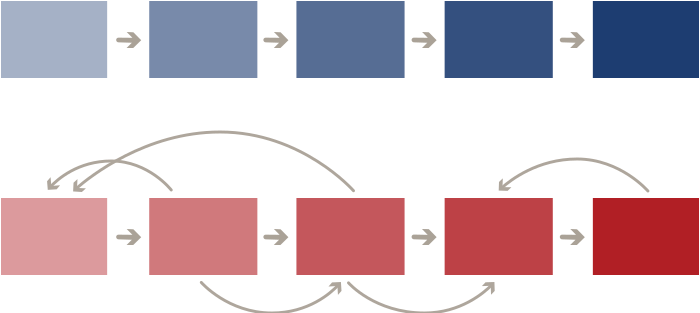
But in today's complex and fast-changing business world, many projects don't fall into this category. Instead:
-
The problems they seek to address are critical and don't have known solutions
-
Project teams lack experience
-
Available technologies are unfamiliar
Regardless of the challenges, your organization may be in danger of missing out on an important business opportunity. It must find a way to take advantage of the opportunity by developing a new product or service offering.
Manage projects adaptively
低成本的快速试错方法 Run a Disciplined Innovation Experiment
哈佛教授讲授视频逐字稿
Try it Out
Take Action
第 5 节
REFLECT
Reflecting on your learning helps you apply relevant concepts to your job.