
Close the Deal 查看中文版
第 1 节
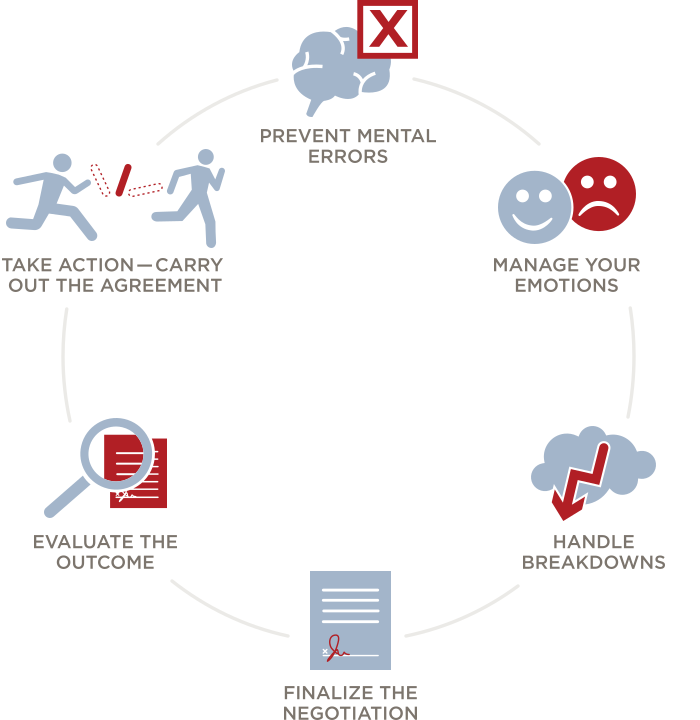
To finalize the negotiated agreement, follow these six tips:
第 2 节
Even the best-prepared people can fall prey to mental errors during a negotiation, which can lead to a disappointing outcome. Cognitive mistakes can result in lost money and time, difficult or impossible terms, or a damaged reputation. By understanding mental errors that commonly occur in negotiations, you can learn how to avoid and correct them.
Be flexible
Negotiations aren't always predictable. For example, your counterpart may be replaced, or newly found opportunities may encourage the other side to drive a harder bargain.
To prevent unexpected events from interfering in your negotiations:
-
Remain flexible and patient.
-
Be open to working with new people and under changed circumstances.
-
View change as an avenue for learning, creativity, and new opportunities.
Close the Deal
谈判者应具备战略敏捷性 Negotiation Agility
哈佛教授讲授视频逐字稿
Set reasonable expectations
Some people enter negotiations with unreasonable expectations. As a result, they eliminate any zone of possible agreement.
Close the Deal
To avoid this error, confirm that your expectations are realistic by researching similar situations. Also, if you believe the other party's assumptions are unreasonable, use facts to support your view.
案例
Balance your confidence level
It's important to be confident during negotiations. If you are uncertain about your skills or negotiating position, the other side will have an easier time getting what it wants—which may result in a worse deal for you.
Too much confidence, however, can also set you up for failure. You may overestimate your strengths and underestimate those of your counterparts. And overconfidence can blind you to dangers and opportunities that may arise during bargaining.
To prevent stumbling in a negotiation because of under- or overconfidence:
-
Be prepared. Research the issues you will be discussing. You must be armed with facts and relevant information because every negotiation is different. A previous success does not guarantee a future one.
-
Have a backup strategy. Even if your initial strategy is strong, you may encounter unanticipated obstacles. Play out different scenarios of how the negotiation could progress and prepare contingency plans for the various possibilities.
-
Get an objective opinion. Ask objective outsiders to examine your key assumptions, the position of the other party, and the deal on the table. They can point out potential weaknesses in your position and issues that you may not have considered while preparing for the negotiation.
Overcome the "vividness effect"
Even seasoned negotiators can be susceptible to the vividness effect—paying more attention to factors related to prestige or excitement than to practical issues. For example, the number of awards that a vendor has won may cloud your objective analysis of the price it is offering.
To avoid the vividness bias:
-
Resist being distracted by attractive features. Take a balanced view of all of the factors involved in the negotiation—and not just the most interesting or exciting ones.
-
Create a scoring system. Assign points to the various factors you will be discussing, and give higher values to the ones you care about most. During negotiations, periodically review your score to be sure you stay focused on your true interests.
-
Separate information from influence. When you find yourself being swayed by certain kinds of data more than others, refocus on your goals.
第 3 节
At one time or another in the course of a negotiation, you're likely to experience strong emotions. Some may be positive—joy or relief as you settle a sticky issue—while others—such as anger or competitiveness—can interfere with your ability to think clearly and creatively. Knowing how to manage your emotional responses is a key negotiating skill.
Stop escalation
In difficult or competitive negotiations, otherwise levelheaded people sometimes follow a course of action beyond the point where it continues to make sense. Some make this error because they can't stand losing. Others get caught up in "auction fever"—irrational behavior that surfaces when individuals bid against each other in an effort to prevail.
To avoid irrational escalation:
-
Refer to your BATNA. Remember that money you don't waste on an overpriced deal is money you'll have to invest in your other alternatives.
-
Remember your walk-away position. If you commit to a walk-away position, you'll be less tempted to escalate your terms during negotiations.
-
Set clear break points. During the negotiation, periodically stop and assess your situation to ensure you are not getting off track.
Recognize built-in biases
People often perceive the "truth" with a built-in bias toward their own point of view. For example, loyal fans of a sports team will often perceive an umpire's ruling as unfair to their side. In negotiation, this partiality can lead to negative emotions, undermine trust, and reduce the possibility of reaching a constructive agreement.
To avoid being influenced by built-in biases:
-
Try to see the issue from the other party's perspective. Before you can change people's minds, you need to understand their viewpoint.
-
Pretend you are a reporter. Consider how you would accurately depict each side's position on contentious issues.
-
Pose the issue to objective colleagues. Explain the situation and solicit their opinions without telling them which side you are on.
Have an emergency plan
By preparing for the strong feelings you may experience during a negotiation, you can make conscious choices about how to respond. To be sure unchecked emotions don't derail your negotiation, create an emergency plan ahead of time. Your plan should include these steps:
-
Take your emotional temperature. If the discussion is contentious, periodically assess your emotions. Are they manageable? Beginning to rise? Out of control?
-
If you're beginning to feel out of control, choose a way to cool down. You might decide in advance that you'll count to 10, take a bathroom break, or sit in silence for a moment.
-
Diagnose the problem. Figure out what is causing your emotional response. When you know if you're feeling frustrated because of the lack of options on the table or because you're hungry, you'll be able to respond appropriately.
-
Formulate your purpose before you respond. Take the time to decide what you want to accomplish before you express your emotions. Do you want to let others know the impact of their behavior on you? Do you want to influence them in some way? By understanding your purpose, you can decide the best action to take.
Tips for managing rising emotions
Make a Plan
Make a Connection
第 4 节
Difficult times in negotiations are to be expected. Breakdowns can be due to an impasse, stalemate, or deadlock. Figure out which barrier you are dealing with, and apply the appropriate strategy to overcome it.
了解对方立场背后的核心诉求 Focus on Interests
哈佛教授讲授视频逐字稿
Make a Connection
第 5 节
Finally, you are nearing an agreement. To close the deal and secure a commitment:
-
Notify the other party that you are getting ready to commit. As you get closer to the final deal that you want, clearly say so, particularly if the other negotiator still seems to expect sizable concessions.
-
Allow flexibility if you are not negotiating with the final decision maker. If the other negotiator does not have final authority, leave some flexibility in the terms. Be prepared with one last trade you'd be willing to make in case the decision maker requests a change to the agreement.
-
Discourage the other side from seeking further concessions. If you reach a deal that is acceptable to both of you, discourage further changes. Explain that any adjustment made in the other party's favor would have to be balanced by an adjustment in your favor—something that would reopen the entire deal.
-
Document the terms. A written record prevents disputes and confusion. Sometimes you and your counterpart will be able to draft the final agreement on your own. If you need legal counsel to do it, be sure the terms are clear during the handoff so errors are not made when the documents are created.
-
Don't gloat. Bragging about your deal and about how much more you were prepared to give up could damage future negotiations. Other parties might be more aggressive and less willing to concede to your requests.
There may be times when you can't reach an agreement with the other party. Although it may be painful, no deal is better than a bad deal. If you are confident of your BATNA and walk-away position, then you know you did the right thing.
3 ways to solidify commitment to an agreement
Poll
第 6 节
After a negotiation concludes, evaluate how it went so you can apply what you learned to your next negotiation. Do this immediately, when the proceedings are fresh in your mind.
To evaluate the outcome, compare your results to:
-
Your initial goals
-
Your BATNA and walk-away position
-
Objective standards such as market value, efficiency, costs, and profits
-
Expert opinions
Also, consider the other negotiators' actions. Is this an organization you would want to work with again? What did your counterparts do well? What mistakes did they make?
To evaluate your performance, think about what worked well and what you would do differently next time. Consider these questions:
-
Were you well prepared? Were you missing any valuable information that you should have known when you walked into the negotiation?
-
How well did you do with estimating the other side's BATNA and the ZOPA? If you weren't close, what did you miss?
-
Could you have done anything differently that would have made the process go more smoothly?
-
Were you able to establish a cooperative, trusting relationship with the other parties? Why or why not?
-
Were you able to read the other party's signals and body language?
-
When you encountered a problem, were you able to come up with a creative solution?
Also ask someone else who was in the room to provide you with feedback.
Once you gain insight into how things went, set personal development goals for your next negotiation. In addition, document and share any lessons with others in your organization so they can learn from the experience.
Make a Connection
第 7 节
Once the deal has closed, honor all agreements that you made. If you don't, you may face legal action and damage your reputation. Following through on your agreements is also the best way to ensure that your counterparts uphold their commitments.
Ensure that all the people in your organization responsible for executing the terms of the agreement immediately get the information they need to follow through. This information may include a copy of the agreement, a list of contacts in the other organization, purchase orders, and schedules.
第 8 节
Test your understanding and reinforce what you’ve learned.
Try it Out
答案与解析
Postpone dealing with the most difficult issue and discuss other issues.
This is a good approach when you are in complete disagreement on one issue and it threatens the entire deal.
Alter one of the elements to change the dynamics of the negotiation.
This is a good approach when you are still talking to each other but can't make any progress.
Invite a neutral third party to help out as a mediator.
This is a good approach when lack of progress s so frustrating that neither of you sees the point in pursuing negotiations.
Ignore the difficulties and continue with your original strategy.(正确)
This is not a good approach. Instead, figure out what kind of barrier you are dealing with and apply the appropriate strategy to overcome it.
Try it Out
答案与解析
Make sure there is clear documentation of all terms you have agreed on.(正确)
A written record prevents disputes and confusion.
Avoid disclosing to Ayo that you are ready to commit to a deal.
You should notify Ayo when you are getting ready to commit.
Ensure that you have made all the trade-offs you are willing to make.
If Ayo does not have final authority, you should allow some flexibility in the terms in case his boss requests a change to the agreement.
Avoid letting your personal values influence business decisions.
If you have already reached a deal that IS acceptable to you both, you should discourage Ayo from seeking further large concessions.
第 9 节
Reflecting on your learning helps you apply relevant concepts to your job.