
Conduct a Negotiation 查看中文版
第 1 节
Work with the other party to establish a process for the negotiation. Whether you plan to meet in person or virtually:
-
Agree on a time, place, and duration.
-
Establish if you will meet once or engage in a series of meetings.
-
Confirm who will participate from both organizations.
-
Keep everyone informed about the meeting logistics.
-
Determine who will prepare the meeting agenda, the topics that will be discussed, and the sequence in which you will discuss them.
Traditionally, most negotiations involved face-to-face communication. In today's connected global economy, virtual negotiations are becoming increasingly common. Before you negotiate by email, telephone, or other electronic media, keep in mind the pros and cons of e-negotiations:
第 2 节
Negotiations can be awkward, especially if you haven't met or worked with the other party before. To get off to a smooth start:
-
Set a positive tone with your opening remarks. Express respect for the other side's experience and expertise. Frame the negotiation as a joint endeavor. Emphasize your openness to your counterparts' interests and concerns.
-
Discuss your expectations regarding process. People often have different assumptions about how the negotiation should work. Some expect proposals to be made at the outset, while others anticipate an open discussion of the issues first. Make sure that all parties have a shared understanding of the process.
-
Offer information. Voluntarily explain some of your interests and concerns first as a good-faith measure. If the other side does not reciprocate, be cautious about providing additional information.
The value of casual conversation
Make a Connection
第 3 节
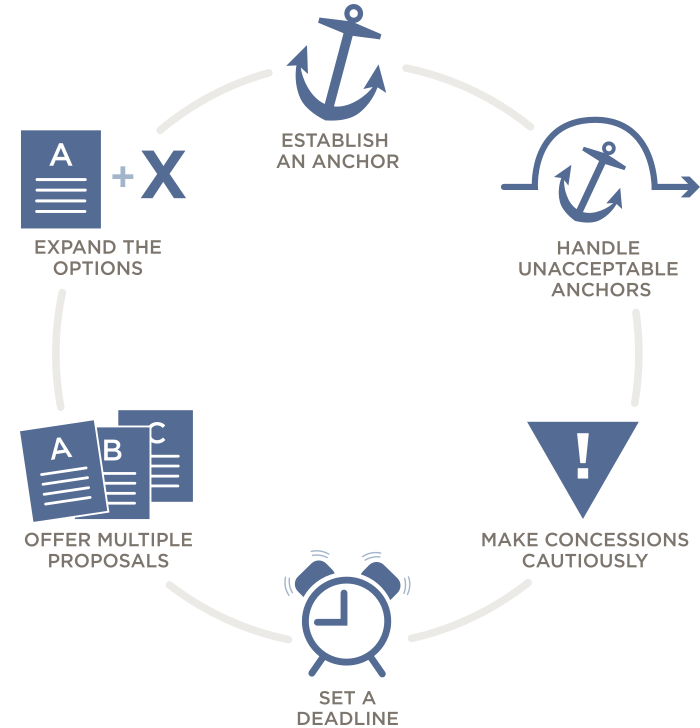
In most single-issue negotiations, a gain by one side represents a loss to the other. You can use several tactics to achieve gains and prevent losses:
-
Establish an anchor. Be sure the initial offer sets an acceptable bargaining range.
-
Handle unacceptable anchors. If the other party sets an unacceptable bargaining range, ask additional questions and then offer your own proposal.
-
Make concessions cautiously. Understand the implications of offering large and small concessions.
-
Set a deadline. Attach an expiration date to any offer to prevent the seller from waiting for a better deal.
-
Offer multiple proposals. Give your counterparts various options so they won’t feel stuck with an ultimatum.
-
Expand the options. Bring additional issues into the negotiation to shift the process from competitive to cooperative.
Establish an anchor
The first offer put on the table, the anchor, establishes a reference point around which the negotiation will revolve. As a result, the anchor often influences the outcome. Without an appropriate anchor, you may not achieve the outcome you're counting on.
Conduct a Negotiation
It's best to offer an anchor when you have a strong sense of the other side's walk-away position. Your proposal should be at or around that number. Don't be too aggressive or the other side may end the negotiation. And always be prepared to justify your offer by providing data.
If your anchor is out of the other negotiator's range, retreat gracefully by indicating that your initial offer isn't final. Be ready to explain your shift to a less aggressive proposal.
If you believe the other party has more information about the item you are negotiating or about the market and industry, then it may be beneficial to hold off on anchoring. Try to gather more information during the discussion before making the first offer.
Poll
Handle unacceptable anchors
If the other party makes the first offer and you feel it sets an unacceptable bargaining range, steer the conversation away from it. Ask questions that focus on the other side's interests and motivations. You might learn new information that can help you reposition the proposal.
After some time passes, present your proposal and your justifications for it. Avoid mentioning the other side's original offer. If that initial offer was not serious, your counterpart may let it drop. If it was a serious offer and the other party refers to it again, respectfully ask the other negotiator to justify the proposal.
Make concessions cautiously
In most negotiations involving money, when one party makes a large concession on price, it often means they have additional flexibility. A small movement generally signals that negotiators are approaching their walk-away position.
You don't have to follow these conventions, but it pays to understand them. This knowledge may affect how your offers and counteroffers are interpreted. If you make a substantial move but are not prepared to move much further, let the other party know that. Also, if you are willing to make significant concessions, be prepared to explain why.
Set a deadline
Attach an expiration date to any offer to buy. This prevents the seller from putting you off and waiting for a better deal. It also allows you to quickly pursue other opportunities if this one doesn't work out.
Offer multiple proposals
Offer at least two proposals. For example, you might offer $18,000 for a piece of equipment and a two-year service agreement as a package, or $16,000 for the equipment alone. When given alternatives, the other party won't feel stuck with an ultimatum. Also, your counterparts may compare the proposals to each other instead of to their original goals or to a competitor's offer—something that can work to your advantage.
Expand the options
If you cannot reach an agreement, find a way to bring additional issues into the negotiation. This shift changes the nature of the process from competitive to cooperative. It also gives both of you an opportunity to create value rather than just competing for it.
Conduct a Negotiation
Frame the issue
Your negotiating tactics depend on what type of bargaining situation you're in and where you are in the negotiating process. In this activity, pick the right tactic for each situation.
Try it Out
答案与解析
A. Frame each price negotiation as a joint endeavor.
Not the best choice. Though this tactic can be useful in getting a negotiation off to a good start, Jing should focus more on tactics designed especially for the type of negotiation (single-issue) in which she'll be participating.
B. Establish an appropriate anchor by putting the first offer on the table.(正确)
Correct choice! Jing is likely facing a single-issue negotiation, in which a gain by one side represents a loss to the other side and the relationship between seller and buyer is short term. In this case, establishing a reference point around which the negotiation will revolve can increase her chances of selling the equipment at the highest possible price.
C. Look for differences that can create a win-win situation in which both parties create and claim equal value.
Not the best choice. Jing is engaging in a single-issue negotiation, in which a gain by one side represents a loss to the other side and the relationship between seller and buyer is short term. Looking for differences on which to build shared value is a tactic that's more appropriate for another type of negotiation (multiple-issue).
第 4 节
Multiple-issue negotiations rely on collaboration and information exchange to create and claim value. Use the following tactics to achieve success:
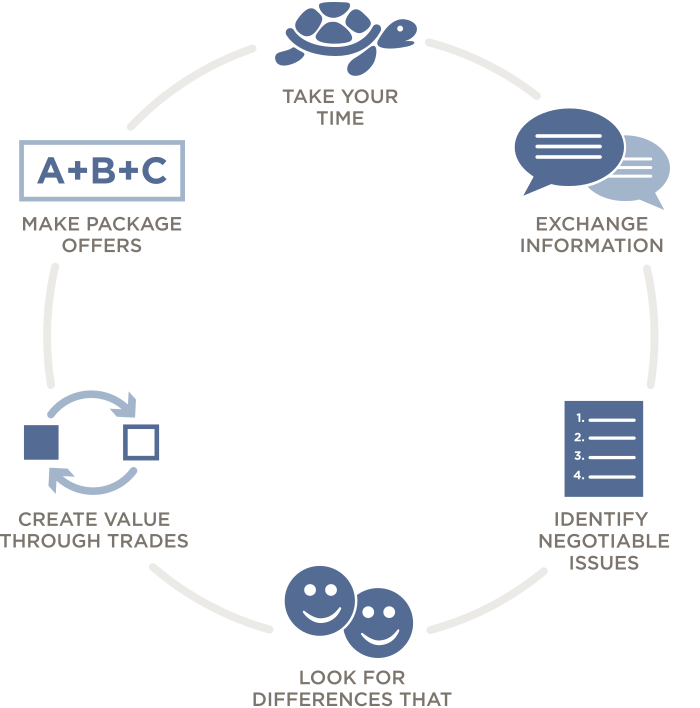
- Take your time. Glean information from the negotiating process before making a proposal or closing a deal.
-
Exchange information. Share details about your needs, interests, and concerns—and ask the other party to do the same.
-
Identify negotiable issues. List all of the issues relevant to the negotiation.
-
Look for differences that offer mutual gain. Identify opportunities for creating benefits based on differing needs, preferences, and constraints.
-
Create value through trades. Generate win-win solutions by finding things you want that the other party has, but doesn't value—and vice versa.
-
Make package offers. To avoid bargaining over every issue, make package offers.
Take your time
Don't make a proposal too quickly. A premature offer won't benefit from information gleaned during the negotiating process. For example, if you are the buyer in the negotiation, you might learn information that alerts you to the seller's eagerness to sell—leading you to make a lower initial offer than you otherwise might have. Or you might learn that the seller is not desperate at all—precluding you from making a low initial offer that might insult the seller.
In addition, don't be tempted to close the deal too quickly, even if the first proposal is acceptable. Signal that the proposal is worth considering, but also state that it might be improved by sharing more about your respective interests and concerns. Be sure to talk about all of the issues on the table before you come to agreement on any one topic.
Avoid appearing needy
嘉信理财:在关键时刻打出王牌 Play Your Cards Right
哈佛教授讲授视频逐字稿
Exchange information
Ask about the other party's needs, interests, and concerns. Listen carefully, because the responses can reveal valuable details.
Likewise, explain why you want to make a deal; and share your real interests, priorities, and constraints. Reveal any additional capabilities or resources you have that could be added to the deal.
Conduct a Negotiation
Identify negotiable issues
Through open conversation with your counterpart, identify all of the issues relevant to the negotiation. These may include things such as:
-
Price
-
Delivery date
-
Financing
-
Quality
-
Contract length
-
Warrantees
-
Future business
The more issues you list as negotiable, the more likely each party will get what it values most. Think of all the things you value that the other side might be able to provide. By doing so, you give your counterparts ways to fill your needs. Likewise, explore ways that you might be able to meet your counterparts' priorities.
Conduct a Negotiation
谈判的三个成功要素 Negotiating on the Back of a Cocktail Napkin
哈佛教授讲授视频逐字稿
Look for differences that offer mutual gain
By identifying differing needs, preferences, and constraints, you and your counterpart may find opportunities for mutual gain. Look for differences in areas such as:
-
Access to resources. One party may have access to information, discounts, and contacts that the other party does not.
案例
- Future expectations. Creatively address contrary views you might have about future conditions.
案例
- Time preference. Changes to the timing of a deal can help the parties reach a mutually satisfactory outcome.
案例
- Risk tolerance. Parties have different risk tolerances. What is highly risky for one party is often less risky for another. In this case, value can be created by shifting the risk to the party better able to bear it—in exchange for higher potential returns for the party assuming the risk.
案例
STAT
Create value through trades
Both parties can end up with a better outcome by creating value through trades. If the other party values something you have more than you value it, you might exchange it for something the other party has that you value. Both of you will get something you want in exchange for something you value less.
案例
Negotiate Interests, Not Positions
Make package offers
To avoid bargaining over every issue, make package offers. A package offer should include your proposal for all of the issues under discussion. In considering a package offer, your counterparts are likely to focus on the elements that they disagree with the most. Instead of asking for across-the-board changes, they will often accept your terms on some items while requesting adjustments on others.
Continually evaluate
Negotiation may seem to be a linear process of preparation, negotiation, and eventual agreement or failure. However, some complex negotiations require a cyclical approach. New information may appear at various points. Different parties may offer concessions or heighten their demands.
In these types of negotiations, you prepare and negotiate as usual. The negotiation then produces outcomes and information that you evaluate and use to prepare for a new round of negotiations. This process continues until you reach an agreement or walk away from the negotiation.
In this activity, pick the right negotiating tactic.
Try it Out
答案与解析
A. Ask Caitlin what her biggest challenges are.(正确)
Correct choice! Chitra prefers to rely on collaboration and information exchange to create forms of value that each party appreciates. By asking Caitlin about her challenges, Chitra can learn more about her potential interests. This can help Chitra identify trade-offs that might create forms of value important to each of them. For example, Caitlin might be willing to charge Chitra a lower fee to list the company’s name in her client roster— something that a newly established consultant might value highly.
B. Discuss her expectations regarding the negotiation process with Caitlin.
Not the best choice. Though agreeing on process can be helpful in a negotiation, this tactic is most useful for getting a negotiation off to a good start. In Chitra and Caitlin‘s case, the negotiation has already begun. Rather, Chitra should ask Caitlin what her biggest challenges are in order to identify trade-offs that might create value for each of them.
C. Take care not to disclose significant information about her needs and concerns.
Not the best choice. This tactic is best used during single-issue negotiations, in which a gain by one side represents a loss to the other side. Chitra is striving to create another type of negotiation (win-win) that requires different tactics. Rather, Chitra should ask Caitlin what her biggest challenges are in order to identify trade-offs that might create value for each of them.
Take Action
第 5 节
Test your understanding and reinforce what you’ve learned.
Try it Out
答案与解析
Set a flexible deadline for agreement.
Vlada should set a firm deadline for any offer. This prevents Mary from waiting for a better deal.
Make concessions cautiously.(正确)
When making concessions in a negotiation, it is a good idea to do so cautiously, with full understanding of the implications.
Offer only one proposal to the seller.
Vlada should offer multiple proposals so that Mary feels she has options and is not being presented with an ultimatum.
Focus solely on the issue of price.
It IS good to expand the options by bringing additional issues into the negotiation. This helps to shift the process from competitive to cooperative.
Try it Out
答案与解析
Act quickly to make a proposal and close the deal.
During multiple-issue negotiations, you should take your time and gather as much information as you can before making a proposal or closing a deal.
Keep quiet about your needs, interests. and concerns.
During multiple-issue negotiations, you should exchange information with the other side. Share details about your needs and concerns, and encourage your counterpart to do the same.
Know what you want from your counterparts that they don't value and vice versa.(正确)
Identifying things you want from your counterparts that they don't value (and vice versa) generates a "win-win" situation by allowing you to create value through trades.
Bargain over every issue that comes up for discussion.
In multiple-issue negotiations, you should avoid bargaining over every issue, and make package offers instead.
第 6 节
Reflecting on your learning helps you apply relevant concepts to your job.