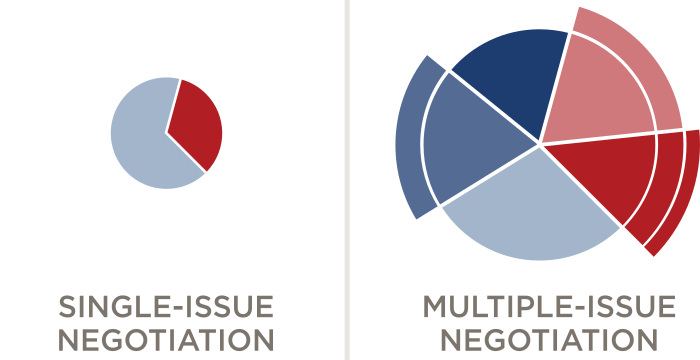
Before you begin bargaining, you need to know what kind of negotiation you are engaging in. This knowledge will influence your strategy and the choices you make. The two main types are single-issue negotiation, also known as "distributive" or "win-lose" negotiation, and multiple-issue negotiation, also known as "integrative" or "win-win" negotiation.
Characteristic
Single-Issue Negotiations
Multiple-Issue Negotiations
Number of issues involved
One
Several
Outcome
Win-lose
Win-win
Motivation
Individual gain
Joint and individual gain
Interests
Opposed
Different value and priority placed on issues
Duration
Short term
Short or long term
Ability to make trade-offs
Not flexible
Flexible
Solution
Not creative
Creative
Multiple-issue negotiation
In the real world, few negotiations involve only one issue. Most negotiations include several variables, such as delivery date, financing, contract length, and quality. While more complex than single-issue negotiations, multiple-issue negotiations also offer opportunities for you and the other side to create—and not just claim—value. Instead of competing for the bigger piece of pie, you and the other party can work together to expand—and even add to—the pie.
Single-Issue vs. Multiple-Issue Negotiation
In multiple-issue negotiations, you and your counterparts make trade-offs to get the things you value most, while giving up other factors that you deem less critical. This approach means that your ability to claim what you want from the deal does not necessarily detract from your counterparts’ ability to claim what they want.
Prepare to Negotiate
Sasha is interviewing candidates to fill a full-time position in her department. One of her colleagues recommends Christopher. Christopher has the necessary knowledge and skills, but Sasha learns that he is looking to work part time and his salary exceeds Sasha's budget. As Sasha talks with Christopher, she discovers that he would like to work from home several days a week. With such an arrangement, Christopher is amenable to working more hours per week for a lower salary because he won't be commuting—and will be getting something he values. Sasha is able to successfully negotiate a deal. She gets the employee she wants for the hours and salary she was looking for, while Christopher gets the job and the ability to work from home.
Prepare to Negotiate
Finding opportunities for mutual benefit requires cooperation and a certain amount of trust. Both parties need to understand both their own key interests and the other side's key interests. This does not mean that you should concede on issues that are important to you. Strive to achieve your goals while identifying something of value to the other party that is of little value to you.
谈判之前,先准备好自己的剧本 Know Your Plays
哈佛教授讲授视频逐字稿
I believe one of the key success factors for successful negotiating is to be prepared. And I could relate to my own experience with owning my own company and having negotiations with my labor union every three years.
And you must prepare something similar to what I experienced when I played football. And that is, when I played college football, I prepared in advance of a game on Saturday by going to practice and knowing exactly what plays I was going to run and physically prepared, as well. The same applies to negotiations.
I knew that I had to literally know in advance of sitting down with the labor union what I was going to ask for specifically in terms of the pay increase that I was willing to give. I had to anticipate what they were going to ask for. I had to anticipate how I would respond to their actual counterproposal.
You should know the order in which you're going to ask for certain things. You should anticipate what the other party is going to say in response to what you ask for. You should anticipate what they're going to ask for. And it should be, ideally, a beautifully well-orchestrated play that occurs in that session where you know in advance what's going to happen. And let me advise you. If something happens that's unexpected during negotiations, you should feel perfectly comfortable in saying to the other person, "Let me get back to you." There's nothing that says that you have to give an immediate answer to any proposal that's submitted to you. If you're unprepared for it, it's OK to say, "Listen, let me get back to you. Let's discuss these other points."
But be prepared such that, when you come out of there, you don't leave something on the table and kick yourself by saying, "Man, I never anticipated that to happen."
The negotiator’s dilemma
The strategy called for during negotiations isn't always straightforward. In most negotiations, the competitive approach associated with single-issue negotiations and the cooperative approach of multiple-issue negotiations become intertwined. This tension between the two approaches is known as the negotiator's dilemma.
According to the negotiator's dilemma, four different scenarios are possible:Tenbergen, Rasmus. "Principled Negotiation and the Negotiator’s Dilemma: Is the “Getting to Yes” Approach Too Soft?" Institute for Leadership Development. May 2001. 12 October 2013.
Scenario
Your outcome
Other party’s outcome
You compete and the other party cooperates.
Great
Terrible
You and the other party share information and fully cooperate.
Good
Good
You and the other party compete.
Mediocre
Mediocre
You cooperate and the other party competes.
Terrible
Good
As shown in the table, it’s most logical for you to compete. The outcome will be great—assuming the other party cooperates. However, if the other party also competes, you may be left with a mediocre outcome. If both parties cooperate, you can both walk away with a good outcome.
Since it’s difficult to predict what strategy the other party will use, the best choice isn’t always clear. By thoroughly preparing for the negotiation, paying close attention to the other negotiator’s tactics, and being flexible in your approach, you can improve your chances of achieving a favorable outcome.
Make a Connection
1. Think about a recent negotiation you took part in. Looking back, how could you and the other party have created—and not just claimed—value?
第 2 节
Another important factor to consider when preparing for a negotiation is scope. The simplest negotiation takes place between two people who meet once and either come to an agreement or walk away. In organizations, these negotiations are rare. Most negotiations involve more than two parties and frequently take place in phases, with each phase devoted to unique issues.
Number of parties
In negotiations that involve numerous parties, coalitions or alliances can form among various groups and influence the process and outcome. They include:
Natural coalitions. These form between allies who share common interests. For example, an environmental agency and a nature conservation group share basic agendas. These groups will often collaborate to block development initiatives, even without an explicit agreement to do so.
Single-issue coalitions. These form when parties that differ on other issues unite to support or block a single issue, often for different reasons. For example, a labor union and a nature conservation group might form a coalition to block an anti-union developer from building a shopping mall in a wooded area. Each group has a different reason for joining the coalition.
If you are up against a coalition, consider how you might break it apart. It can be difficult to break a natural coalition because the parties are closely aligned. A single-issue coalition is more vulnerable because the parties have different reasons for joining. You may be able to address the demands of one party, leaving the other party on its own.
案例
A labor union and a nature conservation group form a coalition to block an anti-union developer from building a shopping mall. The property owner looks for a different developer with a better track record in dealing with unions. As a result, the union withdraws its opposition, leaving the conservationists to fight alone.
If you feel your negotiating position is relatively weak, look for ways to form a coalition with others to improve your bargaining power.
案例
You work in production, and the sales division of your company wants to commit to an aggressive schedule for a long-term customer. You might involve other departments that would be adversely affected by an overly aggressive schedule, such as graphics and fulfillment, in the discussion so you can negotiate a more reasonable timetable.
Worksheet for Assessing the Other Party's Position
Most negotiations are transactions implemented over time in different phases. After the parties complete a phase and uphold their agreements, they progress on to the next stage of negotiations.
Examples of multiphase negotiations include:
The buyout of an inventory-based business in which the parties set a price and agree to modify it later based on the value of the inventory on a specific date.
An architectural design contract in which the architect and client agree on a price for the design phase of the project. They then use the completed design to negotiate a price for the completion of construction drawings.
To be successful during a multiphase negotiation:
Become familiar with the other party's communication and negotiation styles. This knowledge will be useful in the later, more critical phases of the negotiation.
Monitor the other party to ensure follow-through on agreements and promises. If your counterparts aren't holding up their end of the bargain in the early phases, consider walking away. You could also create enforcement mechanisms or other sanctions against non-performance during later stages.
Ensure that the final phase is not the most significant in terms of money or impact. This practice will help protect you against breaches of the agreement by the other party.
第 3 节
Set goals before you negotiate. Many people assume that the goal is to obtain the best price or most favorable terms. That may be true, but there are often higher objectives as well. Those may include establishing a business relationship or becoming a preferred vendor.
Specific goals can:
Help you define what you want to get out of the negotiation
Provide motivation
Give you a way of measuring success
Your goals are only as effective as your commitment to them. Write them down and discuss them with other people. Bring your written goals with you to the negotiation. They will help you stay focused on what's important in those moments when you get caught up in emotions or when you feel driven to push hard to win just for the sake of winning.
案例
An advertising account representative is meeting with a potential client. The representative sets a goal of becoming a preferred vendor for the company. Rather than trying to get the highest price for one project, he accepts a slightly lower price in exchange for winning multiple projects. He understands that if his company consistently provides excellent service, it has a good chance of becoming a preferred vendor—something that will yield steady, ongoing returns in the future.
Before beginning any negotiation, you need to have a solid understanding of your limits and options. Your success depends on knowledge of four concepts:
Concept
Definition
Best alternative to a negotiated agreement (BATNA)
Your option if you fail to reach agreement during a negotiation
Walk-away position
The least favorable point at which you'll accept a negotiated deal; otherwise, you walk away
Zone of possible agreement (ZOPA)
The range in which a potential deal can take place, defined by the overlap between your walk-away position and the other party's walk-away position
Value creation through trades
The trading of goods or services that have only modest value to their holders, but exceptional value to the other party (this primarily applies to multiple-issue negotiations)
Analyze and improve your BATNA
Your best alternative to a negotiated agreement, or BATNA, is your preferred course of action in the absence of a deal. It determines the point at which you can say no to an unfavorable proposal. By knowing your BATNA before entering into a negotiation, you can gauge whether or not a deal makes sense. Without knowing your BATNA, you might reject an offer that is actually better than an alternative you end up with. Or conversely, you might accept an offer that is less favorable than an alternative you could have obtained elsewhere.
The better your BATNA, the more aggressive you can be in negotiating, because you know you have an acceptable backup plan if your talks don't produce an outcome. Therefore, it's wise to try to improve your BATNA before and during negotiations. You might do so by finding additional clients or vendors, or trying to upgrade the agreements you have with current clients or vendors.
In single-issue negotiations, your BATNA will usually focus on price. In multiple-issue negotiations, it will include all of the factors that are important to you, such as price, schedule, fees, quantity, and commissions.
Prepare to Negotiate
A consultant is preparing to meet with a potential client about a monthlong assignment. She is not certain what fee she'll be able to negotiate or even if she'll be able to reach a deal. Before the meeting, she determines her BATNA: She estimates the amount she could earn during the month if she were to work with other clients and determines that she could bill $15,000 for that month. When she meets with the potential client, her goal is to reach an agreement that will yield at least $15,000.
Prepare to Negotiate
A caution on BATNA values
Most people aren't good at estimating BATNA values because their personal perspective influences their estimates. In fact, findings from one study showed that even when given identical business information, balance sheets, and income statements, buyers consistently gave the company they were evaluating a lower value, while sellers gave it a higher value. Neutral observers tend to rank the potential value as somewhere in between. Be as objective as possible, and check your logic with a neutral third party.Lax, David and James K. Sebenius. The Manager as Negotiator. New York: Free Press, 1986.
A caution on BATNA values
Your walk-away position, or reservation price, is the least favorable point at which you would accept a deal. If your counterpart's final proposal falls short of your walk-away position, you end the negotiation without reaching an agreement.
Your walk-away position should be derived from your BATNA, but it is not necessarily the same thing. Your walk-away position should represent at least a slight improvement on your BATNA.
Prepare to Negotiate
Suppose you are in the market for new office space. You identify a suitable property and prepare to negotiate with the landlord over the lease. You consider that you are paying $20 per square foot for your current office space. This number is your BATNA.
Because the new location is closer to your clients and is a more attractive workspace, you'd be willing to pay $30 per square foot. That's your walk-away position. If the landlord insists on more than $30 per square foot, you'll walk away and attempt to lease space in a different building. During the negotiation, the landlord insists on $35 per square foot and won't accept anything lower. His walk-away position is $35 per square foot.
Prepare to Negotiate
When preparing to negotiate on behalf of your organization or a third party, you must be clear about the kind of deal you are authorized to make. Be sure you can answer these questions before you begin negotiating:
What are the objectives of the negotiation?
Is there only one deal that you are approved to make?
Do you have freedom in how to structure the deal?
What items can you factor into the deal aside from money?
Do you have the authority to sign off on the deal, or are you expected have the terms formally reviewed and approved?
Are you authorized to provide information about your organization's needs, interests, and preferences if the other side engages in a good-faith, reciprocal exchange?
萨拉·李集团:从资产细节洞悉经营风险 Confronting a Bad Deal
哈佛教授讲授视频逐字稿
I started working at Sara Lee when I was 35 years old. It was a chance to really understand the international business. And I had done some work in that realm, but my job was to really help the president with his growth of his business.
There was a separate department, the M&A—mergers and acquisition department—that would find the deal and analyze the deal and make the first approach and letter of intent. So I found very early in my time at Sara Lee that the M&A department had done analysis to buy a company in Tampere, Finland, the second-largest city in Finland.
My boss, the president, said, “I'm going to have to deliver the results as projected. Blythe, go lead the due diligence team and find out what's going on over there.” So I went over to Tampere. And clearly, Sara Lee management wanted to get this deal done. But I started looking around, first in the manufacturing plant, then in the warehouse.
And I noticed this company made knit products and nylons, pantyhose, and T-shirts, and I noticed all this dust on the pantyhose. Now this was in June. And I thought, “Why is this inventory so old?” The big season had just gone through, the winter season. We're about to approach summer.
Well, I started talking with the CEO. We had some lovely conversations back and forth, and I wanted to learn about the culture. And he told me just a few months earlier, the Finnish government had stopped guaranteeing receivables from Russia, his major market. And so he was no longer going to be able to sell as much as he had in the past because he couldn't collect.
Well, this was huge, and this totally changed the revenue projections of the company. I realized this was a problem. I wrote a 10-point memo, which I sent to the president explaining why I thought we should not do the deal. I started thinking, “What would be a deal-breaker here?” And I explained to him I would not do the deal at all. And he said, “Well, we're committed already. So let's find a third rail.” And that was buying a minority interest.
The losses happened as we had projected after seeing on the ground what was going on and understanding more what the company was facing. So we had a lower risk by taking a minority interest, and we were able to adjust our expectations, and the president was able to better deliver what he could and also what was promised to the shareholders.
One other addendum to this story is that about four months later, I ran into the chairman of Sara Lee, John Bryan. And he approached me at the elevator and he said, “Blythe, I just want you to know, it took a lot of courage to do what you did.” And I felt so on cloud nine hearing that I had done the right thing.
Never go into a negotiation without carefully determining your BATNA. In this activity, practice identifying BATNAs to sharpen your negotiating skills.
Try it Out
1. Which of the following could be your BATNA?
答案与解析
A. Accept the deal only if Laura meets or offers a lower price than the highest monthly fee that you're willing to pay. Not the best choice. Accepting the deal under these conditions isn’t your BATNA. Instead, it’s your walk-away position, the least favorable price that you would accept to make a deal.
B. Meet with another office equipment supplier to see what their leasing arrangements cost. Not the best choice. Though meeting with another supplier might generate useful information and put you in a stronger bargaining position, that isn’t a BATNA. Instead, it’s simply a way to gather more comparative data before considering what your best deal might be.
C. Buy used office equipment instead of leasing new equipment.(正确) Correct choice! If Laura can’t offer you a favorable deal to lease the office equipment, then buying used equipment might be your BATNA.
2. What might your BATNA be in this situation?
答案与解析
A. You’re willing to take on stretch assignments with peer managers that would let you develop the skills that interest you.(正确) Correct choice! If Diego chooses not to give you the promotion you want, then taking on stretch assignments could be one way you could still develop the skills that interest you, so this is your BATNA.
B. You could find a job with another company that will offer you the professional challenges you’re interested in. Not the best choice. Although finding a job elsewhere is a valid alternative, it may not necessarily be your best alternative to the negotiated agreement. Changing jobs can be both time-consuming and stressful, and you have had a good relationship with TopCo so far.
C. You propose a timeline by which you would like to be promoted if Diego can’t offer you the new role immediately. Not the best choice. Proposing a timeline isn’t a BATNA. Instead, it’s a possible counteroffer you could make if Diego isn’t able to or decides not to promote you immediately.
第 5 节
The more you know about the organization and people with whom you are negotiating, the stronger your position during the negotiation process. Find out what you can about the other side by asking questions, talking with people who know the other party, and researching relevant websites, annual reports, and marketing materials. The information you learn can help you form personal connections, avoid misunderstandings or errors, and plan your strategy.
Ideally, you want to uncover:
Information about your counterparts
Information about the organization
Who you'll be negotiating with and their formal titles and areas of responsibility
Their personalities, styles, backgrounds, and interests
How long they have been with the organization and their relevant experience
How they are viewed within their organization
How they have performed in previous negotiations
How the organization is structured and decisions are made
Its culture, goals, and values
Its business circumstances, including the strength of its financial performance, its strategy, it's key corporate initiatives, and the competitive pressures it faces
The value the deal has to the other side and the objectives the other party is trying to meet by making this deal
How easy it would be for the other party to make an alternative deal with someone else
The terms that would satisfy the other side
能为对方解决问题,才能赢得交易 Fix Their Problem, Win the Deal
哈佛教授讲授视频逐字稿
This is a personal story about my own entrepreneurial journey, but it's really a story about what it takes to create an effective and engaged partnership in any kind of setting. So way back, when in the early days of Fast Company, my cofounder Alan Webber and I had a great presentation, a really compelling business plan. We were able to make a really good case for why Fast Company, the magazine, was a terrific business idea and we were the right people to do it. And we spent months and months and months in New York meeting and presenting to the most blue-chip publishing organizations you could imagine-- legendary publishing executives of all stripes. And all the meetings were the same: “Good idea, you seem like a capable couple of founders. We're not interested in going into business with you.” I must say, we were completely perplexed. If we're so smart, why don't these folks want to do business with us?
And then we had a meeting in New York with a fellow by the name of Mort Zuckerman, billionaire real estate developer, magazine and newspaper publisher. And within 20 minutes, we understood that the dynamic with Mort was completely different.
He began asking questions about our advertising potential, and in particular, could we deliver to his publishing empire advertisers they had not been able to reach. He asked us questions about our potential audience and could we deliver to his portfolio of properties audiences he had not been able to attract. And the meeting went on—I think it went on for several hours. It seemed like just seconds, because it got so exciting and so hands-on, and the conversation quickly went from should we or should we not partner to what would be the most effective ways to partner.
And when we left, we asked ourselves—“Well, the presentation we made wasn't particularly more articulate or eloquent than what we had made before. The numbers and the business plan hadn't changed. Why did this partnership take root so effectively?”
And it dawned on us: because our plan, our idea, solved a problem that already existed in his publishing company. We were bringing a new set of advertisers, a new audience, a really new source of energy to a group of titles that needed it. And the lesson I took away from that—and it's a lesson I share with aspiring entrepreneurs or people who want to get their ideas launched inside their organizations—is simply this: there's such a tendency to think whether or not your idea gets approval is a function of strictly the merits of the idea itself and your capacity as an advocate for the idea.
And what I would urge everyone to do is before you do any of that, ask yourself in terms of the person on the other side of the table, “What is the problem he or she has that my idea is addressing? How does my idea make their life better, simpler, easier, more rewarding?” And when you develop your presentation, always begin not with your idea, but with their problem and communicate your proposal. Communicate your idea in ways that will resonate most deeply with them, not just in ways that you think are the best expression of your idea from your point of view.
Estimate the other party's BATNA and walk-away position
Try to identify your counterpart's BATNA and walk-away position. Doing so can help you develop your strategy, identify factors that may be of value, and predict how things may develop during the negotiation.
Opposing negotiators typically won't reveal this information. They may even bluff about it.However, you can do certain things to determine it:
Contact sources within the industry
Check potentially relevant business publications
Review annual reports or public filings
Learn what you can from others within the other organization
Based on the information you gather, consider what your counterparts' alternatives might be. You can also put yourself in the other side's position and imagine what actions you would take to establish and strengthen your BATNA. And you can anticipate—and prepare a response to—any objections your counterpart may have to your proposals.
高效谈判从准备开始 Do Your Homework
哈佛教授讲授视频逐字稿
I’d like to talk to you about effective negotiations. Negotiation skills are an art, an art that you must prepare for. When you negotiate, it’s clear that you must prepare. You must prepare and understand the other company’s best alternative to an agreement. You need to understand your company’s need for an agreement and how those two either complement each other or conflict with each other. So when doing your homework, it’s also important to understand who you are negotiating with. What does that individual bring to the table, and what do they stand to lose through this negotiation? Once you learn what you are up against, once you have done your preparation, the best negotiation is done face-to-face, but we realize in this global economy that’s not always possible. An effective negotiation can be done over the phone.
It’s important to know when to draw the line. Once you know where you can negotiate and once you know where the individual is coming from, you must also not allow that person and that company to push you further than your company is willing to go.
It’s OK, when the negotiation gets heated, to walk away. Let the situation calm down and come back with clear heads, still pushing what needs to be closed, but making sure that the individual you’re negotiating with understands how firm and committed you are to a successful conclusion.
Poll
Poll
Determine who has authority
It's best to negotiate directly with someone who has the authority to make a decision. Doing so prevents you from proceeding down a path with an unrealistic outcome and reduces opportunities for misunderstanding. Before beginning a negotiation, find out who has the decision-making authority and how the decision-making process works in the other organization.
If you cannot negotiate directly with the decision maker, determine the level of authority of the person with whom you will be negotiating so you can plan accordingly. Sometimes dealing with negotiators who lack full authority has advantages. They may be free to discuss their organization's interests and to explore creative options for coming to an agreement.
第 6 节
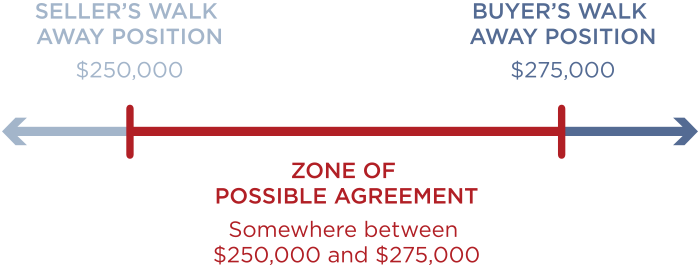
Once you have an idea of the other party's BATNA and walk-away position, you can estimate the zone of possible agreement, or ZOPA. The ZOPA is the range in which a deal can take place. Your walk-away position determines one end of the ZOPA, and the other party's walk-away position determines the other end. The ZOPA exists, if at all, in the overlap between the two walk-away positions. Depending on how large the ZOPA is, there may be many possible agreements you could come to that would satisfy both parties.
Zone of Possible Agreement (ZOPA)
Prepare to Negotiate
Reprinted with permission from "Negotiating Outcomes" Harvard Business Press, 2007.
Two parties are negotiating the purchase price of commercial refrigeration equipment. The buyer has set a walk-away position of $275,000 and would like to pay as little as possible. The seller has set a walk-away position of $250,000 and would like to get as much as possible. The ZOPA, therefore, is the range between $250,000 and $275,000.
If the numbers were reversed and the buyer had a walk-away position of $250,000 and the seller had a walk-away position of $275,000, there would be no ZOPA. No agreement would be possible unless both parties were willing to consider other elements of value—such as delivery costs and service agreements—or one or both sides changed their walk-away positions.
Prepare to Negotiate
第 7 节
Test your understanding and reinforce what you’ve learned.
Try it Out
1. You are buying a commercial condominium and are currently discussing terms with the seller. You have taken the firm position that all lighting fixtures must be included, and you have a predetermined price in mind that you will not exceed. You have established your:
答案与解析
Walk-away position.(正确) Your walk-away position is the least favorable point at which you will accept a negotiated deal; otherwise, you will walk away.
BATNA (best alternative to a negotiated agreement). The BATNA (best alternative to negotiated agreement) is your option if you fail to reach agreement during a negotiation.
ZOPA (zone of possible agreement). The ZOPA (zone of possible agreement) is the range in which a potential agreement can take place. It is defined by the overlap between your walk-away position and the other party's walkaway position.
Value creation through trades. Value creation through trades is the trading of goods and services that have only modest value to their holders but exceptional value to the other party.
第 8 节
Reflecting on your learning helps you apply relevant concepts to your job.
Take a Moment
1. 1. What new insights do you have that could benefit you or others in your workplace?
2. 2. What are your biggest opportunities for applying concepts from this Lesson in your workplace?