Pocket Leadership口袋领导力

Negotiating

Understand Negotiation 查看中文版

第 1 节

What is negotiation?

A negotiation is an interactive process through which two or more parties seek to come to mutual agreement. You typically negotiate when you want something from someone and when someone wants something from you. A negotiation may be a formal affair in which you debate the terms of a contract. Or it may be less formal, such as a hallway discussion between you and another manager about an employee's work assignments.

如何突破现有规则 Winning Your Exception to the Rule

哈佛教授讲授视频逐字稿
I used to work in a bank in Nigeria back in the early 2000s. This was then, I’d say, one of the first-tier banks in Nigeria. It’s currently the number-one bank in Nigeria. And it was a bank that had the culture of not training its staff and not encouraging its staff to train themselves, because it believed that all the training you needed was on-the-job training. I wanted to do my executive MBA then, because I felt as if I needed more. I had a background that wasn’t banking and finance, and I felt that I needed more to be able to be effective at my job. So I applied at the Lagos Business School for the executive MBA program. When I did that, my professor said to me that he knows that the bank I work in has a policy where it doesn’t train its staff. So how do I plan to do this? And I said to him, “Well, I have a proposal for my management, which I think they will find very difficult to resist.” So I went ahead, I wrote a memo to my Managing Director, and I went to see him personally, because I didn’t want to send it through the system. So he said to me, “But you know the policy of the bank is that you cannot do that.” I said, “Yes, I know the policy, sir. But I also know that one of the key things for you, what you expect from the employees, is that we should at least perform optimally at our job. Productivity is very important, and that’s why I’m going to say to you, the highest rating I can possibly get in the bank is an A rating, which is A in performance, which means that I meet 100% of my target. Well, I’m going to guarantee you 300% of that, not just 100%. If you give me this concession for the next two years, I promise that any quarter that I come below 300% of my performance, take away this concession.” And he looks at me, and he says, “Deal.” Because I’m sure in his wildest dream, he never thought that I would be able to achieve that. Because I wasn’t saying to him 100%. I said to him 300%. And he signed the memo for me, and I took it to HR. I showed it to HR, and HR says, “How did you do this?” And I said, “Well, I offered him something that he could not resist.” So it was processed, and my supervisor was advised of this. And she was livid. How did I do this? I was able to find something that I could propose to them which achieved the objective and expectations they had of me as a staff and also helped me achieve what my objective was. So it was a win-win for us, but ultimately, I benefited more, because I gave them what they wanted but actually got what I wanted too.

Poll

Poll

第 2 节

Managers as negotiators

As a manager, you probably spend a significant part of your day negotiating with people inside and outside of your organization. Through negotiation, you:

  • Balance competing interests and resolve conflicts. By working through people's different motivations, needs, and perspectives, you reach agreements, find solutions, and keep projects moving.

  • Work with people over whom you have no control. When you rely on team members from various departments and vendors from around the globe, you can't tell them what to do. Instead, you need to collaborate to get things done.

  • Build and maintain relationships. By successfully making agreements with others, you form connections based on trust.

  • Achieve your goals. Effective negotiation helps you get what you need and want for yourself, your department, and your organization.

Effective negotiators are made, not born

People are not born as good or bad negotiators. Negotiation is a learned skill. Approach every bargaining situation—in and out of the workplace—as an opportunity to practice your skills. By doing so, you will create value for your organization and benefit from satisfying outcomes.

Even if you are an experienced negotiator, you can continue to learn strategies that will strengthen your ability to successfully negotiate complex issues.

Skills of successful negotiators

Many of the skills and methods that successful negotiators use are developed over time. To increase your effectiveness as a negotiator, learn to:

  • Align your negotiating goals with your organization's goals. Any terms you agree on must support your organization's strategic interests.

  • Prepare. Collect and analyze as much information as possible before any deliberations. Use each negotiation phase to prepare for the next.

  • Separate personal issues from negotiating issues. Remain objective so you can produce the best possible outcome.

  • Actively listen. Spend more time listening than talking. You'll learn information that can help lead you to potential areas for compromise.

  • Develop a reputation for reliability and trustworthiness. Earn trust by practicing ethical behavior and following through on all promises.

  • Recognize the value of relationships. Work to retain long-term relationships with coworkers, key suppliers, and others. Communicate openly, admit to and address mistakes, and ask for feedback.

约书亚·张伯伦:战斗前夜的谈判 Negotiation on the Eve of Battle

哈佛教授讲授视频逐字稿
When we think about history—military history—we often think about battles, but sometimes the pivotal events are negotiations. That was true in the American Civil War. On the eve of the Battle of Gettysburg, an obscure colonel from Maine, Joshua Chamberlain, was surprised to be given custody of 120 deserters, mutineers from another regiment. These were people he did not know. They had said that their enlistment was over, they had the right to go home. Others disputed that, so they were marched at bayonet point to Chamberlain, and Chamberlain was given charge because he was from the same state. Chamberlain was even given the power to shoot them if they disobeyed. These are people who wanted to go home, who'd been marched without being fed, were obviously angry, frustrated, and hostile. He was able to negotiate with them, and persuaded 114 of the 120 who were deserting to come back in and join his troops. And what's interesting is he did it in a way that seems to contradict conventional negotiation theory. He fed them without asking anything of them. He didn't say, "I'll feed you if you promise to fight alongside my soldiers." He dismissed the guards without asking [the mutineers] to promise that they would not run. He listened carefully to what their complaints were, listening a whole lot more than he was talking. And it was interesting how in that negotiation, rather than offer a counteroffer, he won them over by delivering an inspiring speech about what they were fighting for. This was a group of people who'd lost faith in their leadership, and in Chamberlain they saw somebody that they could follow. And it was critical that they did, because those 114 men who fought with him the following day in Gettysburg were pivotal in repulsing an enemy attack on Little Round Top. History might have been very, very different if those men had not been there. And those men wouldn't have been there if Chamberlain had not been such a masterful negotiator.

Try it Out

Try it Out

Make a Connection

1. If you didn’t select all the statements above, what will you do to become a more effective negotiator?

第 3 节

Negotiation as an organizational capability

People in every profession depend on negotiation to solve problems and get things done. Unfortunately, few organizations think systematically about their negotiating activities or consider negotiating to be a core competency. Instead, they handle each negotiation as a separate event with its own goals, tactics, and measures of success.

Most organizations would benefit by teaching their employees how to negotiate. Consider how much better off your organization would be if its negotiations with vendors, customers, partners, and employees were even 10% more effective than they are today. Your organization would benefit from lower costs, stronger and more profitable relationships with partners and customers, and improved collaboration among employees.

To help employees improve their ability to negotiate, organizations can:

  • Provide training and resources

  • Clarify organizational goals and expectations regarding agreements

  • Capture and share lessons learned from previous negotiations

  • Develop performance measures for negotiations and link them to rewards

第 4 节

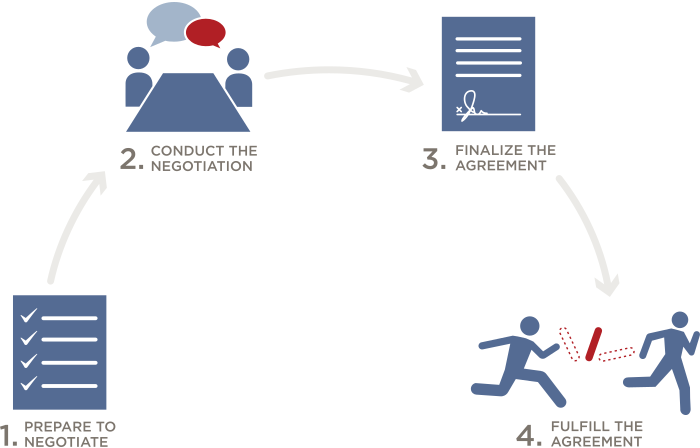
The negotiation process

phases_of_negotiation_whats_involved
phases_of_negotiation_whats_involved

Every negotiation involves different players, interests, and goals. Despite those differences, most negotiations follow the four phases shown here. Once you understand the process and strategies for each phase, you can adapt your approach to individual situations.

第 5 节

APPLY

Test your understanding and reinforce what you’ve learned.

Try it Out

1. You are well known for your work in mediating labor disputes on behalf of the airline industry. What is one of the approaches you take to achieve success in negotiations?
答案与解析

You keep each negotiation phase completely separate from the next.
When negotiating, you should use each phase to prepare for the next.

You admit to your mistakes and address them appropriately.(正确)
You should communicate openly and admit your mistakes. By doing so, you build and maintain long-term relationships.

You enhance the outcome by becoming emotionally involved with the issues.
You should not become emotionally involved with the issues. Remain objective to produce the best possible outcome.

You make your position clear by doing most of the talking.
You should not spend most of the time talking. By actively listening, you will gain information that can help lead you to potential areas for compromise.

第 6 节

REFLECT

Reflecting on your learning helps you apply relevant concepts to your job.

Take a Moment

1. 1. What new insights do you have that could benefit you or others in your workplace?
2. 2. What are your biggest opportunities for applying concepts from this Lesson in your workplace?

Further reading

AI 如何重塑供应商谈判
在复杂供应链中,对于速度、可扩展性和战略敏捷性的需求正在推动 AI 彻底变革供应商谈判。AI 最初被用于自动化低价值任务…
“价值创造式”谈判,超越零和 no local body
在我培训管理者如何更有效地谈判时,有一个模拟场景涉及公司内两个部门之间的技术转让。谈判的核心是技术转让的价格,但也需要考…
谈判中,如何让步才是最佳策略?
在谈判的每一轮中,你应该调整多少你的报价?这是一个很重要的问题:让步幅度太大,会贬低你的报价;让步幅度太小,则有可能陷入…

Top 3 in the source platform's original order