
Set Goals 查看中文版
第 1 节

You set many different goals in your work. In a typical day, you probably think about how your group could operate more smoothly, what new responsibilities you could take on, and how your direct reports could work better as a team.
Your challenge is to sort through all of these concerns and set goals that will create the most value for your group and your organization when they are achieved. Here are some ways to begin.
Brainstorm with your team
With your team, explore questions such as:
-
What initiatives do we need to accomplish to support our organization’s goals?
-
How could we make the biggest difference in our group’s performance?
-
What do our customers want from us?
-
How is the marketplace changing? How could we take advantage of new opportunities and manage new threats presented by these changes?
Use your networks
Talk with others throughout your organization about what they see happening in the competitive environment and what they're hearing about the organization's strategic priorities. Talk with key suppliers and customers to learn how outsiders view your organization's reputation and products. Use the insights you gather, along with your own ideas, to set goals for your group.
EXAMPLE
基于协作设定目标 Collaborative Goals
哈佛教授讲授视频逐字稿
Prioritize your goals
As you brainstorm with your team and use your networks, you may start generating ideas for many different potential goals for your group. You’ll need to prioritize them—that is, determine which ones you’ll pursue, and in what order.
To prioritize your goals, ask which ones would:
- Generate the most value for your organization (such as new efficiencies or new strategic advantages)
- Deliver the biggest improvements in your group’s performance, such as its productivity, efficiency, or profitability
- Best position your team to achieve even more success in the future
An organization or team that has too many conflicting goals will struggle to achieve the most important and valuable ones. One way to prioritize goals is to compare them side-by-side to decide which ones to focus on now, and which to leave for later. Set aside goals that are not an immediate priority, but are still valuable, on a waitlist for future attention.
EXAMPLE
The A-B-C of prioritization
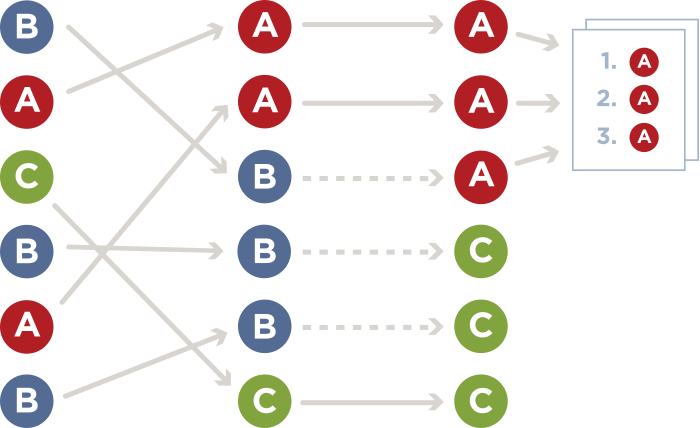
You can also review your list of goals and rank each as A-, B-, or C-level priority. You’ll use two criteria to rank a goal’s priority level:
- Value: The benefits that achieving the goal would deliver for your group and/or organization.
- Importance: The degree to which achievement of a particular goal would support your group’s or organization’s objectives.
EXAMPLE
With these criteria of value and importance in mind, follow these steps:
1. Look at each goal on your list and decide whether it’s A-, B-, or C-level priority.
- Priority A goals have high value and primary importance.
- Priority B goals have medium value and secondary importance.
- Priority C goals have some value but not much importance right now.
2. Put Priority C goals aside for now, delegate them, or cross them off your list.
3. Look at your Priority B goals again. Reassign them as Priority A if you think they’re worth your time—and Priority C if they’re not. Disregard or delegate any goals you’ve just reassigned as Priority C.
4. Designate the goals that are now on your Priority A list as your top-priority goals.
5. Rank your Priority A goals according to their relative importance. Don’t assume that just because a goal is short term that it automatically has greater importance over a longer-term goal.
6. Write down your final Priority A list of goals, ranked by importance.
7. Commit to reviewing your list periodically to ensure that it still reflects your group’s and organization’s priorities.
Making room for new goals
Worksheet for Prioritizing Goals
Align employee goals with unit and organizational goals
Each of your direct reports needs to set individual goals that support the group’s goals, which in turn support the organization’s goals. Your role is to help employees with this process. Each of them should be able to say:
“Our organization’s goal is to _____________. My department’s contribution to that goal is to _______________. And my part in this effort is to ____________.”
To provide this support:
- Ensure that all team members are clear about the group’s goals, their individual roles, and your job expectations for each.
- Ask them to draft or modify their individual goals and express them in clear terms.
- Negotiate the details on commitments to particular goals, including your role in supporting them in achieving each goal.
- Describe what team members are expected to do. Confirm that everyone knows who is responsible and accountable for each goal.
- Tie performance evaluations to accomplishing goals.
Helping team members set individual goals
Try it Out
Make a Connection
第 2 节
The most effective goals have several defining characteristics:
Worksheet for Setting Effective Goals
Challenging
Effective goals inspire you and your group to “stretch”—without making anyone feel overwhelmed or sapping their motivation.
EXAMPLE
Stretch goals can be characterized by:Sim B. Sitkin, C. Chet Miller, and Kelly E. See, "The Stretch Goal Paradox," Harvard Business Review, January-February, 2017
- Extreme difficulty: They go beyond a group's or organization's current capabilities and performance.
- Extreme novelty: They require brand-new approaches to achieve.
Even if they are a stretch, goals must be realistic. As you set challenging goals, make sure you have a solid plan and the resources needed for reaching them. If goals are unreasonable, failure to meet them could be demoralizing and frustrating for everyone involved. One study of stretch goals in organizations identified two factors that consistently seem correlated with success at reaching such goals:
- Recent performance. If your group has just surpassed an important benchmark in its own history, it's better positioned to tackle a stretch goal. Why? Winning affects attitudes and behaviors positively. When facing an unusually challenging task, employees in a group that has had a recent major success will be more likely to see an opportunity, show optimism, and demonstrate flexibility as needed to score another success.
- Surplus resources. If your group has more funds, knowledge, skills, expertise, people, equipment, and other resources than it needs, the extra resources can be used to experiment with new ways of doing things so as to achieve a stretch goal and to recover from any failures.
设定延伸目标的艺术 The Art of Stretch Targets
哈佛教授讲授视频逐字稿
Balanced
Some goals can be measured quantitatively; that is, by using numbers. Examples include increasing sales in a region by 10% in the next quarter, or lowering manufacturing costs by 20% within six months.
You may find it tempting to set mostly quantitative goals because they are easy to measure. But many important goals are qualitative—not so easy to express in numbers. Examples include employee morale, job satisfaction, and performance on skills such as making presentations.
Though it can seem difficult to measure how well a group has achieved its qualitative goals, be sure to include such goals as you go through the goal-setting process. When you do, think about how you might assess progress toward these harder-to-measure goals.
EXAMPLE
Clearly expressed
Effective goals are expressed in clear, unmistakable terms. Such clarity encourages shared understanding of exactly what the group plans to accomplish. Clarity therefore strengthens the group's commitment to achieving the goal. It also reduces the chances of disagreement over whether the group has met the goal.
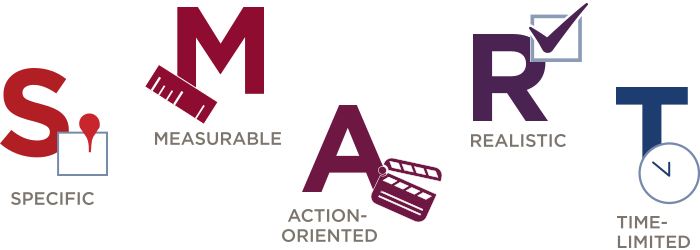
The “SMART” acronym can help you express your goals in clear language:
- Specific. Clearly defines what will be accomplished.
- Measurable. Gauges success using quantitative or qualitative measures.
- Action-oriented. Can be attained through specific behaviors or processes.
- Realistic. Can be achieved given existing constraints, such as time and resources.
- Time-limited. Will be accomplished within a specific time frame.
However, keep in mind that the SMART test can't tell you whether the goal itself is a good idea. It's how you approach the process of identifying and prioritizing your goals that really helps you gauge which goals are worth pursuing.Dick Grote, "3 Popular Goal-Setting Techniques Managers Should Avoid," Harvard Business Review, January 2, 2017
Also, take care that the acronym doesn't tempt you or your team to set low goals. The best way to use the SMART acronym is to check whether the goals you create are clearly stated—not to determine which goals you should be focusing on.
以通俗易懂的语言表述目标 Setting Your Goals Without Jargon
哈佛教授讲授视频逐字稿
Worksheet for Writing SMART Goals
SMART GOALS
Try it Out
答案与解析
A. Specific
Not the best choice. This objective clearly defines a specific percentage goal and geographic territory.
B. Realistic(正确)
Correct choice! This objective isn't realistic. Kwame's company has just entered an industry that requires significant infrastructure. His organization will need to build or acquire storage facilities. His company is unlikely to have the infrastructure necessary to win 70% of the U.S. market in one year.
C. Time-limited
Not the best choice. The objective clearly establishes a one-year deadline.
答案与解析
A. Measurable
Not the best choice. Shannon will be able to measure whether forms have been completed by comparing them to cash register receipts for canceled orders or returned products.
B. Achievable
Not the best choice. Completing a form is achievable, well within the job description and abilities of sales staff.
C. Specific(正确)
Correct choice! Shannon's objective isn't specific. It doesn't state whom the sales staff should give the forms to or a deadline for receipt of the completed forms.
答案与解析
A. Measurable(正确)
Correct choice! The objective isn't defined in a way that can be measured. Measures are usually either financial or in units of output.
B. Time-limited
Not the best choice. The objective includes a deadline.
C. Realistic
Not the best choice. It's likely that Neela's operations staff has resources with which to increase performance and that the objective is realistic.
第 3 节
As a manager, you're responsible for supporting your employee's professional and personal growth, as well as furthering your own. That calls for setting development goals. Such goals enable people to build their knowledge, skills, and effectiveness in their work, personal, and community lives.
When people set and achieve development goals, they grow in their professional and personal lives, becoming increasingly effective, increasingly satisfied by their achievements, and increasingly valuable to their organizations.
Help your employees set development goals
When you help your team members set professional and personal development goals, you make it clear that you care about what they want for themselves as well as how they can contribute even more to the organization. As a result, you:
-
Enhance their job satisfaction. You keep your people motivated and engaged.
-
Boost job performance. When team members learn new skills as part of their professional development, they can do their jobs more effectively and efficiently.
-
Reduce turnover. Talented and ambitious people are more likely to stay with the organization if they have opportunities to further their development. When you retain valuable employees, you build a stronger workforce for your organization. You also minimize the costs associated with recruiting and training replacements for employees who have left to find organizations that offer more developmental opportunities.
-
Increase innovation. When employees have opportunities to achieve personal development goals, they often bring fresh ideas into their work lives.
EXAMPLE
find meaning at work
哈佛教授讲授视频逐字稿
Set development goals for yourself
When you set development goals for your work, personal, and community life, you achieve a healthy and balanced life and become more effective and satisfied in each of those domains. You also set an example for your direct reports, further encouraging them to set development goals for themselves.
Just as you support your employees in setting their development goals, you can work with your manager to set development goals for yourself. That includes building a shared understanding of the expected outcomes of achieving these goals and securing the support you need to attain them, such as training or new job experiences.
How do you set your professional development goals? Consider identifying unique skills, knowledge, and expertise that you bring to your group's efforts. Examples include:
-
Deploying specific skills, such as creating budgets or determining staffing needs.
-
Supporting team members' work, such as providing data to be included in proposals or coaching individuals on certain tasks.
-
Communicating your group's activities to the broader organization, such as securing resources that your group needs to accomplish its goals and integrating your group's goals with other groups' goals.
To set professional development goals, think about which of these skills or forms of expertise you'd like to strengthen, which new skills or expertise you'd like to gain, and how you might do so. Work with your own manager to craft plans for achieving these goals.
Use a similar process to set personal development goals. For example, ask yourself what you'd like to achieve with your family or friends, how you'd like to better manage your own health, or what skills or knowledge you might contribute to your community.
第 4 节
Test your understanding and reinforce what you’ve learned.
Try it Out
答案与解析
Brainstorm which goals you think you can accomplish most easily.
Don’t constrain your brainstorming by worrying about how you’d accomplish challenging goals—you'll have time to consider how realistic or achievable they might be later.
Keep your goals to yourself to avoid interference from others with competing priorities.
It’s better to build trust by being open about your plans and concerns. When you do, other managers are likely to be equally transparent with you.
Investigate what other departments are doing that could affect your goals.(正确)
It’s a good idea to learn what other groups are doing that will influence progress on your team’s goals—and find out how work toward your goals will affect other groups.
Prioritize your goals and work on all the short-term ones first.
Don’t let short-term goals automatically take precedence over long-term ones.
Try it Out
答案与解析
“By next January, we will reduce costs by implementing time-saving assembly-line upgrades."
While the goal is Time-limited and Action-oriented and may be Realistic, it is too vague to be Specific or Measurable.
“We will work to significantly increase the number of coffee makers produced over the next year by scheduling one additional weekend shift.”
While the goal is Specific, Time-limited, Action-oriented, and may be Realistic, it is not Measurable.
“We will eliminate workplace accidents in six months' time by conducting safety training with all assembly line workers."
While the goal is Specific, Measurable, Action-oriented, and Time-limited, it is not Realistic.
“Over the next quarter, we will use statistical methods to reduce rejects from 15% to 10%.”(正确)
This goal is Specific (reduce error rates), Measurable (the percentage rate is specified), Action-oriented (the use of statistical methods), Realistic (the improvement rate is reasonable), and Time-limited (it will be accomplished in the next quarter).
第 5 节
Reflecting on your learning helps you apply relevant concepts to your job.