Pocket Leadership口袋领导力

Goal Setting

Why Set Goals? 查看中文版

第 1 节

What is goal setting?

Goal setting is a process through which you define targets that create value for yourself, your team, or your organization. When you set goals, you commit to accomplishing certain outcomes—and make a plan for doing so.

Setting and accomplishing goals is an important personal and organizational skill. By learning how to establish clear goals, and then having the discipline to reach them, you help to instill a culture of achievement within your team and organization.

Make a Connection

1. Think about a recent outcome you wanted to achieve. What steps did you take to reach that goal? Did you make as much progress as you hoped you would? Why or why not?

第 2 节

Why goals matter

Goals are crucial to personal and professional success. In contrast to New Year’s resolutions—which seldom include a plan for how to accomplish them—goals give a sense of purpose to your activities. They also make you accountable for certain outcomes.

Through goal setting, you and your team decide where you want to go and what you need to do to get there. When you work with your direct reports to define specific, challenging goals, you help yourself and them achieve high levels of performance.

Setting goals drives performance and boosts motivation in you and your team in several specific ways:Jeff Boss, "5 Reasons Why Goal Setting Will Improve Your Focus," Forbes, January 19, 2017

  • Goals motivate behavior change. When you define a clear and compelling goal, you feel motivated to adopt the new behaviors required to reach it.
  • Goals provide direction. When you set a goal, you naturally direct your attention toward the next step you’ll be taking. Consequently, you mentally lead yourself in the right direction—and your actions follow your thoughts.
  • Goals sustain momentum. When you make progress toward reaching a goal, it feels rewarding. That feeling releases a brain chemical called dopamine, which elevates your mood and energy—and can be addictive.
  • Goals generate feedback. When you change your behavior while trying to reach a goal you’ve defined, you get feedback showing that you’re making progress toward the goal—or not. You can use that feedback to make midcourse corrections as needed.
  • Goals build character. The process of defining your goals helps you gain insight into what’s truly important to you. And as you achieve your goals, you boost your efficacy, which in turn builds character.

目标促进个人和职业发展 The Importance of Setting Goals

哈佛教授讲授视频逐字稿
A sense of purpose can help us find direction and satisfaction at work, motivating us to overcome challenges, seek out opportunities, and develop both personally and professionally. Setting goals, whether for yourself or with your team, helps put a sense of purpose into practice. With a clear goal ahead of you and your team, one that you know supports your organization’s strategy, you feel that you’re working together in the same direction towards something worthwhile. Like a compass helping you map out a journey, goals guide you to take the steps you need to achieve results both in the short and long term. But more than that, they can be invigorating, challenging, fun, and unifying. Think of a time when you set a goal for yourself or your team, worked really hard towards it, and then reached it. Back in the early 1990s, before I was an executive coach, I was part of a team charged with the goal of implementing a completely new concept in the fast food industry, where we were coming directly to consumers in airports, mall food courts, and gas stations. We had challenging targets for the number of fast food kiosks to build. And while that was over 20 years ago, I will never forget the day our team hit 1,000 kiosks opened in North America. Our leader took us all out for a big celebration, and it was such an achievement. And to this day, I have never experienced quite the thrill of being part of a high-performance team that made a difference and met an incredible goal together. So improving your goal-setting skills can have a positive and lasting impact—way beyond simply getting results.

Try it Out

Try it Out

Make a Connection

1. If you didn’t select all the statements above, what can you do differently to set meaningful, motivating goals?

第 3 节

Types of goals

As a manager, you play a role in setting many types of goals:

Organization-focused goals

Organization-focused goals define what will be done to bring value to the unit and organization. They include:

  • Unit goals: What your group as a whole will try to accomplish.

EXAMPLE

Your team wants to redesign a product website to improve your customers’ experience and make it easier for them to learn about and purchase products. EXAMPLE
  • Individual goals: How each employee will contribute to achieving the unit goals.

EXAMPLE

Your web designer sets a goal of researching and selecting a web content management system that will save development time and make the new site easy to maintain and update. EXAMPLE

Personal development goals

To grow as individuals, you and each of your employees need to set personal development goals. These goals can relate to your personal life as well as your professional life.

EXAMPLE

One of your direct reports has a goal of becoming a manager. You suggest that she head up a project team, an experience that would help her develop leadership skills essential for being an effective manager. EXAMPLE

EXAMPLE

You decide that you want to get more involved in grassroots political movements so you can have more input into the policy decisions shaping your life. You set out to learn more about how such movements come into being and how the policy-setting process works. EXAMPLE

Short- and long-term goals

Different goals have different time frames. Some goals you aim to achieve within one or two months; others, in many more months or even years. Often, achieving short-term goals can help you score small wins that energize and encourage you to work toward a more ambitious, long-term goal.

EXAMPLE

You want to lead a major product line at your company, and you know that achieving that goal will take time and effort. In the shorter term, you take on several small projects that will help you build some of the knowledge and skills you’ll need to reach your ultimate goal. These more immediate efforts include learning how to analyze competitors’ offerings and completing a course on product manufacturing and supplier logistics. EXAMPLE

Visionary goals

Andrew Winston, "The Ambitious Business Goals Aiming to Change the World," Harvard Business Review, February 5, 2015
An increasing number of companies are setting and publicly announcing visionary goals that aim to promote deep changes in the world. Examples include: Eliminating traffic accidents involving specific vehicle models Powering transport solely by renewable sources of energy Recycling all of a company’s products at the end of their service life Designing manufacturing operations that generate zero waste Ensuring that people who are performing the same jobs earn the same pay Achieving such visionary goals makes the world a better place and can help a company attract talent and strengthen its brand. But to achieve these goals, companies have to address big questions such as: How will we persuade our suppliers to help us achieve the goal? How might we attract investments from government agencies and other players if we’re facing serious resource constraints? How should we reconfigure key operations such as product development, manufacturing, and logistics? How will we need to interact differently with labor markets (to attract needed talent) as well as product markets (to find sources of demand for new offerings)? Companies that can manage this degree of change stand the best chance of transforming their visionary goals into reality—and creating new value for the world as well as themselves. Visionary goals Andrew Winston, "The Ambitious Business Goals Aiming to Change the World," Harvard Business Review, February 5, 2015

第 4 节

Goal alignment

When individual, unit, and organizational goals are aligned, they support one another rather than work at cross-purposes. Goal alignment helps an organization execute its strategies and reap the business value those strategies promise—such as increased market leadership, innovation, or profitability.

EXAMPLE

An organization seeks to become the market share leader in its industry by swiftly introducing innovative products. To support this strategy, the product development unit sets a goal of hiring additional staff to boost its capacity for designing new products. The sales unit sets a goal of training field representatives on the new products. And the finance unit sets a goal of upgrading its budgeting and reporting software to improve tracking of product sales. Team members within each of those units set individual goals needed to support the unit goals. For instance, Dean, a product developer, decides to study new approaches to product innovation. Huong, the sales team leader, commits to creating new training materials. And Mariana, an accountant in the finance department, resolves to research new software applications and compare their pros and cons. EXAMPLE

In many large organizations, the high-level corporate strategy is influenced by ideas and knowledge flowing up from lower levels. Through their everyday work, managers on the front lines learn about changes in customer needs, technology, and competitors’ moves. They share their knowledge with each other and with higher-level executives. Information from all levels in the organization thus contribute to shaping the organization’s strategy.
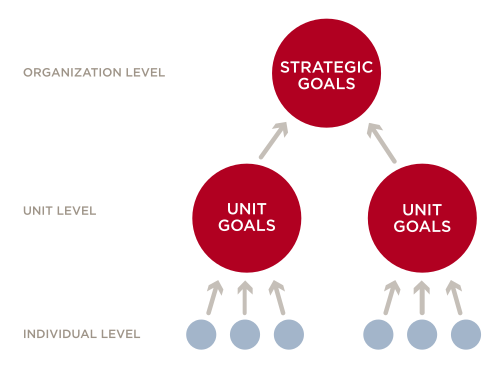
Once managers and employees at all levels understand what the high-level strategy is, they can define goals supporting that strategy. What’s more, individuals and units can explore how the goals they’re setting affect one another, so they can help each other achieve the goals. Understanding such interdependencies is vital. For instance, what information will one unit need from another unit to attain its newly defined goal? What tasks will one unit have to perform for another?

Every employee needs to understand how their work-related goals support the unit's goals, and how achievement of the unit’s goals will help the organization reach its strategic objectives.

成功人士如何实现目标 How Successful People Reach Their Goals

哈佛教授讲授视频逐字稿
Why have you been so successful in reaching some of your goals but not others? If you aren’t sure, you are far from alone in your confusion. The intuitive answer that you were born predisposed to certain talents and lacking in others is really just one very small piece of the puzzle. In fact, decades of research on achievement suggest that successful people reach their goals not simply because of who they are, but more often because of what they do. Based on my review of the research literature in psychology, here are four tips on how to set and achieve your goals. First, get specific about what you want to achieve. Also, think about the specific actions that need to be taken to reach your goal. Just promising you’ll get better at responding to email is too vague. Be clear and precise: “I’ll acknowledge every email within 24 hours” leaves no room for doubt about what you need to do and whether or not you’ve actually done it. Second, decide where and when you will act on your goals. Given how busy most of us are and how many goals we are juggling at once, it’s not surprising that we routinely miss opportunities to act on a goal. Did you really have no time to work out today? No chance at any point to return that phone call? Achieving your goal means grabbing hold of these opportunities before they slip through your fingers. Again, be as specific as possible. Block out time in your calendar. For instance, you might decide that if it’s Monday, Wednesday, or Friday, you’ll spend 30 minutes at 9:00 a.m. researching new sales leads. Studies have shown that this kind of planning will help your brain detect and seize that opportunity when it arises, increasing your chances of success by roughly 300%. Many of us believe that our intelligence, our personality, our physical aptitudes are fixed—that no matter what we do, we won’t improve. As a result, we focus on goals that are all about proving ourselves rather than developing and acquiring new skills. Try to shift your mindset to a “get better” mindset instead of holding yourself to impossible standards of perfection. Finally, focus on what you will do, not what you won’t do. Research on thought suppression has shown that trying to avoid a thought makes it even more active in your mind. For instance, if I tell you not to think about white bears, then all you’ll end up thinking about is white bears. The same holds true when it comes to behavior. By trying not to engage in a bad habit, our habits get strengthened instead of broken. If your goal is to overcome a bad habit, like losing your temper at work, focus on what you’ll do instead. For example, if you’re trying to gain control of your temper, you might make a plan like, “If I’m starting to feel angry, then I will take three deep breaths to calm down.” By using deep breathing as a replacement for giving in to your anger, your bad habit will get worn away over time, until it disappears completely. Remember, you don’t need to become a different person to become a more successful one. It’s never what you are, but what you do.

Poll

Poll

第 5 节

REFLECT

Reflecting on your learning helps you apply relevant concepts to your job.

Take a Moment

1. 1. What new insights do you have that could benefit you or others in your workplace?
2. 2. What are your biggest opportunities for applying concepts from this Lesson in your workplace?

Further reading

你的战略规划目标是否定得过高,还是不够有挑战性?
你的战略规划应该有多大的雄心?如果目标定得太低,你可能会只是获得一些渐进式的提升;如果目标定得太高,则有可能让整个组织感…
新年新决心
涉及完成任务的策略时,我会做出不同尝试。2020 年,我短暂做过子弹笔记,开始但没完成的有《创意,是一笔灵魂交易》(Th…
成功的宗旨宣言有何不同
遗憾的是,在许多组织中,宗旨宣言往往只是空洞的口号。这些企业并未兑现宣言中那些崇高的承诺。但贝恩公司(Bain & Co…

Top 3 in the source platform's original order