Business Case Development
Understand Business Cases 查看中文版
第 1 节
What is a business case?
As a manager, you may spot opportunities to help your team, unit, or organization meet important business goals. You may feel pressure to propose a quick solution in order to seize the opportunity. But recommending an action without considering a range of alternatives is risky—and likely to be rejected by decision makers.
Instead, prepare a business case: a document or presentation in which you compare multiple alternatives and propose a single course of action that creates the most value.
Your goal when creating a business case is to help people decide whether to invest resources in your idea. If you’re making a case for a project or initiative within your organization, you already have access to what you need to present a winning case: information about key stakeholder concerns and your organization’s strategic priorities.Sheen, Raymond and Amy Gallo. HBR Guide to Building Your Business Case. Boston: Harvard Business Press, 2013.
Business case vs. business plan
While the terms business case and business plan are often confused, they address different business questions.
A business case answers the question: “What happens if we take this course of action?” For example, if your unit is considering expanding sales to a new market, your boss might ask, “Which of three alternative markets should we invest in to create the most value? Should we even make this investment?”
A business plan describes how an organization or business unit intends to navigate successfully through its unique competitive environment. Business plans feature long-range projections of revenues, expenses, business strategy, and other information. Typically, managers and executives use business plans to secure financing from investors or to plan strategy execution for an organization or business.
Business case vs. business plan
第 2 节
When to create a business case
The process of building a business case is similar to solving any problem. For example, suppose you don’t have enough staff to accomplish your responsibilities, or you believe your company’s competitors use more efficient processes at lower costs. Developing a business case helps you identify potential solutions and sell the best solution to decision makers.
A business case is useful when you want to:
-
Demonstrate the organizational benefit of a proposed product or service
-
Prioritize projects within your group and identify which ones to eliminate
-
Show the value of a product or service to a customer to make a sale
-
Obtain additional resources for a new project or initiative
-
Modify an existing offering
-
Invest in a new capability, such as a software program or training
- Decide whether to outsource a particular function
商业论证的 3F 原则 Create and Deliver a Strong Business Case
哈佛教授讲授视频逐字稿
A business case is a call for action. Whether you’re an entrepreneur with an idea for a startup or a team member trying to help you group excel, it’s a plan to shake up the status quo in pursuit of a worthy goal. As a partner with the Cambridge Group, my role is to help companies lead their markets by expanding them, to drive growth by creating new categories. We make our business cases focusing on three F’s: facts, faith, and fortitude.
The first and most important F is facts. Your case for change is only as strong as your understanding of both the status quo and the potential for future growth. You need research to help other stakeholders see the opportunity. Here’s an example. Swingline is a well-established company that sells products that aren’t exactly cutting-edge—staplers. The conventional wisdom said that there wasn’t much growth potential in the business. But then, with our guidance, they dug a little deeper. Swingline discovered that about a third of their customers drove 80% percent of their profits. These folks were stapler super-consumers. They needed high-performance devices to do their jobs and were willing to pay for them. So Swingline developed a growth strategy to focus on high-performance products lines and doubled its heavy-duty stapler sales in nine months.
The second F is faith. Faith is a purpose that includes but goes beyond profit. There are two kinds of informed faith. The first is confidence in the path suggested by the facts. The second is a firm belief in the importance and inherent goodness of what you are doing. Most people don’t think twice about a stapler. But if you depend on one to do your job, then its quality really matters. It took faith for Swingline to dedicate their growth strategy to these super-consumers to a broader purpose beyond just profits. And that faith was rewarded.
The final F is fortitude. Change is not easy for people or for businesses. Even if the facts point us in new directions, staying the course can seem like a safer bet. But when you look at some of the best-known success stories in business, you find very few that hit it big right away. For example, the iPad wasn’t Apple’s first foray into tablet computing. Anyone remember the Newton? It takes fortitude to commit to and embrace a new, surprising business case. Swingline showed its commitment to change when one of the major office supply retailers that sells its lines resisted the move into higher-end products, insisting that no one cares about staplers, and that they would always be low-margin commodities. Swingline persisted with other retailers who were ultimately able to join in its success.
Quite simply, it takes guts to pursue an unfamiliar path. And that’s what makes the right business case so important. When you provide stakeholders with a fact-driven vision of the future and demonstrate faith and fortitude in achieving it, you can change their response from, “It’s too risky to try” to “It’s too risky not to try.”
Make a Connection
1. Describe one or two opportunities you’ve spotted to help your team, unit, or organization meet important business goals.
第 3 节
Know your organization’s processes
Sheen, Raymond and Amy Gallo. <em>HBR Guide to Building Your Business Case</em>. Boston: Harvard Business Press, 2013.
Before you create a business case, learn how your organization reviews and approves initiatives. For example:
-
Does your company have a formal process for evaluating business cases? In some organizations, business cases are reviewed only at specific times during the year, such as during the annual budgeting process.
-
Are projects approved in phases, or is an entire project approved at once? Many companies have a tollgate process in which the business case is only for the initial discovery phase. If stakeholders approve the project, they’ll ask the team to break the rest of the project into phases—such as development and testing—and return for subsequent approvals.
Check in with colleagues
Sheen, Raymond and Amy Gallo. HBR Guide to Building Your Business Case. Boston: Harvard Business Press, 2013.
If your organization doesn’t have a formal business case review process, find out what people around you have done to get approval for their initiatives through a more informal process. Meet with colleagues to learn what materials they used, whose help they enlisted, what problems they encountered, and what mistakes they made. Knowing what’s worked at your organization—and what didn’t—will boost your own initiative's chance of success.
Check in with colleaguesSheen, Raymond and Amy Gallo. HBR Guide to Building Your Business Case. Boston: Harvard Business Press, 2013.
第 4 节
Identify decision makers
Sheen, Raymond and Amy Gallo. <em>HBR Guide to Building Your Business Case</em>. Boston: Harvard Business Press, 2013.
Often one individual or a group will decide whether or not your initiative gets approved. Find out who will be evaluating your idea. Then work with your boss to identify:
-
What they stand to gain—or lose—from the opportunity
-
Who or what influences them most
-
Similar initiatives they have supported in the past
-
How they like to receive information
-
How they tend to make decisions
Knowing how decision makers behave and what they care about will help you tailor your business case to the right audience.
第 5 节
The development process
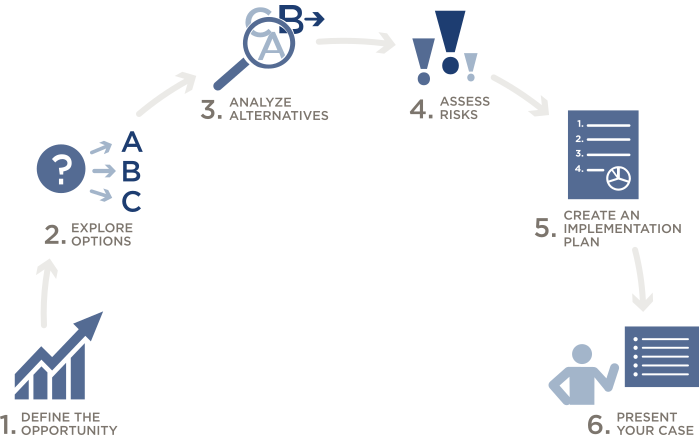
Once you’ve learned how business cases are approved in your organization and what decision makers value, follow six steps to build your case:
-
Define the opportunity. Describe the situation and the business objectives your proposal will impact.
-
Explore options. Brainstorm multiple approaches and choose three or four to analyze.
-
Analyze alternatives. Examine how your options will affect the business objectives and choose one to move forward with.
-
Assess risk. Evaluate how you will mitigate risks associated with your recommendation.
-
Create an implementation plan. Identify, at a high level, how you will achieve your goals and who will be accountable for each milestone.
-
Present your case. Create a document, a presentation, or both, to sell your recommendation to decision makers.
To build a compelling business case, you need to complete each step. However, the depth of analysis and extent of documentation necessary to support your case will vary depending on the initiative’s scope, costs, organizational impact, and risk.
撰写一份坚实可信的商业论证 Making Your Ideas Credible
哈佛教授讲授视频逐字稿
Imagine you are the CEO of a big corporation, so many people walk up to you with big ideas, wanting you to invest in their ventures or in the ideas they are suggesting. How does a CEO decide whether he should go ahead or should not unless it is backed up with a good business case? And that is why I think backing up your idea with a good, sound business case is the most important thing if you want to take your idea ahead.
Let me tell you a few more tips about building up a business case.
First, be sure of your facts. Cross-check them, talk to people, make sure that whatever facts you are mentioning in your business case are verifiable and correct.
Point number two, make sure that your assumptions are realistic and achievable. We have this tendency to put in assumptions that will never be met and that would take the whole business case down when you are defending that case in front of the management.
The third critical thing is to really be clear about your business case. Prepare it well. Put some amount of effort in it. It will go a long way in taking your ideas further.
And last but not the least, communicate well—be able to stand up in front of the management and clearly articulate your idea and your business case so that people can understand well what you are trying to achieve. It gives so much more credibility to your ideas.
Try it Out
Think of an opportunity for which you would like to design a business case. Start to build your case by responding to these questions:
1. What is the opportunity?
2. What are two or three options for addressing it?
3. Which alternative best meets your business objectives?
4. How can you and your team mitigate any risks associated with this alternative?
第 6 节
REFLECT
Reflecting on your learning helps you apply relevant concepts to your job.
Take a Moment
1. 1. What new insights do you have that could benefit you or others in your workplace?
2. 2. What are your biggest opportunities for applying concepts from this Lesson in your workplace?
Further reading
Top 3 in the source platform's original order
