
Understand Sensitivity Analysis and Variance 查看中文版
第 1 节
Through sensitivity analysis, you apply "what-if" situations to your budget to see the effect of a potential change on the original data.
Sensitivity analysis lets you test the assumptions in your budgets and explore the potential impact of alternative scenarios or courses of action. It thus makes your budgets even more valuable as tools for planning and making course corrections.
Many organizations perform sensitivity analysis for their regular operating budgets. But sensitivity analysis is more commonly used for capital budgeting than operational budgeting: Since capital assets generally constitute large investments that a company pays for over a long time period, capital expenditures that prove to be bad decisions can consume precious resources for many years, hurting a company's performance.
Some organizations, such as financial institutions, are required by law to do sensitivity analysis, also known as "stress testing," every year.
Sensitivity analysis software
Poll
Sensitivity analysis and operating budgets
When you use sensitivity analysis while creating operating budgets, you ask what would happen if important inputs for your budget calculations—such as sales of a product you're responsible for, or the cost of materials that go into the product—turn out to be higher or lower than you expected.
Henry is a marketing manager. In developing his operating budget, he explores the following what-if scenarios to gauge their impact on his group's operating income:
table
A scenario where unit sales increase by 10% would obviously have the most positive impact on Henry's operating income. So he identifies the actions needed to achieve that 10% increase in unit sales, such as hiring additional marketing professionals. And he includes in his budget the cost of resources he'll need to carry out those actions.
Sensitivity analysis and capital budgets
When used in capital budgeting, sensitivity analysis can help you evaluate the potential of investment opportunities. Net present value (NPV) calculations can play a major role here by helping you gauge the impact of changes in factors such as discount (interest) rates or inflation rates on the relative costs and benefits of investments you're considering.
If your organization is like most, you have limited resources available for investments. Cost/benefit analysis is critically important. Sensitivity analysis is one approach to cost/benefit analysis; it helps you select the most promising opportunities.
案例
Make a Connection
第 2 节
All budgets are based on assumptions about what might happen in the future. So actual business results for the future time period stipulated in a particular budget may differ from what was in the budget.
Variance is the difference between the actual results produced by your group and the results you've budgeted for. Cost variance represents the difference between actual costs and expected costs. Revenue variance is the difference between actual revenues and expected revenues. Variance can be favorable—for example, sales increase more than anticipated or a capital investment delivers a greater return than originally calculated. Variance can also be unfavorable—for instance, costs exceed projections or a capital investment delivers an unexpectedly low return. Keep in mind that unfavorable variances are not always bad for business: An unexpected increase in spending might well mean an increase in demand for your products or services.
Revenue Variance Analysis: An Illustration
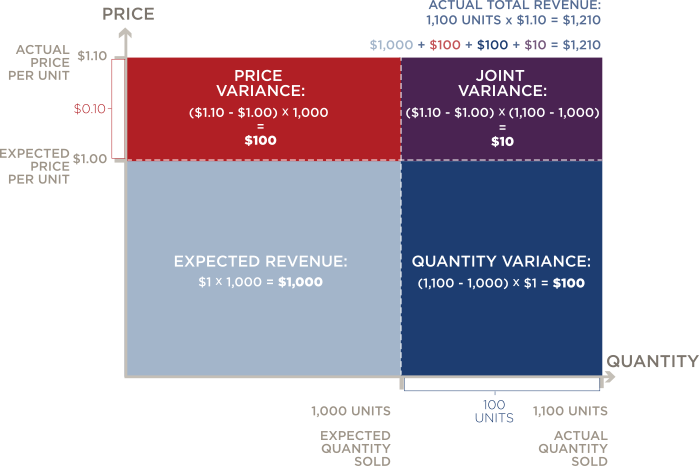
This diagram shows a widely used method of breaking down the two key components of revenue variance: price and quantity. Usually, the difference between actual and expected revenues is the result of differences in both price and quantity. (The same is true with cost variance.) When both the price and quantity differ from their expected values, the result is known as joint variance.
Variance Analysis: An Illustration
成本差异分析入门 Deciphering Cost Variance
哈佛教授讲授视频逐字稿
By comparing actual to budgeted results, you can consider whether you need to take corrective action. With unfavorable variances, you’ll likely want to take action so future results will be closer to your budget. For instance:
It's rare that a variance (especially a cost variance) is the result of only one input. A variance can come from a quantity change or a price change, and it's important to break down the figures to determine the cause. And even with one input, you will sometimes need to dig a little to understand the reason for the variance before taking action. For instance, lowering employees' hourly wage rate might not yield savings. If offering lower wages results in the hiring of inexperienced workers, your employees' lack of skills may translate into more hours of work—or rework. And if cutting the cost of materials results in a lower-quality product, your company might end up losing sales.
案例
Revenue Variance Analysis
In this activity, identify the source of revenue variance by looking at underlying volume and price data. Choose the best action, if any, the manager in the scenario might take.
Try it Out
答案与解析
A. Tara should take action to address an unfavorable quantity variance.
The quantity of burgers sold exceeded the budgeted amount, so it is a favorable quantity variance.
B. Tara may not need to take any action to address a favorable quantity variance.(正确)
The quantity of burgers sold exceeded the budgeted number, so it is a favorable quantity variance. With unfavorable variances, you want to take action so future results will be closer to your budget. But with a favorable variance, you may not need to take any action.
C. Tara may not need to take any action to address a favorable revenue variance.
No information has been provided about the type of revenue variance. This is a favorable quantity variance, since the quantity of burgers sold exceeded the budgeted number.
答案与解析
A. Tara should take action to address an unfavorable revenue variance.
No information has been provided about the type of revenue variance yet. So far, Tara has looked at the quantity variance and the price variance.
B. Tara may not need to take any action to address a favorable revenue variance.
No information has been provided about the type of revenue variance yet. So far, Tara has looked at the quantity variance and the price variance.
C. Tara should take action to address an unfavorable price variance.(正确)
The average price of burgers sold was below the budgeted average price, so it is unfavorable. By comparing actual to budgeted results, you can consider whether you need to take corrective action. With unfavorable variances, you want to take action so future results will be closer to your budget. For instance, in this case, Tara may want to investigate how to raise the selling price.
答案与解析
A. An unfavorable revenue variance resulting from a favorable quantity variance and a favorable price variance
One component of the revenue variance is an unfavorable price variance. The revenue variance is unfavorable, because it is the result of the combination of an unfavorable price variance and a favorable quantity variance.
B. An unfavorable revenue variance resulting from an unfavorable price variance and a favorable quantity variance(正确)
The revenue variance is unfavorable and results from the combination of an unfavorable price variance and a favorable quantity variance. With unfavorable variances, you want to take action so future results will be closer to your budget. In this case, since the quantity sold is favorable—above what was budgeted—Tara needs to consider if she can take corrective action on the selling price, which is below what was budgeted. Tara needs to examine how Great Burgers might increase the selling price.
C. An unfavorable revenue variance resulting from an unfavorable price variance and an unfavorable quantity variance
One component of the revenue variance is a favorable quantity variance. The revenue variance is unfavorable, because it is the result of the combination of an unfavorable price variance and a favorable quantity variance.
第 3 节
A budget variance report helps you and others in your organization gauge your group's performance by comparing budgeted results to actual results. Such a report is important for monitoring overspending and underspending, which is particularly critical in volatile economic periods.
If resources are scarce, overspending can pose a serious threat to your group's operations or projects you're managing. Underspending might lead to a problem in quality control, such as a manufacturing group that has cut back on quality assurance staff and equipment.
Variance reports are created by an organization's finance department. Once actual results for a budget's accounting period have come in, the department uses the general ledger system to calculate variances. Reports indicate whether variances are favorable or unfavorable, and show them as percentage differences between what is budgeted and the actual results. Reports also include explanations for variances.
Here’s a budget variance report developed for the communications department in one organization, with brief explanations for the variance in each item:
report_variance_table
Explanations
-
Salaries exceeded budget chiefly due to accelerated hiring.
-
Benefits exceeded budget chiefly due to accelerated hiring.
-
Consulting expenditures came in below budget primarily due to a delayed project start.
-
General and administrative expenditures were lower than budget due to cost cutting.
-
Facility and related expenditures were above budget due to new landscaping charges in lease.
第 4 节
The budget shouldn't be seen as a static item that is updated according to the calendar. Conditions change. Opportunities and challenges can arise unexpectedly.
An important development—a new competitor, a regulatory change, a novel technology, even a natural catastrophe—can affect your company well before the next budgeting period. So can bad financial news. The sooner such information is shared, the more time the company has to respond, either to take advantage of the opportunity or to stave off losses.
Keep your bosses informed—and encourage your team to do the same with you—so the budget can be adjusted to your company's greatest advantage.
追踪和编制预算时要保持坦诚 Use Bad News to Your Advantage
哈佛教授讲授视频逐字稿
第 5 节
Test your understanding and reinforce what you’ve learned.
Try it Out
答案与解析
“It can be useful when making course corrections.”
Sensitivity analysis is a helpful tool for course corrections.
“Companies find it to be a very valuable overall planning tool.”
Sensitivity analysis is a valuable planning tool.
“It’s a way to apply ‘what-if’ situations to your budget.”
Sensitivity analysis allows exploration of alternate scenarios using “what-if” situations.
“Companies use it exclusively for testing operating budgets.”(正确)
Sensitivity analysis is more commonly used in capital budgeting than operational budgeting due to higher stakes.
Try it Out
答案与解析
Increase the selling price to reduce unit costs.
Increasing selling prices is appropriate when higher costs arise from increased raw material or labor costs, not higher sales.
Take no action.(正确)
If increased production costs result from higher sales, no further action is required.
Reduce fixed expenses.
Reducing fixed expenses is appropriate for lower revenues, not higher sales.
Reduce other expenses to reduce unit costs.
Reducing other expenses is appropriate when costs increase due to raw materials or labor prices.
第 6 节
Reflecting on your learning helps you apply relevant concepts to your job.