
Achieve More of What Matters as a Team 查看中文版
第 1 节
Every team feels pressure to churn out more. How can you help your team be as productive as possible without causing resentment or burnout?
First, let’s get clear about what productivity is. People often confuse productivity with output, but they’re not the same thing.
Output is the amount that’s produced, regardless of the quality.
True productivity is accomplishing more of what matters. It’s not about pushing a team to simply do more.
Try it Out
答案与解析
A. Chatty coworkers
Nice try. Chatty coworkers came in second. Respondents chose poor leadership as the biggest roadblock to team productivity.
B. Unnecessary meetings
Not quite. Unnecessary meetings came in third. Respondents chose poor leadership as the biggest roadblock to team productivity.
C. Poor leadership(正确)
Yes! Respondents most often blamed poor leadership for low productivity. To be productive, teams need someone to help set the direction and provide a sense of purpose.
Make a Connection
第 2 节
As a leader, you play an important role in helping your team make the most of its efforts. Where should you start? By narrowing in on their most important work.
Did you know?
When a team is focused on how they can produce the most value, members invest their time and energy well. They don’t try to “do it all” and instead concentrate on their top priorities—a strategy that lets them meet their goals while minimizing stress.
To help your team stay productive:
Having a vision—a clear and compelling mental image of a better future to steer toward—can also help your team focus.
To learn more about how to create a vision with your team, see the Harvard ManageMentor “Define Yourself as a Leader” lesson in the Leading People topic.
Take a Moment
第 3 节
Even in high-performing groups, complexity naturally creeps in and can erode a team’s effectiveness and efficiency.
To prevent that from happening, regularly evaluate your team’s processes, structures, and goals. Ask yourself: How can we make this simpler? More intuitive? Less cumbersome?
Seeking simplicity doesn’t mean making the team’s work less ambitious or important. Instead, it involves looking for the clearest paths to achieving your big goals.
Seek ways to give people quicker access to resources, more timely answers to questions, and easier ways to connect with each other, even if they work from different locations.
Use your influence to eliminate bottlenecks, clear up miscommunications, and streamline processes or offerings. For example:
-
Based on usage data, you notice that customers no longer use an old feature that takes a long time to update. You work with the team to come up with a proposal to eliminate this feature.
-
You learn that team members spend hours perfecting multiples slides for your monthly team update meeting. You propose a limit of one slide per person.
Take a Moment
第 4 节
When a team isn’t the right size, productivity suffers. Too small and people will be spread too thin. But often, the problem is that the team is too large: People become members by default rather than out of necessity.
The bigger the team, the more likely you’ll have miscommunications, inefficiencies, and unequal effort among members.
Why more isn’t better
Some research suggests that the ideal team size—in which the benefits of greater brainpower outweigh the need for increased coordination—is between three and six people."The Ideal Team Size At Work May Be Smaller Than You Think," by Jaime Potter. Forbes, April 27, 2020
Poll
第 5 节
Productivity depends on good, timely decisions.
Making decisions that everyone on the team can rally behind can be tricky and requires your leadership. While your team will look to you for the right decision-making approach, they’ll also want to feel heard and consulted—and rightfully so. It falls to you to draw the right balance, so your decisions are quick and timely but also well considered.
Let’s hear from Harvard Business School professor Amy Edmondson as she shares best practices for how to lead your team in discussions prior to making decisions.
做出明智的团队决策 Make Good Team Decisions
哈佛教授讲授视频逐字稿
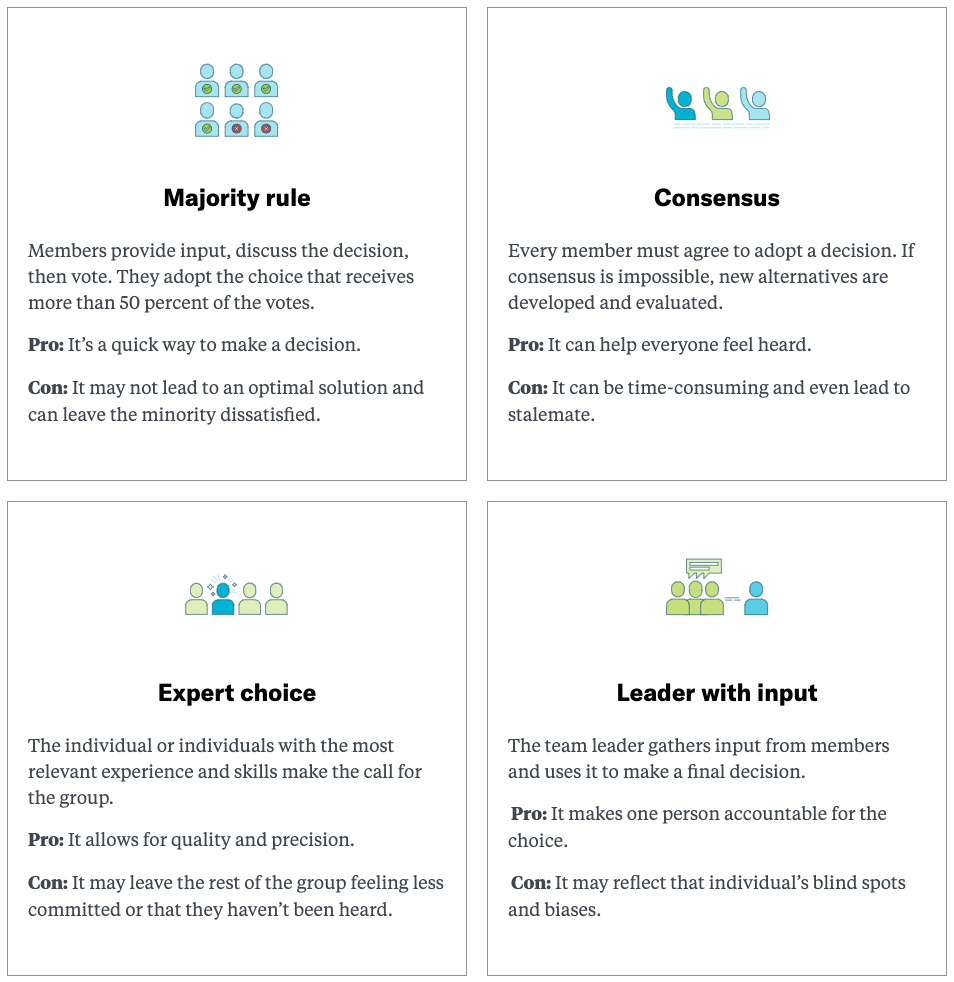
Once you’ve gathered input, explored the implications of the different courses of action, and gotten people’s opinions, it’s time to decide.
Here are a few common methods for team decision making:
Try it Out
答案与解析
A. Consensus(正确)
Good call! This is a big decision, so it makes sense to invest time in thoughtful conversations and analyses. Every team member needs to feel heard and motivated for the group to succeed.
B. Majority rule
Try again. Majority rule is probably not the best approach, because Shareen needs everyone to feel heard and be motivated to put forth their best effort. The correct response is “consensus.”
C. Expert choice
Not the best choice. Because this decision will affect the whole team, it’s important for everyone’s voice to be heard. The correct response is “consensus.”
答案与解析
A. Consensus
Not the best choice. Since the team has already given feedback on both bids, consensus may not provide valuable new insight or be worth the time it takes. The correct response is “leader with input.”
B. Leader with input(正确)
Good choice! Kaori has heard from the team, but since this is a significant business deal, it’s smart for her to be accountable for the final decision.
C. Majority rule
Not the best choice. Putting this kind of significant business deal to a vote may not produce the best decision. The correct response is “leader with input.”
Finally, decisions aren’t always linear—or definitive.
While you don’t want constant flip-flopping, many decisions should be revisited and refined as the team learns from experience. It’s part of being agile!
Assess Your Decision-Making Process
Common Decision-Making Approaches
第 6 节
What’s another common factor that undermines productivity? Too many poorly planned meetings!
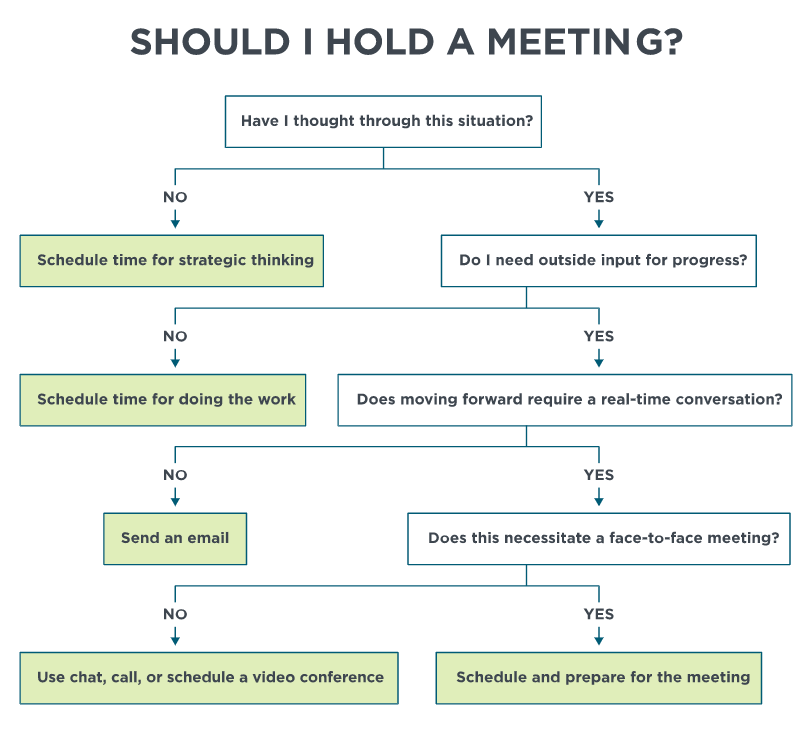
To make your meetings worth the time invested, first ask: Do we actually need to meet?
Use this diagram to help you decide: "Do You Really Need to Hold That Meeting?" by Elizabeth Grace Saunders. Harvard Business Review, March 20, 2015
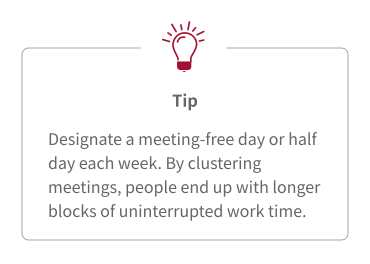
Also, to reduce the need for meetings, consider scheduling “high-availability hours”—a consistent two- or three-hour window each day when team members agree to quickly respond to messages. That kind of rapid-fire communication often helps teams make progress on important work.
Equally important: By choosing a window of “high-availability hours,” you’re also ensuring team members can turn off alerts and focus without interruption at other times. This kind of solo work is also critical for productivity.
When you do need to hold a meeting, make sure you and your team do it effectively:
-
Find time on people’s calendars.
-
Invite only the people who need to be there.
-
Create an agenda that includes a clear purpose.
-
Provide materials for review in advance.
-
Manage time effectively during the meeting.
-
Build in pauses for input.
-
Follow up with a brief written summary.
Take a Moment
第 7 节
In many organizations, workers have flexibility to shift between virtual and in-person working arrangements. And more teams than ever before are hybrid, with some members working remotely and others in the office.
Did you know?
To harness the strengths of different types of working arrangements, take these considerations into account: *
Try it Out
答案与解析
A. People in the office gather in a conference room, while those at home call in.
Not quite. Everyone should dial in separately to a web conference. That way, all faces are afforded equal visibility, and all participants have the same audio access.* “How to Manage a Hybrid Team,” by Rebecca Knight. Harvard Business Review, October 7, 2020.
B. Everyone dials in separately to a web conference—even those working in the office.(正确)
Correct! That way, all faces are afforded equal visibility, and all participants have the same audio access. Also, no one is left out of the side conversations that tend to take place during in-person meetings.* “How to Manage a Hybrid Team,” by Rebecca Knight. Harvard Business Review, October 7, 2020.
第 8 节
No matter what productivity strategies your team adopts, remember this: Productivity is not driven by working long hours. In fact, excessive hours contribute to burnout—chronic, unmanaged stress that can show up as:
-
Depleted energy or exhaustion
-
Poor morale and feeling unconnected to or cynical about the job
-
Drop off in productivity and effectiveness "How to Measure Burnout Accurately and Ethically," by Christina Maslach and Michael P. Leiter. Harvard Business Review, March 19, 2021
Did you know?
Burnout is also bad for your company’s bottom line because of increased absenteeism, turnover, and health insurance costs.
The good news? As this video describes, as a leader, you can prevent burnout.
战胜工作倦怠 Beyond Burned Out
哈佛教授讲授视频逐字稿
Here are additional steps you can take to spot and manage potential burnout among your team members: "Do You Know Burnout When You See It?" by Margaret M. Luciano and Joan F. Brett. Harvard Business Review, January 28, 2021
-
A productive team doesn’t just generate more output; it does more of what really matters.
-
Prioritize tasks and make tradeoffs so your team can achieve its goals while minimizing stress.
-
Simplify team processes and structures to make it easier for people to do their work.
-
Ensure your team is “right sized”—too small and people will be spread too thin; too large will lead to inefficiencies and unequal effort.
-
Lead your team in making good, timely decisions while also ensuring people feel heard.
-
Hold fewer, more productive meetings, and agree on high-availability hours along with stretches of solo work time.
-
Watch for signs of burnout and support struggling team members.
Take Action
第 9 节
Reflecting on your learning helps you apply relevant concepts to your job.