
Manage a Difficult Boss 查看中文版
第 1 节
Bosses can be difficult in a wide range of ways. For instance, they may constantly change their minds, be unavailable, or micromanage every aspect of their people’s work. Some might even verbally abuse employees or manipulate direct reports with promises of promotions that never materialize.
If you have a difficult boss—no matter what kind—there are some basic tactics you can employ to manage the situation:Silverman, David. “Managing Your Bad Boss.” HBR Blog Network, August 21, 2008.
- Understand your boss’s objectives. Identify your boss’s objectives (such as “climb the corporate ladder” or “stay put until retirement”) and determine how they differ from yours. Assess how such motivations might affect your boss’s behavior. Then use that knowledge to figure out the best strategy for supporting those objectives without compromising your own.
Manage a Difficult Boss - example 1
- Show how you’ll support your boss. Focus on helping your boss with the tasks he or she is weakest at—but take care not to criticize.
- Head off confrontations. If your boss does something that angers you, take a deep breath and give yourself some time before responding. When you do respond, keep your manner professional.
Manage a Difficult Boss - example 2
- Document your job requirements. List all the projects and tasks your boss expects you to do. If your boss keeps coming up with more and more things for you to handle, bring out your list. Then explain how you’ll need more staff to take on the additional to-dos.
- Get advice from your boss’s former employees. Contact someone who used to work for your boss. Explain that you’d like his or her insights about working with and learning from your boss. Frame the meeting as a tutorial for you, not a complaint session. Keep in mind that anything you say could make its way back to your boss, so edit yourself accordingly.
- Take care of yourself.Gallo, Amy. “Dealing with Your Incompetent Boss.” In HBR Guide to Managing Up and Across. Boston: Harvard Business Review Press, 2013. Having a difficult boss can be bad for your health. To avoid stress-related health problems, focus on what makes you happy about your job, not miserable. Choose to pay attention to the people you’re glad to see at work, and concentrate on the work you enjoy. Whenever possible, take on projects that let you spend time in other parts of the organization or with other leaders. Identify one or more mentors who can give you things you aren’t getting from your boss, like feedback, instruction, and encouragement. Try not to let this one person ruin your day, job, or career.
In addition to these basic strategies, you can tailor your approach to the specific type of difficult boss you’re dealing with, whether they are:
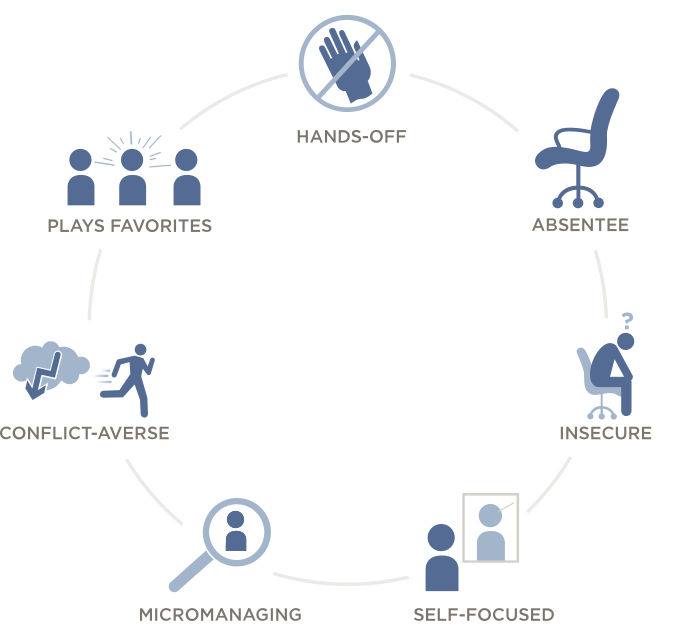
-
Hands-off
-
Absentee
-
Insecure
-
Self-focused
-
Micromanaging
-
Conflict-averse
-
Plays favorites
改善你与“问题上司”的关系Improve Your Relationship with a Difficult Boss
哈佛教授讲授视频逐字稿
Worksheet for Dealing with a Difficult Boss
Make a Connection
第 2 节
If your boss has limited knowledge of the details of the business, is uninterested in the status of your projects, and doesn’t follow up to ensure that agreed-upon actions have been taken, you’ve got a hands-off boss.
Having a hands-off boss can have both advantages and disadvantages. On the plus side, though your manager is less engaged than you prefer, you likely have significant autonomy in managing your workload and making decisions. On the minus side, you may feel a lack of support when problems or questions crop up.
Here are strategies for dealing with different kinds of hands-off managers:
Try to avoid complaining about your boss to others; it won’t improve the situation or your relationships within the organization. Instead, accept that your boss’s behavior isn’t ideal, and make the most of the freedom you have to take the initiative on your own.
第 3 节
If your boss is never around, seems psychologically distant, and doesn’t meet with you regularly to fill you in on critical decisions in the organization, you’ve got an absentee boss.
This disconnect could have a number of causes. Maybe your boss is busy with other projects, is feeling burned out, or has become bored in his or her current role. Whatever the reason, having an absentee boss could make it hard for you to get the information and resources you and your team need to meet business goals.
Manage your absentee boss with these tactics:
- Schedule time together. Try asking your boss to meet with you more often or to give you more feedback.
- Make the most of meetings. Be prepared and efficient when you do get together.
- Keep your boss informed. Provide your boss with regular, brief reports. When something important comes up, send him or her a short note that outlines the issue.
- Build relationships. Network with colleagues and with others outside your organization so you can exert the influence needed to advocate for your team in ways that your boss is not.
- Get to know your boss’s support staff. You can often get responses to questions through them.
- Volunteer. Offer to take on tasks your absentee boss doesn’t enjoy; you’ll help him or her out as well as develop your own skills.
第 4 节
Ideally, bosses and the people they manage work in partnership, with all parties feeling competent and confident in their position on the team and in the organization. But some managers are insecure in their roles and uncertain about their abilities. They may act defensively in response to people’s opinions or suggestions, regardless of how respectfully those are presented.
A manager who is reluctant to seek your input, ignores your ideas, or punishes you for speaking up is likely insecure. Your boss may take employee suggestions as personal criticisms and aggressively stifle good ideas because of his or her own insecurities.
To manage an insecure boss:
- Understand the cause. Evaluate any external factors that may be causing your boss stress, such as looming deadlines or pressures from senior management. Make a point of striking a collaborative tone in your interactions.
- Build trust. Alleviate your manager’s fears and gain his or her confidence by sharing as much information as possible.
案例
- Give feedback carefully. Insecure bosses find constructive criticism threatening, so before providing your manager with feedback, highlight his or her positive qualities and accomplishments. Also, reduce your manager’s defensiveness by offering your comments in private rather than in front of other team members.
- Emphasize potential gains. If you are recommending any kind of change, underscore the potential gains. Avoid implying that your boss caused the problem you are seeking to solve.
第 5 节
Self-focused bosses are so career-oriented that they may see others simply as tools for advancing their own agendas. Some may even take credit for others’ achievements, or hold others back so they can get ahead.
Such bosses often spawn people problems in their teams, like low morale, burnout, and erosion of engagement and motivation. And if such team problems arise from other causes, a self-focused boss might not notice them or care about resolving them.
To manage this kind of boss:
- Own the problem. Rather than seeing yourself as a victim, take responsibility for improving your relationship with your boss and getting your own career needs met.
- Look for alternative explanations. Consider whether there might be other explanations for what you perceive as negative signals from your boss. For example, if your boss excludes you from meetings, it may be that he finds smaller meetings to be more efficient, not that he’s intentionally keeping information from you.
- Suggest ways to balance people and projects. Embrace his or her goals, while offering periodic reminders and recommendations about people issues that need addressing.
Manage a Difficult Boss - example 4
Set an example. Treat your boss as you’d like to be treated.
Manage a Difficult Boss - example 5
Speak up. If you haven’t managed to subtly change the dynamic with your manager, engage her in a constructive conversation. Set a positive tone by indicating that you want to find better ways to support her. Also indicate how you hope she can help you in gaining new skills and experience.
改变棘手的工作关系Change a Difficult Work Relationship
哈佛教授讲授视频逐字稿
第 6 节
If your boss constantly scrutinizes and criticizes your work, he or she is micromanaging. This kind of boss is not only annoying; the seeming lack of faith in you could make you doubt yourself and stunt your professional growth.
To deal with this type of boss:
- Keep your boss up to date. Understand that micromanaging often stems from internal anxiety and a need to control situations—so keep your boss informed of your progress, take your ideas to him or her before sharing them with others, and bring him or her any news you hear.
- Be reliable. Earn your boss’s trust by succeeding in dimensions he or she cares about most, such as on-time delivery of projects.
- Seek guidance. If your boss is micromanaging because he or she has high standards or because you do, in fact, need to make improvements in specific areas of your job, treat it as an opportunity to learn from you boss.
- Create ground rules. Agree with your boss up front about how he or she will be involved in projects, what role each of you will play, how you’ll measure success, and what the high-level guiding principles for the work will be—not the details.
Manage a Difficult Boss - example 6
Free up your boss. Tell your boss that he or she is better off not getting involved in the details of a project, because “Your time and effort are more important and valuable for the big picture.”
我可以帮你分担工作吗?What Can I Take Off Your Desk?
哈佛教授讲授视频逐字稿
Strategies for Dealing with a Difficult Boss
第 7 节
If you have a conflict-averse boss, he or she might avoid advocating for you and your team with others in the organization. As a result, you don’t get the support and resources you need. Your manager might also avoid difficult conversations, even if they’re about important issues—such as serious interpersonal conflicts in your team—that need discussing. As a result, such issues remain unresolved.
To manage your conflict-averse boss:
- Make conflict more comfortable for your manager. Express disagreement using gentle language such as “This may sound like a crazy idea, but...” and ease into awkward conversations by talking about something neutral first.
- Ask “what if” questions. Propose different scenarios to get your boss thinking about how dealing directly with a conflict could help serve business needs.
Manage a Difficult Boss - example 7
- Strike a neutral tone. Focus difficult conversations with your boss on problem solving, not the personalities involved.
Manage a Difficult Boss - example 8
- Provide documentation. Gather supporting evidence to help your boss advocate for resources your team needs.
Manage a Difficult Boss - example 9
第 8 节
Maybe your boss has a favorite employee—someone who gets the most interesting assignments and special perks. She invites this person to social events, confides inappropriately in him about “problem” colleagues, and acts like they're old friends.
Favoritism—especially shown to an average performer—can demoralize you and the other members of your boss's team and cause you to miss out on valuable resources and attention. But because your relationship with your boss is key to your success, it is important to put effort into improving it.
Here's what to do about it:
- Use a sounding board. If you feel that your boss isn't treating you fairly, find someone outside the organization to talk to who can help put things in perspective. Avoid complaining to your coworkers—it won't change things and may create a negative tone on your team.
- Take the high road. Don't take your frustrations out on your boss's favored employee. That person isn't the source of the problem. Instead, focus on your own successes. Look for ways to boost your career and your connections to others in the company.
- Watch and learn. Observe your boss's favorite in action and make note of how he or she interacts with your boss. You may want to adopt some of his or her behaviors—but only if doing so feels authentic to you.
- Build bridges. Create goodwill by getting to know your boss and his or her favorite better. Ask the favorite for advice on how to improve in your job. Regularly check in with your boss to discuss his or her priorities and progress you've made on them. Ask for more challenging assignments, and volunteer for tasks that others don't want to take on.
- Seek out mentors. If you're not getting the career guidance you need from your boss, identify other managers who can provide you with feedback and coaching.
- Move on. If your relationship with your boss doesn't improve and you're not getting the opportunities and guidance you want, consider looking for another job. It's not worth staying in a situation that drains your energy and keeps you from growing in your career. Continue to contribute to the best of your abilities while pursuing other options.
Surviving a difficult boss: What would you do?Adapted from Silverman, David, Gini Graham, Brad Gilbreath, and Lauren Sontag. “Surviving the Boss from Hell.” Harvard Business Review Sept. 2009.
第 9 节
Test your understanding and reinforce what you’ve learned.
Try it Out
答案与解析
A. Take steps to understand your boss’s motivations.
You should identify your boss’s objectives and determine how they differ from yours. Assess how his motivations might affect his behavior and then use that knowledge to figure out the best strategy for supporting those objectives without compromising your own.
B. Talk to your boss’ former associates and employees about how best to deal with him.
You should contact someone who used to work for your boss and ask for insights about his work style. Frame the meeting in terms of a tutorial for you.
C. Confront your boss immediately so you can clarify your feelings about the situation.(正确)
Try to head off confrontation. Give yourself some time before responding to a frustrating situation, and then reply in a calm professional manner.
D. Figure out the best way to help your boss in his weakest tasks.
You should focus on helping your boss with the tasks that he is weakest in—but avoid offering any criticism.
第 10 节
Reflecting on your learning helps you apply relevant concepts to your job.