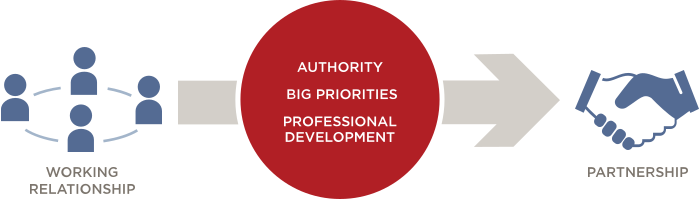
It’s important to have a decent working relationship with your boss. But if you can build that relationship into a true partnership based on mutual trust and shared benefits, you and your boss will prove even more effective as a team.
Keys to building a strong partnership with your boss include:
Understanding and managing your attitude toward authority
Clarifying business priorities for you and your team
Discussing your professional development
与上司合作,而非为上司工作Work With, Not For, Your Boss
哈佛教授讲授视频逐字稿
Managing up for me is like creating a win-win with my boss. I had this big marketing project idea that came to me one day, and the first thing that I did is that on my weekly telecom—which I follow as a very strong discipline for myself to talk to [my boss] on a very regular basis—I just picked it up and said: “This is what I have for this customer segment which means so much to us. And this idea could have kind of been a very large thing for us in terms of what it can give to us.” She got onboard with me on the idea, and we got started working on the proposal for that.
The proposal actually showed what we had in mind that—yes, it is going to be a high-risk, high-reward thing. So whether we do it or not is something that we really had to try to thrash out and decide. But on every weekly call, we were discussing some bits of how exactly we were developing it and what it could mean, and we really grew it into something where we felt that we could actually deliver a good job out of it.
It was important for me on every call that I align myself very well in terms of our values, in terms of our thought process of how we do business, in terms of both of us really trusting to the initiatives that we have on hand and how do we go out and deliver it with the team supporting us in the right way. And that’s what happened in this case.
Finally we actually had a great big event where the customers gave us beautiful feedback. And what I get out of this is very simple: Whenever I work with my boss, it is a partnership, it is not working for her, it is actually working with her.
Building partnerships with multiple bossesHill, Linda A. and Kent Lineback. Breakthrough Leadership. Module 3: Manage Your Network, "Strategies for Multiple Supervisors." Harvard Business Publishing, 2012.
Building a productive partnership with your boss becomes more challenging when you report to multiple people. One boss may be your direct, "straight line" manager: He or she prepares and conducts your performance reviews and decides on your pay increases and promotions. Other bosses may be indirect, "dotted line" managers: They assign you project-based work but have less control over personnel issues.
If you have multiple bosses, you'll need to nurture relationships with all of them. When you do, you'll gain access to more resources and exert more influence than if you had just one boss.
Use these strategies to build strong partnerships with all your bosses:
Understand differences. Recognize that your bosses have different goals, priorities, work styles, pressures, strengths, and weaknesses. Strive to find compatible ways of working with each boss.
Treat all bosses equally. Try not to favor a boss who has an outlook and work style similar to your own; for instance, by spending more time or sharing more information with him or her than with your other supervisors. Send reports about your activities to all your bosses, so each can see your work as a whole.
Connect with local and remote bosses. Today, it's not unusual for people to report to bosses whom they rarely see in person. Take steps to stay connected with bosses in other locations as well as those whose offices are in the same building.
Communicate trade-offs. Acknowledge your multiple relationships and the trade-offs they require. Evelyn realizes that if she satisfies one boss's request, she won't be able to complete a project she promised another boss. She explains to both bosses the conflict she's facing. She then proposes several potential solutions and gets their agreement on one. Build a Partnership - Example 1 Review conflicting expectations together. If possible, bring your bosses together on occasion to review their respective expectations of you. Note areas of alignment. Discuss areas where their expectations may conflict. Negotiate as needed to reach agreement on what your bosses collectively want from you.
Building partnerships with multiple bossesHill, Linda A. and Kent Lineback. Breakthrough Leadership. Module 3: Manage Your Network, "Strategies for Multiple Supervisors." Harvard Business Publishing, 2012.
Try it Out
Try it Out How well do you and your boss partner with each other? Select “Yes” or “No” for each of these statements:
Make a Connection
1. If you answered “No” to any of the items above, what steps can you take to build—and sustain—a strong partnership with your manager?
第 2 节
To build a productive partnership with your boss, think about how you respond to authority in general—and specifically to those who have authority over you.
Identify the feelings that authority has created in you, based on your history with bosses and others. Those feelings may lead you to interact with your boss in one of two extreme ways:Gabarro, John J. and John P. Kotter. "Managing Your Boss." Harvard Business Review Jan. 2005.
Resistance. You may feel antagonistic toward your boss and resist his or her efforts to manage you. Seeing your boss as an adversary, you might oppose his or her decisions and escalate conflicts beyond what’s appropriate. And you could view your boss as an obstacle to be circumvented.
Dependence. You may rely on your boss as someone who should know what's best for you and provide for you. As a result, you may show extreme deference to your boss and comply with his or her demands without question. And you may never disagree with your boss—even when doing so is in your or your team's best interest.
By being aware of these potential responses to authority, you can notice your own tendencies. If you are prone to resistance or dependence, take steps to avoid behaving in a way that hurts your partnership with your boss.
Build a Partnership - example 2
Maha realizes that she often seems to be arguing with her boss just for the sake of arguing. No matter what her boss says, Maha disagrees. The heated exchanges that erupt between them never lead to anything productive. Moreover, Maha's boss has passed her over for several promotions.
Maha decides to make a point of noticing whenever she feels the urge to argue with her boss. She begins to practice active listening instead of automatically opposing whatever her boss says. She commits to asking questions to learn more about her boss's perspective.
Maha also works on recognizing when disagreement with her boss is reasonable and justifiable. If she is going to disagree with her boss, it will be for good reasons—not simply an automatic reaction.
Build a Partnership - example 2
第 3 节
To build a strong partnership with your boss, you need to work with them to identify business priorities such as:
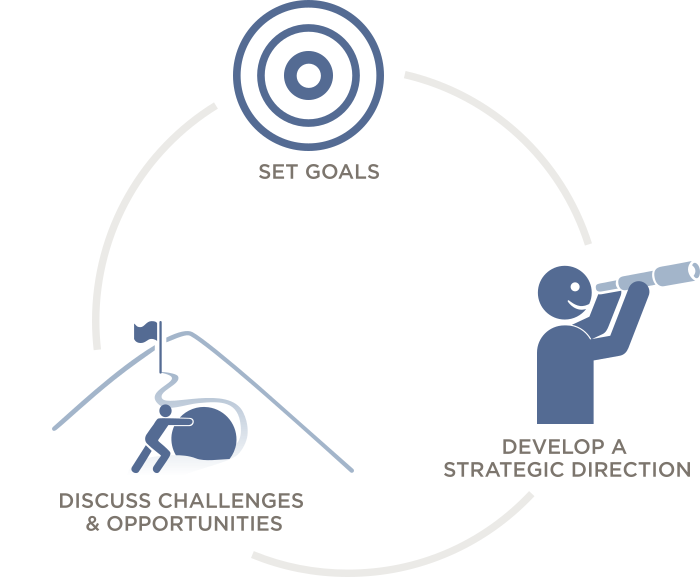
The challenges and opportunities facing you and your team
Regularly describe to your boss the challenges and opportunities your group is facing. Talk about what you think could be done to surmount the challenges and take advantage of the opportunities.
Build a Partnership - example 3
Shawn works for the HR department of a fast-growing organization. He tells his boss that he's been having difficulty recruiting new hires through traditional channels such as career fairs and online jobs boards. Shawn also sees that job seekers are making greater use of social media to learn about open positions and to apply for jobs.
Shawn believes that if he doesn't figure out a way to exploit social media for recruiting, the organization could lose out on hiring the talent it needs. He proposes to his boss that he use social media tools to announce job openings.
Build a Partnership - example 3
Check if your boss agrees with your assessment of your group's challenges and opportunities and with any plans for change you're proposing. If your boss disagrees on any of these points, find out why. You may need to alter your plans to accommodate his or her suggestions. Or you may have to provide more information to convince your boss that your plans are sound.
eBay案例:面对上司,请坦言需求When to Speak Up
哈佛教授讲授视频逐字稿
A number of years ago, I wrote a number of teaching cases about eBay's acquisition of a German company as a part of its globalization strategy. In the case, you see that the founding CEO leaves and eBay hires a new CEO, a consultant from BCG's Internet Group. The new CEO comes in and discovers that the migration of the German website to the U.S. website is not going well. There were all sorts of technical challenges and the customers were becoming very unhappy and beginning to defect. He realizes that having a first-mover advantage is really critical to eBay Germany's success and worries that this defection is going to be a real problem, because a competitor is gaining ground.
What you see in the A case is, after a number of conversations with headquarters, he concludes that he needs to fly there and speak with a group of his superiors immediately, in person, to get the kind of resources they're going to need to actually solve the problem. So when the case ends, the question I ask the MBAs and the executives to consider is, “Is this a good decision on his part? To fly to the U.S. and insist upon having a meeting with a group of his superiors?”
Needless to say, we have a very lively debate about that question. And you’d need to know many more details to know whether it was a good or bad decision in some ways. But what you do see, of course, is that some people feel you have no right to ever demand a meeting of your superiors, particularly the CEO of a company. And others say, “You know what? That's his job. If it's really urgent, if it's really important, he's got to do whatever it takes to create the conditions for the success of his team.”
When you see the B case, you discover that when he gets there, in fact, everybody is waiting for him, and he makes a presentation to this group of executives and explains what he thinks they need to do if, in fact, eBay Germany is to be successful. He makes some demands, some things that he feels are not negotiable, but he does it in a way that, basically, he makes sure that he owns the problem; he agrees that eBay Germany should pay some of the cost. He also talks about those things that are negotiable and really lays out for them, in language they understand, using metrics that really matter to that group of people, why, in fact, they need to do what he is suggesting.
And when you see the C case, you discover that everything has worked out actually quite beautifully, both for eBay Germany and for Phillip [the new CEO] and the other executives on his team. They've been very, very successful.
And there's a quote from Meg Whitman, at the time, who was the CEO of the company, and then she says in that quote that she is so happy that she had Phillip in that position because Philip was one of those executives who understood that it was important to speak up and let the boss know what was really going on. And she wished she had more executives working with her who would really share, very candidly with her, what was on their minds and what they needed, because then you actually could solve the problem.
Because, as Meg Whitman pointed out, she's only human. She's not a mind reader, she's very busy, and sometimes you've got to do some things to make sure that you get her attention so she can address what you need to have addressed. And so I think what we all need to remember is that our bosses are only human, and they're just as imperfect as the rest of us.
Strategic direction
Ask your boss what he or she sees happening with the organization's strategy. Discuss how you and your team can help the company achieve its strategic goals.
Build a Partnership - example 4
Tamara works in the finance department of a large organization. She and her boss, Keith, are talking about the company's recent announcement of an effort to improve operational efficiency. Tamara and Keith discuss how they can help support this effort, including introducing more efficient ways of handling all key business processes in the department, such as monthly, quarterly, and year-end closing processes. Tamara identifies bottlenecks in these processes and suggests making elimination of these inefficiencies a priority for her team. She lays out some ideas for doing so.
Build a Partnership - example 4
If you and your boss disagree on the strategic direction you need to set for your team, not much else in your partnership will work. So identify the causes behind any differences of opinion, then work with your boss to arrive at agreement.
Goals
Hill, Linda A. and Kent Lineback. “Managing Your Boss.” In <i>HBR Guide to Managing Up and Across</i>. Boston: Harvard Business Review Press, 2013.
Partnering with your manager to clearly define your business unit's and organization's needs is crucial for establishing and achieving your team's goals. To clarify your goals:
Come to agreement with your boss on what needs to happen and by when.
Update these agreements periodically.
Warn your boss of potential risks and play out various scenarios of how you might handle them.
Build a Partnership - example 5
The goals Satish needs to achieve by the end of the next quarter include completion of two process improvement initiatives. He suspects that pilot-testing changes to the processes may take longer than he and his boss initially predicted. So Satish lets his boss know his concerns and proposes solutions for accelerating the pilot-testing phase of the projects.
Build a Partnership - example 5
Don't just focus on attaining the goals—also pay attention to how you attain them.
Build a Partnership - example 6
Maite achieved a targeted increase in sales. But her boss hears constant complaints about how Maite has overworked her employees in order to hit the target. As a result, morale in her team is eroding. Maite's manager doesn't feel quite so happy about the fact that she achieved the sales increase.
Build a Partnership - example 6
Resist any tendency to simply accept goals your boss defines without discussing them. If you believe that these goals are unrealistic, be sure to speak up. Explain to your boss why you think the goals aren't achievable, and work together on ways to either alleviate the constraints or adjust the goals.
通过共识目标改善与上司的关系 Improve Your Relationship with Your Boss by Aligning Goals
哈佛教授讲授视频逐字稿
When I was the director of organizational effectiveness for a consumer packaged goods company, I reported to the senior vice president of human resources. At the end of my first fiscal year at the company, my boss asked to meet with me so that we could go over our results for the year. It basically boiled down to how good a job we had done in terms of achieving our objectives.
What surprised me is she began the meeting by sharing the objectives on her plate. These were the goals that had been set by the CEO for her. And the surprise really was, this was the first time I was hearing them, and it was the end of the year.
So what I suggested was, “How about at the beginning of this fiscal year, why don't we begin our goal planning process by you sharing the goals that the CEO has been giving you? And then from there, I can set my objectives very much aligned with it. And more importantly, as I go about making them happen, I can do them in a way that will make you even more successful and make the function look even better in the eyes of the rest of the company.”
She thought it was a great idea. We had that meeting. We set up the goals. And what I didn't expect is the impact it had on the nature of our work relationship. Up to that point, I would describe it as good, but it was formal. She did her job. She trusted me to do mine. You know, there really wasn't a lot of collaboration. And as a result of being all on the same page about the goals and objectives for the year, we found ourselves regularly brainstorming, regularly collaborating, regularly working together.
And by the end of that next fiscal year, the results spoke for themselves. Not only were we much more effective as a department, not just by our own measure but by the rest of the company's measure, really the nature of our working relationship was a much more productive one. Because she knew I had her best interests in mind and was focused on making that happen, her trust in me grew exponentially. And we continued to have a very successful, very effective working relationship.
In a true partnership, your boss will take an interest in and help support your professional development. So talk about your career aspirations with your boss. Explore together how you could grow professionally to help yourself, your boss, and your team become even more successful.
Get your boss's thoughts about your current performance. Ask him or her which competencies you'll need to acquire or strengthen to advance your career.
Then discuss learning opportunities that could help you build those competencies. Learning opportunities might include:
New job assignments
Online or classroom courses and workshops
Coaching or mentoring
Conferences and trade shows
Membership in trade associations or clubs
Build a Partnership - example 7
Martina and her boss have agreed that she could become even more effective in her role if she improved her public-speaking skills. Knowing how to deliver complex ideas in a compelling, accessible way to large audiences could help her exert more influence over peer managers and other key stakeholders within and outside the organization—individuals whose support she needs to achieve her goals.
Martina's boss tells her about a public-speaking club that the organization is planning to establish. Club members will meet once a week and practice giving short speeches and receiving constructive criticism from one another to improve. Her boss suggests that Martina talk with the HR manager who is leading this initiative so she can learn about how she can take part.
Build a Partnership - example 7
我职业发展中的贵人 Primed for Success
哈佛教授讲授视频逐字稿
I can’t help but think about someone that has been really near and dear to my life and my career. And that is a former boss named Diane. Diane had this really special way to her. She had exuberance. She had energy. She was passionate. She was happy-spirited. She was assuring. She was inspirational.
And I think about this one particular experience where I was preparing for a really important meeting. This was a meeting with the senior-most leadership team of the organization--we’re talking a Fortune 100 organization, $10 billion in revenues.
And I was primed. I was being groomed to deliver this presentation that would really show my potential. I didn’t see it at the time. It ended up being that opportunity that made the leaders see that I was ready for that next level.
And I was nervous and I felt ill prepared, even though I had gone through the data over and over and over again, and with Diane. And so after about the fourth or fifth dry run, we had about three more days to go, I call up Diane and I say “Hey, when is our next session together? We need to prepare. We have this huge presentation coming up in a couple of days.”
Diane tells me that “Everything that you need to have a super impactful presentation, to sell your points, to be cleared, to be articulate--everything that you need--you have it already.”
It was a great presentation. Our leaders were completely signed on. They were questioning, they were challenging, and I was able to engage. Again, all of these things really take that level of confidence, right? So you don’t go into your shell when you’re being challenged in that moment. And I have Diane to thank for all of that optimism, positive energy, and more self-confidence. Because she just had this special warmth in telling me that I had everything that I needed to be great. And so it was.
Ask for what you want from your bossRebecca Shambaugh, "Having the Here’s-What-I-Want Conversation With Your Boss," HBR Digital Article, November 20, 2015.
Many people feel uncomfortable approaching their bosses to discuss salary, promotions, and professional development opportunities. But unless you do, you are unlikely to get what you want. By discussing your needs, you open the door to a win-win situation: You gain something in terms of your career progression, and your boss and organization benefit by motivating and retaining a valued employee.
To conduct a "here's-what-I-want" conversation with your boss:
Prepare your case. Collect information to support your request, whether it's from online salary surveys or company benefits packages. Document your accomplishments, including your and your team's recent performance. And show how any professional development opportunities will benefit your organization by providing you with valuable new skills. Lolly Daskal, "Asking for a Raise When You Are Afraid To," HBR Digital Article, November 18, 2015.
Take a collaborative approach. Link your request to your boss's needs. Ask open-ended questions, such as "How can we make this a win for you?" Listen and ask follow-up questions, but be sure to circle back to your request.
Understand the context. During the conversation, collect data to inform your negotiation strategy. For example, if you're planning to ask for a promotion within the next year, ask what skills and experience you'll need to be eligible. You might learn about new areas your organization will be focusing on—something that could help guide your professional development plan.
Use “what if” responses. One way to build on your boss's responses to your request is to prepare "what if" scenarios—specific actions you could take in different situations. For example, if your boss says you need more cross-functional experience before you can advance, you might reply with "what if" ideas for how you could get that experience. These might include collaborating with another department on an upcoming project or participating in a one-day role swap with a peer in another functional area.
Be open to a Plan B. Even if you make a strong case, there may be circumstances that cause your boss to reject your request. If so, explore other ways to meet your needs. For example, if your boss can't give you a raise for budgetary reasons, he or she might be open to alternatives such as extra vacation, more job flexibility, or paid continuing education.
Ask for what you want from your bossRebecca Shambaugh, "Having the Here’s-What-I-Want Conversation With Your Boss," HBR Digital Article, November 20, 2015.
It can take some practice to build a partnership with your boss based on mutual trust and shared benefits. In this activity, consider steps Leon can take to turn his relationship with his boss, Jenna, into a partnership.
Try it Out
1. Which of the following tactics might Leon employ to clarify his business priorities with Jenna?
答案与解析
A. Once a year, Leon should meet formally with Jenna to describe the challenges and opportunities his group is facing. Not the best choice. Leon should have regular discussions with Jenna about the challenges and opportunities his group is facing.
B. Leon should wait until Jenna tells him what she thinks should be done about the challenges and opportunities for his group, and then respond. Not the best choice. Leon should be proactive in talking about what he thinks should be done to surmount challenges and take advantage of opportunities for his group.
C. Leon should propose ways to address his group’s business challenges and opportunities. If Jenna disagrees with any of these suggestions, then Leo should find out why in order to discuss them further.(正确) Correct! Leon should find out if Jenna agrees with his assessment of his group’s challenges and opportunities and with any plans for change he’s proposing. If Jenna disagrees on any of these points, then Leon should find out why. He may need to alter his plans to accommodate her suggestions. Or, he may have to provide more information in the hopes of convincing Jenna that his plans are sound.
2. How can Leon be sure that the goals he and his team are working toward meet Jenna’s and the company’s needs?
答案与解析
A. Leon should assume that he and Jenna share the same expectations about how his team should support the company’s strategic direction. Not the best choice. Leon should talk with Jenna about the company’s strategy and clarify expectations to make sure there are no misunderstandings or disagreements.
B. Leon should check with Jenna to be sure they agree on what his team needs to accomplish and when they need to have it done by.(正确) Correct! Leon should clarify his team’s goals by coming to an agreement with Jenna on what needs to happen and by when.
C. Leon should accept any goals that Jenna defines without discussing them at all. If he believes those goals are unrealistic, then he should discuss his concerns with Jenna’s boss. Not the best choice. Leon should resist any tendency to simply accept goals Jenna defines without discussing them. If Leo believes that these goals are unrealistic, then he should explain to Jenna why he thinks they are unachievable, and they should work together on ways to either alleviate those constraints or adjust the goals.
3. What approach should Leon take to involve Jenna in his professional development?
答案与解析
A. He could gather anonymous feedback on his current performance and then report what competencies he needs to acquire or strengthen to Jenna. Not the best choice. Leon should get Jenna’s thoughts about his current performance. He should ask her which competencies he’ll need to acquire or strengthen to advance his career.
B. He could schedule a meeting with Jenna to talk about his career aspirations and get her input about how he could grow professionally.(正确) Correct! Leon should talk about his career aspirations with his boss and explore how he could grow professionally to help himself, Jenna, and his team become even more successful.
C. He could ask Jenna to set aside time to teach him the new competencies or skills he needs to advance his career. Not the best choice. Leon should ask Jenna which competencies he’ll need to acquire or strengthen to advance his career, and then discuss learning opportunities that could help him build those competencies. Learning opportunities might include new job assignments or online or classroom courses and workshops.
第 5 节
Test your understanding and reinforce what you’ve learned.
Try it Out
1. You are a manager in the design department of an aircraft manufacturer. It is important to you to build a partnership with your boss, Josef. What is the best policy to follow?
答案与解析
A. Leave goal setting to Josef; that’s the senior manager’s job. Resist any tendency to simply accept goals your boss defines without discussing them. You may not be able to meet them.
B. Trust Josef to know what’s best for your team and to provide it. Seeing your boss as a wise “parent” who should know best and provide for you is a sign that you have an overdependent relationship with authority.
C. Talk with Josef about how your team can support the firm’s strategic direction.(正确) You should talk with Josef about what he sees happening with the organization’s strategy. Discuss together how you and your team can help support the company’s strategic direction.
D. Ask Josef to tell you what opportunities your group should be pursuing. You should take the initiative and describe to Josef the challenges and opportunities your group is facing and how you think you can surmount those challenges and exploit the opportunities.
第 6 节
Reflecting on your learning helps you apply relevant concepts to your job.
Take a Moment
1. 1. What new insights do you have that could benefit you or others in your workplace?
2. 2. What are your biggest opportunities for applying concepts from this Lesson in your workplace?