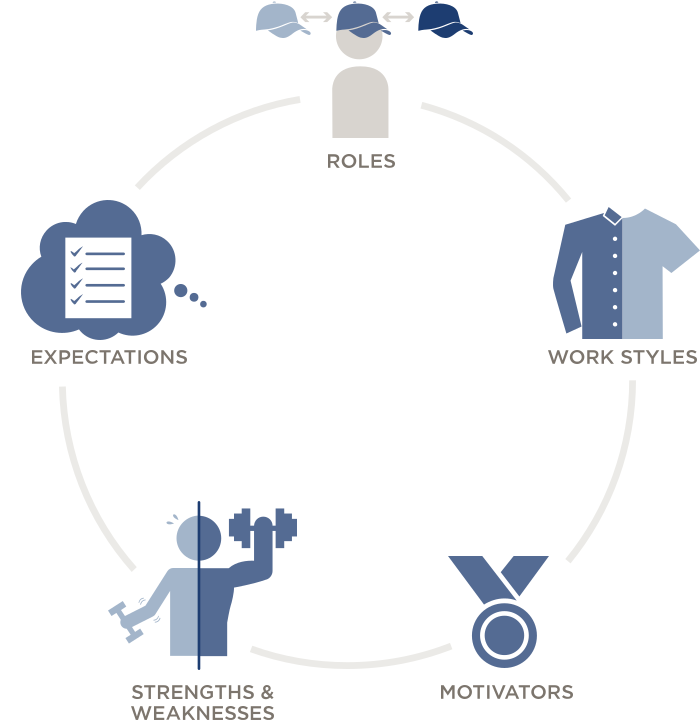
You and your boss each play different roles in the organization. By understanding these roles—and how the differences between them affect your interactions—you can forge a productive working relationship.
Hill, Linda A. and Kent Lineback. Breakthrough Leadership. Module 3: Manage Your Network, "Understand Key Differences." Harvard Business Publishing, 2012.
Your boss fills several roles:
Human being. Like any other human being, your boss has hopes, frustrations, and fears; a personal life; and a cultural background. Your boss may also be significantly older or younger than you.
Manager. As a manager, your boss coordinates a team of direct reports and serves as a liaison to the larger organization and network in which your team operates. In this role, he or she has various goals, priorities, and expectations.
Coach. As a coach, your boss helps you and other team members develop your skills and advance your careers.
Evaluator. As an evaluator, your boss assesses team members' performance and makes decisions about your pay and promotion opportunities.
To better understand your boss and your boss's roles:
Review your job descriptions and organizational chart. You'll gain a sense of how your roles are designed to support each other in achieving your team's and organization's goals.
Meet with your boss. Schedule time to discuss your responsibilities, your team, and your shared goals. Also find opportunities—for example, during breaks or while traveling together—to chat casually with your boss. You'll establish camaraderie and get a sense of your boss's distinctive characteristics as a person and manager.
Ask others. Seek out people who know your boss. Ask them what they can tell you about him or her as a person and manager. Center these conversations on information that can help you improve your working relationship, not on gossip.
在向上协作中消除年龄差异Take Age Out of the Equation
哈佛教授讲授视频逐字稿
One of my clients is a 64-year-old instructional designer. And she got laid off from her job and came to me and said, “I need some guidance. Can you help me network?” And after a short period of time, she accepted a contract position and then, after four or five months, was offered a full-time position at the organization. She called to share the good news and then said, “Big surprise, my manager is the same age as my daughter, 42 years old.”
So, this could be an awkward situation for many of us Boomers, but it doesn’t have to be. In her case, she found the similarities between her manager and herself, focused on adding value to the business because they were all on one team striving and working together for a common set of shared business goals. They found common interests outside of work—cooking and photography. And, more importantly, my client actually became a mentor to her manager. My client understood the demands of having a very successful job while juggling a home life and children, working at home.
So, in the end, it actually was a win-win situation. My client thrived in her new job, and formed really close personal friendships—both at work and outside of work, with her new team.
Know your boss's boss
Claman, Priscilla. "Get to Know Your Boss’s Boss." In HBR Guide to Managing Up and Across. Boston: Harvard Business Review Press, 2013.
Your boss advocates for you and supports your career development. But he likely still has to get the approval of his boss for your pay increases and developmental opportunities. To better understand your role in the organization and advance in your career, it can be helpful to establish your own relationship with your boss's boss.
Here's how to get to know your boss's boss:
Interact. Greet your boss's boss when you see her.
Reach out. Communicate with your boss's boss when opportunities arise; for example, send a congratulatory email if she gets a promotion or award.
Ask for advice. Get your boss's okay to email his boss (copying your manager on the message) to ask for advice. For instance, maybe you'd like suggestions on courses you're thinking of taking or professional organizations you're considering joining. Make your own boss look good in these emails by writing something like, "Michael thought you’d have some good ideas about this."
Extend invitations. If you're giving a presentation or your boss is leading an important meeting, ask your boss if it's okay to invite his boss.
Pass along praise. If you receive praise from a customer or other key stakeholder, send it along to your boss. Your manager will likely pass it along to his boss, since your success makes your boss look good too.
Volunteer for a cross-functional team. Leading or taking part in a cross-functional effort helps you contribute to the larger organization—and that makes you more visible to your boss's boss.
Fix a problem. Find a way to make an improvement that furthers your organization's goals or supports a core value. Share the results with your boss and his boss.
Know your boss's bossClaman, Priscilla. "Get to Know Your Boss’s Boss." In HBR Guide to Managing Up and Across. Boston: Harvard Business Review Press, 2013.
Yourself
Like your boss, you fulfill several roles: You're a unique human being, as well as a manager, coach, and evaluator for your own direct reports. It's especially important to understand these roles in the context of your working relationship with your boss.
Answering these questions can help:
How do you and your boss differ as human beings? Are your cultural backgrounds, upbringing, experiences, outlooks, likes and dislikes, and education similar or different? How might any differences affect your relationship?
How do the pressures and responsibilities you face in your jobs compare? What do any differences imply for your working relationship?
How might you manage your boss's coach/evaluator roles? The dual roles of coach and evaluator present a conundrum: To get your boss's support for your career development, you need to discuss your weaknesses. But you may worry that talking about them might make your boss hold your shortcomings against you during a performance evaluation. How can you work with your boss to manage this paradox?
Know Your Boss—and Yourself - Example1
Matthew recently joined an online news organization as the head of the video production team. He knows the importance of developing a strong working relationship with his boss, Annika, so he schedules a one-on-one meeting with her. In the meeting, he asks about her goals for the team and talks about his hopes for his new role. Matthew mentions that he's working on ensuring that the meetings he runs follow the agenda, and he asks if Annika will coach him to help him achieve this goal. She agrees and suggests they schedule a follow-up meeting in a few weeks.
Know Your Boss—and Yourself - Example1
Try it Out
Try it Out Do you understand the roles you and your boss play on your team and in your organization? Respond with “Yes” or “No” to each of these statements:
Make a Connection
1. If you answered “No” to any of the items above, what actions will you take to improve your understanding of your and your boss’s respective roles?
第 3 节
When you understand your boss's and your own strengths and weaknesses as managers, you can learn how to maximize each other's best capabilities and minimize each other's shortcomings. As a result, you'll boost your effectiveness as a duo. You can also use the information to adapt your behavior so you can work more effectively with your boss.
Your boss
To learn about your manager’s strengths and weaknesses:
Ask what your boss sees as their strengths, weaknesses, blind spots, and trigger points—actions that irritate or anger them.
Speak with other staff members about their insights into these aspects of your boss’s work style. Ask for their advice and feedback.
Closely observe as your boss pursues objectives and interacts with others. Determine what this behavior suggests about your boss’s strengths and weaknesses.
Know Your Boss—and Yourself - Example 2
Ryoko's boss, Tyler, is particularly good at delegating, data analysis, project management, and negotiation. But he has a blind spot when it comes to hiring: He tends to recruit people who are similar to him rather than individuals who bring diverse skills into the team. Tyler's trigger point is not being told about problems in his team until they've become crises: The last time one of his direct reports withheld information about an emerging problem, he became very angry, in part because his own boss was upset that the problem wasn't dealt with promptly. Knowing these things about Tyler, Ryoko makes a point of keeping him informed about potential pitfalls on her projects and asking for his coaching on negotiating with vendors.
Know Your Boss—and Yourself - Example 2
掌握向上协作的要领 Boss Management 101
哈佛教授讲授视频逐字稿
There are a lot of resources on the market about how to manage people, but there are not a lot of resources about managing up. And what that means is how to manage a boss--Effective Boss Management 101. A lot of people don’t know how to do that, and then they end up not saying things, they hold things in, they feel stressed, they feel overwhelmed, and then they create alienation with the boss and resentment that ultimately can diminish their motivation and performance. So this is a really important skill.
So the first thing to know—inside scoop, very important—get to know your boss’s personality. Get to know how they operate. Get to know what they like, what their work preferences are.
So for example, find out: “How do you want to be communicated to? Do you like email? Do you want me to call you?” Do they like the face-to-face meetings? Or, “Do you want, even, a lot of information, or do you want me to just kind of go off and only [let you] if there’s a problem?” Because some managers are micromanagers—they want to know every little detail—and some want you to be able to work autonomously. You need to know what your boss’s work preferences are.
Find out your boss’s personality. Do they tend to be more introverted and quiet, where you have to go and solicit their time, you have to go and just kind of drop by and keep them updated on what’s happening? Or are they extroverts who are always coming by and want to be engaged with you? You need to find that out.
Are they more high-level, visionary kind of people that don’t want a lot of details, or are they more of the detailed, “Tell me step by step how you’re going to get there”?
Those kinds of tips are really, really important because that’s going to help you develop a better relationship with your boss.
The other thing I’m going to tell you is, toot your own horn! The workplace is not a place to be modest. Now, I’m not talking about being arrogant and, “Oh, I’m just such a great manager.” No. What you’re going to do is you’re going to very subtly get your accomplishments out there.
So the way you can do that: Let’s say your team has a big hit, home run. You’re going to send out an email blast congratulating your team on what a wonderful job they did. And that’s a way of getting in front of other people, that they can see that you’re doing a good job managing your team.
Also, keep what I call an “accomplishments file.” This is very important. Track all of your completions, all of your activities, all of your projects—and when I say, “you,” you and your team’s—so that you can always know exactly what you’ve accomplished. And at performance review time, you take those completions, those accomplishments, and you’re going to put them right into your performance review.
I even suggest sending that once a month to your boss and saying, “Just thought I’d keep you in the loop. Here are all of the completions and activities over the last month.” Those are really your accomplishments, but you’re not going to call them that to your boss. You’re just going to say “completions.”
Toot your own horn, because otherwise you may not get that promotion. You may not get that bonus or those other new opportunities to stretch your own leadership skills and expand your skills. You want to be able to create those opportunities, and managing up is a critical way of doing that.
Yourself
What are your own managerial strengths, weaknesses, blind spots, and trigger points? If you're not sure:
Take stock of praise and constructive feedback you've received from your bosses during previous performance evaluations.
Recall successes and failures you've experienced as a manager.
Think of times when you reacted strongly—perhaps overly so—to something that happened at work.
Ask trusted colleagues as well as friends and family members what they see as your strengths, weaknesses, blind spots, and trigger points.
Once you have a clear sense of yourself, consider how you compare with your boss. Think about how you might build on one another's strengths—as well as compensate for one another's weaknesses—to form a more productive relationship.
Know Your Boss—and Yourself - Example 3
William's boss, Susanna, has acknowledged having difficulty preparing presentations. In particular, she knows she tends to create overly long slide decks and pack the slides with too much detail. William happens to be good at creating concise, engaging presentations. So he helps Susanna prepare the slide decks for several talks she'll be giving.
Know Your Boss—and Yourself - Example 3
第 4 节
You and your boss may have different work styles. These styles affect how structured or informal each of you is in handling day-to-day work. They also influence how you each process information, make decisions, and handle conflict. By understanding how your work styles differ, you can craft strategies for accommodating those differences.
Your boss
To understand your boss's work style:
Ask him or her about it.
Seek insights from people who know your manager or who have reported to him or her before.
Observe your boss in action to glean whatever clues you can to these preferences.
Then consider how you might accommodate your boss's work style while getting the information and support you need in a timely way.
If your boss...
Do this...
Prefers a formal, organized approach to handling work
Make sure meetings with your boss have set agendas.
Prepare meeting agendas and give them to your boss before meetings.
Prefers to process information by studying it
Give your boss information in written form.
Prefers being able to ask questions about information
Present information to your boss in person.
Likes to be highly involved in decisions
Check in with your boss often.
Prefers to delegate decision making
Keep your boss abreast of important changes and major problems, but handle the other details on your own.
Seems to thrive on conflict
Be prepared for lively, spontaneous exchanges with your boss.
If these exchanges become heated, don’t assume your boss is angry with you.
Tends to minimize or avoid conflict
Respect this preference—but don’t fall into the trap of telling your boss only good news.
Inform your boss about failures and significant problems in private.
你希望被如何称呼? Clarify Your Boss’s Preferences
哈佛教授讲授视频逐字稿
SHARON GRADY: One of my first jobs out of college was working for a congresswoman in Washington, DC. And when I started working in her office, I noticed that some of the people on her staff called her by her first name, which was Barbara. Other people called her Mrs. Kennelly. So, naturally, I wondered wht should I call her.
And I happened to be on the phone one evening talking to my folks, telling them about my new job, and I mentioned that I was uncertain about what I should call her. And my dad suggested, “Well, if you don’t know, why don’t you just ask her what she prefers?”
And I remember thinking that was a really silly idea, because surely on Capitol Hill that had protocols for everything, there must be some kind of a protocol for what you called your boss. And if I asked her, it’d be obvious I didn’t know what that protocol was, and I’d look dumb. And I didn’t want to look dumb.
But a few days went by. I didn’t have any other ideas about how to answer this question. So, finally, I did go into her office and I asked her. And I was really surprised by her reaction, because she was just delighted by the question. This big grin spread across her face, and she had a twinkle in her eye and she pointed at me and she said, “Good for you. None of the others thought to ask me that question.”
So, here I had been afraid to ask a question that I thought was going to make me look stupid, and it turns out that by asking it I actually increased my standing in her eyes.
I learned a couple of things from that experience. One was to never be afraid to ask a question of my boss or anybody else. If you have thought something through and you’ve got a question about it, chances are pretty good that you’re going to gain more by asking it than by holding back.
The other thing is to ask your boss how she would prefer that you work with her. How does she want you to communicate with her? Does she prefer email, text, in-person meetings? If she prefers in-person meetings, does she want you to drop in or does she want you to schedule time with her?
Asking these kinds of questions is really important, because it shows not just that you really care about getting your work done but that you care about doing it in a way that works for your boss. These kinds of questions helped me get off to a good start with the congresswoman—who, by the way, preferred to be called Mrs. Kennelly.
Whether you take a formal, organized approach or a casual, ad hoc approach to work
How you like to process information
How involved you want others to be in decisions you're making
How you feel about and handle conflict
Identify where your preferences might differ from your boss's and how such differences might affect your working relationship. Think of ways to bridge any disparities.
Know Your Boss—and Yourself - Example 4
Hyun-Ki comes from a culture where it's considered inappropriate for a subordinate to disagree with a supervisor. He thus tends to avoid disagreeing with his boss, Armin. But Armin comes from a culture that expects subordinates to voice disagreements with their supervisors—and he seems to thrive on lively debate.
Armin recently said that, to decrease costs, he wants to change the way a critical business process is carried out in Hyun-Ki's group. Hyun-Ki is concerned that it will require costly training for people to master the new process. Since he has difficulty with open confrontation, he considers ways to disagree that feel comfortable to him. For example, he might express his opinion in the form of a question, asking Armin, "What are your thoughts about the costs of providing training on the new process?"
Know Your Boss—and Yourself - Example 4
Is Your Boss a Listener or a Reader?
Is Your Boss a Listener or a Reader? Harry’s written a detailed report for his boss, Doreen, about a customer management system he’s advocating. But when he meets with Doreen to discuss it, she hasn’t read his report. Instead, she wants him to talk her through the highlights, and he’s not prepared. A professional coach explains how to adapt to Doreen’s preferred way of receiving information—so Harry can communicate far more effectively with her.
第 5 节
Each person has unique motivators driving them to do good work, based on factors such as their age, culture, and personal values. Motivators may include things like challenging tasks, opportunities for advancement, compensation, positive feedback, and a good work/life balance. Identifying what motivates your boss and what motivates you is a key component of managing your relationship.
Your boss
Sometimes it's easy to determine what motivates your manager. Your boss's words and actions often provide clues to what he or she values.
Know Your Boss—and Yourself - Example 5
Peri, the controller of an architectural firm, is clearly driven by a desire to please top management by trimming costs. She has shared that intention publicly, and she often mentions it during meetings and conversations. Oscar, an accounting manager, taps into that goal by looking for processes that can be streamlined in his group.
Know Your Boss—and Yourself - Example 5
Some of your boss’s motivators may not be as obvious. But you can still identify and tap into them.
Know Your Boss—and Yourself - Example 6
Luke's boss, Jennifer, has asked for weekly meetings to review his team's progress on a client project. Luke notices that Jennifer seems impatient when he provides detailed updates. He has the sense that she is inspired by bold visions and prefers to leave practical details for team members to handle. So he briefly sums up what the team has done and explicitly states how it supports the department's overall goals.
Know Your Boss—and Yourself - Example 6
Yourself
Think about what motivates you to do your best work. For example, you might appreciate recognition from your boss and coworkers or thrive in an atmosphere based on competition for rewards. Also, pay attention when you find a particular work activity that especially excites you as you carry out your job responsibilities. Those moments can give you clues to your motivators.
During check-ins with your manager, talk about what motivates you. And whenever you feel particularly inspired and excited by a job activity, let your boss know.
Sharing this information helps your boss identify assignments that will engage you and inspire you to deliver your best on the job.
第 6 节
You and your boss expect different things from each other. By understanding these differences, you can better meet your manager’s expectations while also getting what you need.
Your boss
At a minimum, your boss expects you to:
Produce. You need to create the expected results your boss has to answer for. You can do this by achieving your team's goals such as: reach sales targets, improve productivity, reduce costs, or meet deadlines.
Collaborate. You should be working with colleagues across the organization, including getting involved in cross-organizational projects, to support your boss's and the company's priorities.
Be reliable. This means fulfilling your commitments, including achieving goals on time.
Share information and ideas. Your boss counts on you to share good news, such as positive results from an experiment, as well as bad news, such as delays or mistakes in a project. He or she needs both kinds of information to make smart decisions. Your boss also wants you to share your ideas to spark innovation.
Resolve your team's difficulties. You should be ready to step in if one of your direct reports falls behind with his or her commitments, if an interpersonal conflict develops, or if a crisis erupts.
Stay current. Pay attention to the news. What happens in the world affects what happens with your team, your company's marketplace, and the organization's competition. Also, know what's going on with your organization's customers and competitors—how they're changing, and how technology and world events are affecting their plans.
Know Your Boss—and Yourself - Example 7
Alya is an assistant director in Purchasing at a quick-service restaurant company with numerous store locations around the country. The prices of the ingredients that go into many of the company's products are rising. Alya reads economics reports and trade journals to find examples of what some companies in her industry are doing to manage volatility in commodity prices, such as consortium buying and locking in prices when they're low. She shares what she has learned with her boss.
Know Your Boss—and Yourself - Example 7
Poll
Poll
Yourself
You can expect your boss to:
Define goals for you and your people. You need your boss to share the organization's strategic priorities with you and the role your team will play in fulfilling them.
Make resources available. Your boss should help get you the funding, staff, management attention, and other resources you need to achieve the goals defined for your team.
Be available. You boss should be accessible when there's a major problem to solve or when you need updates on what's going on in the organization.
Advise you on tough trade-offs and priorities. When you face a difficult decision, you count on your boss to offer advice and knowledge of the organization to help you choose a course of action. You also depend on your boss to help you prioritize your projects and tasks.
Support your career development. You want your boss to provide opportunities for you to develop your career—such as taking courses and carrying out challenging job assignments that build your skills.
Clarify these expectations during meetings with your boss. Check for agreement. If your expectations don't match your manager's, try to negotiate an agreement that works for both of you.
Know Your Boss—and Yourself - Example 8
Dasha is meeting with her manager, Nathan, about a project she is leading. During the discussion she says, "For me to be effective on this project, I need clear direction from you on what our unit's strategic priorities are. I also need to know what resources we have available to support those priorities. My understanding is that I'll be able to hire two additional people to complete the project. Is this correct?" Nathan replies, "Sorry, but we can't afford to hire two more people." Dasha proposes another solution: the use of freelancers to get the work done. Nathan supports this alternative, as long as the cost of using the freelancers is lower than what it would be to hire two new people.
Know Your Boss—and Yourself - Example 8
如果你不清楚,为什么你不问? Mad Dog
哈佛教授讲授视频逐字稿
I was once the manager of financial planning and analysis for a pretty large company on the West Coast. The CEO of the company was a former Princeton football player who had the nickname that he carried from college that everyone in the company knew him—they didn't call him that but they knew him—as "Mad Dog." I think he earned it in college, but it did stick with him as the CEO.
In my role, I had to interact with him quite a bit. I found myself constantly sitting in his office listening to some urgent problem that he wanted solved or some analysis that he wanted done. Well, you know, I was not going to say anything except, "Yes sir, I'll go do it." I'd go back down and talk to my folks and we'd do the analysis and after many hours put into it, go back up and present our findings to him.
The first thing he'd say was, "That's not what I wanted done." We'd go through another round, and then we would be chasing our tails eventually. One day I was in his office and he's barking at me about something, and I left the office with marching orders to come back with the analysis. I got out as far as his secretary's desk and I looked at Terry [his secretary] and I turned around and I went, "Nah."
I walked in and I said, "Do you know how much time we waste because you're not clear about what you're asking for and we go do all this analysis, and then you say that's not what I asked for?"
He looked at me and he said, "Why do you think that's my problem?" I said, "Well, because you're not being clear."
He said, "No, if you don't stop and ask me what did I mean by that or 'I don't quite get it' and maybe we'd talk about it, is it my problem or is it your problem?"
I went, "Ahh! Good point."
When expectations differ across culturesMolinsky, Andy. "Impress Your Foreign Boss." HBR Blog Network, May 1, 2013.
If you work for a boss who comes from a culture different from yours, be prepared for the possibility of major differences in expectations about what it means to "do great work." In some cultures, "doing great work" means listening carefully to what your boss tells you to do—and then precisely performing the task. In other cultures, it means taking initiative and volunteering for assignments.
To fulfill your boss's expectations, learn the local context and get to know his or her individual preferences. But resist any urge to overgeneralize: Just because your boss is Indian, for example, doesn't mean she'll have the same expectations about "great work" as an Indian boss you worked for previously. To avoid the mistake of overgeneralizing, consult with colleagues or find a cultural mentor.
When expectations differ across culturesMolinsky, Andy. "Impress Your Foreign Boss." HBR Blog Network, May 1, 2013.
In this activity, help a new employee connect with her boss, so they can accomplish their shared work goals.
Try it Out
1. Which of the following tactics might Mei employ to clarify Malik’s and her roles?
答案与解析
A. She should quiz other members of the team about what they have heard about why Malik left his previous jobs. Not the best choice. Mei should seek out others who know her boss, but she should center these conversations on information that can help her improve her working relationship, not on gossip.
B. She should focus on the similarities in the pressures and responsibilities she and Malik face in their positions. Not the best choice. Mei should compare the pressures and responsibilities she and Malik face in their positions and determine what any differences in these imply for their working relationship.
C. She should find opportunities to chat casually with Malik.(正确) Correct! Mei should look for opportunities—for example, during breaks or while traveling together—to chat casually with Malik. She’ll establish camaraderie and get a sense of her boss’s distinctive characteristics as a person and manager.
2. Mei notices that Malik gets irritated when she drops by his office to ask questions. How might she ensure that she gets the information she needs?
答案与解析
A. She should ask Malik what his preferences are for how and when she should approach him with questions.(正确) Correct! By asking Malik for his preferences for how and when she should approach him with questions, Mei can get the information she needs while continuing to forge a strong working relationship with her boss.
B. She should wait until the weekly staff meeting and put her question on the agenda. Not the best choice. By waiting until the weekly staff meeting, Mei may not get the information she needs in a timely way. Also, she will miss an opportunity to continue to forge a strong working relationship with Malik.
C. She should ignore Malik’s negative response and continue to drop by his office when she needs information. Not the best choice. If Mei ignores Malik's negative response when she drops by his office, she may continue to irritate him and undermine their working relationship.
3. Mei has lots of ideas for updating the menus. She realizes that she finds the creative aspect of her work energizing. What should she do with this insight?
答案与解析
A. She should share information about what motivates her with Malik.(正确) Correct! By sharing this information with her boss, Mei will help him identify assignments that will engage her and inspire her to deliver her best work.
B. She should share information about what motivates her with the HR department. Not the best choice. Mei should share this information with Malik, not with the HR department. By doing so, she will help her boss identify assignments that will engage her and inspire her to deliver her best work.
C. She should keep this information to herself and remember it the next time she looks for a job. Not the best choice. Mei should share this information with Malik, not keep the information to herself. By doing so, she will help him identify assignments that will engage her and inspire her to deliver her best work.
第 7 节
Test your understanding and reinforce what you’ve learned.
Try it Out
1. 1. Brandy, your new boss, will start work next week, and you want to make sure that you build a good working relationship with her. What is the least effective strategy for making this happen?
答案与解析
A. Ask Brandy for help in defining goals for your direct reports. You can expect Brandy to help define goals for you and your people. You need her to share the organization’s strategic priorities with you and the role your team will play in fulfilling them.
B. Avoid discussing your own weaknesses with Brandy.(正确) Talking about your weaknesses is difficult, and you might worry that Brandy will mention them during a performance evaluation. But if you avoid talking about your weaknesses, you may not get the valuable support she can offer you as a coach.
C. Tell Brandy what motivates you even if it doesn’t motivate her. During check-ins with Brandy, talk about what motivates you. And whenever you feel particularly inspired and excited by a job activity, let her know.
D. Ask Brandy what her weaknesses are. You should ask Brandy openly what she sees as her strengths, weaknesses, blind spots, and trigger points.
Try it Out
1. 2. The Engineering and IT departments have jointly developed some new software. Its failure has caused serious disagreement between the two groups on the issue of responsibility. While your manager in IT likes to be highly involved in decisions and prefers an informal approach to problem solving, he does not handle conflict well. What is the best way to approach him with this problem?
答案与解析
A. Discuss the problem and its implications with him privately.(正确) A manager who tends to minimize or avoid conflict should be informed privately about any failures or significant problems.
B. Tell him only the good news you can find in the situation. Respect your manager’s preference for avoiding conflict, but don’t fall into the trap of telling him only good news.
C. Send him an agenda and then hold a team meeting about the problem. Bosses who prefer a formal, organized approach to handling work should be given a prepared meeting agenda in advance.
D. Mention the problem to him but handle all the details yourself. Since your manager prefers to be involved, you should check in with him often, rather handling the details on your own.
第 8 节
Reflecting on your learning helps you apply relevant concepts to your job.
Take a Moment
1. 1. What new insights do you have that could benefit you or others in your workplace?
2. 2. What are your biggest opportunities for applying concepts from this Lesson in your workplace?