Managing Your Boss
What Is Managing Your Boss? 查看中文版
第 1 节
What managing your boss is—and isn’t
A boss or supervisor is someone who assigns work, provides motivation, and typically oversees direct reports' performance.
In many organizations—especially those with matrix structures or project-based teams—an individual may report to multiple bosses, including ones in different time zones or even different countries. In all cases, learning to manage your boss or bosses is essential to your mutual success and to the success of your team, project, and organization.
Managing your boss is the process of taking the initiative to:
- Build a strong working relationship based on mutual respect and understanding
- Consciously work toward mutually agreed-upon goals
- Collaborate to make decisions that benefit both of you as well as your organization
Managing your boss isn't:
- Political maneuvering
- Manipulation only for the sake of advancing your career
积极主动地向上协作 Mentor Moment: Rules of the Road for Managing Up
哈佛教授讲授视频逐字稿
Learning to manage your boss is one of the most important skills in ensuring your success. An experience with one of my clients highlights some of the unwritten rules of the road as it relates to managing up.
My client Alexa joined a fast-growing retail services startup and was responsible for building out and leading a portion of the business. She was talented and smart, yet six months in, she realized a disconnect with her boss.
To figure out what was going on, I asked Alexa to spend a few weeks getting to know her boss in a much deeper way and to reflect on her own style and needs. In doing this, Alexa reflected on the broader context of the business and the pressures it put on her boss. This gave her a sense of compassion for her boss. She also looked deeply at her boss's personality and communication style—by examining emails, prior conversations, and even personality assessments provided by her boss. She got a deeper understanding of how her boss communicated.
We also did the same for Alexa. She also took a look at exploring her relationship with authority to have a better understanding of why she often took a back seat in meetings with senior executives. Alexa held targeted discussions with her boss to clarify goals and priorities and to get a better understanding of expectations on both sides. This was eye-popping for Alexa, because she learned that she had been making a lot of assumptions about the priorities and expectations of her boss. She also learned that her "planful," methodical style, while useful at times, needed to become more agile and fast to fit with her boss's style and the needs of the business. Finally, Alexa realized that she could challenge more and take the lead.
But one of the biggest learnings for her—and perhaps for you—is that you have to take the initiative in managing your boss. Managing up isn't about trying to change your boss or manipulating your boss for your gain. It's really about leaning into your boss's preferred style and appreciating that, while you may not be equals, you really need one another. And by understanding and supporting one another, you both can be successful.
Make a Connection
1. On a scale of 1 to 5, with 1 being “Extremely poorly” and 5 being “Extremely well,” how do you rate yourself when it comes to managing your boss? What areas do you want to improve in your relationship with your manager?
第 2 节
Why it matters
Hill, Linda A. and Kent Lineback. “Managing Your Boss.” In <i>HBR Guide to Managing Up and Across</i>. Boston: Harvard Business School Publishing, 2013.
Managing your boss matters for three main reasons:
1. Your boss plays a pivotal role in your success—or failure. You rely on them to provide you with:
- Information and guidance on your assignments and on troubleshooting problems
- Insight into the organization's strategy, goals, and priorities—important perspectives that can help you make wise choices about how to spend your time and energy
- Resources essential for carrying out your responsibilities—for example, personnel, funding, office space, and equipment
- Access to professional development opportunities—including training and industry conferences
2. You play a pivotal role in your boss's success—or failure. They rely on your work and on the work of your team to meet individual and organizational goals.
What Is Managing Your Boss?
Rashid, the IT director, is Sonya's boss. She needs him to:
Provide details about the company's changing technology needs and strategies
Approve funding for projects
Help her navigate the organization's political dynamics
Work with her to identify opportunities to advance her career
Meanwhile, Rashid needs Sonya to:
Meet agreed-upon goals
Keep him updated on the status of her team's projects
Proactively share information that can help him make decisions
Effectively represent him and the department in cross-unit meetings and company presentationsHill, Linda A. and Kent Lineback. Breakthrough Leadership. Module 3: Manage Your Network, “Shared Goal: Improved Performance.” Harvard Business Publishing, 2012.
What Is Managing Your Boss?
3. Failure to manage your boss can have negative consequences for the broader organization:
- If you and your boss don't have a commitment to shared goals and objectives, bottom-line results may suffer.
- Communication breakdowns between you and your boss can lead to frustration and confusion. That, in turn, can erode morale in your team.
- Poor morale can make it hard for people to get work done and serve customers effectively.
Tips for working with a boss at a different location
Michael Watkins. The First 90 Days: Proven Strategies for Getting Up to Speed Faster and Smarter,Expanded and Updated. Harvard Business Review Press,2013 .
Partnering with your boss when you are in separate locations presents a different set of challenges than when you are in the same building. When your main means of communication are electronic—whether email, phone, or video call—it can be difficult for the two of you to stay aligned.
Here are tips for staying in step with a boss in a different location:
Be disciplined about holding regular meetings. Once you have created a meeting schedule, protect those times. Ensure that you and your boss don't fall into the habit of postponing or canceling them.
Determine norms for communication. This includes which communication channels you and your boss will use and how you will use them. It also means having explicit agreements concerning response times for queries—how quickly you should expect a reply from your boss and vice versa.
Establish clear and comprehensive metrics. By setting up ways to measure and report on the results of your activities, you ensure that your boss has a good sense of where things stand on your team.
Schedule periodic face-to-face meetings, if possible. This is especially important early in your relationship. In-person connections can go a long way toward establishing mutual trust.
Tips for working with a boss at a different locationMichael Watkins. The First 90 Days: Proven Strategies for Getting Up to Speed Faster and Smarter,Expanded and Updated. Harvard Business Review Press,2013 .
与异地上司愉快合作 Working Well with Your Boss When You Work Remotely
哈佛教授讲授视频逐字稿
If you work in a different city or country than your boss does, you need to take an especially proactive approach to managing that relationship. To develop trust and establish accountability:
Set rules for communication. People on virtual teams assume that connecting more often solves the problem of distance. But this usually leads to information overload. Instead, set an appropriate cadence of communications: Is it a daily call or a weekly call?
Build interpersonal trust. Having things in common help steams bond. Send an email to your boss to tell her more about who you are. And start off meetings by spending 30 seconds or so sharing what's going on personally and professionally in your life, and finding out what your boss is up to.
Don't be conflict avoidant -- it's one of the most destructive attributes of many company cultures.
And go overboard to help. Generosity accelerates emotional bonding and shows you care about your boss's success.
第 3 节
The benefits
Hill, Linda A. and Kent Lineback, "Managing Your Boss." In HBR Guide to Managing Up and Across. Boston: Harvard Business School Publishing, 2013.
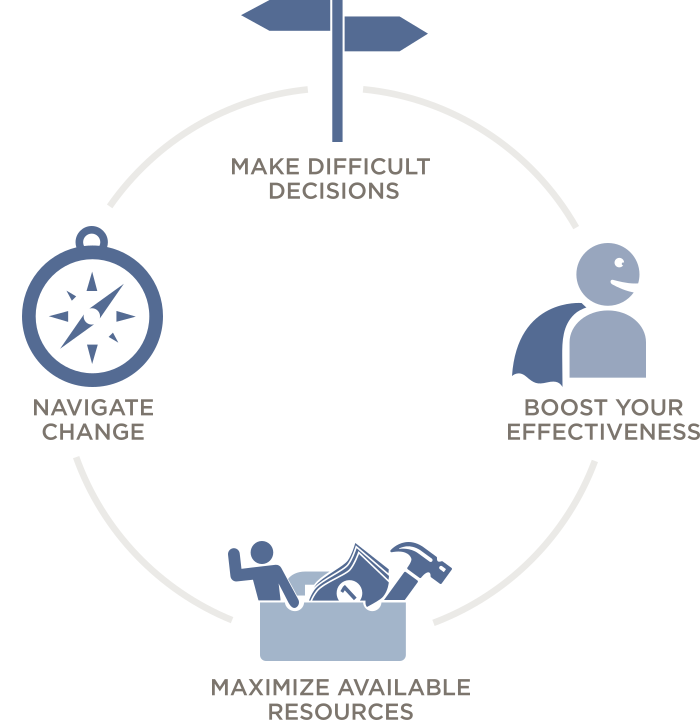
In addition to getting you the information and guidance, insight, resources, and development opportunities you need, effectively managing your boss helps you:
-
Make difficult decisions. Your boss will be better able to support you by providing advice, drawing on their knowledge of how things work in the organization, and seeking insights from higher management.
-
Navigate change. If your organization is experiencing major change, such as acquiring a business or adopting a new competitive strategy, your boss will be more likely to help you navigate through the inevitable turmoil.
-
Boost your effectiveness. Your boss can increase your influence within the organization, buffer you from office politics, and work with you to arrive at solutions to problems facing your team or company.
-
Get the most from available resources. Your boss can support you in getting the expertise and resources you need to achieve your goals and in making good use of them.
What Is Managing Your Boss? - Example2
Caroline is a project manager who oversees a team that is implementing electronic medical records software for a large medical practice. After doing extensive research, she believes the team should test the system offsite for any bugs before installing it in the practice's main office. Caroline brings her proposal to her boss, Brenda, the chief of information services, to get her input before sharing it with the entire team. Brenda suggests that Caroline strengthen the proposal by including examples from other practices that have and haven't done offsite testing and the outcomes in each case. Caroline includes the information in the proposal, and the implementation team approves the plan.
What Is Managing Your Boss? - Example2
与新上司的五次关键对话 Key Conversations with Your New Boss
哈佛教授讲授视频逐字稿
Each year, nearly a quarter of the managers in a typical Fortune 500 company change jobs. That means the average tenure in a position is only about four years. Twenty-first-century executives are in constant transition. So how can you position yourself to transition well? As the author of “The First 90 Days” and someone who has worked with leaders for more than two decades, I can tell you that solid working relationships are the key to success. You have to build them quickly. And you should start with your most important relationship—the one with your boss. Early on, you’re going to want to engage him or her in five key conversations.
First, talk about the business situation you’re facing. Are you leading a startup or a turnaround? Are you trying to keep an already successful unit going, or do you need to revive one that’s lagging? Or have you inherited a mix of these situations? Find out how your boss sees the situation and make sure you’re on the same page.
You’ll also need to talk about expectations. What goals do you need to achieve in the short and long term? How will your success be measured? If your boss’s expectations seem unrealistic, work to reset them. Try to underpromise on achievements and overdeliver on results. This strategy helps build credibility.
Next, talk about resources. What resources will you need to accomplish your agreed-upon goals? This might include more funding or more people, as well as your boss’s time and network. It’s best to get as many commitments on the table as early as possible.
Also, discuss work style. How will you and your boss interact? Would she prefer to meet face-to-face to get updates or have you send emails? How often does he want to be updated? What kinds of decisions should he be involved in—and which can you make on your own?
And finally, as you get deeper into your transition, have a conversation about performance improvement. How does your boss think you’re doing so far? How can he help you develop further and build the skills you need? Your willingness to seek candid feedback on your strengths and weaknesses and to act on it will send a powerful message.
Negotiating success with your new boss is all about communication. Shape the game by talking to your boss about the business situation you’re facing, expectations, resources, work styles, and your performance. These five conversations will lay the foundation for your success.
Try it Out
Try it Out Do you and your boss work together well? Think about recent interactions you’ve had and check “Yes” or “No for each of these statements:
Make a Connection
1. If you answered “No” to any of the items above, what steps can you take to request additional support from your boss?
第 4 节
Manage multiple bosses
Gallo, Amy. “Managing Multiple Bosses.” HBR Digital Article, August 18, 2011
It's increasingly common for people to have more than one boss. For instance, you may be on two project teams—each with its own project manager—and yet report directly to a manager in your functional area.
Having multiple bosses provides a lot of opportunities, but also poses certain challenges. On the positive side, you often have significant autonomy over how and when you complete your assignments. On the negative side, you may run into scheduling issues if each boss demands more time than you have available.
To mitigate the risks and make your job—and your bosses' jobs—easier:
- Know who your ultimate boss is. While you may take direction from several managers, usually only one is responsible for your career within the organization. Find out about who completes your performance reviews, who contributes to them, and who makes decisions about promotions and compensation.
- Be proactive about your workload. Be sure all of your bosses know everything you're working on. Use a shared document or regular check-in meetings with your managers to communicate about your current projects and tasks.
- Encourage your bosses to communicate. If your bosses' expectations create work overload or conflicting priorities, involve them in solving the problem. Schedule a time for them to communicate directly, whether in person or electronically.
- Set boundaries. If constant interruptions regarding one project prevent you from accomplishing your work on others, set times when you can focus on specific tasks without distractions.
与多位上司协作 Managing Multiple Bosses
哈佛教授讲授视频逐字稿
As organizational structures continue to flatten, and team-based work becomes the norm, many more people find themselves reporting to multiple bosses. This presents opportunities and challenges. On the positive side, you often have significant autonomy over how and when you complete your assignments. On the negative side, you may run into scheduling issues if each manager demands more time than you have available.
To mitigate the risks and make your job and your bosses’ jobs easier, consider taking these steps. While you may take direction from several people, chances are good that only one is responsible for your career within the organization. Find out who completes your reviews, who contributes to them, and who makes decisions about promotions and compensation. While this may seem mercenary, it’s important to know from the outset who can help and hurt your professional progress.
Also be sure that all of your bosses know everything you’re working on. Use a shared document or regular check-ins with your managers to communicate about your projects and tasks. Most bosses appreciate when you bring them solutions rather than problems, but this is complicated with more than one manager. If you experience work overload or conflicting priorities, involve your bosses in problem solving. Schedule time for them to communicate directly, whether in person or electronically. If constant interruptions regarding one project prevent you from accomplishing your work on others, set times when you can focus on specific tasks without intrusions.
Negotiating the world of multiple bosses can be challenging, but with a positive attitude and a commitment to following these steps, your success is assured.
第 5 节
REFLECT
Reflecting on your learning helps you apply relevant concepts to your job.
Take a Moment
1. 1. What new insights do you have that could benefit you or others in your workplace?
2. 2. What are your biggest opportunities for applying concepts from this Lesson in your workplace?
Further reading
在新上司手下取得成功的关键频繁的领导层变动已成为现代组织的一个显著特征,这既为员工带来动荡,也带来机遇。许多人在新上司到任时选择被动“观望”,但这…
当你的老板反复无常为一位总是反复无常、不断改变主意的领导工作,是一种让人抓狂却又极其常见的经历。当战略总是在不停地变动时,你很难对今天“潮…
工作需要被正确设计我在《星际迷航》系列里最喜欢的情节之一是星舰学院学员的测试科目——“小林丸号”测试。这套模拟训练…
Top 3 in the source platform's original order
