
Map and Assess a Network 查看中文版
第 1 节
Networks deliver valuable benefits, so it’s worth thinking about your own networks and how useful they are to you.
Thinking along these lines is a good way to start gaining insights into your networks, including how they might be strengthened. But you can get even more valuable insights by creating maps—visual representations of your networks.
Mapping your networks offers huge advantages. For example, it helps you:
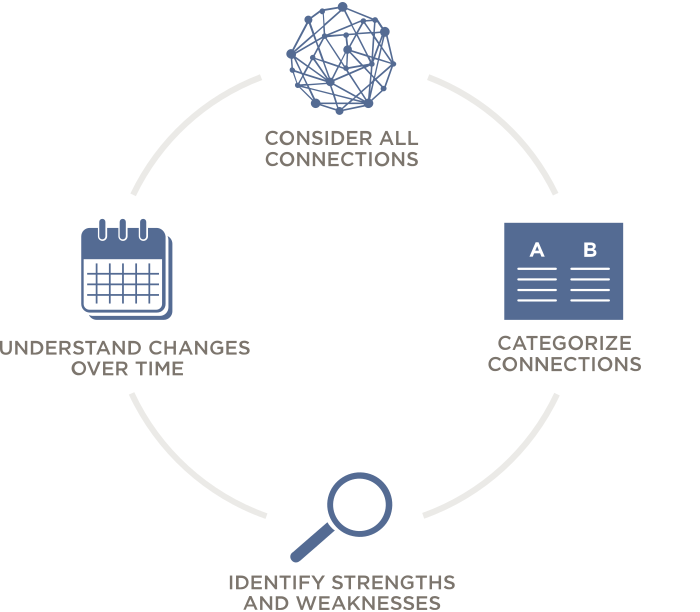
- Consciously consider all your network connections, including which contacts you’re directly connected to and which contacts are connected to each other.
- Categorize your connections in useful ways, such as who you interact with and rely on most and what typically gets exchanged during network interactions.
- Identify strengths and gaps or weak areas in your networks; for instance, insufficient diversity in your contacts, or lack of reciprocity in too many of the relationships.
- Understand how your network connections change over time when you revisit and update your maps.
Simply put, the very process of mapping your networks enables you to see and analyze patterns in them. Informed by those insights, you can continually assess and strengthen your networks as needed.
Make a Connection
第 2 节
To choose a network to map, consider the various types of networks you may have, such as:
Strategic: People who:
- Can see trends unfolding in your organization and the external business environment. You and they depend on each other to achieve longer-term goals.
- Are located in various functions, business units, and levels in your organization.
- May work outside your organization e.g. suppliers, customers, or former colleagues.
- Can serve as “outposts” at the edges of your everyday world, extending your reach with access to unique information and other resources.Linda A. Hill and Kent Lineback, “Weave Your Own Web of Influence,” in Being the Boss: The 3 Imperatives for Becoming a Great Leader, Harvard Business Review Press, 2010.
Operational: People who:
- You rely on to accomplish your everyday work—your peers, direct reports, and superiors in the organization. They may also include key outsiders such as suppliers, distributors, and customers.
Developmental: People who:
- Enhance your personal and professional growth.
- May be other managers within your organization whom you respect and admire, and people you have common ground with outside your usual circles.
- May be people you know from previous jobs, professional associations, alumni groups, clubs, and your circles of friends and acquaintances.
In deciding which of your networks to map, pick one that has a manageable size—around 12 people at most. That will help you think in a more focused way about the contacts in the network and more easily assess their connections. If the network you’d like to map is considerably larger than 12 people, focus your mapping effort on the 12 most important contacts.
Consider whether you have a particular goal that would cause you to select a specific network to map. For example:
Take a Moment
第 3 节
There are a number of approaches and tools you can use to map a network. The “Network Mapping Tool” included in this lesson provides an easy-to-use template that you can download and print. We suggest having a copy on hand as you read through the lesson. Completing it as you go along will help you understand and apply the process.
如何绘制人际网络图? How to Use the Network Mapping Tool
哈佛教授讲授视频逐字稿
Here are the key steps involved in mapping a network:
1. Give your chosen network a name. That way, you’ll focus only on that specific network and won’t confuse it with others you decide to map later.
2. Note the selected network’s purpose. Keeping that purpose in mind will help guide you as you evaluate your network after mapping it.
3. List the names of each contact in this network. Remember, contacts:
-
Can be individuals, teams, or organizations. To represent the latter, identify the person you interact with the most as the contact to include on your map.
-
Are people with whom you interact and exchange information, resources, support, and other forms of value essential for achieving professional or personal goals.
4. Position yourself at the center of the map. Then position each contact from your list on the map. Place contacts in ways that indicate:
-
Where each is located (such as in your department, in another department in your organization, or in another organization entirely).
-
How frequently you interact with each contact.
5. Draw lines between “You” and network members you interact with directly. Draw lines between network members who interact with each other directly.
You could also use these steps to visualize a new network you’d like to create for a specific purpose, such as carrying out a special project.
Network Mapping Tool
第 4 节
Once you’ve mapped your selected network, step back and assess it. Look for signs of strengths as well as improvement opportunities.
Consider network purpose and membership
As you review your map at a high level, keep two key questions in mind: “How well is my network serving its intended purpose?” and “Who do I depend on to achieve that purpose?”
For example:
绘制战略型人际网络图 Mapping a Strategic Network
哈佛教授讲授视频逐字稿
Poll
Consider structure, composition, and relationships
In addition to purpose, consider how well your selected network demonstrates these key characteristics:
-
The right structure. Look at your map, and ask yourself how interconnected your contacts are:
- Are enough people in the network connected to each other—creating a degree of cohesion that can foster trust, easy corroboration of information, and collaboration?
- Does the map show you as a link or bridge between enough people in the network who aren’t connected to each other? Does this position give you sufficient access to novel information and knowledge?
- The right composition. Examine your map’s composition—where the different contacts are located on the map. With the network’s specific purpose in mind, consider these questions:
- Is your network diverse enough in terms of contacts’ location within and outside your organization?
- Does the network contain strong ties—connections with people near you with whom you interact frequently and can get work done efficiently and effectively? Does it also contain weak ties—connections with people at the periphery of your daily life with whom you interact less frequently, but who have unique viewpoints and are sources of a wide range of perspectives, information, and resources?
- Does your network contain “superconnectors”—people who link independent clusters of contacts in the network together and thus stimulate collaboration between individuals and teams with diverse, specialized skills and knowledge?
- The right relationships. Consider what your map suggests about the quality of your relationships. For instance, are you interacting frequently enough with the contacts you consider most important? Look at the contacts on your map and think about how you’d describe the relationships between them. For example:
- Do people in your network trust one another and reciprocate—giving just as much (if not more) to the network than what they take from it?
- Are the relationships mutually beneficial?
This early, high-level review of your chosen network’s structure, composition, and relationships can help you take the next step: analyzing these key aspects more deeply. Informed by that more rigorous analysis, you’ll be able to diagnose issues that may limiting your network’s value—and craft strategies for addressing them.
绘制运营型人际网络图 Mapping an Operational Network
哈佛教授讲授视频逐字稿
第 5 节
Test your understanding and reinforce what you’ve learned.
Try it Out
答案与解析
Streamline his contacts by showing only those he's directly connected to and meets most often.
Mapping a network helps you to consider all your network connections, including the contacts to whom you are indirectly connected. It also shows which contacts are connected to each other.
Show all his connections within the firm.
The mapping process is most useful when it's focused on network for a particular purpose, rather than covering everyone you know. It can then help you to assess the effectiveness of your network in useful ways, such as whom you interact with and rely on for that purpose.
Show if he ll need to develop some new connections to support the project.(正确)
Network mapping helps to identify strengths and weaknesses in your networks, such as lack of diversity in your contacts or areas where new connections would be helpful.
Give him a map he can use for different initiatives in the future.
Mapping a network is most useful when it's completed for a particular purpose. You needl to revisit and update it to see how your connections change over time, rather than use the same map for a variety of future projects or different purposes.
第 6 节
Reflecting on your learning helps you apply relevant concepts to your job.