
Recruit and Retain a Diverse Team 查看中文版
第 1 节
Each time you hire, you have an excellent opportunity to increase your team’s diversity.
First, consider what the position you’re filling entails and what characteristics are required to carry out its responsibilities successfully. Then assess what resources your team might need to be more successful. Consider factors related to diversity, including:
- What types of different skills, viewpoints, and connections would help improve your team’s performance?"How to Increase Workplace Diversity.” Wall Street Journal: How-To Guides [no date].
- Can you use diversity to reach desired customers–for example, by recruiting someone from a community you want to serve better?Pak, Andrew.“Making Diversity a Business Advantage.” Harvard Management Update Apr. 2008.
- Is there a personality style, approach, or experience set that’s missing from your team?
Consider how the partners at a public-interest law firm approached a hiring decision.
Recruit and Retain a Diverse Team-26
第 2 节
Consider the last few times you’ve filled a certain position and look for a pattern—for instance, have all your candidates attended a certain kind of university? Have you relied exclusively on recommendations from current employees?
When managers rely on narrow assumptions about the background someone needs to succeed, they may unwittingly exclude certain groups. Continually challenge your own beliefs and habits. Look at diverse teams in your company for best practices, and talk to other leaders who have made nontraditional hires about their experiences.
Recruit and Retain a Diverse Team-28
发现独特人才的管理智慧 Managing Idiosyncratic Talent
哈佛教授讲授视频逐字稿
第 3 节
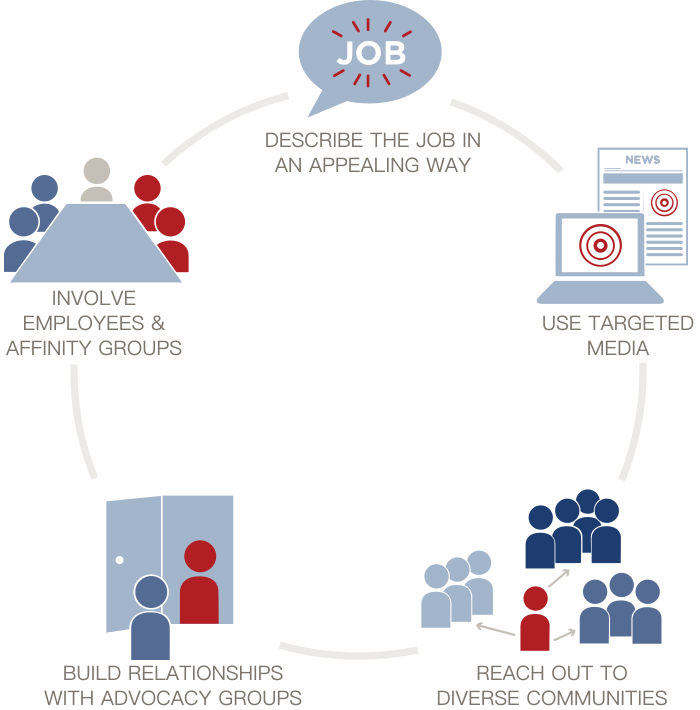
Stretch beyond your usual recruiting tactics to find diverse, qualified candidates and persuade them to join your team. Use as many channels as possible.
To reach a diverse talent pool:
-
Describe the job in an appealing way. Emphasize what makes your organization a good place to work and highlight benefits that might interest a diverse group of applicants. For example, does your organization offer flexible schedules for those who take care of extended family members or provide benefits for same-sex couples? Does it provide opportunities for social good, such as reaching underserved communities?
-
Use targeted media. Advertise in magazines, newspapers, and websites that appeal to a broad range of identity groups. Tweet support for key diversity issues. Use a broad variety of media outlets to advertise job openings.Ruiz, Gina. “The Art and Science of Recruiting a Diverse Workforce.” Workforce 10 May 2006.
-
Reach out to diverse communities. Sponsor special activities such as children’s sports events or concerts in diverse neighborhoods. Sponsorship of such events not only increases your organization’s visibility but demonstrates that you care about the community. Such events also put you in contact with community leaders, who might be able to identify potential talent.Ruiz, Gina. “The Art and Science of Recruiting a Diverse Workforce.” Workforce 10 May 2006.
-
Build relationships with advocacy groups. Nonprofits and other organizations that serve your target audience may be able to give you feedback about your company’s reputation for diversity and inclusion. They may also be able to connect you with job seekers.“How to Increase Workplace Diversity.” Wall Street Journal: How-To Guides [no date].
-
Involve your employees. Individuals within your organization that represent groups you're interested in recruiting may know qualified candidates. To help employees find qualified candidates, give tips on where to look.Ruiz, Gina. “The Art and Science of Recruiting a Diverse Workforce.” Workforce 10 May 2006.
-
Involve affinity groups. Ask members of affinity groups to help "sell" your organization to potential job candidates at career fairs. Also ask them to refer candidates from their networks.
第 4 节
After you’ve recruited diverse candidates, work to retain them. For example, if a person has relocated for the job, be aware that geographic locations that lack diversity or are very different from the employee’s previous home may present adjustment challenges. Thus, a new employee who grew up in an urban location may feel out of place in a small town.
To ease the transition, help new employees make connections in the community.“How to Increase Workplace Diversity.” Wall Street Journal: How-To Guides [no date]. For example, if you learn that an employee enjoys playing soccer, you could suggest facilities that have adult soccer leagues. Or, if an employee has children at a particular school, you could make introductions to other parents you know with children at that school.
第 5 节
Talented employees from diverse backgrounds will be attractive not just to your company, but to your competitors too. Keep them loyal to your organization by providing opportunities for career growth.
Facilitate career development in the following ways:
-
Communicate often. Be clear about the criteria for promotions and the next steps your employee needs to take. Introduce him or her to people within the organization who can discuss the variety of career paths available at your company.
-
Provide stretch assignments. Choose challenges aligned with the person’s interests and talents. Look especially for opportunities to make diverse employees visible to company leadership. For instance, ask the employee to present part of your group’s results at a company meeting.
-
Give regular feedback. Let employees know, specifically, what they do well and where they can improve.
-
Provide mentors. Mentors are people who can offer advice, provide insights about the organization, and discuss career paths. Diverse employees should have multiple mentors. At least one should be someone with whom they feel comfortable discussing diversity issues that they might not bring up with you.
-
Introduce employees to potential sponsors. These are senior leaders who can take an active role in helping high-potential diverse employees advance.
反馈意见应包括行动计划 The Best Feedback Includes an Action Plan
哈佛教授讲授视频逐字稿
Coach employees to find sponsors
第 6 节
Your firm’s culture or “personality” plays a powerful role in recruiting talent. However, when it comes to retaining individuals, microculture matters most.
“Microculture” is the culture that’s specific to your department or team—the daily experience of work. For instance, the sales department may have an informal culture based on open workspaces where team members’ results are posted in good-spirited rivalry. The human resources department, in contrast, may sit in traditional, enclosed offices and have an expectation that team members will keep matters they are working on confidential.
To build an inclusive microculture, gather information about the diverse expectations and habits of your team members:
-
Ask how they would define the current team culture. Discover how they view the team’s culture and what they like best.
-
Seek feedback. Is your team viewed as welcoming and inclusive? For instance, is humor appropriate? Are team activities suitable for everyone? Some employees may feel concerned about discussing concerns candidly, so find a way for your team to submit information anonymously if necessary.
-
Solicit ideas on what their ideal culture looks like. Encourage them to frame their answers both in overarching terms like "family friendly” and in more specific terms such as "A place where I can work without getting interrupted" or "A place where I can wear comfortable clothing when I work."
-
Find out if employees have unique needs or preferences. For example, do they have religious holidays or family obligations that require them to take time off at a certain time during the year? Or would a flexible start time in the morning help parents who need to get children to school?
You may not be able to accommodate every employee preference into your team’s operations. But you’ll likely find some simple changes can make your team culture more inclusive. For example, when you schedule team meetings, you might take into account part-time workers’ availability so that your whole group can be present. Or you can make sure to have vegetarian food options available during your next team outing.
32% — That's the percentage of Indian executives with elders living in the household.
32% — That's the percentage of Indian executives with elders living in the household.Sylvia Ann Hewlett et al., “Leadership in Your Midst: Tapping the Hidden Strengths of Minority Executives,” Harvard Business Review, Nov. 2005.
32% — That's the percentage of Indian executives with elders living in the household.Sylvia Ann Hewlett et al., “Leadership in Your Midst: Tapping the Hidden Strengths of Minority Executives,” Harvard Business Review, Nov. 2005.培养未来领导者 Tomorrow's Leaders
哈佛教授讲授视频逐字稿
第 7 节
Stay interviews help you better understand your diverse employees’ needs and goals so you can customize strategies to retain them. Stay interviews keep you from making faulty assumptions about diverse employees’ interests and desires. Such conversations may also give you information about noninclusive workplace conditions that diverse employees could be reluctant to discuss.
When you conduct a stay interview, be sure to discuss:
-
Your employees’ core interests. Core interests reflect how people engage with the world and what kinds of activities feel most natural to them. For instance, they may have a core interest in using technology to solve problems, or a core interest in teaching others. Ask your employees: What have they loved doing recently? What experiences do they seek, both at work and in their personal lives?
-
Their skills. Review new learning, training, or certifications. Staying apprised of employees’ expanding capabilities also helps you delegate effectively to them and offer new challenges.
-
Their goals. What milestones do they want to achieve in the next six months? The next year? What about five years from now?
-
Their work/life balance. Are they able to balance work priorities with family or personal needs? How are their stress levels? Prevent burnout by discovering what obstacles you can eliminate.
-
The level of support they get from you. Do they need additional resources or guidance from you? In contrast, is there anything they’d like to be able to do with greater independence?
Sometimes, despite your best efforts, talented diverse employees decide to leave your group.
In this case, learn as much as you can about the factors that went into their decisions before they go. Ask your human resources department to conduct a formal exit interview so you can gather additional insight. Use the information to determine what, if anything, you could do differently in the future to prevent others’ departures."How to Increase Workplace Diversity” The Wall Street Journal: How to Guides [no date] http://guides.wsj.com/management/building-a-workplace-culture/how-to-increase-workplace-diversity/
第 8 节
Test your understanding and reinforce what you’ve learned.
Try it Out
答案与解析
Look for recruits who can help the company reach diverse customers.
When making hiring decisions, companies should consider how they could use diversity to reach desired customers.
Use the power of employee affinity groups.
It is good practice to ask members of affinity groups to help "sell" the organization to potential job candidates at career fairs and refer candidates from their networks.
Trust in the official company policy of hiring qualified people regardless of culture.(正确)
Actual hiring practices don't always match official policy. Managers need to challenge their actual criteria for hiring and promotion.
Pursue relationships with advocacy groups.
Advocacy groups such as nonprofits and other organizations that serve your target audience may be able to give feedback and connect the company with job seekers.
Try it Out
答案与解析
Assign each diverse employee a single mentor to ensure consistent advice and insight.
Diverse employees should have multiple mentors who can offer advice, provide insights about the organization, and discuss career paths.
Be sure to align your team's "microculture" with the firm's overall corporate culture.
While corporate culture is important, when it comes to retaining individuals, microculture matters most. Build an inclusive microculture by tailoring it to your team's needs.
Offer a standard set of work/life programs equally to everyone.
You may not be able to accommodate every employee preference, but find out if employees have unique needs and try to adapt your work/life programs to suit.
Regularly conduct stay interviews with diverse members of your team.(正确)
Stay interviews help you better understand your diverse employees' needs and goals so you can customize strategies to retain them.
第 9 节
Reflecting on your learning helps you apply relevant concepts to your job.