Pocket Leadership口袋领导力

Diversity

Develop Your Cultural Competence 查看中文版

第 1 节

Is it hard for you to relate to someone whose life experience is drastically different from your own? If so, you’re not alone. Most people feel some degree of discomfort with difference.

However, as a manager, you have a responsibility to develop cultural competence. Cultural competence is based on:

  • Self awareness about your own biases

  • An ability to learn about and empathize with others’ viewpoints

  • A commitment to use difference constructively in the workplace

  • The development of cross-cultural skills

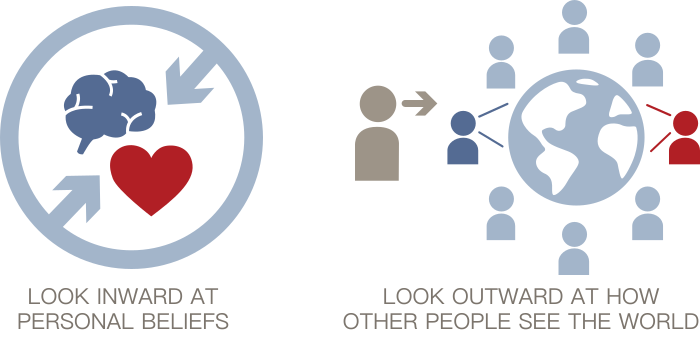
To develop cultural competence, you’ll need to look both inward at your own beliefs and outward at how other people see the world.
Worksheet for Understanding Interpersonal Bias

附件:worksheet_for_understanding_interpersonal_bias(docx · 1103 KB,本地副本)

第 2 节

By nature, human beings tend to group people into categories. Scientists estimate that we are exposed to as many as 11 million pieces of information at any one time, but our brains can functionally deal with only a fraction of that input.“Proven Strategies for Addressing Unconscious Bias in the Workplace.” CDOInsights 2 (5) (Aug. 2008): 3 <http://www.cookross.com/docs/UnconsciousBias.pdf> We make unconscious decisions and notice things based on what feels safe, familiar, or relevant at the time.

However, we need to guard against stereotyping—automatic judgments about people based on their religion, gender, sexual orientation, age, or race. These oversimplified conceptions of particular groups breed discrimination.

Examples of stereotypes include:

  • "Asians are smart and hardworking."

  • "Men love sports."

  • "Germans are efficient."

  • "Americans are pushy negotiators."

Consider what happens to Eric, who has stereotyped a member of his team.

Develop Your Cultural Competence-1

Eric, a VP of Business Development, runs a team that looks for new consumer products to acquire. When his team has identified a potential target, Eric assigns them roles to pull the deal together. He consistently gives Dev, a team member of Indian descent, the job of gathering the financials. When Dev has asked to try negotiating a deal, Eric has been noncommittal. But unconsciously, quiet Dev doesn’t fit Eric’s picture of a successful negotiator. Further, Eric sticks to the notion that Dev’s cultural background means he’ll excel at financial analysis. Dev becomes increasingly frustrated by his lack of growth opportunity. So when a competitor contacts Dev with a position that will allow him to lead a negotiation, Dev accepts the offer and resigns. Eric has lost a talented employee, someone who wanted to learn both the financial and deal-making sides of the business and who could have potentially reached new audiences for the team. Develop Your Cultural Competence-1

不要让偏见妨碍你识人 Learn, Unlearn, Relearn

哈佛教授讲授视频逐字稿
I&#39;d like to share with you a personal leadership moment. I was asked to chair a leadership conference in Barcelona. And I was really looking forward to this. In fact, leadership and diversity was the subject matter. Four hundred Pan-European leaders coming in together. And I was wearing my usual work uniform, a dark suit and a white shirt. It was first thing in the morning, and I&#39;m standing outside the hotel in Barcelona, and I want to take in the vibe. With my limited Spanish, I wanted to open up the conference in Spanish. And I&#39;m thinking, How am I going to do this? Just get into the vibe. As I&#39;m standing there, a brand new Rolls Royce pulls up. A chauffeur in a gray uniform and a peaked cap steps out, walks around to the front, opens the back door, and out steps an absolutely gorgeous, middle-aged Iberian woman. Absolutely everything is in the right place. Her hair is superb, the jewelry&#39;s fantastic, haute couture, and the most expensive fur coat I&#39;ve ever seen. The chauffeur walks behind her, takes the fur coat off her shoulders, lays it over her arm, climbs back into the car, and drives off. I&#39;m standing there trying to get into the mood, into the zone for the conference. So I&#39;m a million miles away. And she steps [up to me and] she says, “Excuse me please, sir”&mdash;in perfect English with an Iberian accent&mdash;“Do you know where the leadership conference is today?” I say, “Yes, of course, it&#39;s in the ballroom downstairs.” She says, “Thank you very much indeed,” and places the fur coat over my arm and walks downstairs. I&#39;m never normally short for words&mdash;[but] I was speechless. Before I could even think of what to do, a voice came over the tannoy: “Please welcome your host for today, Ren&eacute; Carayol.” I ran down the stairs, jumped onto the stage, and did my, “Buenos d&iacute;as, welcome to Barcelona.” And everyone in the audience is pointing at this fur coat that&#39;s hanging over my arm. And I share with them, “This fur coat belongs to someone who is sitting here in the auditorium. And you know, I&#39;m sure she&#39;d like to come on stage and collect her fur coat.” And I tell the whole story. We turn the auditorium lights on and nobody moves. I start looking around, we find her, and it&#39;s the longest walk in the world. When she comes up, I say to her that sometimes, wrong assumptions are our greatest learning opportunity. We laugh, clumsily. And the learning moment was there for&mdash;not just for her, but for 400 people in the auditorium. I will never forget that moment. I&#39;ve been back and forth to Barcelona maybe three or four times. I&#39;ve always had dinner with her and her husband. And the first thing we talk about is the fur coat. And it&#39;s something that will never go away. So the lesson, I think, is the illiterate of the 21st century won&#39;t be those who can&#39;t read and write; it&#39;ll be those who can&#39;t learn, unlearn, and relearn.

Reduce your biases

To avoid unconsciously favoring some of your employees over others:Adapted from Myers, Verna. What If I Say the Wrong Thing? 25 Habits for Culturally Effective People. Chicago: American Bar Association, 2013: 12-13.

  • Recognize that you have biases. It takes conscious effort to evaluate your decisions for bias, but it’s important to regularly do so.

  • Think about people who are both similar and different from you. Your biases aren’t limited to people from other cultures and backgrounds. For example, a man might unconsciously assume that a male colleague would be more interested in a sports-related project than a fashion assignment.

  • Challenge your beliefs. Recall individuals you know who do not fit the stereotypes of their ethnic group, age, gender, or other defining characteristic. What is powerful about these people?

  • Consider ways in which you don't fit certain stereotypes. Identify faulty assumptions others have made about you. What did it feel like to be judged based on something other than your talents and interests?

  • Notice when your biases arise. Stressful situations are more likely to trigger biased judgments. For example, the last time a project deadline slipped, how did you react? Was your judgment influenced by biased assumptions you made about some of your employees? How could you avoid a similar reaction in the future?

认识自己的“偏见” Recognize Your Biases

哈佛教授讲授视频逐字稿
There&rsquo;s a Museum of Tolerance in Los Angeles. When you walk into the museum, you gather in a small group, you wait for your guide. The guide says to you, “There are two doors through which you may enter the museum. One door, you can see, is marked &lsquo;Prejudiced,&rsquo; the other door, you can see, is marked &lsquo;Not Prejudiced.&rsquo; Now, you choose the door that is most representative of you and how you feel about yourself. Are you prejudiced or are you not prejudiced?” So, of course we all stand there going, “Hmm, feels like a trick.” Right? One manager in the group&mdash;and he was a manager&mdash;stepped forward and tried to walk through the door marked “Not Prejudiced.” And&mdash;you guessed it&mdash;it was locked. Now there are irritated people standing there who have just been labeled “prejudiced,” even though they thought they weren&rsquo;t. You go into the museum and you are educated then about what they mean by “prejudice.” It&rsquo;s about preferences, leanings. I call them leanings. It&rsquo;s about things you&rsquo;re not even aware of. So, what I encourage people to do all the time is to think about their leanings. Do you lean toward or away from someone with a particular accent? Like I love a French accent, but there may be another accent where I just kind of [think], “Ooh, wow, that grates on my nerves somehow.” Do you lean toward or away from somebody with different skin color, educational level? Think about your leanings. I know people, for example, who lean toward or away from extroverts versus introverts. Or flip it the other way around. They prefer the introvert. And the goal here is not to label yourself or feel guilty about your leanings, but to recognize them. Because you see how it plays out in the workplace&mdash;we hire sometimes based on our leanings. We promote sometimes based on our leanings. We give developmental opportunities sometimes based on our leanings. So, for us to be fair, to be viewed as fair by all of our employees, we really must take a look at our leanings&mdash;we take action in some cases&mdash;and make sure that in fact we are being fair in the workplace.

Be aware of affinity bias

Unconscious biases don’t just influence how we treat those who are different. We may also favor people who seem familiar to us—a phenomenon known as an “affinity bias.” For example, a manager may instinctively like someone with similar educational background, personal interests, or religion. An affinity bias may become a self-fulfilling prophesy: A manager may give that person additional attention, coaching, and opportunity, thus reinforcing the positive stereotype that "people like me" are best suited for the team.

Consider the following example:

Develop Your Cultural Competence-23

Janice interviews two candidates for the same position. The first, Amy, reminds Janice of her own daughter. Amy is nervous at the start of the interview and stumbles in her response to the first question. Janice makes a small joke to reassure her. Amy laughs, relaxes, and the interview proceeds smoothly. The second candidate, Ray, has similar experiences and skills, but Janice doesn’t feel a personal connection. He is nervous and awkward in his response to the first question. She wonders if he prepared properly for the interview and moves directly on to the second question. Ray’s interview continues to go poorly. The next day, Janice tells her boss about the interviews. She recommends Amy for the job. She does not remember the quick interaction she had with Amy after the first questions and is completely unaware of how her unconscious affinity bias could have influenced the outcome of the two interviews."Proven Strategies for Addressing Unconscious Bias in the Workplace.” CDO Insights 2 (5) (Aug. 2008): 8. Develop Your Cultural Competence-23

Resist the Urge to Hire People Like You

Resist the Urge to Hire People Like You Mike’s trying to boost diversity in his team. But while recruiting, he’s drawn to people who are like him. A professional coach offers advice for avoiding this common bias—such as asking all job candidates the same set of questions to objectively assess their qualifications.

第 3 节

When you are culturally competent, you’re aware both of how you filter information—and how others do too.

For example, based on your personality and life experience, you may believe that the best way to address a conflict is to be direct and honest. So when you see someone on your team dealing with an issue indirectly, you may view him or her to be disingenuous. But the employee may view being indirect as a polite, less confrontational way to handle the situation.

 When you’re culturally competent, you acknowledge there are many successful work and personal styles. Therefore, instead of judging the method or the person, look at the result: Was the issue resolved successfully?

Identify your cultural filters

Your life experiences affect how you behave and what you value. Think, for instance, about the assumptions you make about the “right” way to do things—these are your cultural “filters.”  

For instance, you may have been raised in a household where people were emotionally reserved. Employees who are highly expressive might seem uncontrolled and less competent to you. You might unconsciously shy away from them and spend less time giving them coaching and advice.  

To identify your filters: 

  • Think about your childhood. What did you learn about values, conflict, religion, family obligations, and work? Did you have rules about what to wear to certain venues? Were you expected to speak in a certain way to certain people, such as your friends’ parents or your teachers? What was forbidden? What was encouraged?

  • Reflect on how you live now. Do you hold on to any of these childhood lessons? How does what you learned as a child affect the decisions you make as an adult? In what areas have your ideas shifted since childhood? What factors caused these shifts?

  • Focus on how cultural filters influence your interactions. With whom do you feel comfortable living, working, and socializing? What types of people makes you feel uncomfortable?

Worksheet for Identifying Your Cultural Filters

附件:worksheet_for_identifying_your_cultural_filters(docx · 1104 KB,本地副本)

Learn about your employees&rsquo; filters

Investigate how your employees see the world. What you learn about others can add richness to your life and help you develop new interpersonal skills.

  • Learn about each team member. Talk informally with individual employees about their backgrounds and unique experiences. Go beyond discussing work matters and ask them about their interests, their families, their holiday plans, etc. Make the relationship mutual by sharing details about your life.

  • Observe behavior. An employee who comes from a more formal culture may wipe down a break-room table before sitting to have lunch. Another team member may switch to Spanish when talking to relatives on his cellphone. Such things can provide clues about the values and concerns of diverse employees.

  • Consider differing viewpoints. People with varied backgrounds might see the same problem in different ways. You might not immediately agree with someone’s suggestions, but take time to give the person's ideas some thought. After consideration, you might decide that an idea that didn’t seem promising at first might have potential.

  • Investigate other cultures. It is helpful to understand the cultures, customs, and belief systems represented on your team and in your workplace. But be cautious with this information—don’t assume that everyone from that culture will be the same.

  • When you’re unsure, ask. Part of cultural competence is staying in “learner’s mode,” open to what others have to teach you.

As you get to know your team members as individuals, you’ll make the authentic connections that are the foundation of mutual respect.

探索文化差异的两个维度 Compare Cultures to Understand Your Own

哈佛教授讲授视频逐字稿
Diversity has become a lot more global. And one of the questions that comes to me&mdash;and I head talent development learning for a financial services firm&mdash;is how do we go to very analytical people who have gone through business education, and all of a sudden, at this point in their career, they need to go out to an emerging market, to a culture that they&#39;ve never experienced before, and establish themselves, work with clients and customers? And how do they know what to do, and how do you teach it? So fortunately, there are some really interesting approaches that I found very helpful. And that is applying some analytical tools to look at cultures as a whole, and then creating a taxonomy of cultures and understanding them as a whole based on a few dimensions that are really critical in the framework you built around what my culture is all about and how is it different from the culture I&#39;m going into. And the two dimensions that I want to use to illustrate that point are time orientation and the power distance. Time orientation is the overall, general environment that the cultures live in; how people perceive time. Is time flexible? Is time looking backward or forward? Is it future oriented or past oriented? And how punctual or on time do I have to be to do the business or to live my life? Really, it comes down to living one&#39;s life in the business as well. And so what we know, in your own experience is that cultures react to time differently. In the northern world, when the sun is very limited, the days when you have good weather are very limited&mdash;and I think it comes from nature&mdash;you have to be very punctual. You have to manage your project really tightly, on time, and to deliver. In the world that had the luxury of the sunshine for the majority of their history, the time commitment is a lot more flexible. And a second one is power distance. In every culture, the hierarchy is defined different ways, and it&#39;s important to know. In the Nordic cultures and more meritocratic cultures, it&#39;s very easy for an employee to write a letter to the CEO with a new innovation proposal. When you go to the Asian world, where the environment is much more structured, for example, you see a longer power distance. And that distance shows up in the meetings that people run, in who they invite to the functions, etc., and how the whole world is structured around who&#39;s in charge and who&#39;s not in charge. As we know, in some cultures, there&#39;s a very strict protocol around who is at the table in negotiations, for example, and who&#39;s speaking, who is not speaking. So that&#39;s one of the examples of how we teach culture. And at the end of the day, what&#39;s important about teaching culture is making people realize that their view of the world, their dimensions of culture, are also specific to their own environment. And what is most exciting for me to see when I teach culture is that people finally realize what they are culturally in comparison to the rest of the world. So I would like to encourage you to explore those dimensions, and apply them to yourselves and the business you&#39;re doing. And I guarantee a very exciting journey.

Worksheet for Learning About Employees' Cultural Filters

附件:worksheet_for_learning_about_employees'_cultural_filters(docx · 1104 KB,本地副本)

第 4 节

Despite your best efforts, you might unintentionally say or do something that offends someone. The key is not to ignore such a mistake. Instead, address it, apologize if necessary, and learn from it.

Consider the following example:

Develop Your Cultural Competence

Michael, an African-American vice president at a consulting firm, sees Jenna and Grace, two Asian-American analysts, in the lunchroom. He asks Jenna a question about a project. Jenna looks confused for a moment, and then responds that she isn’t working on the project. Grace then answers Michael’s question. Embarrassed, Michael apologizes, thanks Grace for the information and hurries out of the lunchroom. Develop Your Cultural Competence

A “cultural mistake” like the one Michael made isn’t unusual. Research shows that we recognize faces of people who share our racial background more accurately than those of other races.Tanaka, James W. et al. “A Holistic Account of the Own-Race Effect in Face Recognition: Evidence from a Cross-Cultural Study.” Cognition 93 (1) (Aug. 2004): B1ess. These mistakes are more likely to happen when racial groups are underrepresented in a particular setting.

How you respond to a cultural mistake can make the difference between a hostile environment and an inclusive one.

Develop Your Cultural Competence-25

Michael’s embarrassment could lead him to try to avoid Grace and Jenna in the future. He might assign projects to other analysts whenever possible to avoid working with them. But if he follows that path, he is compounding the mistake in a way that could harm both women’s careers. A better response would be to visit both women’s offices, apologize for the mix-up, and invite them to lunch to get to know them. He could look for future assignments to work on with them based on what he learns about their individual interests and talents. Michael’s positive response to his cultural mistake could ultimately help Grace and Jenna get better assignments and feel more connected to the firm. To avoid making a similar mistake in the future, Michael could commit to getting to know all the analysts as individuals. Then he’s better positioned to match their talents and interests with appropriate opportunities. Develop Your Cultural Competence-25

It can feel awkward to pursue cultural competence because it will force you outside your comfort zone. You’re likely to make mistakes. When you do, acknowledge it, think about how you’ll avoid a similar blunder in the future, and continue to pursue cultural competence.

第 5 节

Test your understanding and reinforce what you’ve learned.

Try it Out

1. 1. After a talented employee left for another job, Amy began to wonder if she was to blame. She realized that she might have unconsciously treated him differently because of his race. Amy resolved to become more culturally competent. What is the least effective thing she could do to achieve this?
答案与解析

Consider ways she might favor people in the office who are similar to her.
To avoid unconsciously favoring some of your employees over others, it is a good idea to think about people who are both similar and different from you.

Resolve to judge people purely on their work style.(正确)
When you're culturally competent, you acknowledge there are many successful work and personal styles. Therefore, instead of judging the method or the person, look at the result.

Think about whether stereotypes apply to her.
To avoid unconsciously favoring some of your employees over others, it is a good idea to consider ways in which you may or may not fit certain stereotypes.

Reflect on how stress affects her judgments of others.
Stressful situations are more likely to trigger biased judgments. It's a good idea to notice when your biases arise to avoid unconsciously favoring some employees over others.

Try it Out

1. 2. You need someone to go to Japan to evaluate a new line of production equipment, so you ask Doris, because you think she is Japanese. You are very embarrassed when she tells you she is actually Chinese. What is the best way for you to deal with the misunderstanding?
答案与解析

Put your cultural filters to work, to prevent it from happening again.
Cultural filters are the result of life experiences that affect how you behave and what you value. They can lead to cultural misunderstandings.

Let it go to avoid further embarrassment, but learn from your mistake.
It is better to address the mistake, apologize if necessary, and learn from it.

Do some soul searching about your racial attitudes, since this kind of mistake is rare.
A cultural mistake like this isn't unusual. Research shows that we recognize faces of people who share our racial background more accurately than those of other races.

Ask Doris to lunch as soon as possible to get to know her better.(正确)
It is a good idea to invite Doris to lunch to get to know her better. You could look for future assignments to work on with her, based on what you learn about her individual interests and talents.

第 6 节

Reflecting on your learning helps you apply relevant concepts to your job.

Take a Moment

1. 1. What new insights do you have that could benefit you or others in your workplace?
2. 2. What are your biggest opportunities for applying concepts from this Lesson in your workplace?

Further reading

AI 测评工具如何影响求职者行为
在考虑采用 AI 测评工具时,大多数企业关注的是这些工具所带来的效率和质量提升。然而,他们通常忽略了一点&mdash;&…
高绩效管理与职场多样性的奇妙联动
在过去的几年里,私营和公共组织纷纷撤回了多元化、权益和包容性(DEI)项目。对于那些致力于推动劳动力多元化的倡导者来说,…
多文化职场“闲聊”指南
想象一下你第一次参加国际会议。你已经签到完毕,在衬衫上贴上了自己的名牌,并步入了举办当晚交流活动的宴会厅。你已经准备好结…

Top 3 in the source platform's original order