
The Business Case for Diversity 查看中文版
第 1 节
What is diversity?
The word “diversity” commonly brings to mind categories such as age, gender, religion, race, ethnic background, and sexual orientation. People often think the term refers just to these areas.
But diversity is broader than these categories. It also encompasses things like socioeconomic background, personality type, learning style, and many other factors.
Consider the many dimensions that make up you—and how each of these affects how you view the world.Myers, Verna. Moving Diversity Forward: How to Go from Well-Meaning to Well-Doing. Chicago: American Bar Association, 2011: 29. Your coworkers are equally complex. The varied backgrounds you and your coworkers bring to the workplace are essential to your organization’s success.
the mix of experience
哈佛教授讲授视频逐字稿
第 2 节
Why build a diverse workforce?
It’s morally right to provide people with equal opportunity in the workplace, regardless of age, gender, ethnic background, or sexual orientation. In some countries, antidiscrimination laws require diverse hiring.
But diversity isn’t just a moral or legal imperative. It’s a performance enhancer too. Companies have discovered that a diverse workforce provides important competitive advantages. Studies show diverse teams generate higher profits, greater innovation, and increased productivity compared with homogenous teams.
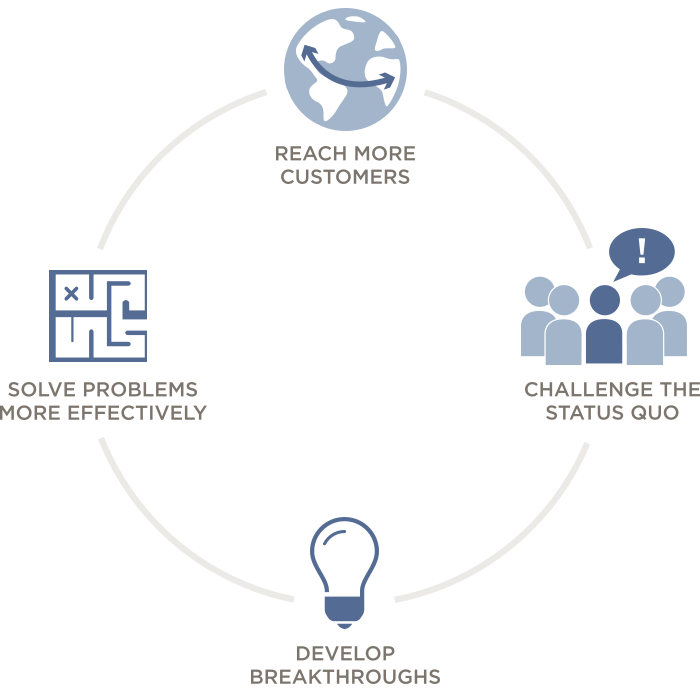
Diverse groups are powerful because they:
-
Solve problems more effectively. A group of people with different skills and perspectives is better able to anticipate obstacles, make accurate predictions, and find creative solutions than a homogenous group.Myers, Verna. Moving Diversity Forward: How to Go From Well-Meaning to Well-Doing. Chicago: American Bar Association, 2011, p. 76.
-
Reach more customers. A demographically diverse team is more likely to be able to identify, attract, and keep a wider range of customers.Slater, S. F. et al., “The Business Case for Commitment to Diversity.” Business Horizons 51 (2008): 201-209.
-
Challenge the status quo. Teams with diverse opinions challenge “business as usual,” engage in vigorous debate, and consider more alternatives.Passion and Purpose: Stories from the Best and Brightest Young Business Leaders. Boston: Harvard Business School Publishing Corporation, 2012.
-
Develop breakthroughs. Diverse opinions stimulate creativity and divergent thought, which are critical to innovation.Slater, S. F. et al., “The Business Case for Commitment to Diversity.” Business Horizons 51 (2008): 201-209.
团队成员越多元,绩效潜力就越高 How Diversity Fuels Group Emotional Intelligence
哈佛教授讲授视频逐字稿
第 3 节
Focus on inclusion
It’s not enough to hire diverse talent. To reap the benefits of diversity, you’ll need to create an inclusive environment. Such an environment acknowledges and supports differences, rather than pressuring people to conform. In an inclusive environment, people feel:
-
They are treated with respect and fairness.
-
The unique life experience, opinions, and ideas they bring to the group are valuable.
-
They belong within the team and are not “outsiders.”
- They can be their “true selves” at work. For instance, a Muslim can talk about a friend in his mosque community, and a gay man can bring his partner to a company party.
培养多元化和包容性的关键:重视每位员工 Value Your Employees as Individuals
哈佛教授讲授视频逐字稿
第 4 节
Barriers to inclusion
Though inclusion is essential, it can be difficult in practice. Some common obstacles managers face include:
-
Employees’ preference for being around others most like themselves
-
Employees’ tendency to mask their differences in order to “fit in”
-
Managers’ tendency to unconsciously stereotype minority employees
Each of these factors can limit the contributions of diverse employees and hinder your team’s performance.
In-groups and out-groups
Though it may be uncomfortable to admit, most people prefer the company of others of the same race, nationality, and religion. We trust them more, cooperate with them more willingly, and feel more comfortable with them in work settings. When a large group of employee has the same values, attitudes, and beliefs, this can form a dominant faction or “in-group.”
In contrast, an “out-group” is often a group in the minority at your organization. It might be members of an ethnic or cultural group. It could be a woman in a field that’s generally male-dominated, or an older worker on a youthful team. Members of an out-group may feel they have less “voice” in the organization because they don’t see many people like themselves as role models in positions of power.
证明自己的实力,需要时间和坚持 Establishing Credibility Takes Persistence
哈佛教授讲授视频逐字稿
The pressure to fit in
Most people want to feel accepted and liked by others. Some adaptation is healthy and appropriate, such as adhering to a company’s dress code or recycling to honor a company focus on sustainability. However, when particular individuals feel they have to cover their true identities in order to be accepted by the larger group, that’s problematic. In those situations, your team is losing the strength of its diversity.Consider the range of changes your diverse employees may be making to fit in:
Undervaluing employees
Because of unconscious habit or bias, managers may undervalue or marginalize some employees. This not only hurts the affected employee’s morale and undermines his or her talents, it sets a damaging example for the rest of the team.
Managers may undervalue employees when they:
-
Base work assignments on stereotypes. For instance, when a team’s meetings run long, one manager always asks the sole woman in the group to step out and order lunch for the rest.
-
Relegate racial minorities and women to junior status. For example, during a strategy meeting, Horatio, the only Latino in the room, offers a suggestion for implementing a new competitive strategy. The room is quiet until a white male team member echoes the idea. The group manager then responds to the idea, expressing interest and asking follow-up questions.
-
Assume racial minorities do not have a strong work ethic.Myers, Verna. Moving Diversity Forward: How to Go From Well-Meaning to Well-Doing. Chicago: American Bar Association, 2011: 126. For example, Mark, an African-American employee, misses a deadline. His manager takes note and assumes Mark will be unable to handle challenging work assignments in the future. In contrast, when a white employee misses a deadline, his manager assumes it is an aberration.
第 5 节
REFLECT
Reflecting on your learning helps you apply relevant concepts to your job.