
U.S. and Japanese Companies Struggle with Different Parts of AI Adoption—and Offer Different Lessons for Making It Work 查看中文版
第 1 节
In the global story of AI adoption, the United States appears to be the clear leader. Meanwhile, Japan, once a global powerhouse of technological innovation, appears to lag. The numbers seem to confirm it: recent research from McKinsey found that 88% of U.S. companies use AI in at least one business function, while comparable research from the Yano Research Institute last spring found just 26% of Japanese companies said the same. According to the Stanford AI Index 2025, the U.S. ranked first globally in private AI investment in 2024; Japan ranked 14.
Like most simple stories, however, this characterization is wrong enough to be misleading. The U.S. may be deploying AI faster, but it is not capturing value from AI faster.
While U.S. enterprises have deployed AI at historic speed, the returns have been quite thin: McKinsey data shows only 39% of companies report any measurable EBIT impact from AI; in HBR, the authors of a recent study wrote that employees experiment with tools but don’t integrate them into how work actually gets done. Meanwhile, Japan offers some examples of companies that have pulled off deep, valuable AI integrations. For example, as of 2024 Toyota’s factory workers (rather than its data scientists or IT teams) had built 10,000 AI models with company-provided tooling, with significant, measurable improvements in efficiency and productivity.
What this reveals is that speed, while important, does not necessarily equal value. For leaders of companies—whether they’re in these countries or not—ignoring this critical distinction increases the likelihood of a stalled AI adoption. But understanding what’s happening in both contexts offers important lessons for companies trying to develop an AI strategy and demonstrate ROI on their AI investments.
Both foundational and contemporary research on technology adoption—substantiated by our extensive interactions with executives leading AI initiatives—demonstrates that value creation is not merely a function of deployment speed, but rather how deeply these tools are absorbed into organizational workflows. In this respect, both U.S. and Japan are lagging, but in different ways.
第 2 节
Two Countries, Two Failure Modes
AI belongs to a category of technologies that economists call general-purpose technologies (GPTs)—they include innovations such as electricity or the personal computer—where realizing value requires not just adoption but costly, time-consuming complementary investments in new workflows, management practices, and redesigned decision processes. Every major GPT in history produced the same pattern: productivity declined before it surged. A recent study of U.S. manufacturing firms indicates AI adoption appears to be following it, too. Technology is only half of the story here. Organizational systems and culture are the other half.
The U.S. and Japan are useful counterpoints in technological adoption representing a fundamental tension between decentralized agility and centralized control. Technological innovation underpins both economies, yet management practices and cultures differ starkly. Historically, this has meant that U.S. firms excel at the messy, rapid reorganization required for early adoption, while Japanese firms favor structured, consensus-driven consistency. These differences have had implications for value created through technology adoption. For example, a 2008 U.S. Census Bureau study found that U.S. manufacturers demonstrated twice the productivity benefit from computer network use than in their Japanese counterparts. The study attributed the gap to differences in how U.S. firms used their networks, a finding confirmed by later research that attributed better performance by U.S. firms to management practices that enabled reorganization around new technology.
However, while the U.S. was successful at reorganization, its fluid approach struggles when a technology demands strict, centralized oversight. Because climbing the AI ladder requires both rapid workflow adaptation and rigorous institutional control, the historical strengths of both nations mutate into liabilities. Indeed, when it comes to AI, the two countries offer two different ways to fail.
To illustrate how, we considered the mode of failure in AI value creation across six layers: 1) infrastructure, 2) task augmentation, 3) workflow redesign, 4) human capital, 5) governance, and 6) organizational reinvention. Rooted in research on IT adoption, the structural progression of this framework mirrors established models such as the digital transformation paradigms of the MIT Center for Information Systems Research and the “AI Factory” model.
These six layers are a ladder, not a checklist. Each rung generates more value than the one below it and extracts more from the organization to reach it. Task augmentation asks individuals to change their habits. Workflow redesign asks teams to abandon processes they have refined for years. Organizational reinvention asks the institution to remake what it is.
An enterprise does not simply succeed or fail at AI, but rather stalls at a particular rung because of distinct institutional conditions. The dynamism that lets American firms deploy fast is the very thing that leads them to skip the slow, disruptive work higher up. The consensus machinery that would make Japanese adoption durable is the very thing that keeps it from starting. Strength at one layer is often purchased with weakness at the next. The United States and Japan are useful illustrations for this strategic impasse because they sit at opposite ends of nearly every AI-readiness ranking, but the same phenomenon plays out in companies around the globe.
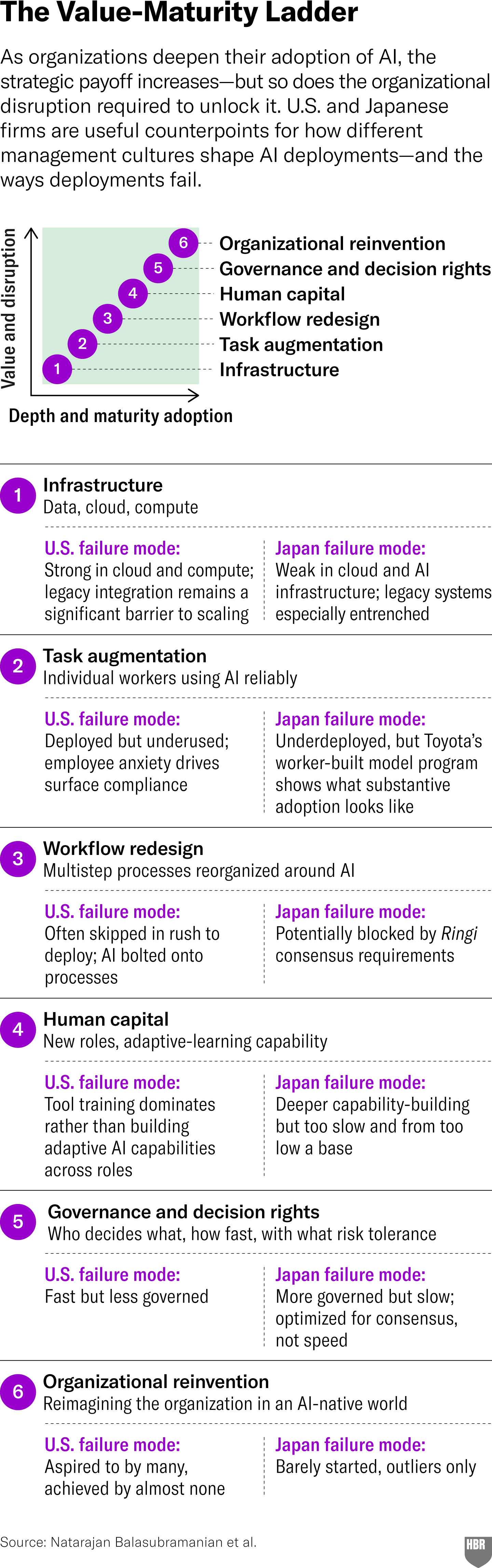
Two failure modes fall out of this map, and they are near-perfect inverses of each other.
The American pattern is speed without depth: strong at the bottom of the ladder, racing through deployment, then stalling because the rungs that create real advantage: workflow redesign, governance, reinvention, require exactly the slow, disruptive organizational work that a deploy-first culture is built to avoid. AI gets bolted onto the existing organization rather than reshaping it.
The Japanese pattern is depth without speed: barely onto the ladder, held back by weak infrastructure and consensus-bound decision-making, yet climbing more soundly where it does, building genuine capability from the bottom up. The problem is not the quality of the rungs Japan reaches, but that it reaches so few, so slowly, from so low a base.
Same ladder, opposite stalls. We take each in turn.
The U.S. deployment-depth gap. U.S. companies suffer from a common problem: While deployment metrics look strong, adoption is often shallow. There are a few reasons for this. One is that many employees harbor significant anxiety about what AI means for their careers, and so use it only superficially. But organizations are also to blame. According to Deloitte, only 30% of organizations have redesigned key processes around AI. Governance is equally thin: only one in five companies has a mature model for overseeing autonomous AI agents even as agentic AI becomes dominant.
Deploying AI without redesigning workflows can be worse than simple under-adoption. A BCG study of nearly 1,500 U.S. workers found that workers using four or more AI tools simultaneously reported reduced productivity and higher mental fatigue, a phenomenon the authors aptly label “AI brain fry.” A separate study by METR found that experienced developers using AI tools took 19% longer to complete tasks and yet reported that AI had sped them up by 20%.
The Japan deployment-speed gap. Japanese companies are genuinely lagging on adoption. The 2025 IMD World Digital Competitiveness Ranking helps explain why: While Japan ranks 9th globally in Technological Framework, it ranks 60th in Business Agility. Japan’s large enterprises, with their layered hierarchies and long-standing management routines, generally lack the managerial incentive structure that drives aggressive U.S. experimentation.
The labor dimension here deserves a careful look. The standard narrative is that the practice of “lifetime employment,” where companies hire graduates and they work their whole career there, slows AI. Japanese firms have adapted this approach to AI-driven change by redeploying workers rather than laying them off. For instance, when Mizuho Financial Group announced plans to replace 5,000 clerical roles with AI, it explicitly ruled out layoffs. Staff would be reassigned to other positions. This approach may produce better organizational outcomes than U.S.-style displacement, which discards operational knowledge, but it also makes process redesign politically and organizationally complex because roles must be redesigned around people who cannot easily be replaced.
第 3 节
Where Japan Is Leading
Despite the laggard label, Japan is genuinely ahead on what might be the next wave of AI value creation: integrating AI into physical operations. Physical AI includes systems that perceive, reason, and act in the real world, embedded in robots, factory equipment, medical devices, and logistics infrastructure. Here, the same organizational features that slow Japan’s enterprise software adoption may accelerate its physical AI adoption.
For instance, Ringi, the practice of bottom-up decision making, blocks enterprise software deployment because redesigning a procurement or credit-approval workflow requires broad cross-functional sign-off. In contrast, while the high-level decision to purchase physical AI technologies is still made at a corporate level, frontline workers have substantial discretion over the details of implementation—such as what specifications to choose, where and how to deploy the technology, and how to integrate it into existing workflows. Guided by Kaizen, the philosophy of continuous improvement, technology is treated not as static corporate mandates, but as evolving systems to be augmented iteratively from the bottom up. The consensus culture ultimately supports the implementation of physical AI because the concrete details of implementation are developed collaboratively with frontline workers rather than imposed from above. Japan has, in effect, already built the complementary organizational investments for physical systems along task augmentation (layer 2), workflow redesign (layer 3), and human capital (layer 4) through more than 40 years of robotics integration.
第 4 节
An Action Agenda for Leaders
While we’ve focused on companies in two countries, versions of both failure modes are easy to find in other countries. The six-layer framework gives executives a structure for self-assessment: leaders should audit where their organization sits at each layer and prioritize the moves that close their weakest layer. The recommendations below are calibrated to the two failure modes described above.
Fixing Failure Mode 1: Invest in depth before breadth.
This failure pattern is fast progress at the infrastructure (1) and task augmentation (2) layers that pulls away from workflow redesign, human capital, governance and decision rights, and organizational reinvention (layers 3 through 6). The corrective moves slow deployment in favor of integration.
Rethink a few workflows end-to-end, and measure those rather than deployment (layer 3). Most U.S. firms are running dozens of shallow pilots. Because leaders are measuring metrics such as “tokenmaxxing,” deployments can look like a success without creating much value. Instead, leaders should focus engineering and management bandwidth on a small number of workflows where AI can reshape decision and information flow without a complete rip and replace. For example, credit underwriting, claims adjudication, demand planning, customer onboarding, or software release management. To assess progress, look to workflow-level indicators: cycle time on redesigned processes at steady-or-better quality, the quality of the decisions produced, and output per person on the redesigned work. Tie a defined portion of executive compensation to outcomes of those redesigned workflows rather than to the number of pilots launched or simply the breadth of AI adoption.
Build governance ahead of agentic AI rollouts (layer 5). Only one in five companies has a mature governance model for autonomous agents, yet agentic AI is moving into customer service, IT operations, and finance at scale. Set up key governance artifacts before the next agent goes live: a registry of every agent in production, decision-rights documentation that specifies dollar and risk thresholds for human approval, an audit-log standard capturing the full reasoning chain for agent decisions, and a kill-switch protocol with named owners. Doing this work after agents proliferate is materially harder and exposes the firm to regulatory and operational risks that compound quickly.
Cap the number of AI tools available to any single role (layers 2 and 3). The BCG finding that workers using four or more tools simultaneously report lower productivity has direct operational implications. Set a default of, for instance, two AI tools per role and require formal justification to add a third. Consolidate overlapping tools even when budget owners resist losing their preferred vendor. Pair tool consolidation with workflow and information flow redesign so the remaining tools are integrated into the work rather than layered on top of it.
Convert generic AI training into role-specific capability building (layer 4). Generic prompt-engineering courses build awareness rather than capability. Replace them with role-specific programs structured around the actual decisions a person makes. For instance, a credit analyst’s program can cover AI-assisted credit memos, model interrogation, and bias review. Hitachi is a model here. The company has committed to training 50,000 employees in generative AI; a comparable target is 30–50% of relevant roles certified on a role-specific curriculum within 18 months.
Fixing Failure Mode 2: Invest in speed while preserving what works.
This failure pattern is strong organizational complements that move too slowly to capture early-stage AI gains in software. The corrective moves preserve the strengths of deliberative management traditions while creating a faster lane for AI.
Create a faster decision and deployment cadence for AI (layer 3). Traditions that rely on broad consensus in decision making and implementation (such as Ringi) may protect organizations from poor decisions, but AI experimentation—where the cost of being wrong on a pilot is low, but the cost of delay is high—requires a fast cadence.
Leaders should establish an AI fast-track that bypasses full sign-off for defined decisions: AI initiatives under a set spending threshold and limited to internal-facing workflows can be approved by a small cross-functional council in two weeks rather than two-to-four months. Reserve full sign-off for decisions with broader strategic or risk implications. Pair the faster decision process with explicit targets at the task level. Track usage at the team level, publish results internally, and require team leaders to explain underuse. MUFG’s experience suggests that universal deployment without usage targets settles at roughly 50% utilization; team-level accountability can lift it higher.
Commit to a three-year infrastructure investment plan (layer 1). Any infrastructure gap is structural and will not close through gradual investment. In such cases, commit to a three-year program that migrates significant levels of analytical workloads to cloud, modernizes the top 10 data sources by usage, and establishes a unified data platform with documented access controls. The capital required is meaningful but recoverable. The alternative is a permanent ceiling on what later layers can achieve. Companies cannot rely on national infrastructure providers to do this work for them; the data foundations must be built inside each firm.
Treat physical AI as a CEO-level strategic priority (layers 3 and 6). Demographic pressures are not unique to Japan. As these spread to other countries, physical AI will only become increasingly important. If your company builds, moves, or maintains physical assets, you hold a strategic position that software competitors cannot quickly replicate. Leveraging this dominance can offer an asymmetric advantage in the AI era, although it is far from guaranteed.Leaders of such companies should consider physical AI centers of excellence that pair robotics engineers with foundation-model teams, set a target for embedding AI into, say 30%, of installed robot fleets within three years, and pursue targeted acquisitions of software firms whose models can be deployed onto the company’s hardware. As an example, Medicaroid pairs Kawasaki’s robotics engineering with Sysmex’s medical-diagnostics expertise to build Japan’s hinotori surgical robot, while exploring data and AI as a way to scale surgical know-how. The window for consolidating this lead is open now and will narrow as U.S. and Chinese firms invest more aggressively in physical AI.
Raise the base rate of AI capability across the workforce (layer 4). Toyota’s Software Academy and Hitachi’s training of 50,000 employees are the right model, but they remain outliers, even within Japan. The base rate of AI-skilled employees in most countries is well below the U.S. rate, even where the ceiling at frontier firms is likely comparable. Set a board-level target that, for instance, 40% of the workforce completes an AI capability program within 24 months, and that a subset, say 10%, achieves an advanced certification. Tie progress to executive performance reviews, the way safety metrics are tied today.
. . .
AI is a general-purpose technology, and the companies that succeed will be those that name their own failure mode and invest in the complementary changes AI requires. U.S. leaders should not mistake broad deployment for deep transformation; Japanese leaders should not mistake careful deliberation for risk management when the greater risk is moving too slowly. The two countries are failing at different layers of the same problem: the U.S. deploys fast but not deeply enough, while Japan approaches AI carefully but too slowly. The firms and countries that push through all six complement layers will be the ones most likely to see the kind of productivity surge that followed electricity in the 1920s and computing in the 1990s. For managers everywhere, the lesson is the same: AI adoption is not merely a technology decision, but a test of organizational will to change.