
AI’s Impact on SaaS Will Be Uneven. Here’s What Leaders Need to Know. 查看中文版
第 1 节
For two decades, software-as-a-service (SaaS) grew by digitizing workflows. Customer relationship management systems recorded sales activity. Field-service platforms scheduled jobs, retrieved customer histories, and fed upsell opportunities back into sales teams. The model created value by taking opaque or messy information and putting it in workers’ hands. Before AI coding tools, few buyers were positioned to build comparable feature sets in-house.
Generative AI changes that calculation. Frontier models and AI coding tools now allow companies to build features internally that they previously bought from SaaS vendors. Several executives I have interviewed have already approved internal tools that can materially reduce external vendor spend. The early-2026 software selloff, which some market observers labeled the “SaaSpocalypse,” reinforced a tempting through-line: If AI can build or automate software, most SaaS should be rebuilt internally or shopped to a new vendor with a cost structure that reflects lower building costs with AI tools.
My research into the SaaS product market finds that conclusion is too crude. The market, and many executive teams, have treated very different kinds of software as though they were the same. They are not. By analyzing 45 publicly traded SaaS companies using their 10-K filings and other public disclosures, I found there are significant differences within the SaaS category based on what the software is being asked to do and what kind of data powers it. In particular, I find that one kind of SaaS, powered by pooled data and asked to do predictive tasks, is already proving more valuable in the market than media reports would suggest.
I draw on my findings, as well as my work with Bluon, an AI-enabled SaaS, to help executives understand the current SaaS landscape, and I provide a framework for evaluating whether companies should keep paying an external vendor, renegotiate, consolidate, or build SaaS tools in-house.
第 2 节
How to Make Informed SaaS Decisions
When evaluating potential or current SaaS products, companies should consider two sources of defensibility (as what cannot be replicated in house is defensible, and vice-versa). These are proprietary context and network effects. A vendor with neither is exposed. Businesses with network effects have been examined in depth over the years, and few internal buyers can realistically architect a platform play for themselves that taps into network effects. As a result, I focus mainly on understanding when proprietary data is valuable, with the recognition that network effects may feed an engine for proprietary data collection.
The simple framework below separates the problem into two dimensions and helps clarify which tools are genuinely at risk of disruption from new entrants or in-house builds, which should be retained or expanded, and how buyers should evaluate where a SaaS offering falls.
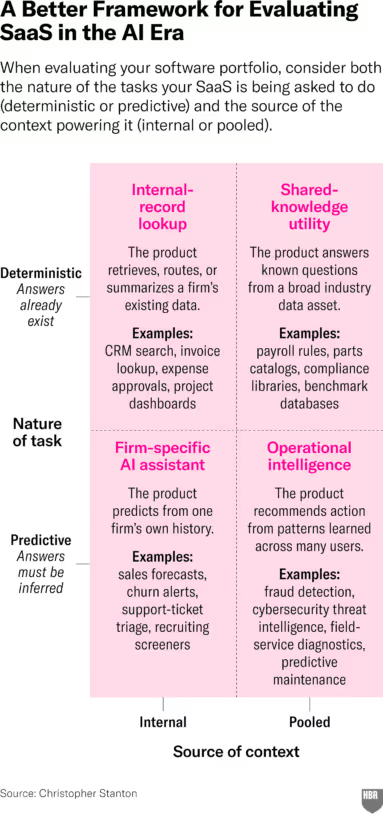
Consider a 2-by-2 matrix. One axis describes the nature of the task: deterministic or predictive. A deterministic system answers questions from data that already exist somewhere: Which part fits this unit? What did we invoice last month? What coverages are in this insurance policy? A predictive system does something harder: It estimates what is likely wrong, what should happen next, or which action is most promising when the answer is not stored in any single record. The writing of Ajay Agrawal, Joshua Gans, and Avi Goldfarb (including in HBR) that frames both generic AI and generative AI as a prediction problem remains useful because it directs attention to situations where algorithms help firms navigate uncertainty.
The second axis describes the context that supports the task. Internal context means tools draw mainly on one company’s own data. Pooled context means tools learn from patterns accumulated across many customers, jobs, environments, and edge cases.
Where the Disruption Risk Is Real, and Where It Is Not
The SaaS most vulnerable to displacement fall in the upper left quadrant: deterministic software built on internal context. These products, like ServiceTitan and Monday.com which support scheduling and individual operations, surface a firm’s own transactions or route work through known rules. Lower development costs from AI coding tools and increasingly capable agents are putting real pressure on incumbents here. Several C-suite leaders I have interviewed are deploying internally built AI tools, many of them built by nontechnical teams, that threaten seat-based pricing and enable vendor consolidation. For tools in this quadrant, consolidation and selective in-house building are often reasonable responses to current AI capabilities.
Moving down the left column, predictive tools built on internal or non-proprietary context (like publicly available data) face a related problem. Foundation models from Anthropic, OpenAI, and others mean that prediction based only on a single company’s records is unlikely to remain a defensible moat. Much of the pessimistic commentary around SaaS reflects this logic. One reason the early-2026 selloff spread so quickly was that investors saw general-purpose AI systems moving into non-routine, predictive workflows, including legal work, where abundant public context lowers the barrier to entry. Observers quickly realized that prediction from foundation models would leapfrog existing solutions that drew only on public data or limited, single-firm records. For tools in this quadrant, maintaining legacy tools depends on the internal cost of building and maintaining an internal version.
In the right column, pooled context from many customers powers the tool, so data ownership matters. The buyer’s question is whether an internal team or a new entrant can recreate a useful proxy for that proprietary data. If not, the relevant comparison is not simply the contract price. It is the cost and risk of going without the external capability.
What matters is the degree of idiosyncrasy in each transaction compared with what can be learned by observing many transactions across customers. For example, an auto mechanic can memorize the cars they see most often but will still keep a parts database subscription because uncommon problems require external knowledge. If that database is proprietary, the vendor has a defensible position against new entrants and internal builds. If the database vendor is also involved in the supply chain, cheap software that pushes mechanics to digitize may strengthen the database operator’s position, but only if a rival cannot acquire the same data without seeing a large volume of transactions. When evaluating products in this category, the most important consideration is whether a vendor’s data advantage is genuine rather than something that can be synthesized quickly by quickly improving AI tools.
The lower-right quadrant, operational intelligence, is the stickiest. In many real-world workflows, deterministic lookup is table stakes. The hard problem is inferring the likely answer in unusual situations, or when an operator encounters an edge case that does not match a textbook procedure. In those settings, a company’s own historical records are thin, and vendors create value by pooling long-tail events across tenants. In my research into SaaS companies, I found that the market is already distinguishing between the extremes, or the group of SaaS companies that are heavy on prediction using pooled context from those that are more likely to focus on deterministic workflows using internal data.
Since the release of ChatGPT in November 2022, an equally weighted portfolio of predictive-pooled companies has outperformed a comparable portfolio of deterministic-internal companies by approximately two percentage points per month. Over the more recent period covering the early-2026 SaaS selloff, the deterministic-internal portfolio fell roughly 9 percent, while the predictive-pooled portfolio fell roughly 4 percent.
The implication is not that executives should follow equity markets as a leading indicator. It is that the logic embedded in those relative valuations is sound, and executives evaluating their own software portfolios should apply the same reasoning.
第 3 节
The Unit Economics of Pooled Context
The clearest way to see why external vendors in the lower-right quadrant shouldn’t be lumped in with generic SaaS offerings is to work through the unit economics of specific cases.
Consider a lower-right quadrant company such as Cloudflare, whose machine-learning models draw on visibility into global internet traffic and large volumes of threat signals. Dropping that external capability could be costly in ways that a budget line item does not capture. No internal security team, and no point solution built on a single company’s traffic logs, could replicate that signal. The cost of the software is small relative to the exposure. This asymmetry characterizes the lower-right quadrant generally: The downside of losing pooled intelligence typically far exceeds the software line item, and the comparison should be made against the cost of what would replace it, not against what the contract costs.
A more concrete example comes from Bluon, where I serve as an advisor (and, for full disclosure, have an equity stake in the company). Bluon provides predictive AI tools that support HVAC technicians in the field. When a technician confronts a failing unit, they must reason through several possible sources of the problem: electrical, gas, refrigerant, brand-specific quirks, or interactions among them. Then, once the likely problem is narrowed, the technician needs to determine a remedy, which may not be a single answer: Are there different parts that could work? Altered setups? Or would full replacement options be justified?
Bluon’s core product is an AI assistant that helps HVAC technicians identify problems and solutions in the field. It is trained on roughly 135,000 tech support calls that were answered by veteran HVAC technicians in the country. The AI combines these transcripts with documentation from 200 original equipment manufacturers covering 3 million models, 5 million parts, and 60 million part cross-references. In addition to reduced time spent on service calls, the vast, pooled context allows for more accurate diagnosis matched with more accurate parts look up, leading to greater efficiency in supply chains.
Sources of Advantage from Pooled Field Context
I have used Bluon as an example not only because I understand the unit economics from an operator’s perspective, but because its technical leaders allowed me to explore what pooled context means for their product. The tech support issues Bluon has seen can be organized by similarity in topic space. Doing so reveals 59 clear clusters, each representing a domain of knowledge: compressor issues, electrical faults, OEM-specific operational quirks, and so on.
But the clustering structure misses a substantial part of the data and misrepresents the story. The real value of pooled context comes from the connective tissue between the clusters. In this case, 37% of field issues in the Bluon corpus are “outliers” that resist clustering entirely. These queries represent nuances that require practical field wisdom developed through experience or mentorship from a skilled master technician, rather than recurrent pattern-matching. Answering them requires interpolating between known patterns inferred from a large and varied dataset.
Frontier models or new upstarts are also unlikely to replicate this kind of support. Frontier models will not have access to the problem-solution mapping without the underlying data from seeing a huge number of issues, with the edge cases occurring so rarely that synthesizing an equivalent knowledge base would be impractical in any reasonable time frame, regardless of capital. For example, in the Bluon data, 27 of the 59 support-topic clusters contain fewer than 300 records each, or under 0.3% of the training data. These low-frequency, high-difficulty areas are where errors are most costly, where a single shop’s dispatch history provides the least help, and where synthetic models won’t have context for what actually fixed a problem.
That 37% outlier rate is the practical source of a vendor’s advantage. It is also where the labor economics have bite. The long tail of low-frequency, high-difficulty issues is where a shop’s callbacks and repeat visits consume operator margin. A vendor that aggregates signal across thousands of technicians’ calls can address those cases; a tool built on any one shop’s records cannot.
第 4 节
How to Evaluate Pooled, Predictive SaaS Vendors
I have spoken above about how to evaluate SaaS powered by internal data or that tackles more deterministic tasks: They should be considered based on how much it would cost to maintain internal versions and the genuine advantage provided by large, proprietary data sets.
Evaluating pooled, predictive SaaS is a bit more complicated as the standard approach to software evaluation—a polished demonstration controlled by the vendor—can be particularly misleading. A demonstration almost always runs in the dense, well-clustered part of a tool’s knowledge, where use cases are common, vocabulary is consistent, and any reasonably built product performs competently. But real field calls land disproportionately in the interstitial regions: mixed vocabulary, incomplete information, and edge cases that require interpolation between known patterns.
The right evaluation method presses on those regions. Prospective buyers should identify a sample of the queries or jobs that previously required a skilled human with judgment and time and test the software specifically against those. In most industries, the volume of work in that category is substantial. If the tool handles it well, the external software is earning its keep by surfacing real expertise. If it fails, the buyer has learned something useful: either the vendor lacks genuine pooled context, or the buyer’s own records are sufficient to support a narrower internal tool.
An internal build effort, even if modest, also serves as a useful benchmark when re-evaluating external vendors. A buyer who understands what is achievable with internal context has a clearer view of what a predictive-pooled vendor is actually contributing and whether that contribution justifies the contract.
. . .
The broad impulse to cut software spend in response to AI is wrong as a blanket rule. The right question is not whether a vendor sells SaaS, but where its tools sit in the matrix and whether its data moat is genuine.
However, it is true that the majority of traditional SaaS offerings mostly documented and organized work, meaning spending was largely confined to software budgets. Operational intelligence solutions in the lower-right quadrant of the matrix extend into the labor budget by capturing work that previously required expensive expertise, especially in sectors where mistakes are costly. As Bessemer Venture Partners has argued, the long-term opportunity is larger when software performs judgment-heavy work rather than merely recording it. External vendors capture that work when they own proprietary context. Aggregating signal across thousands of touchpoints is what creates the moat, and pressure testing solutions around edge-cases is the right method for determining whether a vendor has actually built a quality solution.
AI does not make all SaaS less valuable. It makes weakly differentiated SaaS easier to replace. The software it augments comes from owners of rare, private, operationally verified context that apply it to costly judgment-heavy work.