
The 3 Types of Customers Who Buy Smart Products—and How to Market to Them 查看中文版
第 1 节
A decade ago, Samsung’s Family Hub Refrigerator became the poster child of the smart home revolution. It was marketed as “the smart way to manage food,” and it was a success. But today, as the smart product market matures, selling “smartness” alone isn’t enough. Indeed, while the smart home products industry is currently projected to reach $537 billion by 2030, three out of four projects in the space, by some estimates, still fail to deliver expected value.
Part of the problem, we believe, is that most brands’ market strategies rely on abstract claims that their products are “smart,” “intelligent,” and “automated,” assuming customers are lured in by technological sophistication alone. For example, Nikon advertises its new camera as having “an advanced algorithm developed using deep-learning technology.”
But our research, published in the Journal of Consumer Research, shows that too much promised “smartness” can actually hurt sales if it doesn’t meet customer needs: For some tasks—a smart lock, say, that just needs to lock and unlock—customers will likely prefer simpler, more predictable algorithms over AI. But a smart voice assistant expected to handle diverse tasks? Here, highly adaptive algorithms become a selling point. The takeaway? Match your offering to the outcomes customers really care about.
Of course, this isn’t always easy. To explore what drives smart product buyers, we conducted an industry report for which we surveyed more than a thousand customers across 31 smart product categories. We gathered a range of demographic and customer preference data, as well as asking them to rank eight potential advantages of smart products over traditional products. We then used a statistical method known as cluster analysis to identify three main clusters, or personas, of smart product customers.
The clusters didn’t map to traditional cohorts of age, income, or tech savviness, but rather, they reflected different ways of extracting value from smart products: One group tended to use these products to feel more comfortable, another to live with more purpose, and the third used them to run their lives more efficiently. We call these three personas comfort-seekers, purpose-seekers, and efficiency-seekers.
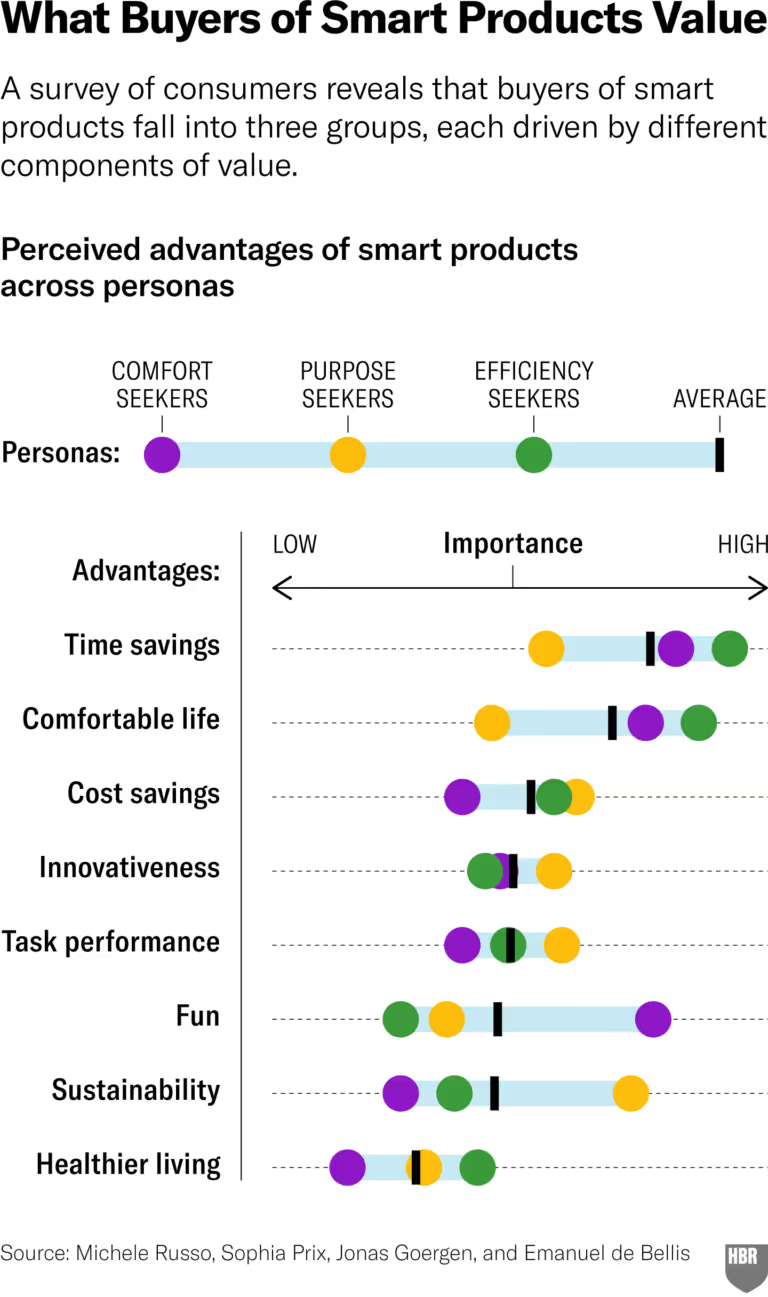
Let’s look at what each of these personas is looking for in a smart product—and what it will take for companies to market to them effectively:
第 2 节
Persona 1: Comfort-Seekers
Comfort-seekers, who represented 46% of the participants in our study, are not tech enthusiasts. They look for three simple things: comfort, fun, and time savings. They look for products like robot vacuums that clean at the push of a button, or entertainment systems that adapt to their preferences. They actively avoid high-commitment or more experimental tech, such as 3D printers. As such, effective messaging for comfort-seekers focuses on:
-
Simplicity of use (e.g., plug-and-play setup)
-
Clear, immediate benefits (e.g., “more you-time and less to-do time”)
-
Positioning that signals comfort without complexity (e.g., “making your life easier”)
For example, the automated shading and lighting control systems manufacturer Lutron advertises that its Serena Smart Shades “move so you don’t have to.” Even more concretely, Kärcher, a cleaning systems manufacturer, promotes its robotic lawn mowers by emphasizing comfort alongside functionality: “Sit back, relax and enjoy a perfectly mowed lawn!”
第 3 节
Persona 2: Purpose-Seekers
The 18% of customers who fell into this category were looking for smart products that would help them deliver on big goals like reducing their carbon footprint, building healthy habits, or contributing to a better world. When choosing a smart product, they look for data, impact metrics, and third-party validations that prove that the product will help them achieve their goals.
These customers buy products like smart kitchen appliances that track nutritional intake, 3D printers that reduce waste through on-demand manufacturing, or smart thermostats that provide detailed energy savings reports. In addition, we found that purpose-seekers tend to be much more emotionally invested in their tech than other customers, often giving their devices nicknames, seeing them as family members, or even referring to them as “the boss.” To reach these buyers, companies should offer a value proposition with:
-
A clear mission (e.g., “smarter choices for a better life—and a better world”)
-
Precise mission-related metrics (e.g., “reduces energy consumption by 23%”)
-
Integration with health, sustainability, or performance tracking apps (e.g., Apple Health)
-
Third-party validation (e.g., through scientific backing and certifications)
Nest, for instance, includes extensive energy savings data in its messaging and focuses on its positive environmental impact. Similarly, Oura’s Give Us the Finger campaign reframed aging as “the ultimate aspiration,” departing from typical short-term fitness messaging to focus on longevity and holistic health insights. These brands speak to purpose-driven customers who are motivated not by near-term comfort, but by big-picture, long-term goals.
第 4 节
Persona 3: Efficiency-Seekers
Efficiency-seekers view smart products purely through an ROI lens. Like comfort-seekers, they value comfort and time savings, but they place much less value on smart products being fun and much more value on cost savings. They don’t care about plug-and-play interfaces or emotional wellbeing—what matters most to these customers is getting the job done faster, cheaper, and more efficiently. In line with this motivation, on average, efficiency-seekers reported saving more time using smart products than either of the other two personas.
In our study, we found that 36% of customers were efficiency-seekers, making this the second-most common persona type. And what does it take to reach these buyers? To emphasize efficiency gains, companies should highlight features like:
-
Hard ROI calculations (e.g., “pays for itself in 6 months”)
-
Quantified time savings (e.g., “saves 2 hours per week”)
-
Performance guarantees (e.g., money-back offers)
Roborock exemplifies this approach, emphasizing its core benefit—time saved—by showing how its robot vacuum frees time and “does the dirty work” for you. Similarly, Instant Pot highlights how its smart multi-cookers “cook up to 70% faster than traditional cooking methods,” providing a clear, quantified description of their ROI.
第 5 节
A Smarter Way to Sell Smart Products
When smart products first hit the market, just advertising their “smartness” was enough—but those days are gone. Today, selling smart products is all about identifying and communicating the specific ways in which they will add value to the customer. Ask yourself, “What makes my customers tick? Which need does my product solve best?” Then, tailor your strategies to match the persona that is most aligned with your brand. That means:
-
Developing Products with Customer Needs in Mind. Design features that map directly to persona needs. Comfort-seekers want intuitive interfaces and simple shortcuts; purpose-seekers want impact dashboards and progress tracking; efficiency-seekers want automation, custom presets, and streamlined workflows. Create product bundles or customizable plans that are optimized for each persona: For example, a purpose-seeker focused on sustainability might be interested in a bundle that includes a smart thermostat and an energy monitor, while a comfort-seeker might prefer an auto-renew package or all-inclusive bundle that simplifies decision-making.
-
Marketing to Buyer Personas. Train salespeople to identify which personas best represent their customers through asking questions about daily routines (comfort-seekers), long-term goals and values (purpose-seekers), or priorities around efficiency and control (efficiency-seekers). Create content in each persona’s language: stories and case studies for comfort seekers; charts, proof points, and expert endorsements for purpose seekers. Efficiency-seekers respond well to straightforward product comparisons. Customize their onboarding experiences: comfort-seekers like quick-start guides and visual walkthroughs, while purpose-seekers will need goal-setting tools and tutorials tied to long-term outcomes.
The smart product revolution isn’t about technology—it’s about transformation. Whether your customers seek comfort, purpose, or efficiency, they’re not buying algorithms or sensors; they’re buying better versions of their daily lives. As such, the winners in this $537 billion market won’t be those with the most advanced AI, but those who best understand that success comes from solving real problems for real people—one persona at a time.