
Adobe’s CEO on Making Big Bets on Innovation 查看中文版
第 1 节
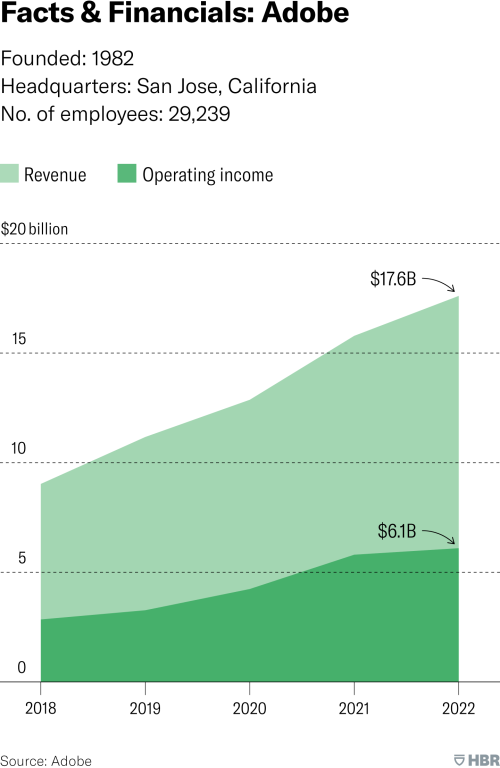
When the founders of Adobe, the late John Warnock and Chuck Geschke, called me into the company’s boardroom in 2007 and offered me the role of CEO, I felt an immense sense of gratitude and awe. To be asked to lead an organization that had had such an impact—from the advent of desktop publishing with PostScript to digital documents with PDF to imaging with Photoshop—was the opportunity of a lifetime. Adobe was a beacon of innovation, had been profitable since its first year, and was on track to announce $3.16 billion in revenue later that year.
Today we have more than 29,000 employees and more than $18 billion in annual revenue. Our mission to change the world through digital experiences has led us to empower billions of customers—individual artists, small businesses, and Fortune 500 companies such as Coca-Cola, Nike, and Pfizer—to imagine, create, and deliver any digital experience. (Disclosure: We’ve also worked with Harvard Business Review. )
At its core, Adobe is a company dedicated to delivering product innovation, delighting customers, and fostering a culture where employees can thrive. We have always anticipated client needs and launched transformational technologies that propel the company and the industry forward. We have embraced invention and reinvention to better serve our customers, expand into new markets, and deliver the best of Adobe to our stakeholders. During my tenure I’ve tried to build on and extend this legacy.
第 2 节
Early Lessons
Before coming to Adobe, in 1996, I cofounded Pictra, an online photo-sharing company. That was a crash course in management: Create the vision, raise money, and hire every employee. I was passionate about imaging and visual communications, and I loved developing technology that solved a real problem. Although the idea behind Pictra was right, the timing wasn’t conducive to commercial success.
However, it was a great learning experience that led me to Adobe, because the company had at one point shown interest in partnering with or acquiring our start-up. Those conversations had left me a bit awestruck by Adobe’s innovations and brand and its potential for influence. In 1998 I joined as vice president and general manager of the engineering technology group, with a focus on building shared technology and platforms to provide consistent interfaces and experiences for customers. Six months later, as part of a broad reorganization, I took on the layout engineering group, which included InDesign. At the time, Quark, a rival platform, was the de facto publishing standard, but the Adobe team was working on creating a new paradigm for modern digital publishing, taking on the incumbent in the process. In 1999 we released InDesign, built from scratch with a plug-in architecture to leverage developer contributions from the start and designed to tackle some of the hardest problems faced by our global community of customers. Those early strategic decisions helped us make InDesign a powerhouse. From that experience I learned the importance of being adaptable—willing to do anything required to advance our key priorities.
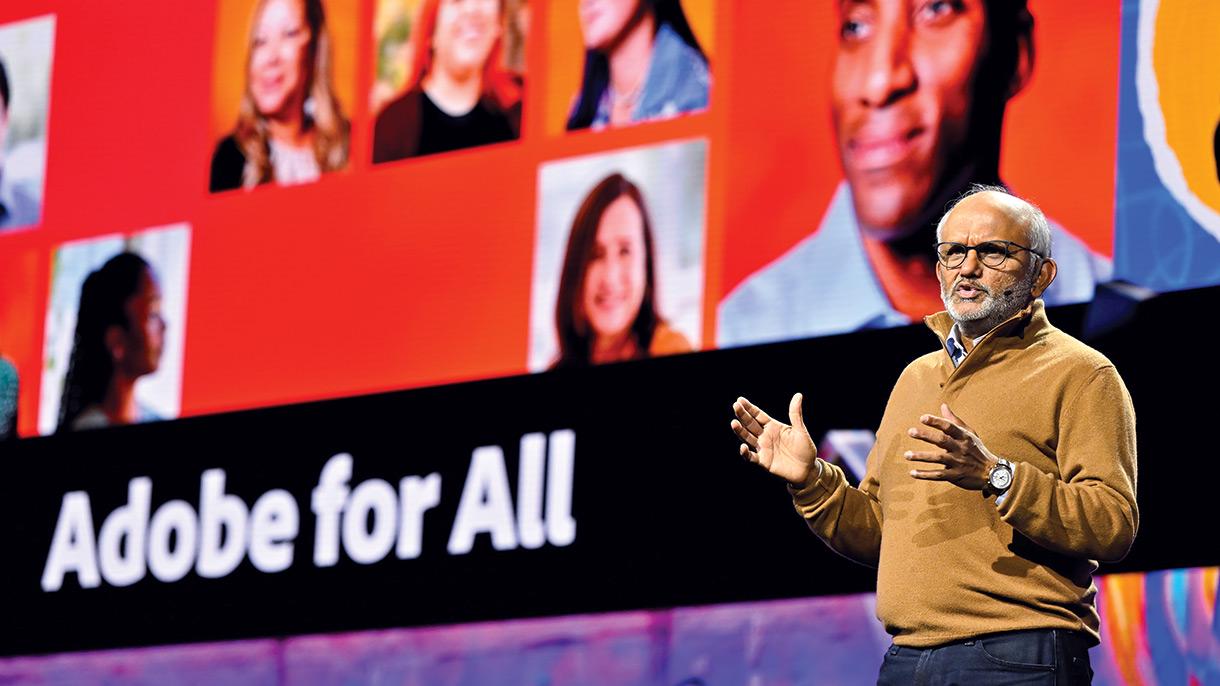
CEO Shantanu Narayen speaking at Adobe Summit 2023 Courtesy of Adobe
After the successful delivery of InDesign, then-CEO Bruce Chizen asked me to lead all engineering. I’ve always been inspired by how customers use our products as well as by the business side of things, and in 2001 I began to lead all of product. I focused on balancing innovation with predictability in software. We established a portfolio approach that refined how we balance long-term innovation and short-term execution. I learned from Bruce the art of building teams with complementary skill sets, and together we created the strategy to acquire Macromedia. I was named COO in 2005 and tapped for the top job two years later.
In this new role, I had the privilege of continuing to drive and expand Adobe’s mission and leverage its talent. But less than 12 months later the Great Recession hit. That was something that I, as a first-time CEO, hadn’t previously dealt with. The leadership team had to adapt and make tough decisions: to reprioritize projects and, unfortunately, to institute a companywide layoff, as many other tech companies did. We recognized that although the recession was beyond our control, it could provide an opportunity to refocus on the company’s core values—innovation and people—and to come out the other end smarter and stronger. Since then we’ve dealt with every other macroeconomic crisis without mass restructuring, which is something I’m proud of.
第 3 节
Looking Around the Corner
Technology is inherently a growth business. Great companies and leadership teams are constantly reevaluating their market opportunities by expanding their perspective on how to deliver value to customers. Adobe had begun as a desktop-software company that was instrumental in creating the world’s content, but during our recession-era strategic evaluation, we realized that we were not playing a role in the entire content supply chain. Content was increasingly being distributed and monetized on the web.
Our hypothesis was that we were delivering the art of marketing but not the science. So in 2009 we expanded from content creation to content management, measurement, and monetization with the acquisition of Omniture, a web-analytics software company with clients including Ford, TD Ameritrade, and Walmart. Because it wasn’t an obvious move, our decision was met with skepticism from multiple constituencies. But we pressed forward, confident that it was right for the long term. We understood that most if not all content would soon be developed for and stored on the web, which would make it easier to analyze and increase consumption. We also understood that Omniture’s cloud-based web analytics, combined with Adobe’s creative and digital-media applications, would help users of all kinds both imagine and optimize their ideas. Over time we have continued to deliver on that vision by connecting all the dots.
The lesson for me was that creating fundamental technology innovations requires being comfortable with ambiguity and trusting your team’s instincts. Bold pivots have been part of Adobe’s DNA since PostScript, which was originally a product for printer vendors before becoming a full-fledged application business. Pioneering the digital marketing category by moving both content creation and management to the web involved multiple acquisitions in that tradition.
Any successful technology company needs to look around the corner and make some key assertions about how the world is going to change over the coming years and decades. As leaders, we’re paid to make investments to grow a business. Some of them succeed and some fail, and we have to be comfortable with that. At Adobe what consistently gives us the courage and the conviction to pursue nonobvious ideas is the intense understanding of customers’ needs that we develop through our own use of technology, and our conversations with customers around the globe.
第 4 节
The Shift to Creative Cloud
The world gives us credit for being the first major software company to transition from a desktop-based, perpetual-licensing business to a multibillion-dollar SaaS one. That was driven by our desire to both innovate at a faster pace and make our products more affordable and accessible. The traditional 12-to-18-month product cycle kept customers at arm’s length and slowed down our engineers, and amid growing adoption of cloud computing and mobile, we needed to be quicker. For a product company, anything that gets in the way of serving the most customers and delivering innovation as fast as possible will stymie long-term financial success.
The shift to Creative Cloud was our solution. It was an entirely new way to deliver ongoing product advances, engage existing clients, and attract new ones who might previously have considered our products unaffordable. Our business and revenue became much more predictable, and our product teams were unshackled from the typical secrecy of boxed software launches. They could engage with customers as never before—a huge win for future innovation.
When we adopted a SaaS business model, everything had to change: how we built and marketed our products, what we expected of our employees, and how we communicated with Wall Street. Finance had to develop new models for recognizing and reporting revenue. For marketing, customer retention became as important as—if not more important than—customer acquisition. Our product teams developed ways to gather customer input on early product releases and make continual improvements.
Our key takeaway from this transformative period was that to accomplish enormous change, everything must be aligned to the priorities, key performance indicators, and incentives in the system. The tremendous companywide effort was well managed by our leadership team but also propelled by the tens of thousands of employees who embraced this new way of running our business.
Many companies (Adobe included) significantly underestimate the complexity of communicating such a gigantic transformation both inside and outside the company. The strategic part of change, while difficult, pales in comparison with the operational execution and the people-focused elements. The key to success is inspiring employees to understand the change while providing incentives for them to apply their own ingenuity to making it better.
My role was to champion the narrative with all our stakeholders. I devoted my time to evangelizing the new approach so that all our team members could understand how they were contributing, and all our customers could understand how they would benefit. Finding champions of change, identifying potential quick wins, and logging short-term successes was important. We erred on the side of overcommunicating to address the inevitable opposition from both inside and outside the company. (One customer even created an online petition demanding that we revert to boxed software, and it garnered thousands of signatures.) Repetition was important to winning people over. I couldn’t just say, “We’ve spent a lot of time thinking about shifting to the cloud, and now we’re doing it.” To get everyone behind the transition, I had to overcommunicate the strategy and allow employees to embrace and personalize it.
Of course, moving to the cloud was the right strategy. It sped up our innovation processes and encouraged every employee to engage with the community. Creative Cloud revenue reached $10.5 billion in FY 2022.
第 5 节
Charting New Frontiers with AI
Every disruptive technology presents exciting opportunities for Adobe to innovate and increase our addressable market. This has been true for cloud computing, mobile, and, most recently, artificial intelligence. But with any hot technology trend, the leadership challenge is to distinguish between hype and reality so that you can make an informed decision about its potential for your business. My Pictra experience underscored the importance of market timing and the state of a technology’s readiness for broad market adoption.
Without a doubt AI and generative AI have enormous potential. Adobe has invested in these technologies for more than a decade, and we’ve delivered hundreds of innovations across our portfolio through Adobe Sensei, which helps customers improve the precision, ease, and speed with which they do their work. Our ongoing R&D investments have also enabled us to develop and deploy Firefly, our generative AI technology—a copilot that augments rather than replaces human ingenuity— with impressive speed. We believe that generative AI will drive further accessibility and adoption of our products. It is an accelerant for idea generation and refinement among the world’s creative minds. For businesses it presents opportunities for greater automation, productivity, and personalization.
AI will help us do things that we couldn’t have imagined a decade ago. Adobe is at the forefront of its development and use because we have always been, and always will be, focused on enabling art through technology. Before launching Firefly, we talked to hundreds of customers, including those who were concerned that generative AI would hurt their careers, and enlisted their help in making our product the best it could be. We engaged them in testing new features and watched even the staunchest skeptics’ faces light up when they realized how much time they would save using AI-powered technology. I remember similar reactions when we introduced Creative Cloud.
Of course, we don’t expect everyone to like the way we use generative AI, and that’s OK. But our approach to building it puts accountability, responsibility, and transparency at its center. We are pushing for open industry standards through the Content Authenticity Initiative, which we launched in 2019 to combat misinformation. We also established Content Credentials, enabling creators to provide a “digital nutrition label” that shows how content was made and edited. Once again, we’re finding that clear and candid communication and dialogue with all stakeholders is key.
I recently celebrated my 25th year at Adobe. We’ve introduced pioneering technologies that have transformed creativity, digital documents, and digital experiences. We’ve merged channels by bringing analog creative work to the cloud. We’ve enabled unprecedented productivity and personalization. Now we’re helping lead the AI revolution. We’ve always invested in innovation, been comfortable making big bets to better serve our customers, and ensured that Adobe is a place where employees feel empowered to drive the company’s achievements.
Ultimately, successful innovation comes from balancing strategy, execution, and talent. I hope my legacy at Adobe will be one of guiding us to innovate without bounds and taking the long view. I’ve learned that every leader must be a flag planter and a road builder—setting an inspiring vision and clearing a path for teams to take ownership and execute. Leaders must also be dissatisfied with the status quo. If you set unreasonable expectations, people will amaze you with their ingenuity.
Adobe is a business built on intellectual capital, and every employee contributes to our success. I could not be prouder of how our teams bring our mission to life and work together to drive results for our customers.