
Making Your Products Accessible to Underserved Markets 查看中文版
第 1 节
In the early 2000s, Indian-American researcher and author CK Prahalad’s book, The Fortune at the Bottom of the Pyramid sparked a global conversation about the role of businesses in addressing poverty. It has since influenced the strategies of many successful companies.
For the uninitiated: Prahalad argued that the world’s poorest people constituted the “bottom of the pyramid”(BoP) and presented a massive opportunity for the world’s wealthiest companies. He posited that this segment was an untapped market opportunity and that companies, by developing products and services accessible to them, could create sustainable and profitable ventures, while also improving the lives of the poor.
A testament to the popularity of Prahalad’s thinking were smaller-sized stock keeping units (SKUs) for shampoos and chocolates — introduced by companies such as Hindustan Unilever, Nestle, and Godrej — which are widely available in Indian markets even today. In fact, the BoP framing also gave birth to the impact investing industry, which is focused on investing in projects with measurable social impact alongside financial return. Leading impact investors such as the Acumen Fund and Omidyar Network, as well as forums such as Global Impact Investing Network (GIIN) credit Prahlad for shaping their vision. Today, the impact investment industry is globally estimated to be greater than $1 trillion in 2022, and it is predicted to double by 2030.
第 2 节
The problem with the “bottom of the pyramid” theory
When a certain problem gets overt focus, others tend to get overlooked. The very famous gorilla basketball experiment from 1999 demonstrated inattentional blindness — a phenomenon where people fail to notice unexpected events because their attention is focused on a specific task. In the experiment, participants were asked to count the number of basketball passes between players during a match and many of them failed to notice a person in a gorilla suit walking through the scene.
The BoP framing did something similar to the world of management. It brought focus to the “money scarcity” problem (meaning, products were not reaching low-income groups because they were not designed to cater to them) and helped create new market segments and increase product accessibility. But in doing so, it also drew attention away from other inclusion gaps. This resulted in an identity problem with certain other groups getting marginalized on the basis of gender, race, caste, religion, disability, sexual orientation, and ethnicity.
Billions of people around the world experience sub-optimal outcomes in life because their identity leads to implicit or explicit bias. Many products and services do not directly address their unique needs, although for some it might be incidental. In her book Invisible Women, Caroline Criado Perez, explains how even the most basic products have been designed to account for men’s needs, such as the average smartphone being 5.5 inches long — a little too big for most women to hold comfortably. Even public utilities such as gender-neutral toilets that have an equal number of urinals and cubicles benefit men more than women, when you factor in that women can use only one of these facilities but take up to 2.3 times as long as men to use the toilet. Similarly, non-ramped walkways or videos without closed captions do not account for specific needs of people with physical disabilities.
第 3 节
What stops companies from solving for this gap?
At Dalberg and Belongg, we have started employing what we call the Side of the Pyramid (SoP) framing, both at our own workplaces and for our clients. The SoP represents the populations that are underserved in markets due to one or more aspects of their identity, regardless of income. Just like with the BoP, addressing the needs of those in the SoP group not only improves lives of the marginalized groups but also represents a significant opportunity for businesses. For instance, globally, the collective disposable income of Persons with Disability accounts for $8-13 trillion, while that of LGBTQ persons accounts for $4.6 trillion.
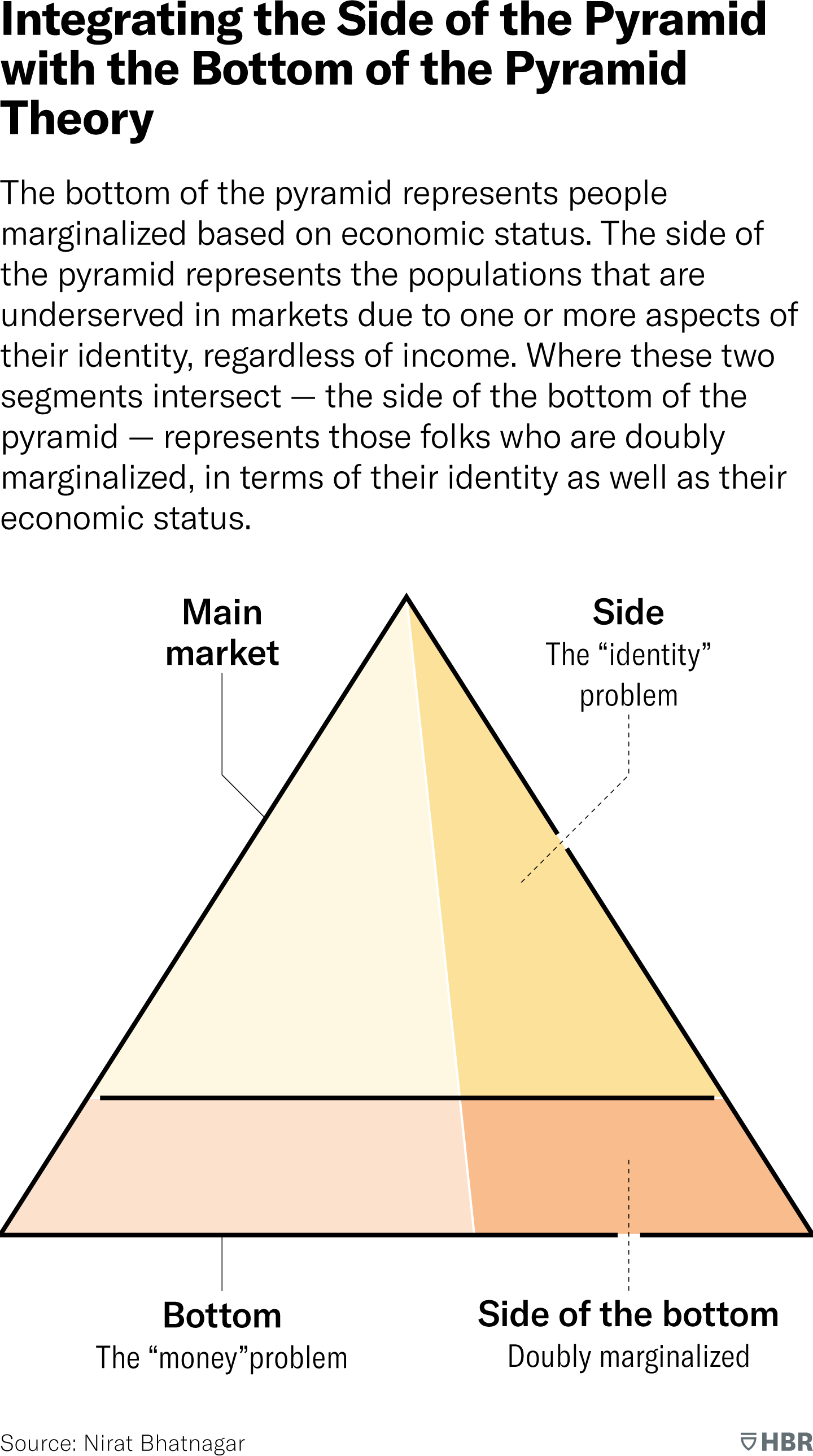
When the size of the opportunity is that large, what’s holding companies back from developing more inclusive products? Through our experience collaborating with product startups, industry bodies such as NASSCOM Foundation and The Product Folks, and NGOs such as Mission Accessibility, we recognize four key factors:
-
Information asymmetry: Leaders and companies significantly underestimate the purchasing power of marginalized groups. One reason is that popular market research and intelligent sources that companies rely on when designing products or creating strategies do not adequately cover these user segments.
-
Lack of empathy and understanding: Business leaders and product teams find it difficult to step into the shoes of such users since they may not have direct or proximate experience of these identities. This is partly due to poor representation in top leadership (and sometimes even the teams), and also because these topics receive scant attention in the business press.
-
Narrow lens and framing: For years now, companies have treated these issues through the “CSR lens.” Due to that framing, this group hasn’t been seen as a potential business opportunity either as a primary business focus or as an additional target customer. This is suboptimal because CSR funds are limited and those relying solely on a BoP framing miss the opportunity to embed inclusive thinking into product and service design.
-
Absence of collaboration: Inclusive product and service design requires multi-disciplinary collaboration between companies, NGOs, inclusive design firms, research institutions, and domain experts. Countries like India lack string design hubs or networks that can encourage this kind of collaboration for inclusive designing.
第 4 节
Moving the needle
Management leaders need a clearly defined Side of the Pyramid (SoP) strategy to optimize the available opportunities. Based on our work, here’s a six-step approach companies can use to craft and execute an SoP strategy:
1. Create diverse innovation teams within the organization.
The development of inclusive products and services that target SoP users requires the creation of diverse teams within the organization. In our work with companies such as Wysa and Evolve over the past few years, we have seen that there are several champions for inclusion within companies who can be leveraged. Even if organizations do not have dedicated inclusion-focused design teams, they are almost certain to find a few champions (those who volunteer or support causes impacting marginalized groups) whose passion and expertise can be harnessed. It is especially beneficial to intentionally drive recruitment efforts to increase representation of people with lived experiences of marginalization.
2. Prioritize inclusive collaborations to build deep understanding of lived experience.
In addition to creating diverse teams within, companies need to create more “open” innovation processes where they partner with a wide network of organizations that bring expertise related to inclusive design. This could include NGOs, media houses, design studios, and user research organizations that specialize in intersectional themes and focus on lived experiences. Say, for instance, if you’re a cab aggregator, you could collaborate with a rights-based organization to build features into your app that improve user experience in locating landmarks for people with visual impairment.
Another way is for companies to send employees on immersion trips to gain direct experience of user needs or cultivate empathy through sensitization programs. For instance, Bloomberg recently partnered with the inclusive experience program Beyond Our Sight so employees could better understand the lived realities of visually impaired individuals. This encouraged employees to be more mindful and to adopt an accessibility lens in the way they develop services for their clients.
3. Identify inclusive innovation pilots and develop a minimum viable product (MVP) of the solution.
The next step is to make this real through live projects. Leaders could identify two-three project opportunities to embed a SoP lens in their product and service design through employee ideation, user testing, and objective market assessments. The objective is to create a minimum viable product (MVP) and gather feedback on product features and user experience from a sample of target audience, including employees. Based on initial reviews, companies can then improve the MVP to meaningfully address the needs of diverse users. In addition to product features, the pilot projects could also include process innovations – such as ensuring that product teams engage with intersectional researchers, for instance — to enable an organization-wide mindset shift.
4. Develop a clear vision for change and compelling storytelling to communicate it to stakeholders.
Leaders could harvest insights from the pilot projects to develop a clear vision related to the SoP and communicate this within the organization. Internal storytelling, or campaigns that create visibility and support for certain themes within companies, is one of the most powerful tools for transformational behavioral change within organizations. Microsoft’s Allyship Program offers online courses and facilitated sessions to highlight the significance of inclusive teams. Such storytelling has always been recognized as important, with change management experts such as John Kotter emphasizing the need for this. Internally, there are simple ways to do this — talking about the need for diversity and inclusion with team members, highlighting successes in management meetings or through regular newsletters. For example, at the macro level, managers could lead open discussions about why it is important for society or organizations to develop intersectional thinking and to enact inclusive behaviors. At the micro level, managers could take employees through trainings to make them aware of their subconscious biases, what behaviors could lead people to feel excluded, and what they can do as individuals to prevent that.
5. Identify key performance indicators (KPIs) to measure progress and empower leaders in the organization to drive performance in this area.
To firmly embed inclusive product and service development within the organization, leaders could develop concrete metrics to assess their firm’s focus and performance on the SoP. These metrics should help break performance into Specific, Measurable, Achievable, Relevant, and Time-Bound (SMART) milestones and should be relevant for different roles within product teams covering product managers, user researchers, designers, and business leads. Choosing the right metrics and gathering data against them is critical to the long-term success of a firm’s SoP efforts. For instance, if you are a fast-moving consumer goods (FMCG) company, you could formulate the following goals for creating as inclusive a product as possible:
-
Specific: Develop an inclusive, minimum viable product (MVP) for toothpaste packaging that is inclusive.
-
Measurable, Achievable: Do this through a collaborative design process with at least five external experts on inclusive design.
-
Relevant: Make it easier for people with physical disabilities to use the product independently and without difficulty.
-
Time-bound: Achieve a final version of the product by Q4 2024.
Another example of such a goal could be:
-
Specific: Assess the uptake of new packaging for our current toothpaste and gauge user-satisfaction.
-
Measurable: Do this within three months of the launch of the new packaging.
-
Achievable: Appoint five employee champions to conduct a rapid survey.
-
Relevant: Capture responses to inform future processes.
-
Time-bound: Do this within three months of the launch, ideally the end of Q3.
6. Celebrate victories with tangible rewards and incentives.
Finally, leaders could embed the SoP approach in their organizations by going beyond celebration of victories to creating tangible rewards and incentive structures for inclusive outcomes. It is vital that wins from early efforts get visibility within the organization and people associated with it get public recognition and rewards. Leaders should leverage different settings — annual meetings, town halls, marketing materials, internal podcasts and newsletters, conferences, ERGs — to incentivize their efforts and successes in developing products, services, experiences for SoP users.
While following this six-step approach is realistically achievable, it does require genuine commitment and the willingness to learn and engage with a range of diverse actors outside and inside the organization. It is fair to assume that SoP strategies, when internalized and effectively implemented by companies, have the potential to impact millions of lives while expanding their market and strengthening their brand.