
How Banks Can Stay Resilient as AI Becomes More Disruptive 查看中文版
第 1 节
If you were to walk around one of the investment banks that occupy the skyscrapers of Manhattan at midnight, you would see an industry that hasn’t changed very much in the last 25 years. A room full of smart, hardworking 24 to 34 year olds with advanced degrees from top universities would likely be staring into computers, searching for data in a PDF file, pasting the data into an Excel model, and transferring the charts from these Excel models into a PowerPoint deck. The next morning their managers will use these decks to persuade a company to hire the bank to help them find a buyer or a target.
These models aren’t especially accurate — research consistently finds that more than 70% of M&A ends in failure . Yet the workflow for determining how much one company should pay for another has stayed remarkably unchanged, despite the countervailing evidence that it should evolve. The same workflows that consume the nights and weekends of young investment bankers have close cousins in law, insurance, and management consulting.
Historically, disruption is extremely rare. By our analysis, only 23 of the 568 companies included in the Fortune 500 since 1997 were under 15 years old when they entered. Only 10 of the 58 industries which constitute the Fortune 500 have ever seen a startup displace incumbents. And the average Fortune 500 company is 70 years old — four years older than a decade ago. Personally, we’ve both spent our careers in industries that have never seen a new entrant steal market share from incumbents: investment banking, insurance, and management consulting.
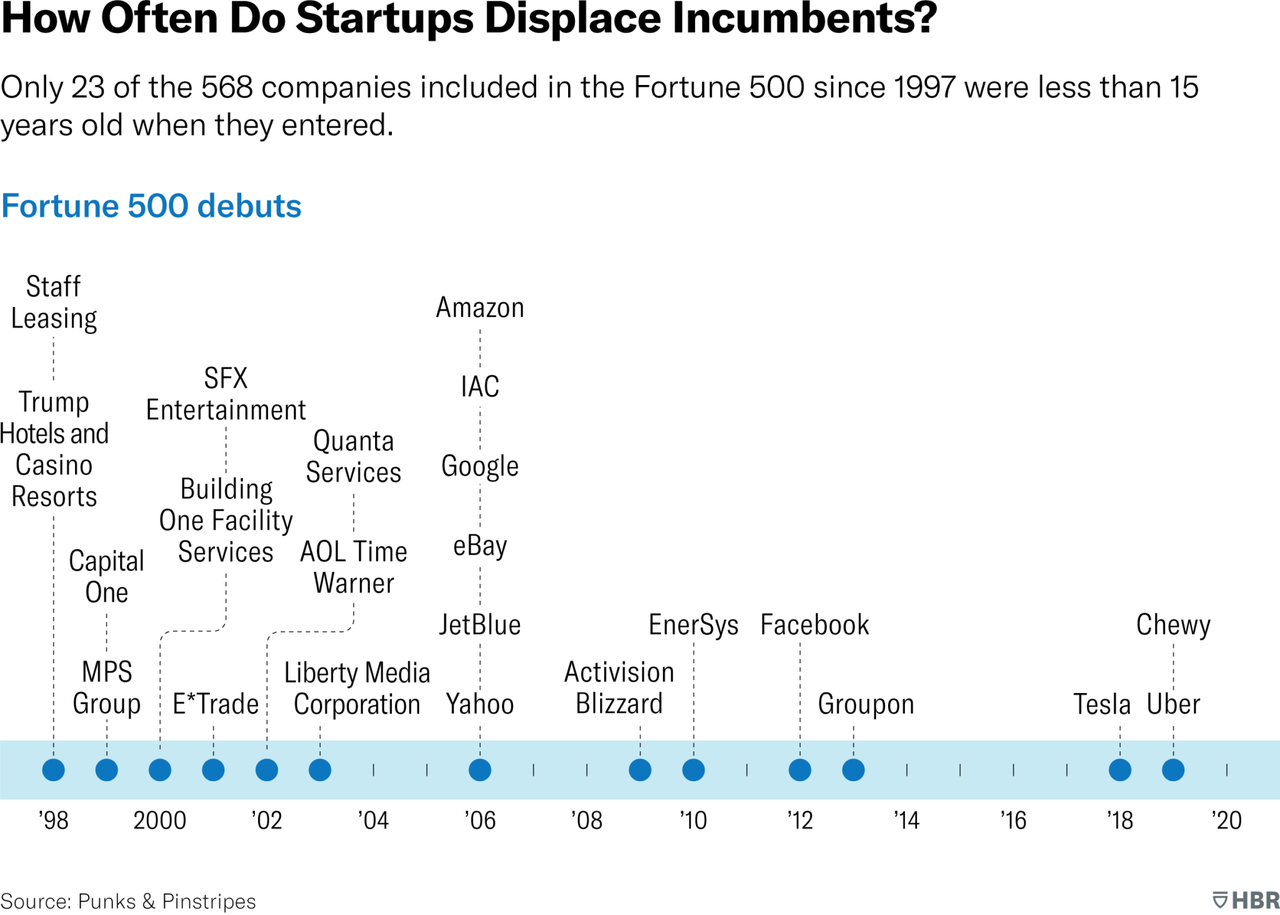
But right now, there are three forces converging that might transform finance and industries like it. The first is the explosive growth of AI. The second is a massive migration of tech talent from big finance to big tech. The third is an increased appetite by big tech companies to enter industries like big finance. The disruption of big finance isn’t imminent — but it’s more probable than ever before.
第 2 节
How AI Could Transform Work In Big Finance
There are important elements of a banker’s workflow that artificial intelligence can do better than people, once it is properly trained:
-
Find and gather data
-
Validate whether the data is correct (again, after some training)
-
Source data points from multiple sources (unstructured data) and build it into a clean time series
-
Validate whether data is useful for forecasting the future
-
Identify other useful data that people hadn’t thought to include
-
Learn what people do with the information that’s been gathered and do it better and faster than them. (This is where we are with generative AI.)
AI absolutely makes mistakes. It hallucinates. It learns how to do the “right thing” from people doing the wrong thing. But when it is used to augment human intelligence, rather than replace it, it can be more accurate, faster, and less expensive than a smart human working until midnight. All of these advantages can be applied to the banking workflow that keeps junior bankers in the office for 90 hours a week.
Because of AI, who works late into the night and what they do should be different. People with degrees in finance should be outnumbered by people with degrees in artificial intelligence. Instead of asking, “How can we find the data for the model?” they should ask: “How can we change the model so that it identifies the leading indicators of the % of acquisitions that succeed? How can we train the model to recommend buyers and acquisition targets which possess those characteristics?”
But just because AI could transform finance doesn’t mean that it will. There’s a huge difference between a company that innovates with interest and one that innovates with urgency. AI, on its own, is not enough to create urgency in finance. It would have to be used by outsiders to encroach on incumbents’ market share in order for bank leaders to implement AI at scale and with urgency.
But who might those new entrants be?
第 3 节
The Entrepreneur Exodus
Over the past two years there has been a massive migration of AI talent from big banks to big tech companies. We analyzed the LinkedIn data of 5,000 AI executives in finance (VP level and above) who have left banking and found that the typical bank loses four AI people for every five that it hires. When AI talent leaves the biggest banks, they usually leave the industry altogether, finding new roles at tech giants like Amazon, Google, and Microsoft. These three tech companies have quietly been building a workforce of AI expats from the biggest banks.
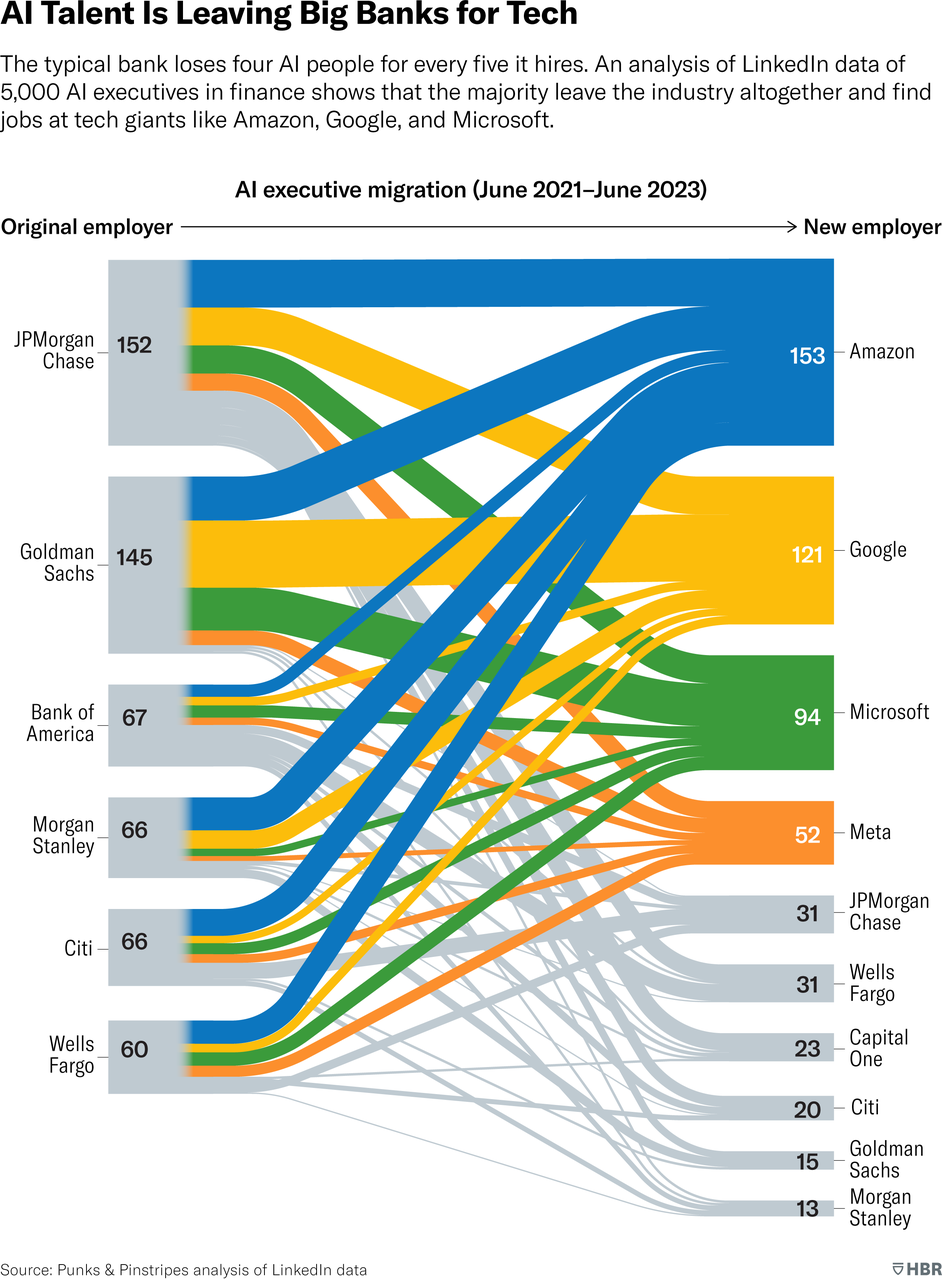
A notable exception is JPMorgan. It is the only bank which has retained more AI talent than it has lost, with a 318 to 204 hire to lost ratio. According to our analysis of LinkedIn data, JPMorgan has 1,260 AI people on staff, at every level of seniority — more than twice employed by Citi, which comes in second with 576.
第 4 节
Big Tech As A Bank Challenger
The AI talent that is leaving finance is joining companies like Amazon and Google, which are increasingly diversifying into banking and other heavily regulated industries, such as health care.
This diversification by Big Tech should be seen in the context of the broader history of disruption. In our analysis of new entrants breaking into the Fortune 500, we found that a large company diversifying has historically been more disruptive than a small startup growing. The 23 new entrants that successfully entered the index before their 15th birthday were hard to categorize, and that is exactly what made them disruptive. Capital One began life as a diversified financial company before acquiring its way into commercial banking. Google, Meta, and Amazon were tagged “Internet and Direct Marketing Retail” even though they competed against media, retail, automotive manufacturers, and later health care and banks. In short, large-scale diversification is disruptive.
If AI emerges as a significant competitive advantage in investment banking, then it’s not inconceivable that Amazon, Google, or Microsoft might create (or, more likely, acquire) a challenger investment bank. Amazon, in particular, has some history entering highly regulated new markets like healthcare. And Jeff Bezos began his career on Wall Street, at hedge fund D.E. Shaw.
第 5 节
More Probable Doesn’t Mean Imminent
There are many reasons why investment banking might remain undisruptable. Investment banks are systemically significant institutions with enormous protection and scrutiny from the government. (Circuit City never warranted a government bailout. But every bank did in the aftermath of Lehman Brothers.)
Banks also have pockets of innovation and technological excellence. For example, trading desks are built with some of the most advanced technology in the world, and it’s possible that banks upgrade quickly as AI becomes more advanced.
Big tech and big finance are also deeply interdependent. This might deter big tech incumbents from challenging the inefficiencies of big finance as they have in health care. We want to be careful not to overstate the magnitude of AI’s disruptive threat to big finance.
第 6 节
What Should Bank Leaders Do?
Leaders in finance should take the following three steps:
Cultural transformation is a necessary precondition for digital (and AI) transformation.
In finance, tech leaders are often order takers not order makers. This, in our experience, is why so many of them leave. It is often their job to implement the strategy of other executives rather than to determine the strategy.
One notable exception is Marty Chavez, who was the CFO of Goldman Sachs*. Marty was a cultural outlier on Wall St, a Silicon Valley technologist who wasn’t sequestered into a tech role. Above all he was a magnet for Wall Street tech talent, who loved the flat, fast, innovation-forward culture that he nurtured. (He was also a DEI cultural outlier, and was the most senior, openly gay, Latino exec on Wall St.) Banks should proactively develop tech leaders to lead the company beyond their tech silo as Goldman did with Marty Chavez.
Don’t settle for AI optics.
The same banks with inefficient workflows that could be enhanced by AI also have labs, incubators, and VCs that celebrate AI. Within finance there is a tendency to engage in innovation theater with emerging technologies. These optics keep banks from doing the hard work that is necessary to implement meaningful change. And it deprives tech talent from the impact they know they could have, driving them to leave.
Every investment into AI should have an explicit goal to increase revenue, reduce costs, or mitigate risk — and at a scale that meaningfully impacts earnings. Anything less will be easily detected by talent and potential competitors.
Assume the disruptive threat is real, and be proactive.
There are four catalysts that spark serious transformation in a large company: a financial crisis, M&A, new activist investors, and technological disruption. Sometimes a visionary leader anticipates these crises and makes a compelling case to proactively change. Being that proactive leader is hard, and especially hard in industries which have never experienced disruption before. Many other leaders will not share your sense of urgency and will try to thwart you. Banks should assume the disruptive threat posed by AI is credible, even if it hasn’t materialized yet. Now is the time for a proactive leader to step forward and act — even though change in the face of resistance is hard.
· · ·
The probability that big tech will challenge big finance is higher now than before. A combination of AI talent migrating from finance to big tech; AI technology that can do the job better, faster, and cheaper; and a newfound willingness by big tech to challenge highly regulated industries, mean that the window for disruption is open a little wider today than yesterday. But this heightened competitive pressure is an opportunity for proactive leaders to catalyze meaningful cultural, and technological change in big banks.