
Develop a Strategic Plan 查看中文版
第 1 节
Strategic planning is the ongoing process of turning a company’s strategy into a workable plan.
Whatever your role in your organization, you and your team play an important part in strategic planning. You may:
In all cases, to contribute to or develop a strategic plan, you’ll:
-
Analyze external and internal factors.
-
Consider strengths, weaknesses, opportunities, and threats.
-
Identify priority issues.
-
Develop high-level action plans and allocate resources.
As University of Toronto’s Rotman School of Management professor emeritus Roger Martin explains, you don’t need to be an executive to have a powerful impact on your organization’s strategy.
并非只有高管才能制定战略 Strategy Isn’t Just for Executives
哈佛教授讲授视频逐字稿
第 2 节
Your role in strategic planning begins by looking at factors that affect your team and its work. Include external forces such as technology changes and internal ones such as aging business processes.
By staying alert to emerging trends, you'll be able to identify new opportunities to achieve your organization's strategic goals.
Prioritizing new technologies
One way to analyze external and internal factors is to focus on five forces that shape competition in an industry:"The Five Competitive Forces That Shape Strategy" (updated) by Michael E. Porter. Harvard Business Review. January 2008.
-
Threat of new entrants
-
Threat of substitute products or services
-
Bargaining power of buyers
-
Bargaining power of suppliers
-
Rivalry among existing competitors
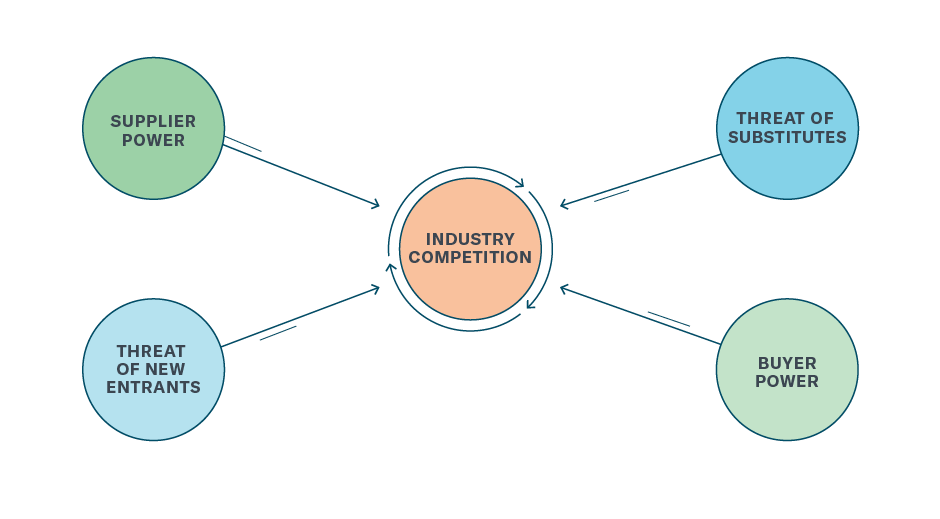
When you have insight into the competitive environment in which you’re operating, you’re in a better position to design a profitable and sustainable strategic plan.
Make a Connection
第 3 节
Based on your exploration of external and internal factors, identify your team’s or organization’s strengths, weaknesses, opportunities, and threats (SWOT). This process is known as a SWOT analysis.
Strengths or weaknesses might include:
-
Leadership
-
Decision-making abilities
-
Innovation
-
Productivity
-
Quality
-
Customer service
-
Efficiency
-
Technological processes
Opportunities or threats might include:
-
New competitors to the market
-
Legislation or regulations that increase or decrease costs
-
Changing economic conditions
-
New technologies
-
New products or services
-
Expansion of markets
Steps for conducting a SWOT analysis
Worksheet for Conducting a SWOT Analysis
第 4 节
Now that you’ve completed a SWOT analysis, you and your team can identify priority issues. These are the make-or-break areas the organization must focus on for the strategy to be successful.
Priority issues generally take advantage of a short window of opportunity and have a major financial impact. Choose ones with the most potential positive effect on your organization’s future.
Based on your organization’s SWOT analysis:
Pick three or four priority issues. Focus on broad issues such as “Revamp cost structure.” A narrow item such as “Reduce manufacturing reject rate” may be of minor strategic importance.
If you’re contributing to your organization’s overall strategic planning, present your team’s priority issues to senior leaders. The senior leadership team reviews priority issues submitted by the organization’s business units as well as ones they’ve generated themselves.
Senior leaders typically select three or four key priority issues for the organization to pursue. They then delegate each priority issue to one or more units or cross-functional teams.
poll
第 5 节
Once business units or teams identify—or are assigned—priority issues, they develop one or more high-level action plans to address them. These plans list the objectives, tasks, and resources needed to tackle each priority issue.
For example, if “Customer retention” is a priority issue, it may lead to two action plans: one for improving customer service and another for developing a customer loyalty program.
Once you complete your high-level action plans, you send them to senior leaders for review and discussion. Senior leaders may ask for refinements. They’ll then approve final plans, assign teams, and allocate resources.
Try it Out
答案与解析
Determine the cross-functional collaborations your employees will need to participate in to generate the business results desired by your company.
Not the best choice. Though identifying needed cross-functional collaborations is valuable, it’s not a step in the strategic planning process.
Assess factors that affect your team and its work, such as developments in technology, new laws, your group’s culture, and the business processes used in the unit.(正确)
Correct choice! As the first step in developing your unit’s strategic plan, you evaluate external trends and forces, such as markets, technology, and laws. You also evaluate internal trends and forces, including your unit’s core competencies, business processes, financial measures, and culture.
Take stock of your unit’s strengths and weaknesses, new opportunities that may be important, and potential threats that your unit may need to plan for or mitigate.
Not the best choice. While taking stock of strengths, weaknesses, opportunities, and threats (SWOT analysis) is a later step in the strategic planning process, it’s not what you would do first to begin developing your plan.
答案与解析
You should focus primarily on internal developments important to your unit’s ability to generate desired business results.
Not the best choice. A SWOT analysis covers both internal and external trends and forces important to your unit.
You and your team should avoid using brainstorming to conduct a SWOT analysis.
Not the best choice. Brainstorming and intense debate are useful techniques for conducting an effective SWOT analysis.
You and your team should identify at least three strengths, weaknesses, opportunities, and threats.(正确)
Correct choice! Ask each team member to cast three to five votes (three if the list of issues is 10 items or fewer, five if it is longer than 10 items).
答案与解析
Generate several action plans for mitigating the most serious threats facing your unit.
Not the best choice. While generating action plans is part of the strategy planning process, generating plans for the most serious threats isn’t.
List one priority issue for every strength, weakness, opportunity, and threat you identified during your SWOT analysis.
Not the best choice. Listing one priority issue for every strength, weakness, opportunity, and threat would generate too many items to handle effectively. Instead, you should identify only the top two or three priority issues.
Identify broad areas where your team or business unit needs to focus its efforts over the long term.(正确)
Correct choice! The next step is identifying broad areas of focus—called priority issues—over the long term. In most cases they emerge directly from your SWOT analysis.
答案与解析
Briefly detail the objectives, tasks, and resources needed to carry out strategic action plans related to your priority issues.(正确)
Correct choice! These details will help senior managers evaluate your plans, suggest needed revisions, designate cross-functional teams, and allocate resources required to carry out the plans. Each priority issue typically generates two to three action plans.
Ask senior managers to provide input on your list of priority issues to inform your high-level action plan.
Not the best choice. You should seek input from your senior managers after you’ve done your high-level action planning.
Generate one action plan for every priority issue you defined.
Not the best choice. Each priority issue typically generates several action plans, not just one.
第 7 节
Test your understanding and reinforce what you’ve learned.
Try it Out
答案与解析
Scope, Workflow, Objectives, Tasks
A SWOT analysis identifies Strengths, Weaknesses, Opportunities, and Threats.
Situation, Weaknesses, Operations, Tactics
A SWOT analysis identifies Strengths, Weaknesses, Opportunities, and Threats.
Strengths, Weaknesses, Opportunities, Threats(正确)
Feedback: A SWOT analysis identifies Strengths, Weaknesses, Opportunities, and Threats.
Try it Out
答案与解析
It takes advantage of a very long window of opportunity.
Priority issues take advantage of a short window of opportunity and have a major financial impact.
It’s generally focused on very narrow items.
Priority issues are broader and strategically important, not narrow.
It’s likely to affect your organization's future.(正确)
Priority issues have a major financial impact and are critical for the organization's future.
第 8 节
Reflecting on your learning helps you apply relevant concepts to your job.