
Persuade with Logic and Emotion 查看中文版
第 1 节
Have you ever listened to someone make a case for an idea and found the facts and data they presented compelling? Did you also experience a stirring of emotion as they shared a story as part of their pitch?
If so, you’ve discovered a key principle of persuasion: In most situations, you need to win both minds and hearts. That is, you’ll want to appeal to your audience’s sense of reason and emotion to help convince them that your idea deserves their support.
But knowing how to win hearts and minds isn’t enough. To be convincing, determine which of these two strategies you should lead with when you present your proposal to different people.
How do you decide whether to lead with reason or emotion when you make your case? Consider what you know about your audience and what will resonate most with them.
If you don’t know whether your potential supporters will respond better to logic or emotion, think about what you’re trying to accomplish. Sometimes the situation can help you determine which tactic to use."Focus on Winning Either Hearts or Minds" oy Lisa Lai. Harvard Business Review, May 20, 2015. For example:
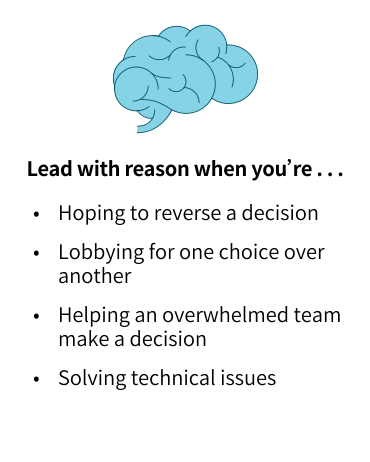
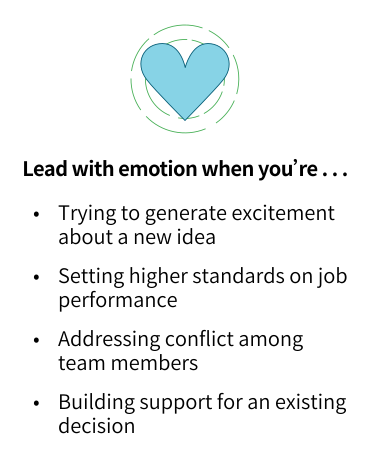
Regardless of which of the two strategies you start with, you’ll want to bolster your argument with the other tactic. For instance, if you’re making a business case for a new product launch and you know the decision maker relies on facts, lead with data on market trends and customer needs. But support your pitch by also including a narrative about how customers would benefit from the product.
Make a Connection
第 2 节
What’s the best way to win people’s minds? Employ a fact-based approach that emphasizes data and analysis. Start by clearly stating your position, and then present evidence to back it. Types of evidence you can use include:
After you share your ideas and supporting evidence, be sure to spotlight the benefits of your proposal. For example, if you want to implement a new software tool, emphasize how it can save time and increase productivity on your team by automating tedious tasks. Explain why your audience should accept your idea over others.
Ayame uses data to convince her boss
Try it Out
How to Win Minds
第 3 节
Storytelling is a powerful tool for winning hearts. Good stories can help you:



Craft a narrative about your idea that hooks your audience. To make your pitch relatable, memorable, and engaging:"Storytelling Can Make or Break Your Leadership" oy Jeff Gothelf. Harvard Business Review, October 19, 2020.
Use Stories to Win Hearts
Here, Jonathan Allen, co-founder of Leadership Brainery, shares how telling stories helped his organization gain its first corporate sponsorship.
故事是赢得他人情感认同的钥匙 The Persuasive Power of Storytelling
哈佛教授讲授视频逐字稿
第 4 节
In values-driven organizations, employees who talked about company values when advocating for an idea were 24% more successful at winning support.
The language you use when you’re trying to persuade someone can influence whether they see your idea as worth pursuing. When you select the right words, people will conclude that your idea makes logical sense and feel an emotional connection to your proposal.
Choose straightforward yet evocative language that your listeners can easily relate to and understand. Here’s how:"Find the Right Words to Inspire to Your Team,"" by Joel Schwartzberg. Harvard Business Review, April 13, 2021. "How Great Leaders Communicate," by Carmine Gallo. Harvard Business Review, November 23, 2022.
Persuade with Big-Impact Words
Try it Out
答案与解析
This effective approach will alert our most important and relevant audiences to appreciate and value our brand.
Try using straightforward yet evocative language.
This approach will inspire our most profitable customers to treasure our brand.(正确)
This statement is straightforward and uses evocative words (“most profitable” instead of “important and relevant” and “treasure” versus “appreciate and value”).
答案与解析
We faced some real challenges brought by this new entry in our industry.
Use positive, action-oriented verbs to capture your listener’s attention.
We overcame the toughest challenge this new competitor threw at us.(正确)
This statement uses the action word “overcame” versus “faced” and uses visually compelling words (“toughest” and “threw at us”).
答案与解析
Our new operating model has allowed us to protect our supply chains and market leadership in a fast-changing business world.
Try using metaphors to simplify abstract concepts and make your point more memorable.
Our new operating model has created a vast web that links us to the best suppliers at every point around the globe.(正确)
Use action-oriented words (“created” versus “allowed”) and metaphors to evoke a compelling image in listeners’ minds.
Knowing how to create a persuasive pitch using compelling language can boost your chances of winning hearts and minds.
第 5 节
Using logic and emotion to persuade others is an important strategy, but you’ll need to do more than that to convince others that you—and your ideas—are worth supporting. Before you craft your next pitch, follow these key steps:
Your Persuasion Checklist
Here, Babson College professor Vini Onyemah shares how taking steps to connect with your audience can help you build the trust you need to win their minds and hearts.
想要说服某人?坐到他们身边去 Want to Persuade Someone? Sit Beside Them
哈佛教授讲授视频逐字稿
When you listen to how people respond to your ideas, you position yourself to overcome any resistance they may have to your pitch.
第 6 节
-
To be persuasive, you’ll need to appeal to both minds and hearts. To determine whether you should lead with an appeal to reason or emotion, consider the audience, your goals, and the situation.
-
Use a fact-based approach that emphasizes data and analysis to win minds. Provide evidence to support your claim and explain the benefits of your proposal.
-
Tell stories to win hearts. Put your audience at the center, set the context for your idea, share something personal about you, show your humility, and include a clear call to action.
-
Communicate for impact and influence by using clear and simple language, sharing metaphors, humanizing data, choosing positive and action-oriented verbs, and focusing on your mission.
第 7 节
Test your understanding and reinforce what you’ve learned.
Try it Out
答案与解析
Elaborate on the specific steps needed to implement your idea.
It’s premature to elaborate on the specific steps for implementation when you haven’t provided evidence to make your case. Instead, start by clearly stating your position and presenting data and research to appeal to the decision maker’s sense of reason. Then, you can use storytelling to bolster your argument and appeal to their emotions.
Spotlight the benefits of your idea and present data and research to back up your proposal.(正确)
By first spotlighting the benefits and making a logical argument using data and research, you appeal to the decision maker’s sense of reason. Then, you can use storytelling to bolster your argument and appeal to their emotions.
Tell a story that speaks to the decision maker’s concerns.
While storytelling can be a powerful tool for persuasion, it’s most effective to lead with when you want to appeal to someone’s emotions. If you know that logic resonates most with the decision maker, start by clearly stating your position and presenting evidence to back it.
Try it Out
答案与解析
A story will allow you to strengthen your case with compelling data and research.
Stories don’t have to include data and research to be compelling. A good story can help make your case more relatable and memorable by creating an emotional connection with your audience.
A story can grab your audience’s attention, simplify complex ideas, and make your pitch more relatable and memorable.(正确)
Good choice! Storytelling is a powerful tool for winning hearts. A good story can help make your case more engaging by creating an emotional connection with your audience.
A story can help you appeal to your audience’s sense of reason and prompt them to take action.
Stories don’t need to appeal to your audience’s sense of reason to be effective. A good story can help make your case more relatable and memorable by creating an emotional connection with your audience.
第 8 节
Reflecting on your learning helps you apply relevant concepts to your job.