Pocket Leadership口袋领导力

Persuading Others

Prepare to Make Your Case 查看中文版

第 1 节

Have you ever been eager to get approval for a great idea, and rushed right to your boss or another decision maker to get their buy-in? If you’re like many of us, you’ve found yourself in this position—and failed to get the support you needed because you didn’t prepare.

When planning your pitch, start by considering which unique advantages you’ll want to highlight. Ask yourself:

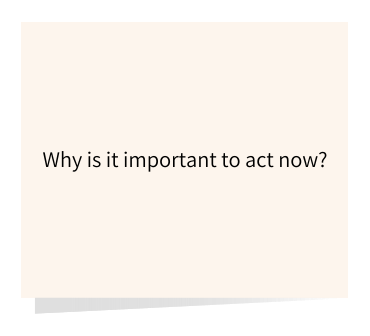
By clearly explaining the problem you’re solving, rather than just sharing a solution, you give potential supporters context for why your idea is relevant. And when you anticipate objections your stakeholders might have, you’ll be ready to address them.

But simply highlighting a problem may not be enough to persuade decision makers. You’ll also want to show why they should act now—and identify the costs of waiting.HA Checklist for More Persuasive Presentations" by Dorie Clark. Harvard Business Review, October 11, 2016. For example, if your organization delays adopting a new technology that your competitors have already implemented, you risk losing market share.

第 2 节

Before pitching an idea—whether through a presentation, a conversation, or in writing—be sure you know who exactly you need to persuade, and then build your case with their interests in mind.

You’ll often have to convince several people about the validity of your proposal, including:

Decision makers They have the power to support or reject your idea. For example, if your boss is the one who’ll approve funding to put your proposal into action, they’re the decision maker. Key stakeholders They’ll be directly affected if your proposal is accepted. For example, if you’re recommending a change in a business process, team members who perform that process are stakeholders because they’ll have to learn the new approach. Influencers They can sway decision makers and key stakeholders by providing them with advice and information. An influencer could be a colleague your boss often turns to for advice.

All of these individuals are potential supporters of your idea. By taking time to identify your audience and preparing to win them over, you can boost your chances of success.

Make a Connection

1. What’s an idea you have that you want others to support? Identify a decision maker, a key stakeholder, and an influencer you’ll need to win over.

第 3 节

Once you’re clear about whose support you’ll need for your proposal, reflect on what’s most important to them. This will help you determine what you’ll say—and how you’ll say it—to make your case and gain their support.

For each person you’ll need to persuade, consider:

To figure out what your potential supporters’ key priorities are:"How to Increase Your Influence at Work" by Rebecca Knight. Harvard Business Review February 16, 2018.

  • Speak with them about what they want to achieve and what’s making it difficult for them to accomplish their goals.

  • Listen for what they sound most excited by or concerned about.

Once you’ve taken the time to learn more about your audience’s priorities, use what you find out to frame your proposal as a “win-win”—a solution that would benefit you and them. Determine what they’d want to hear from you and what information would capture their attention. Be sure to:"7 Rules for Persuasive Dissent," by Todd B. Kashdan. Harvard Business Review, July 22, 2022.
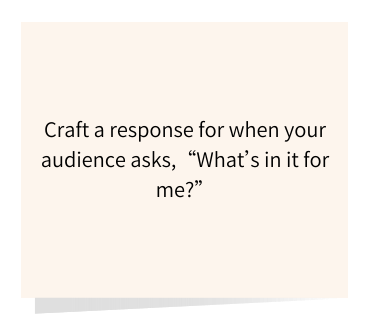
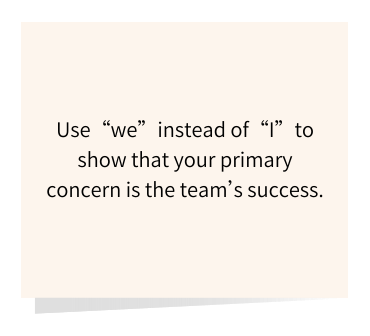
By applying these tips, you’ll illustrate how backing your idea will benefit your stakeholders and organization.

Sayeeda prepares to make her case

Sayeeda prepares to make her case Sayeeda works at a financial services company and manages a call center team. Lately, customer complaints and employee turnover have significantly increased. She wants to develop a more robust training program that would enhance employee engagement and improve the customer experience. Before sharing the proposal with her boss to secure approval and funding, Sayeeda determines how to frame her idea as a win-win by identifying: Her boss’s key priorities: Increase customer loyalty. Drive profitability. Improve talent retention. Benefits of the proposal: Employee engagement will improve, and turnover will decline. The team will respond more effectively to customers. Customer loyalty will increase, which will boost profitability. Sayeeda prepares to make her case

You may be asking yourself: What if I have to persuade a group, not an individual stakeholder? In this case, your tactics will change slightly. While you can customize your pitch based on an individual’s specific interests, you’ll need to build consensus to persuade a team. Take time to consider each person’s concerns and include everyone in the group in finding common ground.

Here, Harvard Business School professor Ranjay Gulati shares how knowing your audience’s perspective and anticipating their concerns can help you prepare to win them over.

三个步骤阐明你的论据 Make Your Case in Three Steps

哈佛教授讲授视频逐字稿
So, a great illustration of persuasion is a case I wrote on GE Rail. The government of India was opening up a huge bid for probably one of the largest rail contracts ever, and the whole question was, will GE bid for it or not? And you have one gentleman who is trying to now persuade his own company first, his bosses, that we should bid for this. Then he is trying to line up people inside GE to come and work with him, and nobody wanted to do it, and he had to figure out how to kind of get this buy-in to the idea. The first starting point for persuading somebody of a point of view is having clarity about what your point of view is in the first place. Have you worked out the facts? Have you thought through the facts? The last thing you want to do is walk into a persuasion conversation and not have all the facts laid out in your head and not even know what your argument and reason for doing it is. Once you get there, then the question is, who do you persuade first? You see, you're trying to establish credibility, and it's always more credible when you have other people already lined up. And so having that momentum always helps. Then you have to understand, what is it the other person might be thinking? You see, we think of persuasion as me getting my message right, but it's as important--equally important--to know what the other person is thinking also. So, persuasion is fundamentally about understanding what it is the other person might be worried about. In the case of GE, this young gentleman sitting in India is wondering why headquarters sitting in Erie, Pennsylvania doesn't want to do it. They're worried about doing it in India. They've never done that kind of business in India. Can we be viable in India? Manufacturing localized content, can we produce in India the way the Indian rail wants us to? So, thinking through, I can only persuade you if I thought through what it is your concerns may be. We're saying, look, I believe we can do this, but I also want to acknowledge your concerns, and I have incorporated your concerns into my idea that I'm trying to persuade you. So, preemptively modifying your idea or collaboratively modifying your idea. And remember, when you talk about messaging, you can talk about fear and hope. And in this instance, the fear was, well, if we don't do it, we are just handing it in our lap to our main competitor in this case. And if we do win it, look at the upside. So, how do you message the message also becomes important. So, persuasion really involves preparation. Thinking ahead about the context, about the individual you're trying to persuade, about sequencing this, and getting it right. And only then can you be effective in getting your message through to the other person. And ultimately, the outcome was not only did he persuade his team to do the bid, they actually won the bid. And they won it by less than 0.5% difference, so they bid just right.

第 4 节

When you’re preparing a compelling pitch, consider how to frame the information in a way that best resonates with your audience. For instance, depending on the individual, they may be more influenced by:


Even though some people are more receptive to one approach than the other, a successful pitch will include both facts and emotion—but the balance between the two will shift depending on the audience’s needs and style.

Here’s how you can gain insight into how your audience absorbs and interprets information:"Want to Win Someone Over? Talk Like They Do" by Maxim Sytch and Yong H. Kim. Harvard Business Review, December 8 2020.

Build relationships The best way to understand someone’s default style is to cultivate an authentic, ongoing relationship with them. As you spend more time together, you’ll begin to recognize their communication patterns and preferences. Notice how they communicate Observe how the other person speaks and writes to find clues about their style. Do they tend to rely on numbers and data or stories and emotions in their presentations? Ask open-ended questions Engage in an open conversation about stakeholders’ preferences by asking, “How do you like to receive information?” or, “What types of communication do you find most effective?”

If you don’t interact often with the person you need to win over, seek out opportunities to get to know them better. Consider asking others who do know them for advice on how best to make your case.

The bottom line? Everyone communicates and processes information differently. What works for one person may not work for another. That’s why investing time in getting to know stakeholders and their preferences can help you win support for your pitch.

Take a Moment

Take a Moment Think of a potential supporter for an idea you have. Do they tend to:

Make a Connection

1. What do these responses suggest about how your potential supporter prefers to receive information? How will this affect your pitch?

第 5 节

Studies of more than 800 managers show that adapting your message can increase the likelihood of winning their support by 15%-18%.

Studies of more than 800 managers show that adapting your message can increase the likelihood of winning their support by 15%-18%. Studies of more than 800 managers show that adapting your message can increase the likelihood of winning their support by 15%-18%."How to Sell Your ldeas up the Chain of Command" by Ethan Burris. Harvard Business Review,

You’ve identified who you’ll need to persuade, considered what matters most to them, and assessed how they like to receive information. Now it’s time to put all your insights together to customize your message for each possible supporter.

Depending on what you learned about your audience, consider how you might:
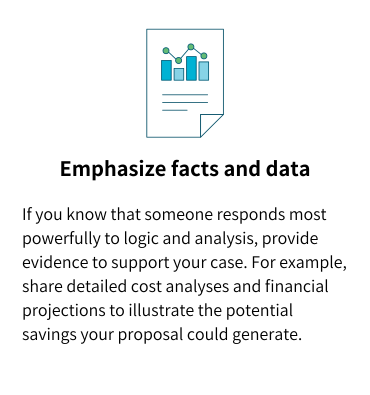
Customize Your Message for Your Audience

附件:customize_your_message_for_your_audience1742895255033.pdf(pdf · 67 KB,本地副本)

When you figure out how you’ll tailor your pitch to each prospective supporter or group of supporters, you’ll go into the conversation ready to convey your message with confidence. However, as Northeastern University professor Laura Huang explains, focus on striking a balance between preparing and staying nimble during the actual encounter. Here’s why.

不要过度准备你的说辞 Don’t Overprepare Your Pitch

哈佛教授讲授视频逐字稿
We often think that being persuasive is about being prepared, but actually being overly prepared can immobilize you. It can prevent you from bobbing and weaving when, instead, you want to stay alert and light on your feet. What I find is sometimes the most delightful interactions are more improvisational in nature. And they strike a balance between preparing and staying spontaneous in the moment. You don't want to be tethered to a script that feels forced. When you're passionate and you clearly convey your message, you don't overly index on any sort of details or any particulars that you were prepared to say. Instead, you're dynamic and improvisational. For example, I once saw an organization where someone got the unexpected question, “What do you think is the biggest weakness to your proposal?” And he was caught off guard because he was prepared to talk about all the strengths of this proposal. But very quickly, he pivoted, and he said, “Well, this proposal is pretty amazing. I think my biggest weakness is that I'm sometimes late, just as you were late to this proposal meeting.” And they shared a bit of humor and laughter and forged this connection between that answer. And what we saw was that delight can be a lot of things. It can be something that's authentic and unexpected, also like the surprise element in humor. It's equally important to be prepared and to be nimble, so that we can engage with our audience through any sort of unexpected responses or questions that they may have for us that allows you to come up with examples and exemplars that can surprise the person that you're persuading. So, when we stay authentic and look for opportunities to delight, that's when we can re-engage with those we're persuading in unexpected ways.

Preparing to win someone over may seem like a lot of work—especially if you’re eager to approach a potential supporter and present your case right away. But it’s a worthwhile investment. The more prepared you are before you pitch your idea, the more likely you’ll develop messaging that appeals to your audience. And that will boost your chances of convincing others that your idea has merit.

Prepare Before Delivering Your Pitch

附件:persuading_others_worksheet_prepare_before_delivering_your_pitch1742895360407.docx(docx · 249 KB,本地副本)

第 7 节

Test your understanding and reinforce what you’ve learned.

Try it Out

1. You work in human resources and have an idea for how your organization could more competitively attract a diverse talent pool. You’re preparing a proposal to pitch to your boss for approval. In addition to thinking about your boss’s key priorities, what else should you consider when tailoring your message?
答案与解析

Your boss’s current stress levels.
While being aware of your boss’s stress level may help you determine the best timing to pitch your idea, knowing your boss’s key priorities and how they prefer to receive information is more effective for tailoring your message to resonate with them.

Your boss’s past experiences with recruitment strategies.
Being aware of your boss’s past experiences with recruitment strategies won’t help you determine how to tailor your message. Determine your boss’s key priorities and how they prefer to receive information to develop a pitch that will resonate with them.

How your boss prefers to absorb and process information.(正确)
By understanding your boss’s key priorities and how they prefer to receive information, you’ll be able to develop a pitch that will resonate with them.

第 8 节

Reflecting on your learning helps you apply relevant concepts to your job.

Take a Moment

1. 1. What new insights do you have that could benefit you or others in your workplace?
2. 2. What are your biggest opportunities for applying concepts from this Lesson in your workplace?

Further reading

别再因客户举棋不定而丢单
所有销售人员都会告诉你,比起竞争对手,他们更有可能因为“还没决定”而丢单。我们针对 250 多万份销售对话的录音,包括交…
意义解读型销售
B2B 客户可获取的产品及服务信息数量实在太多,令人应接不暇。分析师报告、企业播客、展示广告、电子邮件营销、信息图表、播…
说服他人与你合作的 6 种方法
关于合作所带来的益处,已有许多论述,但如果你并不确定该如何说服潜在的合作伙伴与你携手,你该怎么办?在这篇文章中,作者介绍…

Top 3 in the source platform's original order