Pocket Leadership口袋领导力

Persuading Others

Persuasion Begins with Credibility 查看中文版

第 1 节

Your colleague pitches an idea for developing a new service for customers. You know that this team member always thoroughly researches their proposals, including the technical challenges and constraints. As a result, you see them—as well as their proposal—as credible. So, you’re excited to help them.

Credibility—the quality of being convincing—is the cornerstone of persuasion. A credible person is someone who has established a reputation for being reliable, honest, and consistent in their words and actions.

For people to listen to you and support your ideas, they need to believe that you’re credible. And to build your credibility, you’ll need to establish your expertise and earn the trust of others.

Credibility = Expertise + Trust

You can develop your credibility—and enhance your power to persuade—through practice.

Take a Moment

1. Think of a time when you persuaded someone to support your idea. What did you do to build your credibility first?

第 2 节

When you have expertise in your field or knowledge that’s valuable in your organization, people are more likely to listen to you and consider you to be credible.

You demonstrate expertise when you:
Establishing expertise should be an ongoing practice integrated into your daily work and interactions. Here are a few tips to enhance and showcase your expertise:"How to Increase Your Influence at Work" by Rebecca Knight. Harvard Business Review, February 16, 2018.
Research your ideas Gather data and evidence to demonstrate your knowledge of a topic and to support your recommendations. For instance, share statistics showing that a new quality-control system you’re proposing can reduce manufacturing errors by an impressive percentage. Get firsthand experience Consider volunteering for a project, joining relevant professional organizations, or attending conferences. You’ll learn new things and add to your expertise. Make your credentials known Take classes or specialized certification programs, write articles for your organization’s newsletters, or publish blog posts on LinkedIn. You’ll accumulate credentials and showcase your expertise. Show your successful track record Highlight relevant past successes. For example, point out that another quality-control approach you recommended delivered valuable improvements in just two months after it was adopted.

Sade establishes her expertise

Sade establishes her expertise Sade is a drug delivery technology specialist at a pharmaceutical company. Because she’s the youngest person on her team, she sometimes thinks her peers are skeptical about her expertise. She takes care to establish her credibility so she can win their support for her ideas. For example, Sade believes that the company should invest more in researching and developing a new drug delivery technology. She conducts a market analysis that shows there’s a high demand for this type of system and shares data from preclinical studies that have shown its effectiveness. Sade also highlights the potential cost savings that could be achieved and provides examples of competitors who have successfully developed similar technologies and gained a competitive advantage. She shares the information she has gathered during a team meeting. Sade establishes her expertise

Establishing your expertise takes time and effort, but it can enhance your credibility and reputation.

Make a Connection

1. What steps will you take to demonstrate your expertise in your organization?

第 3 节

To build credibility, it’s not enough to highlight your expertise—you also have to be seen as trustworthy. And just as establishing your expertise takes time, so does gaining trust.

A good step is to strengthen your personal connections and build rapport with your team members. As you cultivate relationships with others, pay attention to the key elements of trust:"Begin with Trust" by Frances X. Frei and Anne Morriss. Harvard Business Review, May-June 2020.
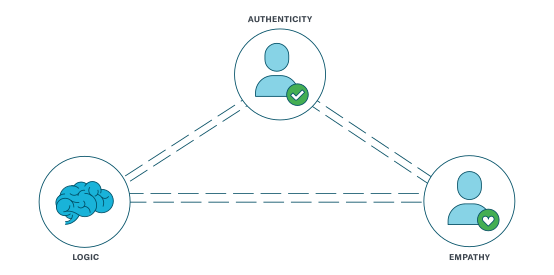
  • Authenticity: People believe they’re interacting with the real you.

  • Logic: People have faith in your judgment and competence.

  • Empathy: People feel that you care about them and their success.

Here, Jonathan Allen, co-founder of Leadership Brainery, shares how building relationships and leveraging connections in his network helped him accelerate the trust-building process with a potential donor for his organization.

快速建立信任 A Fast Track to Building Trust

哈佛教授讲授视频逐字稿
The reality is you can't build dynamic relationships and effective credibility without trust. And trust is not always easy to build quickly. And for many of us who are building things from the ground up, time is always of the essence. I'm co-founder of Leadership Brainery, and our work is centered on increasing access to master's and doctoral degrees for underrepresented communities. In building a startup, we're always thinking about how to build and develop the relationships necessary to raise capital, so we can deploy that into our programs and make the impact. And one of the ways to do that we've found is by doing so by way of introduction and connection from people where we may have a mutual affiliation with. Trust by proxy. An example of that is one of our board members introduced us to his colleague and friend Matt. Matt is a chief financial officer in the biotech industry and has a long track record thinking about how to transform companies. And certainly, how to do so in a way that makes them successful and sustainable economically. And so, we got the introduction to Matt, had our first initial call, and on that call, it was our understanding that Matt was only expecting to make about a $1,000 contribution or investment into the organization. And as we talked about the different stakeholders that we serve, particularly the students being people of color, being the first in their families to go to college, some of them being LGBTQ+, but also many of which are coming from lower socioeconomic backgrounds, and that was it. Because Matt has a background in finance, and so he really connected with that economic relevancy. And out of that call, we ran out of time. And so, he said, “Well, look, let's get you another call for later in the week, but in the meantime, send me over your financial statements, your profit and loss, as well as any other information demonstrating the impact of the organization.” We did that, and we met again a few days later. And in that call, what I was expecting to be a commitment of $1,000 ended up being a commitment of $25,000. And of course, yes, I was blown away. I was not expecting this, and we continued to stay in conversation. And later, six months later that same year, he made another $25,000 investment into the organization. And so, when you're trying to build credibility for yourself and your venture, it's going to take building relationships. And relationships require trust, which often requires time. But when you don't have time on your side, then you have to leverage the relationships that you have in your network already to introduce and unlock access to people that they already have spent the time building trust with. And that is the power of trust by proxy.

Here’s what you can do to earn people’s trust:"Begin with Trust" by Frances X. Frei and Anne Morriss. Harvard Business Review, May-June 2020.

Sometimes, we lose trust. Let’s face it: We may not always be our most authentic, logical, and empathetic selves in every situation. The good news is that if you lose someone’s trust, you can work to restore it. Earning—and keeping—people’s trust will go a long way toward building your credibility.

Diagnose Your Trust Challenges

附件:worksheet_diagnose_your_trust_challenges1742887490089.docx(docx · 251 KB,本地副本)

Take a Moment

Take a Moment

Make a Connection

1. If you tend to have difficulty with a particular component of trust—authenticity, logic, or empathy—what one thing could you do to improve your ability in that area?

第 4 节

Do you know people at work whose words and actions seem to carry more weight than others? This is a quality known as gravitas. When you have gravitas, people take you seriously and consider your contributions important.

You may think gravitas is something you either have or don’t have. But it isn’t a personality trait—it’s a quality you can develop. Here’s how:"Gravitas Is Quality You Can Develop," by Rebecca Newton. Harvard Business Review, September 24, 2020.

Gravitas isn’t one-size-fits-all; it differs from person to person. Here, organizational psychologist and executive coach Rebecca Newton discusses common misconceptions about gravitas and how to develop it while being true to yourself.

提升工作表现:培养份量感 Level Up at Work: Develop Your Gravitas

哈佛教授讲授视频逐字稿
Hey, It's Isa, and I have a huge client call tomorrow. Not only that, but senior leaders have been really asking me to step it up. And they've been throwing around this word gravitas. Lucky for me, I'll be chatting with Rebecca Newton, who is an expert on everything gravitas. Isa: So this whole idea of gravitas is really interesting to me. What is gravitas? Rebecca: It's a great question. Having gravitas at work means that you are taken seriously. Your contributions are considered important. You're trusted and respected. Your words carry weight. Essentially, you are leading in the room, regardless of your position in it, regardless of hierarchy. Isa: So is gravitas something that you're born with, like an innate trait? Or is it something that you can develop over time? Like for me, for instance, I don't really feel that confident going into the room. So is it something that I can work on? Rebecca: Gravitas is not binary. We don't have gravitas, or we don't have gravitas. And it's not something that's fixed. We're not born with gravitas, right? So this is a skill that you can develop. It is not a personality trait, which is important, because personality is relatively stable over time. It's not for example, something that's connected to being charismatic. Of the people that you're thinking of who has gravitas or you would describe as having gravitas, some might be charismatic and some might not. Then you also mentioned about confidence, and you just kind of said confidence and gravitas all in one go. And that's really natural for us to look at people who we consider to have gravitas and think, well, they're super confident. We need to challenge is that really what we're seeing? When I was doing research for the book, I would ask people to describe other people who had gravitas. Then I went and asked those people about how they felt in high pressure situations, and do you think that they said that they were super confident all the time? No. That's important, because we don't feel necessarily that confidence is something completely within our control. What we do have within our control is realizing, this is something that matters to me. I'm excited about this opportunity. And I'm going to choose to do it, even though I don't feel like necessarily I've got all the pieces together. So we're choosing courage instead of worrying about confidence. Isa: I definitely want to develop my gravitas, but I don't really know how to. And I really want to be true to myself when I do it. I'm someone with ADHD, and these types of things don't come necessarily easy to me. Rebecca: Thank you for your openness and for sharing about yourself. I am such a big believer in authenticity. For ourselves, authenticity, actually the research shows, is one of the strongest predictors of psychological well-being. But even at an organizational level, authenticity and a culture where people can be their best authentic selves at work actually fosters really positive organizational outcome. So your consultancy will do better as a result of feeling you can be your best authentic self. As we consider, say, neurodiversity, the example that you raised that our perceptions of what someone who has gravitas look like, we should always be challenging ourselves. That's a responsibility for all of us. Isa: So if you could, give me a super quick checklist on what I could do to prep and bring my gravitas game tomorrow. Rebecca: What we know from research is that what can be really powerful is constructive self-talk. It might feel a little bit cheesy. But essentially, it's thinking about this is why I'm at the table, right? Here are my strengths. Here are Isa's strengths. Here's what I bring to this. Here's what I'm learning. What's important is to think about, what do you want people to remember. If nothing else, if they just remembered a small part of what you talked about, what would you want them to take away? So those are your key messages to decide on in advance. Think about what questions you're going to ask, how you want them to perceive you. Really focus on that relationship, not just on the content of what you share. Just remember, it's about building that connection and having the impact that you want to have. And there are people that I think you trust and respect who have decided that you are the right person in the room. So that should be encouraging. So all the best with your career and as these doors continue to open for you. Thank you. So in order to step up my gravitas game, going into tomorrow's meeting and all future meetings, I'll have to remember a few things. I will focus on positive self-talk, remember my expertise and why I'm in the room in the first place. Finally, gravitas is all about building connections so not only will I have content prepared for the meeting, I'll also have some questions in my back pocket, so I can connect with everyone in the room.

Take a Moment

1. What steps will you take to develop your gravitas?

第 5 节

As you seek to persuade others, how do you convincingly convey your message? Effective communicataion goes a long way. These tips can help you win people over to your point of view:"To Win Over an Audience, Focus on Building Trust" by Allison Shapira and David Horsager. Harvard Business Review, March 9, 2022.
Communicate Your Credibility

附件:communicate_your_credibility1742887968487.pdf(pdf · 62 KB,本地副本)

Another way to encourage people to support your message is to show them that you’re also open to being persuaded and influenced. Make a point to:"3 Ways to Grow Your Influence in a New Job," by Luis Velasquez and Jenny Fernandez. Harvard Business Review, September 17, 2021.

  • Listen more than you talk and give individuals your undivided attention when they’re talking.

  • Ask clarifying questions, such as, “What do you think of this approach?” or, “What might be another way to do this?”

  • Avoid responding to people’s ideas with “But…” statements that negate what they’ve said.

Make a Connection

Make a Connection Which of the following communication strategies do you use or plan to use to convey your message with credibility?

Activating the Credibility = Expertise + Trust equation puts you in a strong position to build your powers of persuasion and influence. That’s because credibility is the foundation of persuasion. By building your credibility, you boost the likelihood that others will see you and your ideas as convincing.

第 7 节

Test your understanding and reinforce what you’ve learned.

Try it Out

1. You lead a manufacturing team and want to persuade team members to adopt a new quality-control process that would help reduce manufacturing errors. How can you best demonstrate your expertise so your team members will see you as credible?
答案与解析

Share data showing how the new process can reduce manufacturing errors.(正确)
Researching your ideas is a great way to showcase your expertise. Gather data and evidence to demonstrate your knowledge of a topic and to support your recommendations.

Provide a list of companies that have implemented a similar process.
Simply offering a list doesn’t provide evidence of successful outcomes from the implementation. Share data and evidence to demonstrate your knowledge of a topic and to support your recommendations.

Showcase your knowledge by using technical terms to explain complex concepts.
While it’s important to showcase your knowledge, using technical jargon can make it difficult to understand your message. Demonstrate your expertise by gathering data and evidence to support your recommendations.

Try it Out

1. You’re assembling a task force on cybersecurity at your organization, and you’re meeting with a peer to convince her to join it. You know that your colleague values authenticity. In order to gain her trust, what could you do to assure her that she’s interacting with the real you?
答案与解析

Share your experiences working on similar initiatives and convey your commitment to the task force’s goals. Ask your colleague for her perspective on cybersecurity.(正确)
When you’re open and share your experiences—and ask others to share their own perspectives—you demonstrate authenticity and foster trust with others.

Explain how joining the task force can advance your colleague’s career.
While explaining the benefits of joining the task force can be persuasive, it doesn’t demonstrate your authenticity. Instead, share your experiences—and ask others to share their own perspectives—to demonstrate authenticity and foster trust with others.

Limit distractions while talking with your colleague and be patient if she needs time to understand what you’re saying.
Staying engaged when individuals are talking and being patient with them are great ways to demonstrate your empathy, but not necessarily authenticity. Instead, share your experiences—and ask others to share their own perspectives—to demonstrate authenticity and foster trust with others.

第 8 节

Reflecting on your learning helps you apply relevant concepts to your job.

Take a Moment

1. 1. What new insights do you have that could benefit you or others in your workplace?
2. 2. What are your biggest opportunities for applying concepts from this Lesson in your workplace?

Further reading

别再因客户举棋不定而丢单
所有销售人员都会告诉你,比起竞争对手,他们更有可能因为“还没决定”而丢单。我们针对 250 多万份销售对话的录音,包括交…
意义解读型销售
B2B 客户可获取的产品及服务信息数量实在太多,令人应接不暇。分析师报告、企业播客、展示广告、电子邮件营销、信息图表、播…
说服他人与你合作的 6 种方法
关于合作所带来的益处,已有许多论述,但如果你并不确定该如何说服潜在的合作伙伴与你携手,你该怎么办?在这篇文章中,作者介绍…

Top 3 in the source platform's original order