
You also need to rely on your own judgment. Here, Harvard Business School professor Tsedal Neeley discusses important questions to consider as you work with this technology.
Manage Gen AI’s Risks 查看中文版
第 1 节
Generative AI (gen AI) can generate new content, answer questions, and perform a wide array of tasks, but it comes with certain challenges and concerns. These range from privacy and security issues to inaccurate and biased outputs.
The answer isn’t to avoid using this technology. Doing so could lead your organization to fall behind its competitors as they gain efficiency and innovate faster.
Instead, by understanding the potential pitfalls, you can take steps to counteract them. While it’s up to leaders to set guidelines around gen AI use, everyone must play an active role in applying this technology responsibly.
Begin by making sure you know your organization’s policies on:

负责任地使用生成式 AI Use Gen AI Responsibly
哈佛教授讲授视频逐字稿
You've heard that gen AI is biased, that it even hallucinates, and it wants to please you because it learns about you from all the information you enter. Gen AI does not have an ethical code. Humans do.
Here are three questions that everyone, whether you're a team leader or not, has to answer. Do I know how AI works and what my responsibilities are? Understanding the basics of AI is crucial, especially how to safeguard your organization's data. Next, how do I verify the accuracy of my outputs? Before using AI-generated content, consider how you will verify its accuracy.
Are you using methods like cross-checking with other sources and ensuring proper citations to confirm that all that information that you have is trustworthy? Am I familiar with the responsible use and ethical guidelines of my company? Are you making sure that your use of AI respects data privacy and avoids any harmful effects?
Finally, how can I stay updated and provide constructive feedback? Consider how you'll keep yourself informed about the latest AI developments, use cases, and policies. In addition, think about how you can provide constructive feedback to continuously improve AI processes and outputs at your company.
As you and your team leverage gen AI, it’s essential to be transparent about how and where you’re putting it to work."AI’s Trust Problem," by Bhaskar Chakravorti. Harvard Business Review, May 3, 2024.
Follow these best practices to ensure openness about your usage:
Document gen AI use
Set up a system to capture how and when you and your team use gen AI in your work. Include the tools you use and note any data, content, or information you give gen AI when prompting it.
Label content
Follow your organization’s policies for informing customers and other stakeholders when you use gen AI to produce content or results. Indicate whether it was created entirely by gen AI or developed with gen AI’s help.
For example, include a statement such as:
This article was written by gen AI.
This report is based on analysis performed by gen AI and reviewed by experts.
Explain data use and acknowledge risk
If customers or users interact with gen AI within a product—for example, through an AI chat bot—ensure they know how their data is used, stored, and protected.
Include a brief statement noting potential risks, such as inaccuracy and bias in outputs, and data security concerns. For example:
Chat bot answers are generated by AI and may contain errors.
Data you provide is stored securely and used to enhance our services.
Take a Moment
1. What do you and your team need to learn right now about using gen AI responsibly?
第 2 节
You can get tailored, relevant results from gen AI by giving it examples of what you need, providing it with data you want it to use, or supplying it with content to improve or analyze.
Be aware that some gen AI tools may use the information you provide to train their models.
For that reason, before you input any kind of data—spreadsheets, reports, articles, notes, or other forms of information—you must have a clear understanding of what the tool will do with it.
Review the gen AI tool’s privacy policy to understand:
In general, when using a gen AI tool that’s available to the public, avoid giving it:
-
Proprietary material: Any information your organization creates or owns and doesn’t want to make accessible to competitors or others.
-
Personal information: Details such as customers’ or employees’ birthdates, addresses, driver’s license numbers, or other identification card numbers.
-
Confidential data: Any potentially sensitive or private information that you wouldn’t typically share with a wide audience.
Even when using a tool that’s been vetted and approved by your organization, be aware of the potential risk of a data breach. Check with your compliance and data security teams any time you’re unsure about a possible use you’re considering.
Try it Out
1. You want to use gen AI to summarize key points from a series of internal reports. In addition to using an approved tool, which of the following actions should you take to protect company data?
答案与解析
Find the data sharing feature and confirm that it’s set to “off” before uploading the reports to the tool.(正确)
Even if you’re using an approved gen AI tool, actively opting out of data sharing is crucial for protecting proprietary information.
Upload half of the reports and summarize the other half manually to reduce the amount of information you give the tool.
This strategy doesn’t safeguard confidential data and limits your ability to fully utilize the tool. Actively opting out of data sharing is crucial for protecting proprietary information.
Use multiple approved gen AI tools and upload different reports into each one to avoid giving one tool the whole series.
While using multiple gen AI tools can help you get good results, this strategy doesn’t safeguard confidential data. Actively opt out of data sharing to help protect proprietary information.
第 3 节
A report found US mortgage lenders using AI were more likely to deny loan applications from people of color than from white applicants with similar financial profiles. While the AI-based decisions didn’t include race as a factor, the underlying data reflected and magnified systemic biases.
A report found US mortgage lenders using AI were more likely to deny loan applications from people of color than from white applicants with similar financial profiles. While the AI-based decisions didn’t include race as a factor, the underlying data reflected and magnified systemic biases. A report found US mortgage lenders using AI were more likely to deny loan applications from people of color than from white applicants with similar financial profiles. While the AI-based decisions didn’t include race as a factor, the underlying data reflected and magnified systemic biases."Al’s Trust Problem," by Bhaskar Chakravorti. Harvard Business Review, May-June, 2024.
Gen AI tools draw on content created by humans, which means they often reflect—and even accentuate—stereotypes and preconceptions in the original material.
Such biases—or prejudices in favor of or against a thing, person, or group compared with another—can relate to gender, race, age, ability, and other aspects of identity. For example, an AI hiring tool might favor male candidates for leadership roles if trained on gender-biased historical data. Biases can also stem from particular areas of expertise or focus, such as a team of engineers prioritizing technical efficiency over user experience.
Mitigating bias is an important part of ensuring accurate, high-quality, and relevant results.
This requires you to think critically and take time to reflect on both the data you enter into the tool and its output.
Here, experts Sarah Newman and Pallav Agrawal explain how bias creeps into gen AI tools and what you can do to minimize this risk.
消除使用 AI 过程中的偏见 Steps to Reduce Bias When Using AI Tools
哈佛教授讲授视频逐字稿
This video was produced with AI assistance.
SARAH NEWMAN: The way most of the large language models, which is the most prominent and popular form of generative AI, tools like ChatGPT, have been built, is essentially by taking as much data as the companies could find. That's basically using almost the entirety of the internet as a source of data. And that the training data set, the internet, isn't representative in the first place of people around the world, of values around the world, of the nuance and diversity of culture.
PALLAV AGRAWAL: There's a strong Western bias that tends to be present in these models. And so, if we were to ask, generate an image of a successful businessperson, it will most likely generate an image of a man with very masculine features, wearing a suit, in a context that looks like somewhere in downtown Manhattan. And we know that successful businesspeople come in all shapes, sizes, genders, and locations, but there's still that bias.
But not all hope is lost. We do have some options to counteract this bias. The first option, which I would always recommend, is talk to a colleague, get a second opinion from somebody whose opinion you trust and value and somebody who maybe has a different background than you do. That, almost in all scenarios, is quite helpful.
In addition, you can also use a large language model to give you feedback on the text that it might have generated itself. So if a model outputs a paragraph for you, you can put it back into the same model and ask it to analyze it for any potential biases in it and give you feedback as how to counteract it.
SARAH NEWMAN: You can also make sure you prompt with things like, be representative of the world population. Make sure you include a diversity of perspectives. Please include not only your points, but also the counterpoints. These kinds of things embedded in the prompts will help you broaden what might be just the initial or the dominant viewpoint.
PALLAV AGRAWAL: Another thing you can do is give the LLM a persona, saying that you are a businessperson in Kenya. How might you interpret this image or text to identify any biases that might be non-conformant with your worldview? You could give it a personality, such as, you are a woman of color who's an entrepreneur. I'm publishing this report. What might be some notes you can provide to me for the language to be more inclusive?
SARAH NEWMAN: So remember, approach these tools with as much creativity as you can bring. Experiment with them. Try prompting in different ways. You'll develop more of an intuition the more you use them about what works well and what doesn't.
The critical part is don't trust them blindly. Always approach the outputs critically and curiously. And it's through the combination of the creative and the critical that you will see the best outcomes from these tools.
When working with gen AI, remind yourself that its responses aren’t neutral. Many factors influence the output, including how the tool was trained and how you frame your requests.
These tips can help you identify and reduce potential bias:
Identify your own assumptions
Ask yourself what preconceptions may shape your perspective on the issue or task you’re working on.
Example: Lindy uses gen AI to develop tailored messages to encourage patients to schedule yearly check-ups. She thinks about what tone and content might sound encouraging to people in the communities her practice serves and reflects on what assumptions underlie her reasoning.
Consider your audience
Think about who will use or be affected by the content. Prompt your tool to provide several answers, representing multiple perspectives, or tell it to reflect a specific viewpoint.
Example: Lindy tells her tool to generate 10 messages to appeal to different parts of the patient population.
Ask gen AI about bias
Ask your AI to evaluate the responses it generates to identify potential stereotypes, assumptions, or missing perspectives.
Example: After developing a set of messages, Lindy asks her gen AI tool to analyze each one and point out any biases it may reflect. The AI points out that a tone perceived as friendly in one culture might be viewed as overly casual or unprofessional in another.
Consult others
Ask a trusted colleague whose experience, worldview, or expertise differs from yours to review AI output to identify possible bias.
Example: Lindy refines the messages and then asks three colleagues from other teams, whose identities and perspectives reflect the patient community, to provide feedback on them.
Make a Connection
1. What steps will you take to identify and reduce potential bias when working with gen AI?
第 4 节
Your individual judgment can serve you well in avoiding AI’s potential challenges and maximizing the benefits of this technology, but it may not always be enough. Collaborating with your team can help you to make smart decisions and minimize gen AI risks.
When you’re grappling with concerns around accuracy, bias, or nuanced ethical questions, your colleagues can provide important input or perspectives. Together, you can share experiences with the technology, critically review questionable responses, and create shared practices and guidelines.
Here’s how one team worked together to optimize the use of gen AI:
规避使用 AI 时的常见陷阱 Avoid Common Pitfalls While Using AI Tools
哈佛教授讲授视频逐字稿
This video was produced with AI assistance.
Generative AI can deliver impressive results and streamline your team's work. But success isn't automatic. Let's look at how Grace and her team of software engineers have unlocked AI's potential, while avoiding common pitfalls.
While building a new e-commerce platform, Grace's team has been using gen AI to write code, generate test cases, and identify security vulnerabilities. The tools have made their work more efficient, but Grace has learned to be cautious with AI generated code.
She's already run into a few issues, like:
Inconsistent quality: Sometimes the AI generates code that works well on its own but doesn't integrate with the larger system.
Security oversights: The AI flags many vulnerabilities but misses more nuanced or complex security issues.
Grace's organization has guidelines for using approved gen AI tools, but she feels she needs to do more to minimize these problems.
During a team meeting, Grace shares her concerns. She learns others are facing similar issues. Together, her team decides to ramp up their review process. Here are three practical strategies you can apply to overcome common challenges like the ones Grace's team faced.
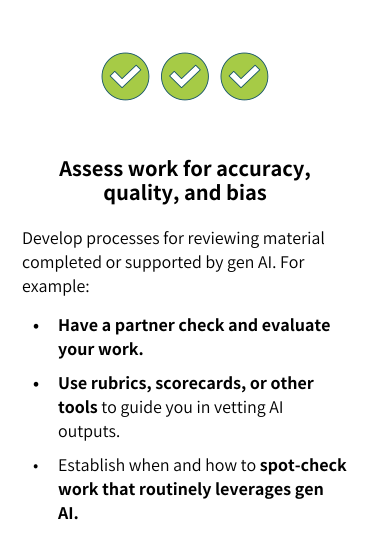
Review AI content as a team: Don't rely on just your own judgment to assess AI generated assets. Bring in others to evaluate the content together. Grace's team now regularly meets to examine code, combining their expertise to catch errors.
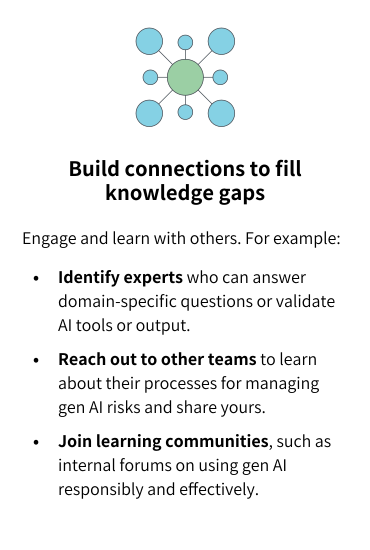
Consult experts as needed: Don't hesitate to ask specialists for help with nuanced challenges. When Grace's team encounters a particularly complex issue, they consult with their company's cybersecurity expert.
Hold regular retrospectives: Set aside time to reflect on your experiences with gen AI. Grace's team meets weekly and asks questions like, “What types of errors did the AI make most often? How can we improve our prompts to get better results?”
By working together, you and your team can reap the benefits of gen AI while minimizing risks no matter how you're using it to accelerate your work.
Follow these tips to strengthen your collective judgment and get the most out of gen AI:
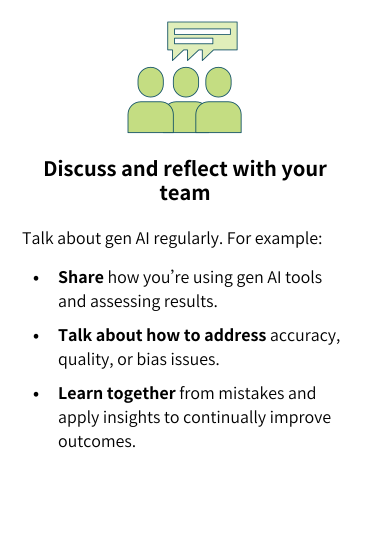
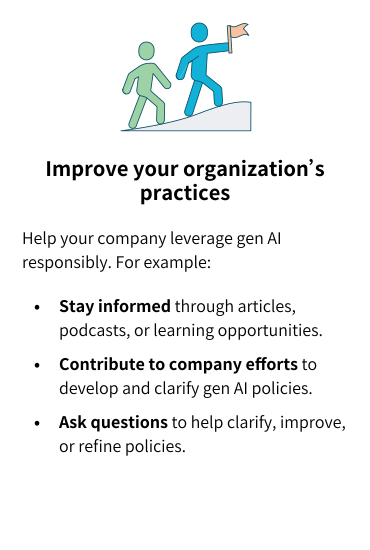
Mitigate Gen Al Risks as a Team
Teams that routinely collaborate as they apply gen AI not only avoid pitfalls, they also keep pace with this technology as it continues to evolve. At the same time, by building connections across teams, you support the organization in making quicker, more effective decisions around gen AI.
Make a Connection
Make a Connection
第 5 节
Exercising caution around security, privacy, accuracy, and potential bias not only helps you get good results; it’s also part of ethical gen AI use. Two other important ethical concerns are the environmental impact and human costs.
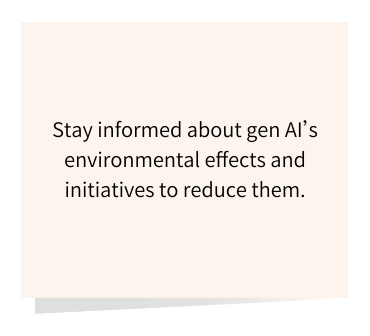
Gen AI tools demand enormous amounts of electricity and generate significant carbon emissions."Managing the Risks of Generative Al," by Kathy Baxter and Yoav Schlesinger. Harvard Business Review, May-June, 2023. In addition, the large data centers that support AI computing require a great deal of water to cool equipment. As the world grapples with climate change and water shortages, keep these impacts in mind.
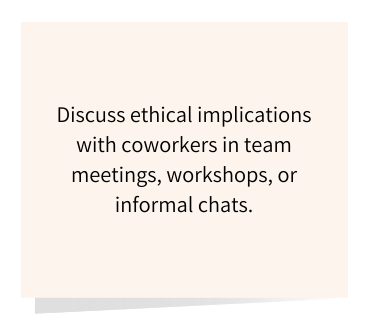
You may feel powerless to address these concerns, but in fact you can play an important role. Make a point to:
Another complex issue is people’s fear that gen AI will take over their jobs or devalue their skills and talents. The good news: While this technology can perform many complex tasks, it can’t replace human judgment or creativity.
To help ease these anxieties, talk about them with your team. Doing so will not only alleviate stress, it’ll help the group explore solutions to specific worries and discover promising ways for your team to leverage these tools.
Create opportunities to discuss:
-
Concerns about job displacement and how to build new skills.
-
Ways gen AI could enhance or transform the way you work.
-
Spending time saved by using gen AI to deepen competencies, connect with other groups in the organization, or innovate.
It’s possible that people could lose important skills by relying heavily on gen AI. For example, while AI can summarize reports, draft emails, and take notes, doing these tasks yourself can help you understand or retain information, think through details, and generate new ideas.
To balance this risk with the benefits of using gen AI, discuss with your team what skills you need to keep sharp. Make a point of continuing to employ and develop these capabilities, while also building new ones.
Use Gen Al Responsibly
Gen AI presents various risks, but you and your team can mitigate them by learning about and working with this technology. By doing so, you’ll be equipped to develop practices and processes for using it responsibly and effectively.
第 7 节
Test your understanding and reinforce what you’ve learned.
Try it Out
1. 1. You want to use a gen AI tool to analyze internal sales reports. Which of the following steps will enable you to use the tool responsibly and protect sensitive company data?
答案与解析
A. Confirm that the tool is approved for use by your organization, review the tool’s privacy policy, and make sure the data-sharing feature is disabled.(正确)
Confirming your organization’s policies on acceptable gen AI use, reviewing the tool’s privacy policy, and ensuring data sharing is disabled are essential steps for safeguarding sensitive information when using gen AI tools.
B. Select a reliable, publicly available tool, document when and how you use it, and continue to analyze some reports without using gen AI.
Avoid giving sensitive or proprietary information to a publicly available gen AI tool. Documenting gen AI use and continuing to do some tasks without gen AI can’t safeguard company data. Instead, know and follow your organization’s policies on acceptable gen AI tools and use, understand gen AI tools’ privacy policies, and opt out of data sharing.
C. Use multiple approved AI tools to analyze different sections of the reports to avoid giving one tool all the data contained in the reports.
Using multiple tools doesn’t mitigate the risks of data breaches or misuse. Instead, make sure you know and follow your organization’s policies on acceptable gen AI tools and use. Protect sensitive and confidential information by understanding gen AI tools’ privacy policies and opting out of data sharing.
Try it Out
1. 2. You’ve used gen AI to draft patient outreach messages promoting a new healthcare initiative for underserved communities. What’s the best next step to ensure the messages aren’t biased?
答案与解析
A. Ask another gen AI tool to evaluate the output for potential stereotypes, assumptions, or missing perspectives. Then review the messages and consult colleagues whose experiences and worldviews differ from yours.(正确)
Combining the AI’s evaluation with a human review and input from others helps to counteract potential bias in your messages.
B. Use the AI-generated messages as is. Since you crafted your prompt to specifically address underserved communities, the AI’s outputs should be unbiased and ready to share with patients.
While focusing on underserved communities is important, AI can still reflect or amplify biases in its training data. To counteract stereotypes in the gen AI output, examine your own assumptions, consider your audience, ask another gen AI tool to evaluate the output, and seek input from others.
C. Review and edit the messages to ensure they use inclusive language and emphasize the importance of the new initiative.
While inclusive language is important, addressing bias requires a deeper review. To counteract potential stereotypes in gen AI output, examine your own assumptions, consider your audience, ask another gen AI tool to evaluate the output, and seek input from others.
第 8 节
Reflecting on your learning helps you apply relevant concepts to your job.
Take a Moment
1. 1. What new insights do you have that could benefit you or others in your workplace?
2. 2. What are your biggest opportunities for applying concepts from this Lesson in your workplace?