
Here, Wharton School professor Ethan Mollick demonstrates his prompting process.
Guide Gen AI for Better Results 查看中文版
第 1 节
Generative AI (gen AI) analyzes large collections of information to provide insights at a staggering speed. It can save you and your organization time and money by automating tasks, creating more streamlined processes, and generating text and images.
Beyond these efficiencies, gen AI offers advanced capabilities like personalized customer experiences, complex scenario modeling, and even code generation.
But while gen AI can produce remarkably human-like content, it falls short of the nuanced understanding and real-world awareness that only humans can provide. To ensure AI-generated content is accurate, relevant, and aligned with your organization's goals, you and your team need to oversee and guide the technology."Generative Al ls Still Just a Prediction Machine," by Ajay Agrawal, Joshua Gans, and Avi Goldfarb. Harvard Business Review, November 18 2024.
It’s up to you to:"Good Judgment is a Competitive Advantage in the Age of Al," by Elisa Farri, Paolo Cervini, and Gabriele Rosani. Harvard Business Review, September 25, 2023.
Make a Connection
1. How have you or will you use your judgment to double-check a gen AI response?
第 2 节
The key to unlocking gen AI’s potential is crafting the right requests or prompts."The Art of Asking Smarter Questions," by Arnaud Chevallier, Frederic Dalsace, and Jean-Louis Barsoux. Harvard Business Review, May-June 2024.
Many people’s first experience with this technology comes with tools like ChatGPT. You ask a question or provide instructions, and the AI generates a response based on patterns it learned from its training data. The quality of the output largely depends on how well you structure your prompt."To Work Well with GenAl, You Need to Learn How to Talk to It," by Jaime Teevan. Harvard Business Review, December 15, 2023.
Unlike a simple web search, where you enter a search term and get a list of results, gen AI allows for conversational, back-and-forth interactions. To get useful, relevant outputs:
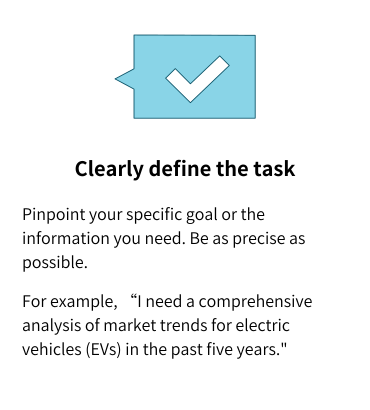
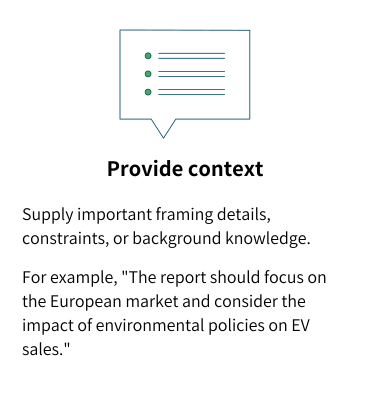
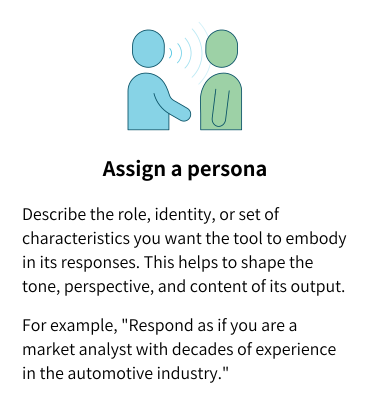
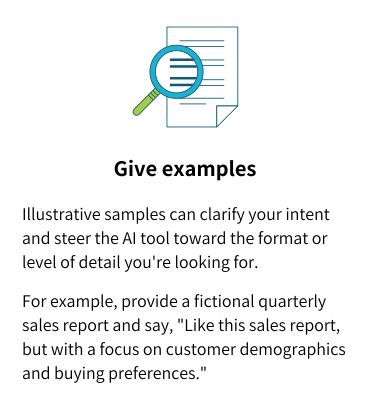
Guidelines for Writing Effective Generative Al Prompts
Adding the phrase “Let’s think step by step” to your gen AI prompt can triple the accuracy of the response.
Adding the phrase “Let’s think step by step” to your gen AI prompt can triple the accuracy of the response. Adding the phrase “Let’s think step by step” to your gen AI prompt can triple the accuracy of the response."Embracing Gen Al at Work," by H. James Wilson and Paul R. Daugherty. Harvard Business Review, September-October 2024.
Once the tool generates a response, you need to evaluate the output and decide where to take the conversation next.
For example, if you notice an AI-generated report on market trends for electric vehicles lacks insights on regional consumer behavior, you could follow up with additional requests to solicit content that’s more tailored to your needs. In this case, you’d ask the tool to include specific regional sales differences.
Craft Smart Gen Al Prompts
高效使用生成式 AI Engage Effectively with Gen AI
哈佛教授讲授视频逐字稿
So there's a mindset you want to have when you're working with these generative AI systems. And that mindset is based around the idea that it's an interaction. You brought an alien mind to the table. How are we going to interact with that alien mind to get the most results out of it?
So let's say we want to make an argument on behalf of continuing a hybrid work policy at our workplace. So the first thing I often want to do is get the system to learn some stuff. You want to provide context to it about who it is and what it's trying to accomplish.
How do we provide context? So a few different ways – we can tell it who it is, and we can also give it a kind of context of knowledge.
So let's first ask it to get some information. Look up why hybrid work is good and the arguments for hybrid work. So what we're doing now is we're kind of seeding it with context that we want it to understand.
Now, the next thing I'm going to do is give it a persona. I'm going to say who it is. So I'm going to say, you are the manager at a Fortune 500 company, and you want to write a memo to the senior leadership team about why hybrid work is good.
And so if I don't like this answer – and it looks like it's going to be OK so far – I would actually just stop the response. Either ask it again or do a clean sweep and start over.
Now, you can see this actually is a pretty high-quality kind of memo piece it's already doing – "Dear senior leaders, I'm writing with you with my perspective" – it's pretty good. But I would be reading this over carefully and saying, OK, are the facts correct? And I might want to make some corrections, like I think some more specificity might help. I would say, "We are a manufacturer of batteries. Redo it with that information."
We'll see if it's better. It might be better. It might be worse. The point is, it's almost costless for me to do this, while if I sat down to write a memo to senior management, it would take forever. Even if I don't use a single bit of the text here, it still has pushed me to think about topics I wouldn't have thought about otherwise. I'm going to end up being more creative. I'm going to have less problems in the way here. And you'll now notice it's now starting to weave this battery perspective into this. "Now tell me the arguments I would likely hear against this point in a meeting and how to answer them."
And so now we go one step further. It's giving the argument and the answer. So now we're prepping for this whole thing.
And by the way, I've got a fictional case here, but I could give the names of the people. It would look them up and then tell me about the individuals involved and who would likely make that argument. Again, not everything here is going to be right. But we're working through a process of working with this. So that's sort of how this process works overall.
第 3 节
At first glance, AI-generated content can look comprehensive and persuasive. But even the most sophisticated models hallucinate—meaning they generate false information that appears plausible but isn’t based on actual data or facts.
It’s your job to think critically about the answers you receive to identify potential inaccuracies, biases, and flaws in reasoning."Managing the Risks of Generative Al," by Kathy Baxter and Yoav Schlesinger. Harvard Business Review, June 6, 2023.
To evaluate AI-generated responses:"3 Ways to Build Critical-Thinking Skills," an interview with Helen Lee Bouygues. HBR On Strategy Podcast, August 16, 2023.
Verify claims
Rather than accepting information at face value, cross-reference any data points, statistics, or facts against trusted, well-established sources to validate their accuracy and identify gaps. Confirm dates and make sure studies are recent and relevant. Prompt your tool to justify claims, share evidence, and provide possible counterarguments.
Example: If the tool claims, “EV adoption rates in Europe increased by 50% in 2023,” you might ask, “What specific studies or datasets support this claim? Explain how these figures were calculated and whether they account for variations like regional differences or fleet purchases.”
Check the logic
Evaluate the reasoning in the output. Look for inconsistencies or unsupported assertions and verify them against reliable sources. Ask your tool to explain its reasoning and cite sources that support the output—and then check them.
Example: If the AI states, “Environmental regulations are driving EV growth in Europe,” confirm this claim by reviewing relevant policy announcements or market analyses. Investigate further by asking, “Which specific regulations are driving this trend? Summarize how these policies compare to those in other key markets.”
Ask smart follow-up questions
Clarify vague points and redirect the tool’s focus to your needs. Experiment with rephrasing your initial prompt if the outputs miss the mark.
Example: If the tool says, “Government subsidies have boosted EV sales,” ask, “Which subsidies? How do they compare to those in other regions, like North America or Asia?”
Stay alert to biases
Seek balance by questioning one-sided answers and even asking the tool what perspectives you may be missing. AI reflects the stereotypes and inclinations of the information it was trained on. Likewise, your own preconceptions and blind spots can influence how you interpret the AI’s responses—potentially causing you to overlook important nuances.
Example: If AI highlights only environmental benefits of EVs, ask about potential downsides. Also, stay alert for stereotypes, such as claims that all Europeans are ecology minded.
Seek diverse perspectives
Combine AI insights with multiple trusted sources such as external research, expert opinions, or team input to develop a well-rounded understanding of the issue.
Example: Compare the AI’s EV market analysis with findings from industry reports, academic studies, and internal experts.
Watch how a podcaster works with gen AI to improve his show.
提高生成式 AI 的内容生成质量 Elevate Your Gen AI Results
哈佛教授讲授视频逐字稿
This video was produced with AI assistance.
NARRATOR: Dimitry is a podcaster who wants to use AI to increase subscribers to his women's basketball show. He's getting help from his favorite LLM, which we've represented as an AI character named Jen.
JEN: Hi, Dimitry.
NARRATOR: But Jen needs direction, so Dimitry is working on his prompting.
DIMITRY: Hey there. Can you give me some advice on how to get more listeners on my women's basketball podcast?
JEN: To increase listenership, consider collaborating with popular influencers in the women's basketball community. You could also run social media campaigns and engage with your audience through live Q&A sessions.
NARRATOR: His first prompt got a decent but generic response. He's now following up with some more questions.
DIMITRY: How do I find influencers to reach out to?
JEN: You could try local sports reporters, college players, or coaches. You could also partner with other podcasts to cross-promote each other's content.
DIMITRY: Can you give me suggestions for repeatable segments?
JEN: Try a player of the week segment or a game analysis segment where you break down key plays.
NARRATOR: Dimitry evaluates each response and continues to expand ideas.
DIMITRY: All right, now, how do I get sponsors?
JEN: You could approach sports brands, fitness equipment companies, or even local businesses interested in supporting women's sports. Consider what's important to you and your message.
NARRATOR: He's now asking for sources to check for accuracy. Remember, ask smart follow-up questions. Evaluate all ideas. Ask for multiple sources. Critical thinking is critical when you use AI.
Critically evaluating the responses you receive helps you recognize AI’s limitations and guide it to more meaningful and accurate results.
Checklist for Evaluating AI-Generated Content
第 4 节
With your guidance, gen AI excels at straightforward tasks like writing reports and streamlining processes. But these uses only begin to tap into its full potential.
Think of gen AI not just as a problem-solving tool but as a partner that enables you to create something you never could before.
By taking advantage of AI’s ability to generate fresh perspectives, you can break free from conventional thinking and uncover unexpected ideas."Train Your Brain to Work Creatively with Gen Al," by Brian Solis. Harvard Business Review, November 27, 2024.
To take your collaboration with gen AI to the next level:
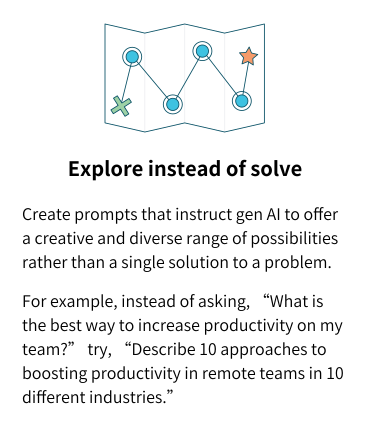
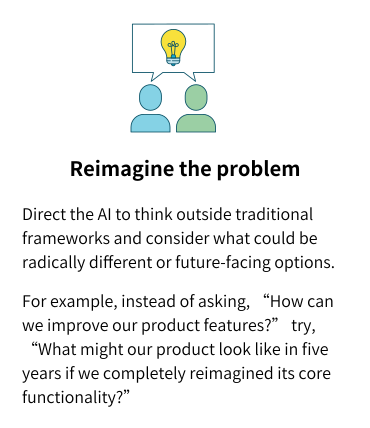
Here are other ideas for sparking ideas with gen AI:
如何从与AI协作中获取更多价值 How To Get (A Lot) More Out of Working with AI
哈佛教授讲授视频逐字稿
There's a ton of advice out there around how to use gen AI to automate boring tasks and gather information. The AI can do so much more than speed up our workloads. And one of our authors says that we can get a lot more from these tools if we start to think more creatively about not just how to use them, but how to actually collaborate with them. So here are four exercises he suggests anyone can use to train your brain to think more collaboratively and get more innovative outcomes when working with gen AI.
Instead of asking, how can I improve my presentation? Try a prompt that pushes both you and the AI to think outside the box. What if I approached my presentation in an unconventional way? What might that look like? Use metaphors and analogies in your prompts to open up creative pathways.
For example, instead of asking for productivity tips, try, imagine productivity as a dance. How might my approach change? Tap into multiple perspectives by asking gen AI to generate outcomes from the mindsets of the world's best experts in any industry or genre. Even fictional personas can work.
How would an innovative CEO, an artist, and a futurist each solve this problem? Finally, treat AI as a partner in innovation by asking something like, “How would you, as an AI, design a solution to accomplish A, B, or C in ways that only AI can perceive.”
By implementing these practices, you can move from merely completing tasks with AI to engaging in a dynamic process of co-creation.
Raj designs an innovative office space
Raj designs an innovative office space
Raj, an architect at a global design firm, leads the team that’s redesigning a tech company’s headquarters to embody its innovative culture and support hybrid work. At first, he approaches gen AI with a straightforward prompt: “Provide me with design ideas for a new hybrid office space.” The tool suggests conventional solutions like hot-desking zones and well-lit video conference rooms—functional but uninspiring.
To push for unique concepts, Raj reframes his approach, asking, “What are some groundbreaking ways to inspire collaboration in hybrid teams?” and “What might this office look like in 10 years with cutting-edge technology?” The AI proposes ideas like AI-driven environmental controls, spaces that adapt based on occupancy and activity, and experimentation zones. These insights help Raj and his team design a future-ready workplace that exceeds the client’s expectations.
Raj designs an innovative office space
Generative AI is a powerful tool, but its real value comes from how you prompt its responses and act on its insights.
Drawing on your critical thinking skills, you can harness this technology to overcome challenges, make better decisions, and spark innovation.
第 6 节
Test your understanding and reinforce what you’ve learned.
Try it Out
1. 1. You want to use gen AI to help you draft an email to customers announcing a new retirement savings account your company is launching. Which of the following prompts is strongest?
答案与解析
A. “Draft an email to customers announcing the launch of our new retirement savings account. Create a clear and concise message that introduces the product and explains its purpose.”
While this prompt clearly defines the task, it neglects to assign a persona to guide tone and perspective—which are elements of a strong prompt.
B. “Draft an email to customers announcing the launch of our new retirement savings account, using the example I provided as a guide. Highlight features such as no monthly fees and a competitive 4% annual interest rate. Use the professional yet friendly tone of a marketing manager.”(正确)
This prompt clearly defines the task, provides relevant context, assigns a persona to guide tone and perspective, and provides an example—which will steer the tool to provide a useful and precise output.
C. “Draft a marketing email about our new retirement savings account, making it appealing to customers. Provide key details, but don’t make it too promotional or sales focused. Include a call-to-action to encourage sign-ups.”
While this prompt clearly defines the task and offers some guidance on tone, it neglects to provide relevant context or provide an example—which are elements of a strong prompt.
Try it Out
1. 2. You’ve prompted gen AI to provide a summary of recent trends in your industry. What’s the best way to evaluate the tool’s output?
答案与解析
A. Review the AI-generated summary to make sure it aligns with your industry knowledge and share it with your team if it appears reasonable.
Relying solely on your instincts without confirming the details against trusted sources can lead to inaccuracies. Think critically about AI-generated content by verifying claims, checking the logic, and staying alert to biases. Ask follow-up questions to clarify unclear statements.
B. Review the summary and accept it as accurate if it includes citations or seems detailed and comprehensive.
Even when gen AI responses appear well-cited or sufficiently detailed, they can include fabricated or outdated information. It’s critical to verify the claims, check the logic, and stay alert to biases. Ask follow-up questions to clarify unclear statements.
C. Verify the information by cross-checking key points against reputable sources, identify any gaps or biases, and ask follow-up questions to clarify unclear areas.(正确)
By verifying claims, addressing gaps, and refining the output with follow-up questions, you ensure the information is accurate, comprehensive, and aligned with your needs.
第 7 节
Reflecting on your learning helps you apply relevant concepts to your job.
Take a Moment
1. 1. What new insights do you have that could benefit you or others in your workplace?
2. 2. What are your biggest opportunities for applying concepts from this Lesson in your workplace?