Pocket Leadership口袋领导力

Difficult Interactions

Resolve a Conflict Successfully 查看中文版

第 1 节

All conflicts are different, but one thing is certain: To resolve a disagreement in a way that satisfies you and your counterpart, you’ll need to work together.HBR Guide to Dealing with Conflict, by Amy Gallo. Harvard Business Review Press, 2017. A good resolution requires clear communication and some give-and-take from each party.

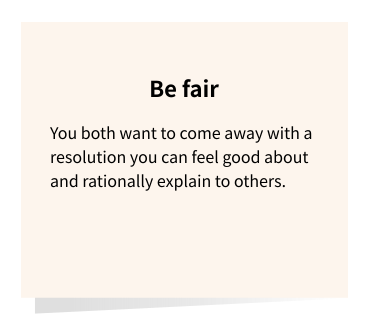
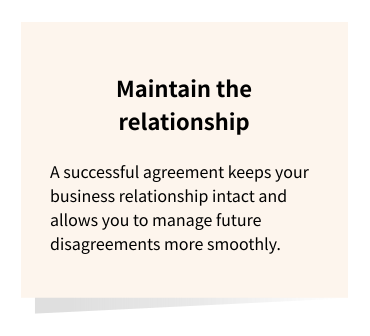
No matter what kind of conflict you’re trying to address, seek a resolution that will:
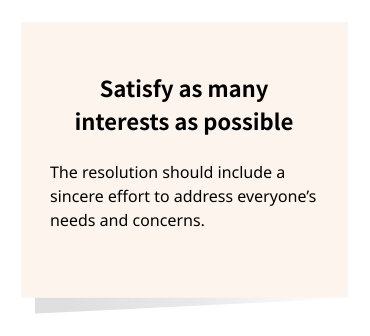
A successful resolution addresses the source of the conflict and provides a way to move beyond the dispute. It prevents future problems that can arise if one party feels ignored, wronged, or disrespected.

Take a Moment

1. Think about the last time you successfully resolved a conflict. How did you and the other party ensure that the resolution met both of your needs?

第 2 节

One survey shows that 87.8% of professionals are willing to compromise in a workplace conflict if it will bring forth a resolution.

One survey shows that 87.8% of professionals are willing to compromise in a workplace conflict if it will bring forth a resolution. One survey shows that 87.8% of professionals are willing to compromise in a workplace conflict if it will bring forth a resolution.Workplace Conflict Statistics: How We ApproachConflict at Work," by The Niagara lnstitute. Niagara Institute, August 11, 2022.

When you approach the conflict as a challenge that you and your counterpart can work together to overcome, you often defuse tension. A good next step is to find areas where you agree. When you identify where your interests, perspectives, and goals overlap, it becomes easier to start exploring solutions.

And acknowledging your counterpart’s point of view—by saying something like “That’s a valid point,” or “I see what you mean”—demonstrates that you are listening and willing to collaborate.

Here, two colleagues who disagree talk through their concerns together.

菲利克斯和莎拉会面尝试解决冲突 Felix and Sarah Meet to Resolve a Conflict

哈佛教授讲授视频逐字稿
FELIX: Sara, I'm concerned with how much of our budget is spent on the product demos, including focus groups. Don't you think it's adding a lot of time and money to the process? SARA: Well, usually the focus groups provide us valuable insights. FELIX: So you think we should continue with them? SARA: Yes, I do. FELIX: Well, I know how much we both care about keeping a close eye on department expenses this year. What if we still include the focus groups? Do you think we can figure out another way to get the demos done more efficiently? I'm sure we can find ways to trim costs and time from the schedule. SARA: OK. I'm willing to work with you on this.

Try it Out

1. What’s the first step Felix and Sarah take to begin finding a resolution?
答案与解析

A. Felix proposes they eliminate the focus groups.
Felix establishes that they both care about department expenses and are seeking a way to trim costs and time from the schedule.

B. Felix and Sarah find they have a common goal.(正确)
Felix and Sarah both care about department expenses and are seeking a way to trim costs and time from their schedule.

C. Sarah accepts responsibility for starting the conflict.
Even though Sarah wants to keep the focus groups, she and Felix recognize that they both care about department expenses and are seeking a way to trim costs and time from the schedule.

第 3 节

Reaching a resolution requires you and the other person to thoughtfully consider options that are acceptable to you both. To do that well, you have to remain flexible and open to ideas.

Keep these approaches in mind.HBR Guide to Dealing with Conflict, by Amy Gallo. Harvard Business Review Press, 2017.
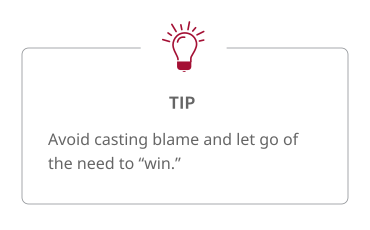
Be creative Come up with several creative ways to satisfy your goals. For example, if your finance director won’t approve hiring an additional staff member to complete a project on time, request help from another team or a delay in implementing certain aspects of the project. Collaborate well When you propose a possible solution, be collaborative and invite input by asking questions, such as, “What other ideas do you have?” Let the other person offer their own solutions and acknowledge what’s important to them. Consider what you can offer Think about what you can give—or give up—to help resolve the situation. By doing so, you show your counterpart that finding a solution is truly important to you.

Focus on good communication as you brainstorm solutions. Make an effort to:

  • Clearly express your point of view. Use a neutral tone and emphasize that you want your counterpart to understand your reasoning, even if they don’t share your perspective.

  • Listen and ask for clarification. When you do so, you signal that you’re respectfully considering the other person’s perspective.

  • Summarize your differences. This conveys that you are listening to your counterpart and that you understand their position.

Here, Sarah and Felix come up with options for resolving the conflict.

By generating options together, you can develop better solutions than you might have on your own. And as you make proposals, ask your counterpart for constructive criticism. Remember, there’s almost always more than one way to solve a problem.

菲利克斯和莎拉一同探讨解决方案 Felix and Sarah Explore Solutions Together

哈佛教授讲授视频逐字稿
FELIX: Let's figure out how to get product demos done more quickly and for less money. SARA: OK, but we want to get them right. We hold focus groups and then up to five rounds of review so that we can get the best possible product demo. FELIX: I think we have different perceptions on what's critical here. You're focusing on quality, which I understand, but I'm looking at the bottom line. I'd much rather have a very good and cost-effective demo completed in a timely manner than to aim for perfection. SARA: OK, so what I'm hearing is that you don't see any added value in our current process. So let me ask you this: What is your vision of a “very good” demo? FELIX: I'd say enough for customers to get a clear and compelling idea of the product. SARA: OK, and do you see any value in the focus groups? FELIX: Sure, I do. But is the feedback really giving us much? Like anything of real importance? SARA: Yeah, I'd agree. Not every focus group gives us new insights. And then-- FELIX: And what about the review rounds? SARA: Well, I'd say maybe after the fourth session, we see a drop-off in critical feedback.

Try it Out

1. Sarah asks Felix questions to . . .
答案与解析

A. clarify how Felix views the value of product demos.(正确)
Sarah seeks to understand what Felix thinks about the value of the product demos.

B. prove that Felix doesn’t care about the quality of product demos.
Sarah isn’t trying to prove that Felix is indifferent to quality. She understands that he’s keeping a close eye on department expenses.

C. persuade Felix that product demos are necessary.
Sarah isn’t trying to persuade Felix but rather to explore areas for compromise.

第 4 节

Once you and your counterpart have come up with a few possible ways to resolve the conflict, you’ll need to evaluate them and make a decision together.HBR Guide to Dealing with Conflict, by Amy Gallo. Harvard Business Review Press, 2017.Once you agree on a path forward, put it in writing so you can refer to it if the issue comes up again.

Macy and Wes reach an agreement

Macy and Wes reach an agreement Macy, a brand manager at a medical technology company, meets with Wes from design to discuss her frustration that Wes’s team isn’t consistently following the new branding style guide. Wes argues that his team doesn’t always have time to apply the new standards. After a long conversation, they agree that Macy will assign a member of her team to show Wes's group how to apply the new styles. Wes agrees to hold his team accountable for using the new style guide or to let Macy know if they need additional help. They commit to meeting again to review whether this process resolves their issue. Macy and Wes reach an agreement

Sometimes, you may be unable to agree on a resolution. What happens then? Here are three approaches you can take:
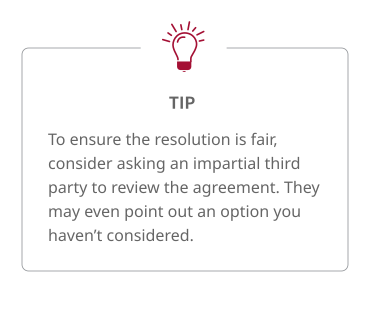
Take a break Step away from the situation and allow any emotions to cool down. When you revisit the issue, you may see a new option, or an existing possible solution may seem more appealing. Ask for help When you’ve reached an impasse, it’s okay to appeal to someone in a higher position. Let them know you need their help to find a solution. Look elsewhere Consider what else you can do if the conflict can’t be resolved. Is there a way to get what you need without involving the other person? For example, if you can’t reach a resolution with an outside vendor, is it worth changing suppliers?

Make a Connection

1. Think about a time when you—or someone you know—weren’t able to resolve a conflict. What could you or the other person have done differently?

Explore Solutions Together

附件:explore_solutions_together1703137878042.docx(docx · 63 KB,本地副本)

第 5 节

In most cases, you still need to work with the other person after a conflict is over. Even if there is some loss of trust between you, it’s possible to put the conflict behind you and move on by taking deliberate steps to rebuild your working relationship.HBR Guide to Dealing with Conflict, by Amy Gallo. Harvard Business Review Press, 2017.

Try these strategies:
Rebuild Your Relationship After Conflict

附件:rebuild_your_relationship_after_conflict1703139622659.pdf(pdf · 63 KB,本地副本)

Here, Bryan Simmons, vice president of communications at Arcus Foundation, shares advice on how to resolve a conflict in a way that positively shapes your future relationship with the other person.

将冲突转化为更健康的关系 Turning Conflict into a Healthier Relationship

哈佛教授讲授视频逐字稿
One of the things I've learned from the conflicts I've encountered with colleagues over the years, in various work situations, is that when you're in conflict with a colleague, the way you handle it, the way you resolve it with them, is often a way of shaping the future relationship with that person. And I think it's really valuable, if not important, to think of it that way. One episode that jumps out to me when I think about this is a conflict I once had with another senior executive on a job. This executive was new to our team and still learning our culture. One of the tasks I had was to integrate the budget planning of the various departments and the rationales for their respective budgets into one integrated, unified plan and proposal. And that meant that I would edit things written by my peers on the staff and the leadership. My new colleague was uncomfortable with this and eventually became frustrated enough that he came to my office one afternoon and simply started laying into me, yelling, telling me that this was his content. I simply couldn't believe I was being addressed in this way. And I was immediately angry. I felt something rise up in me. I wanted to respond. But in the moment, I simply told him that I thought he should leave my office now and that I would get back to him. Being a Black man in corporate environments, I'm very cautious about losing my temper. And I normally am able to contain it because the risk that I perceive is that I will not have people think I just had a bad day. They'll feel they've discovered who I am. I collected myself. And I collected my belongings to get ready to go home. And then I stopped by his office. And I told him a few things. I said, “Number one, I need you to understand that what happened before can never happen again. You will not address me in the way that you did. You will not yell at me.” “You should also understand that I expect you and I will resolve this and find a new way to work with one another. And I will not escalate this. I will not socialize this to embarrass you.” So, where we left it was that beginning the next week, we would work together in a different way, in the way that I prescribed. And that's exactly what happened for the rest of the time that we were on staff there together. My takeaway from all of that is what I know instinctively, which is that it's important when you're resolving conflict to leave your adversary some door to walk through where their professional reputation isn't at risk and where they may feel they have a partner they didn't know they had. I really do try to shape the resolution of my conflicts in such a way that I have a closer partnership with that person on the other side of the moment that we're in.

It’s also a good idea to talk about the experience with the other person. Discuss what steps you can take if a conflict arises between you again."How to Mend a Work Relationship," by Brianna Barker Caza, Mara Olekalns, and Timothy J. Vogus. Harvard Business Review, February 14, 2020.

第 6 节

  • A successful resolution to a conflict should satisfy as many interests as possible, be fair, and maintain your working relationship.

  • Start by revisiting what you and the other party agree on and identify where your interests, perspectives, and goals overlap.

  • Explore solutions together. Reaching a resolution requires you to be creative, collaborate well, and focus on good communication.

  • Make a plan for moving forward. Agree on a course of action and document your solution.

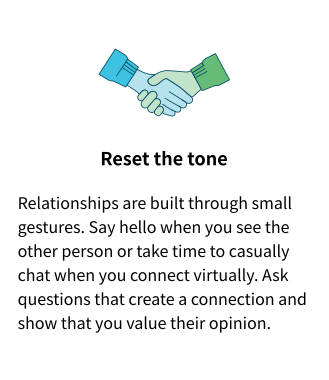
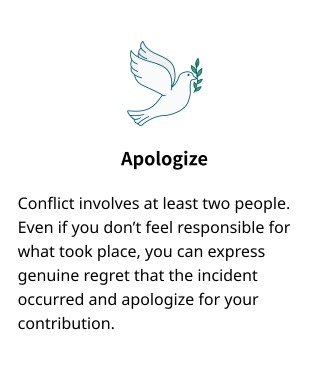
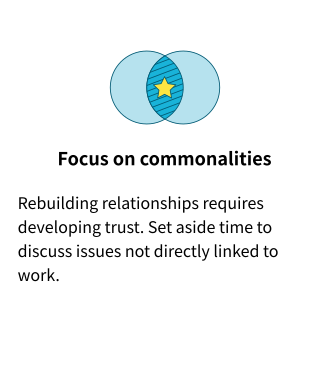
  • Rebuild your relationship by resetting the tone, apologizing for your contribution, and focusing on commonalities.

第 7 节

Test your understanding and reinforce what you’ve learned.

Try it Out

1. 1. After a difficult interaction, you meet with the other person to resolve the disagreement and move forward. As you explore possible solutions together, what approach should you take to reach a successful resolution?
答案与解析

A: Persuade your counterpart to agree with your point of view and seek to change their mind.
At this point, it’s a good idea to let go of the need to “win.” There’s almost always more than one way to solve a problem. Reaching a resolution requires you to be creative, collaborate well, and consider what you can offer to help resolve the situation. To do that well, you have to remain flexible and open to ideas.

B: Stand your ground and seek a resolution that benefits you and your team.
A successful resolution should include a sincere effort to address everyone’s needs and concerns, not just your own. Reaching a resolution requires you to be creative, collaborate well, and consider what you can give (or give up) to help resolve the situation. To do that well, you have to remain flexible and open to ideas.

C: Be creative, collaborate well, and consider what you can give (or give up) to help resolve the situation.(正确)
Reaching a resolution requires you and the other person to thoughtfully consider options that are acceptable to you both. To do that well, you have to remain flexible and open to ideas.

Try it Out

1. 2. Although you and a coworker resolved an ongoing conflict, there are some lingering hurt feelings. What strategies will effectively help you rebuild the working relationship?
答案与解析

A: Give your colleague some space. Ask to be assigned to projects with other people.
It’s natural to feel like you need to give each other some space. However, relationships are built through small gestures. Reset the tone by engaging in friendly chat, express regret that the incident occurred, and focus on commonalities.

B: Reset the tone by engaging in friendly chat, express regret that the incident occurred, and focus on commonalities.(正确)
Relationships are built through small gestures. Reset the tone by saying hello or casually chatting with the other person to create a connection. Rebuild your relationship by expressing regret, redeveloping trust, and focusing on what you have in common.

C: Move on and avoid talking about the conflict with the other person so you can both heal.
You may be able to act like nothing happened, but the other person may not. It’s a good idea to talk about the experience with your counterpart and discuss what steps you can take if a conflict arises between you in the future. You can also reset the tone by engaging in friendly chat, express regret that the incident occurred, and focus on commonalities.

第 8 节

Reflecting on your learning helps you apply relevant concepts to your job.

Take a Moment

1. 1. What new insights do you have that could benefit you or others in your workplace?
2. 2. What are your biggest opportunities for applying concepts from this Lesson in your workplace?

Further reading

化干戈为玉帛的 7 个锦囊——冲突年代的领导力必修课
随着全球范围内社会动荡不断加剧,职场中的冲突也日益频繁。工作中的不文明行为愈演愈烈,每天都因生产力下降和员工缺勤给企业造…
走心倾听有多难
研究表明,当员工感到自己的声音被倾听时,他们的投入度会提升,工作表现也会随之改善,从而为企业带来显著的收益。然而,对职场…
如何与团队谈论“房间里的大象”
如果你的团队感到“卡住了”,问题很可能涉及一些难以讨论的话题,比如两位团队成员之间的冲突,或者某位员工表现不佳。要正面应…

Top 3 in the source platform's original order