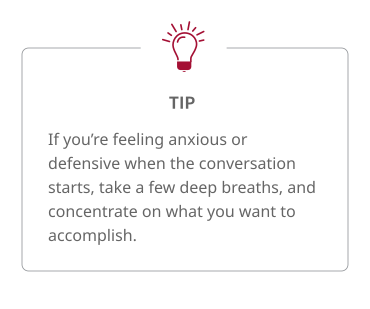
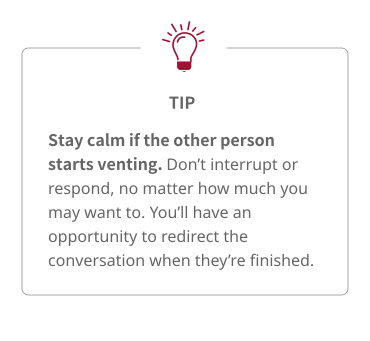
As much as you’d like conflicts to resolve on their own, in most cases they need to be actively addressed. And that means working with your counterpart to understand the causes and come up with solutions together.
The key to a productive discussion is to begin the conversation collaboratively—not combatively.
To set the right tone for your conversation:HBR Guide to Dealing with Conflict, by Amy Gallo. Harvard Business Review Press, 2017.
During the conversation, focus on the future. Don’t spend too much time revisiting what’s already happened. Instead, direct the discussion toward solving the problem.
Make a Connection
1. How do you usually start a difficult conversation? What changes would you make to set a more constructive tone the next time you address a conflict?
第 2 节
You probably have had moments when you haven’t given someone your complete attention. But you can’t resolve a conflict unless both parties make a genuine effort to receive the other person’s message. Listening well and responding thoughtfully to your counterpart improves mutual understanding.
To show your interest in their perspective:
Hear the person out
Let them talk. Pay attention to what they’re saying, not to what you’ll say next.HBR Guide to Dealing with Conflict, by Amy Gallo. Harvard Business Review Press, 2017.
Offer nonverbal cues
If you feel comfortable doing so, show you’re listening through eye contact, an occasional nod, and attentive posture.How to Become a Better Listener," by RobinAbrahams and Boris Groysberg. Harvard Business Review, December 21, 2021.
Acknowledge your counterpart’s position
This doesn’t mean you’re agreeing with it. Saying, “I see your point . . .” shows you respect and value the other person’s opinion.Disagreement Doesn't Have to Be Divisive," by Francesca Gino. Harvard Business Review, November16, 2020.
Seek to understand
To show that you’re not only listening but also that you want to better comprehend what they’re saying, ask thoughtful questions to clarify the other person’s perspective.HBR Guide to Dealing with Conflict, by Amy Gallo. Harvard Business Review Press, 2017.
Questions to invite others to share their viewpoint
To show that you’re open to a true dialogue, ask questions that signal your willingness to understand your counterpart’s point of view. Here are a few good ones:HBR Guide to Dealing with Conflict, by Amy Gallo. Harvard Business Review Press, 2017.
What’s most troubling to you about this situation?
What’s most important to you?
How does this relate to your other concerns?
What would you like to see happen?
What ideas do you have that would meet both of our needs?
What does a resolution look like for you?
Questions to invite others to share their viewpoint
Amy Gallo, podcast host and contributing editor at Harvard Business Review, offers advice on how to become what she calls a “trampoline listener.”
成为“蹦床型倾听者” What Good Listening Really Sounds Like
哈佛教授讲授视频逐字稿
Are you a good listener? No, really. Are you? You might think you are because you stay silent while they're speaking, nod your head and say "mm-hmm," and repeat back word-for-word what you heard them say. This has been standard management advice on good listening for ages. But what if I told you that following those tips could leave the listener feeling unheard or even dismissed?
The truth is that mastering the art of listening involves a whole host of other skills. You need to do more. The first step, after putting away all distractions like cell phones and laptops, is to recognize that listening is an active, non-competitive, two-way interaction. Authors Jack Zenger and Joseph Folkman write that we shouldn't be passive, like a sponge, merely absorbing information. Instead, we need to be active listeners, like a trampoline, giving the speaker's thoughts height, acceleration, energy, and amplification.
But how do you become this so-called "trampoline listener?" In reality, speaking up and asking good questions signals to the speaker that, not only have you heard what they said, but you understood it enough to want more information. Here's an example. An employee tells you, “I'm worried about my presentation for the board meeting.”
You might try to naturally reassure and relate by saying something like, “Oh, you're going to do great. It took me years before I could present without being nervous.” Unfortunately, while you're attempting to make a connection here, that kind of response can actually dismiss their concerns without inviting further detail. It ignores what might be an important issue underlying their statement and switches the focus to you.
To show that you're listening in a deeper way, you can say something like, “I was nervous when I started presenting, too. What's worrying you?” Big difference, right? When trying to be a better listener, another good question to ask is, “Am I getting in my own way?” All too often, we prevent ourselves from listening deeply because of our own insecurities or head trips. We might be emotionally uncomfortable or worry about how confident and prepared we seem to the other person.
With practice, quieting that internal monologue will leave space to actually hear what's being said by the other person. This is especially useful when the conversation you're having is a tricky one or involves a conflict. Listening actively and making sure your counterpart feels heard can help you uncover important information that could lead to a resolution.
By listening well, you show your counterpart that you respect their position, even if you don’t agree with it.
第 3 节
When it’s time to present your side of the issue, offer your perspective in a direct and sincere way. In the process:HBR Guide to Dealing with Conflict, by Amy Gallo. Harvard Business Review Press, 2017.
Own your role. A conflict is a disagreement between two people. Set a tone of accountability by acknowledging your contribution to this issue.
Use “I” statements. Start sentences with “I” to offer your point of view and show you’re not casting blame.
Carefully lay out the facts. Offer specific, observed descriptions without opinion or judgment. You’re sharing how you arrived at this view, not trying to persuade the other person to agree.
Don’t apologize for your feelings. This conversation isn’t about how you feel. Telling the other person that you feel bad shifts the focus onto yourself and away from the problem.
Poll
Poll
Want to be heard? Use these phrases
When you’re sharing your point of view, choose your words carefully to help your counterpart better understand where you’re coming from. Here are some sample phrases:HBR Guide to Dealing with Conflict, by Amy Gallo. Harvard Business Review Press, 2017.
Here’s what I’m thinking.
My perspective is based on this observation.
I came to this conclusion because . . .
I’d love to hear your reaction to what I just said.
Do you see any flaws in my reasoning?
Do you see the situation differently?
Want to be heard? Use these phrases
When you’re receptive to hearing and respecting an opposing view, you become more persuasive. Disagreement Doesn't Have to Be Divisive," by Francesca Gino. Harvard Business Review, November16, 2020.
第 4 节
Words matter. When navigating a difficult conversation where tensions are high, be aware of—and avoid—language that tends to make a bad situation worse.Words and Phrases to Avoid in a Difficult Conversation," by James R. Detert. Harvard Business Review, June 21, 2021.
Phrases that exaggerate the situation or challenge others personally will work against you when you’re trying to constructively solve a problem. Make your conversations more productive by taking care not to:
Assume your viewpoint is obvious
Using words such as "clearly" or "obviously" suggests that any different view is irrelevant or unimportant.
Exaggerate
Using "You always" or "You never" derails the conversation by leading away from areas of substance.
Lecture
Telling other people what they should do makes them feel judged. Instead of saying “You should . . . ,” ask, “Have you thought of . . .”
Challenge someone's character or integrity
Calling someone "unprofessional," "unethical," or “wrong" puts them on the defensive.
Tell someone, “It’s not personal . . .”
When someone is hurt, angry, or affected by something you’ve said or done, telling them it’s not personal can be offensive.
Instead, try using language that shows your counterpart that you are receptive to their point of view.To do this:"Disagreement Doesn't Have to Be Divisive," by Francesca Gino. Harvard Business Review, November16, 2020.
Buffer your assertions
Soften your claims with phrases like, “I think sometimes . . .” and “We often encounter . . .” to strike a more collaborative tone.
Use “and” instead of “but”
You can share a different perspective without using the word “but,” which tends to be combative. For instance, “I understand why you want to approach the project that way, and I think we can also consider my suggestion.”
Phrase your argument positively
Instead of digging in on what not to do and focusing on what you think is wrong with your counterpart’s position, use affirmative language such as, “It would be great if we could try . . .”
Miya and Lincoln spar
Miya and Lincoln spar
Miya is frustrated with Lincoln. Once again, the IT team he leads failed to set up her new team member’s computer in time for their first day of work. When Miya arrives at their scheduled meeting a few days later, she is still upset. She starts by saying, “Lincoln, I don’t know what’s wrong with your team. They always ignore our requests. Clearly, they don’t have any consideration for our schedule.”
Lincoln becomes defensive, saying, “You have no idea what you’re talking about. In addition to completing our usual work this week, my team is dealing with an urgent request from the executive team to support the company accreditation audit. You should have requested the computer earlier, so we’d have time to work it into our schedule.”
Miya and Lincoln spar
Try it Out
Try it Out
Let’s see what happens when Miya and Lincoln choose their words more carefully.
Miya and Lincoln try a different approach
Miya and Lincoln try a different approach
Before Miya meets with Lincoln to discuss her frustration, she prepares for the conversation so she’s more intentional about her language choices when they speak. She says, “Lincoln, thanks for meeting with me. I’m not sure if you’re aware, but your team missed a deadline last week for having a new employee’s computer ready. This is the third time it’s happened. I know you and your team are up against some big challenges. Help me understand how we can work together to address this issue?”
Lincoln responds, “Thanks for bringing this problem to my attention. I can see where that would be really frustrating. My team is working to meet internal requests this week, and we’re also supporting an urgent need from the exec team. Let me personally review your request and get back to you with some ideas of how we can prioritize your team’s needs in the future. Can we regroup this afternoon?”
Miya and Lincoln try a different approach
How did you do? No matter where your choices led you, you probably learned that when you start a conversation well and employ good listening skills, you’re better able to effectively express your point of view. This helps to make a potentially difficult interaction a constructive one. Often, issues can be resolved when you both truly listen to each other.
第 5 节
Start your conversation off right by establishing the ground rules, noting areas of agreement, acknowledging differences of opinion, and inviting feedback.
Listen carefully when the other person speaks. Ask thoughtful questions to understand their perspective and offer nonverbal cues to show you’re listening.
When sharing your perspective, acknowledge the role you played in the interaction, offer facts without judgment, and seek a collaborative tone.
Phrases that show that you’re making assumptions, exaggerating the situation, or challenging others personally will sabotage the conversation.
第 6 节
Test your understanding and reinforce what you’ve learned.
Try it Out
1. 1. You’re meeting with a colleague to discuss a disagreement that occurred in a team meeting a few days ago. During your conversation, how can you show you’re listening when the other person is talking?
答案与解析
A: Pay attention, acknowledge their position, and ask questions to clarify their perspective.(正确) During a conversation, the best way you can show you’re listening is to pay attention to what they’re saying, acknowledge that their position is valid (even though you disagree with it), and ask questions to show you want to better understand their perspective. Listening well and thoughtfully responding to your counterpart improves mutual understanding.
B: Interject often with your point of view to show you’re engaged in the conversation. Interrupting the other person while they’re speaking is disrespectful. The best way you can show you’re listening is to pay attention to what they’re saying, acknowledge that their position is valid (even though you disagree with it), and ask questions to show you want to better understand their perspective. Listening well and thoughtfully responding to your counterpart improves mutual understanding.
C: Nod your head throughout and begin thinking about your response. You aren’t giving the other person your full attention if you’re thinking about what you’ll say next. The best way you can show you’re listening is to hear the person out and pay attention, acknowledge that their position is valid (even though you disagree with it), and ask questions to show you want to better understand their perspective. Listening well and thoughtfully responding to your counterpart improves mutual understanding.
Try it Out
1. 2. It’s your turn to present your side of the issue during a conversation with a coworker. How can you share your perspective constructively?
答案与解析
A: Acknowledge the role you played in the interaction, offer facts without judgment, and seek a collaborative tone.(正确) When it’s time to present your side of the issue, offer your perspective in a direct and sincere way. The best way to share constructively is to acknowledge the role you played in the conflict, offer facts without judgment, and seek a collaborative tone.
B: Start by telling your counterpart that it’s not personal and then thoughtfully detail the problems with their position. When someone is hurt or angry, telling them it’s not personal can be offensive. When it’s time to present your side of the issue, offer your perspective in a direct and sincere way. The best way to share constructively is to acknowledge the role you played in the interaction, offer facts without judgment, and seek a collaborative tone.
C: Apologize and let the other person know you’re feeling bad about the argument before outlining what should happen next. Telling the other person that you feel bad shifts the focus onto yourself and away from the problem.
When it’s time to present your side of the issue, offer your perspective in a direct and sincere way. The best way to share constructively is to acknowledge the role you played in the interaction, offer facts without judgment, and seek a collaborative tone.
第 7 节
Reflecting on your learning helps you apply relevant concepts to your job.
Take a Moment
1. 1. What new insights do you have that could benefit you or others in your workplace?
2. 2. What are your biggest opportunities for applying concepts from this Lesson in your workplace?