Decision Making
Use Data to Guide Decisions 查看中文版
第 1 节
Data, when used thoughtfully, can be a powerful part of your decision-making process. It’s a valuable source of input you can use to answer questions and evaluate options as you decide on a course of action.
Data can help you:
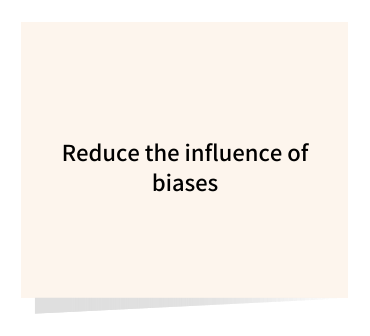
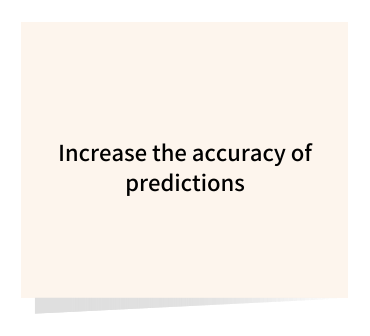


What exactly is data? In business, data is information related to your company’s operations. Data comes in many forms, such as sales figures, employee satisfaction ratings, customer reviews, website traffic statistics, and overall financial performance.
There are two primary types of data:
Quantitative
Quantitative data is expressed as numbers, like the percent increase in sales during a specific time period, or the amount of time it takes someone to perform a new process. If you’re asking, “How many?” or “How much?” or “Who?” questions, you likely need quantitative data.
Qualitative
Qualitative data consists of observations or feedback, such as the difficulties someone might have while performing a new process, or a person’s opinions about a product or service. If you’re asking “Why?” questions, you likely need qualitative data.
To learn more about types of data, visit the Draw Insights from Your Data lesson in the Harvard ManageMentor course Digital Intelligence.
As you explore various options, data can help you decide on the best course of action. For example, you might:
-
Refer to usage or sales figures to assess customer interest in a feature.
-
Analyze information gathered via a survey, focus group, or observation.
-
Test two alternative product ideas with customers to observe which one gets better results.
And once you implement a decision, you can use data to evaluate whether you’re reaching your key objectives.
Digging into data and applying it to your decisions might feel challenging. But don’t let that stop you. You don’t need to become a data scientist in order to use data meaningfully. In this video, learn three simple concepts that can help you apply data to your decisions: access, accuracy, and analysis.
数据的“3A”要素 The Three A's of Data
哈佛教授讲授视频逐字稿
You and your team need to become comfortable with data. This doesn't just mean having a few specialists who translate the data for everyone else. It means rethinking how you collect and act on information. Don't worry you don't need to suddenly become a data expert. You just need to learn a few guiding principles to unlock the power of data on your team.
Start by understanding what types of data sets you need, and how your team can access them. Then, validate this information. Get to the bottom of how it might be biased or otherwise inaccurate. From there, you'll be able to tap into the insights behind the data, report them out to others, and use these insights to fuel smarter decisions.
To help instill these ideas across your team, learn the three A’s of data-- access, accuracy, and analysis. Let's kick things off with data access. Three questions lie at the heart of data access. You'll want to consider each to start using data effectively. How does your team get access to the information it needs? Is the information you're looking for collected already, or will you need to start from scratch? And what types of data would best serve your needs?
The next hurdle is data accuracy. Not all data is created equal. Its quality is central to how helpful it can be. You need to know that the information you're accessing is valid. In other words, that it accurately portrays the reality of what's being measured. To do so, start by finding out how it was collected, how it's been evaluated, and how recently it's been updated. Work with your team to establish a repeatable process for checking data accuracy.
A third component is data analysis. Evaluating bad data can result in bad decisions. But a poor analysis of good data can lead to bad decisions, too. So, watch your biases. Come at the data with a fresh pair of eyes. Don't use the data to reinforce assumptions you already have.
Becoming proficient at data analysis takes time, but with a little practice, you'll draw insights from your data to make improvements to your processes, products, and services. You don't have to become a data expert to be able to make the most of your data. Remember the three A’s and help you and your team practice-- access, accuracy, and analysis.
Take a Moment
1. Think of a decision you or your team made in the past using data. What kind of data did you use? How did the data influence your decision?
第 2 节
Data can help guide many of your decisions by helping you better understand customers, choose marketing and pricing strategies, and plan how to allocate resources, among other things.
With an ever-increasing amount of information available, the challenge is to learn how to use it effectively. To get started, identify decisions that can most benefit from data. Refer to data when you have:"Keeping Up With the Quants" by Tom Davenport, December 8, 2021 (Unpublished).
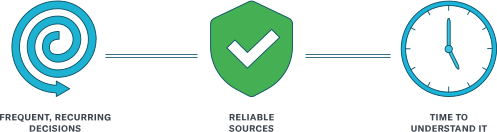
As you begin to think through a decision, consider how data could benefit you. Here, Babson College professor Tom Davenport explains more about when and how to bring data into decisions.
适用数据的决策类型 When to Use Data to Make Decisions
哈佛教授讲授视频逐字稿
Data-based decisions tend to be more accurate, more precise to have better outcomes than any other type in almost every circumstance. Now there are, of course, some circumstances where you can't get data. Maybe you have to make the decision very quickly. Maybe your organization has never made this decision before, so you don't really have any data on it.
You might be able to do an experiment to gather data and then make the decision. If so, you should do that. In general, the types of decisions that are best suited to applying data are those that are both consequential, that they really matter, and also repetitive.
Repetitive decisions are good for a couple of reasons. One, because you know you're going to do it over and over again and it's worth the investment to create the data, do the analysis, and so on. And two, because repetitive decisions create data. If we are looking at pricing, for example, a typical repetitive decision in an organization that's also consequential because it has a big impact on profitability. Pricing happens every time you sell something, and you know what the customer has been willing to pay under what circumstances, so you can create a model or an algorithm that predicts what is the optimized price you can charge.
The third issue is you may not have a data scientist available. The technology is improving rapidly so that ordinary people can do this type of analysis in many cases. We have this concept of the citizen data scientist or the citizen data analyst that can do the work with a lot of help from, sort of, automated computer programs.
But if you're going to be doing this a lot, you still probably want to have an expert data scientist around to, kind of, check your analysis and make sure you're looking at it in the right way and that the data are good and so on. So, in general, stick to data and analysis-based decision-making. In almost every situation, it will have a better outcome than the other options.
Araceli uses data to understand customers
Araceli uses data to understand customers
Araceli, a director at a regional bank, wants to increase the number of auto loans to customers. She needs to decide on a strategy to reach this goal. She reviews internal data collected over four years about the volume of auto loans. She also looks at several of the bank’s incentive programs.
Araceli sees a clear pattern: More customers take out auto loans when the bank offers a $50 bonus per new loan. Digging deeper into the data, she observes that the $50 incentive seems to have an effect even when interest rates change. She also notices that advertising dollars spent promoting the incentives don’t seem to make much of a difference. Araceli recommends offering the $50 reward for a year. She’ll continue to examine data to test her idea that the bonus is a highly effective strategy to increase auto loan volume.
Araceli uses data to understand customers
Some decisions are less likely to benefit from data. For example, there might not be much data that can help you decide whether to try a brand-new idea or strategy. Sometimes, it’s too costly to put off making a decision until you can collect and analyze data. But as technology continues to evolve rapidly, you’ll have increasing opportunities to bring data into your decisions.
第 3 节
Using data as part of your decision-making process doesn’t have to be complicated. To do it effectively, you need to take a thoughtful approach. To get started, ask yourself or your team:
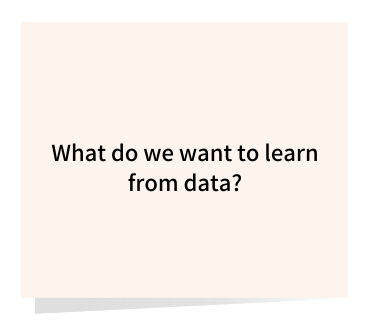
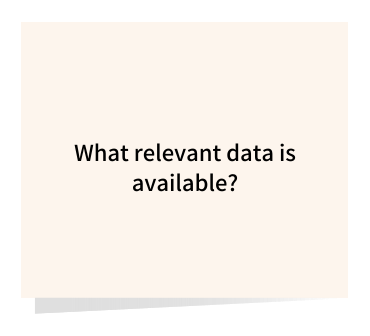
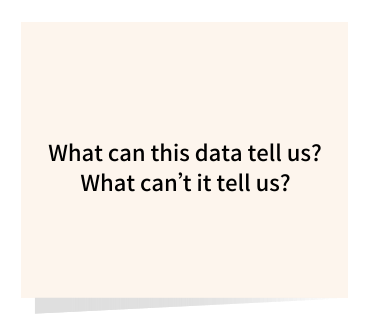
For example, if you’re deciding how to price a service, you could start by looking at data your organization collects about how demand for the service changes when the price goes up or down. Looking at both sales and pricing data can give you a sense of the relationship between the two. But you should ask yourself what other factors might also impact sales.
As you begin to look at data, consider what additional information you might need. Are there gaps that could be filled with more or different data? Is it feasible to collect additional data that applies to the decision you’re making?"Data-Driven Decisions Start with These 4 Questions," by Eric Haller and Greg Satell. Harvard Business Review, February 11, 2020.
Drew identifies additional data needs
Drew identifies additional data needs
Drew is an advertising manager at a sports equipment retailer. Each month, they need to decide which products to feature on the home page of the company website to promote sales. Drew has access to data that shows how long visitors spend on the home page and which products get the most clicks.
This information can help Drew make educated guesses about which featured products will attract customer interest. But it doesn’t show if featuring products increases sales. To decide which products to feature, Drew needs to seek related sales data. Analyzing the relationship between the two data sets can help Drew make smart choices.
Drew identifies additional data needs
By identifying answers to your questions, you’ll get a better understanding of how data can help you make your decision and explain it to other stakeholders.
How to collaborate with data experts
When possible, consulting with a data team or expert can help you make sound decisions more quickly."Your Data Initiatives Can’t Just Be for Data Scientists," by Thomas C. Redman. Harvard Business Review, March 22, 2022. If you don't already work alongside data experts, reach out to individuals or teams who specialize in collecting and interpreting data. Use these tips to guide your collaboration:
Focus on your goals. Explain what you want the data to help you aclhieve. Ensure that data experts understand the decision you're making and how data could help you answer key questions about it.
Test your thinking. Talk though conclusions you've drawn from the data and note points of confusion. A data expert may pinpoint errors in your analysis or suggest additional insights.
How to collaborate with data experts
Make a Connection
1. Think about a decision you’re working on or will soon need to make. What forms or sources of data are available to you? What additional data might be helpful
第 4 节
Data is increasingly important in business today. Yet data can’t always show you exactly what the best decision is. And sometimes you may not have access to data that gives you clear guidance. So, you may have to rely on your experience or your instinct to make certain decisions.
It’s smart to be a little skeptical about your ability to make a good decision without data. If you’re overconfident about your abilities, you may not be checking your thinking for bias or looking for ways to improve your decisions.
Research shows that data-informed predictions are generally more accurate than those based on intuition.
Research shows that data-informed predictions are generally more accurate than those based on intuition. Research shows that data-informed predictions are generally more accurate than those based on intuition."Act Like Scientist," by Stefan Thomke and Gary W. Loveman. Harvard Business Review, May-June 2022.
Data is most valuable when you have a good set of relevant data available to you and your decision can be made using objective criteria.
For example, if your decision hinges on knowing who regularly buys your product or whether sales are stronger online or in physical stores, it’s better to refer to those numbers rather than to rely on your own hunches. But this doesn’t mean that data is always better than intuition.
Your intuition is most valuable when:"When It’s Safe to Rely on Intuition (and When It’s Not)," by Connson Chou Locke. Harvard Business Review, April 30, 2015.
Many decisions benefit from a combination of data and intuition. You might use one to whittle down your options, then use the other to make a final choice.
Malai blends data with intuition
Malai blends data with intuition
Malai is setting up a new branch office of an urban planning firm. To choose furniture for the new office, she consults research about ergonomic design and considers user reviews. This helps her identify some top vendors. Malai also tries to understand whether furniture that costs more is better. For instance, do more expensive brands seem to be more comfortable, more stylish, or longer lasting?
Malai uses the data she’s gathered to narrow down her options, but her research doesn’t tell her which furniture brand best fits her needs. People have different opinions about comfort and style, and most top brands offer similar levels of quality. Malai follows her gut feelings in deciding on which furniture to purchase. From the list of options, she picks one brand that she thinks most people will like and that appears to offer good quality for a reasonable price.
Malai blends data with intuition
If instinct guides your choice, be sure you can still justify your decision to stakeholders. If you rely on data, be sure the data is sound and you can explain why the data backs up your choice.
Make a Connection
1. Think of a decision you made at work that was based mostly on intuition. How did you make the decision? What was the result?
As you work with data, you’ll gain more insights into when and how to use it to guide your decisions. That will save you time and boost your chances of making a successful decision that gets valuable results for your organization.
第 6 节
Test your understanding and reinforce what you’ve learned.
第 7 节
Reflecting on your learning helps you apply relevant concepts to your job.
Take a Moment
1. 1. What new insights do you have that could benefit you or others in your workplace?
2. 2. What are your biggest opportunities for applying concepts from this Lesson in your workplace?
Further reading
用 3 个问题检验你的优先事项当下的领导者正处于一种“环境性紧迫感”(ambient urgency)之中——不断的变化、优先…
Top 3 in the source platform's original order
