Pocket Leadership口袋领导力

Attracting and Cultivating Talent

Shape a Positive Employee Journey 查看中文版

第 1 节

Why focus on employee engagement?

Think about your current role. What drew you to the position and what keeps you there? If you’re like most people, one key factor is a meaningful and positive work experience.

Research shows that employees who are invested and engaged in their work are far more likely to stay. 

And in a world altered by the Covid-19 pandemic and a tightening labor market, more and more professionals are seeking fulfillment in their jobs beyond a paycheck.

It’s true that senior leaders and human resources specialists develop many of the policies that contribute to corporate culture and help to engage employees. But you also play an important role. Your attention to the people you work with beyond their daily tasks and business goals provides them—and you—with meaning and connection.

When you focus on fostering a positive work experience, you:
Try it Out

Try it Out

Take a Moment

1. If you don't agree with the statements above, what can you do to make your own work experience more meaningful?

第 2 节

The employee journey

Your role in that journey includes these steps:

  • Attract the right candidates by crafting a compelling job description and recruiting a diverse group of applicants.

  • Hire new employees, help them acclimate to your organization and their new positions, and make them feel they belong.

  • Engage and develop team members by providing them with work that is meaningful, personalized, and full of learning opportunities.

  • Transition employees with grace when they choose to move to other teams or leave your organization.

As Angela Cheng-Cimini, senior vice president of talent and chief human resources officer at Harvard Business Publishing, explains, managers like you are the single most important influence on the employee’s experience, wherever they are on their journey.

让员工离开的不是公司,而是他的上司 Your Role in the Employee Journey

哈佛教授讲授视频逐字稿
I've been a practitioner of human resources for nearly three decades. And one important thing I've learned is that your organization will have a culture, whether you've designed it intentionally or not. Culture is a product of your values and behaviors. And how well those two things align will drive how much your staff engages and how well they perform. The primary function of HR is to ensure an environment that is equitable and inclusive. We achieve that through programs, offerings, and policies that serve the entire business. But that purview is not exclusive to HR. In fact, you, as a leader, are the singular most important force that influences the employee journey, from the candidate experience to onboarding through their career progression and, yes, even exit. Your role as a manager is critical to aligning purpose to performance. Candidates may come to us based upon what they see on our website or read on social media. But they won't stay long if the reality doesn't live up to the hype. Employees don't really quit their companies. They quit their managers. And even managers have managers. What does good leadership look like for you? Consider, how are you fostering inclusion? Are you accommodating your team members' needs? Are you modeling a healthy work-life balance? Think about what you want for your team and your own employee experience. And use that to drive your leadership behaviors.

Make a Connection

1. Think about bosses you've worked for in the past. What did you learn from them about how to engage with people at each stage of the employee journey?

第 3 节

Align purpose to daily work

In a study by McKinsey, 70% of the employees who participated said their sense of personal purpose is defined by the work they do.

In a study by McKinsey, 70% of the employees who participated said their sense of personal purpose is defined by the work they do. In a study by McKinsey, 70% of the employees who participated said their sense of personal purpose is defined by the work they do.

Studies show that employees today want to feel part of something bigger than themselves. Many of us want to make a difference in our communities and the world. Having a sense of purpose brings meaning to daily work, provides motivation, and leads to higher productivity.

You’re probably familiar with your organization’s mission and vision statements. These are used to align and focus teams throughout the company on a shared strategic direction and goals. But purpose is a little different. It’s your organization’s core reason for existing and its unique contribution to society.

Unilever: “Doing well by doing good”

Unilever: “Doing well by doing good” For almost a century, Unilever’s sense of purpose—focused on changing lives for the better—has driven the company’s global success. Times have changed, but Unilever’s core purpose hasn’t. The Unilever Sustainable Living Plan, drafted in 2010, now drives the company’s strategic decisions, policies, and processes. Doing good means helping more than a billion people improve their health and well-being and reducing the environmental impact of Unilever products. The company’s employees feel confident in knowing their contributions make the world a better place. Unilever: “Doing well by doing good”

People want to work in an organization that supports and aligns with their personal values. That’s where you come in!

"Those who lead by example and demonstrate passion for what they do make it much easier for their followers to do the same."

As a manager, begin by making your organization’s purpose relevant to your team. Try these practices:

  • Lead discussions about the positive impact your company has on its customers and the world.

  • Share your personal sense of purpose and how your work allows you to fulfill it.

  • Help team members see how their work contributes to both fulfilling their own purpose and supporting the company’s important purpose.

  • Ensure people’s job descriptions clearly identify how their work serves the organization’s purpose.

When you regularly prompt people to talk about purpose—theirs and your company’s—you inspire a greater sense of connection and bring context and meaning to your team’s work.

Here, Hubert Joly, former CEO of Best Buy, describes how you can help the people on your team connect their personal sense of purpose to the work your team does.

帮助团队成员实现梦想 Help Team Members Reach Their Dreams

哈佛教授讲授视频逐字稿
Meaning and purpose are key elements of what drives us, and of course, if we can connect what drives us individually with our work, and if this work is connected to the purpose of the company, that's how you create joy and extraordinary business results. But imagine for a second that you and I walk into a Best Buy store, and we tell the store general manager and the associates, we have some big news big corporate news, we have a new corporate purpose. It's to enrich lives through technology by addressing key human needs. I can bet and almost guarantee you that the reaction from the staff in the store is going to be, we love you but we have no idea what you just said. What do you want us to do tomorrow morning at 10 AM when we take our shift, it's corporate speech. And so for me, a big insight from my journey at Best Buy is the importance of leadership from the inside out and uncovering what drives us as individuals to connect it to the work and to the corporate purpose. I will always remember visiting a store in Boston where the store general manager told me he asked everyone in the store, about 100 associates, every one of them, what is your dream, at Best Buy, outside of Best Buy what is your dream? OK, write it down in the break room and he said, my goal is to help you achieve your dream. And I said OK, so tell me concretely, and they will say this woman he told me about, this young woman, her dream was to be able to buy an apartment. The store general manager told her, OK, we're going to need to help you make progress in your career at Best Buy from Blue Shirt to supervisor, to assistant store manager. She was able to do it. She was able to buy the apartment, developing her skill set in the process, and learning how to enrich lives through technology for our customers. And so for me, the lesson is that a very practical thing that everyone can do is sit down with individual team members or your team as a whole and have a conversation, share with each other your life story, and then what drives you in life, your dreams. And then talk about how you can support each other in achieving your dream, and connecting these dreams with the work and with the purpose of the company.

Make a Connection

1. What is your organization's purpose? How does your team contribute to fulfilling that purpose?

第 4 节

Develop an inclusive team culture

Your team’s culture is the answer to the question, “How do we work together?” It develops from the way you and other members routinely show up, both one-on-one and in group settings. In a strong collaborative team culture, members support one another, communicate openly, and listen to each other respectfully.

Take a Moment

1. How would you describe your team’s culture? For example, is it caring, competitive, congenial—or something else? What role do you play in shaping that culture?

You help shape your team’s culture, so you have an important opportunity to make everyone feel included. Inclusion means ensuring everyone feels safe and welcome to bring insights from their own experience to the conversation. Your team benefits from multiple perspectives on how to accomplish goals and tasks. And people are more likely to stay in an organization that values diversity.

What steps can you take to create an inclusive team culture? Be sure to:

  • Set everyone up for success by providing access to equal opportunity and resources.

  • Get to know each member of your team individually, listen to what’s important to them, and ask what strengths they bring to their role.

  • Make a point of praising good work and responding to people’s concerns.

Try it Out

Try it Out

Make a Connection

1. Are there any statements you didn't pick that you'll try? What other steps can you take to build an inclusive team culture?

Improve Your Team Culture

附件:IMPROVE YOUR TEAM CULTURE1700126735500.docx(docx · 261 KB,本地副本)

第 5 节

Embrace flexibility

In a recent survey, 83% of the participating employees said they were more likely to stay at their company if they were allowed to work flexibly.

In a recent survey, 83% of the participating employees said they were more likely to stay at their company if they were allowed to work flexibly. In a recent survey, 83% of the participating employees said they were more likely to stay at their company if they were allowed to work flexibly.

The Covid-19 pandemic caused many teams to expand beyond the physical office space to remote settings. As a result, the way people approached their work and achieved productivity changed in important ways.

You may notice that team members now desire some degree of flexibility. For example, they may want more choices in where and when they work. While there will always be certain job roles that can’t offer flexible options, consider where you can give people the autonomy to make choices. Talk to team members and listen to what flexibility means to them.

Flexibility can take many forms, including:

Schedule Allow team members to vary their working hours to suit their lifestyle, while setting core hours when everyone is available for collaboration. Place Offer opportunities for employees to work from home, in an office, or a combination of both. Resources Provide the digital tools needed to enhance team communication and collaboration from anywhere. Workload Offer people part-time schedule opportunities if your company supports this option.

Felix Oberholzer-Gee, professor at Harvard Business School, gives an example of the value one company created by offering employees flexibility.

提升工作吸引力 Make Work More Attractive for Your Team

哈佛教授讲授视频逐字稿
You have such a big role in making the working conditions, the conditions that attract the best talent for your organization. One scary statistic, when you ask people what are the most important reasons why you left your last job? More than half of employees say, my manager, my boss. Every time you create better working conditions, every time work becomes more attractive, you create more value for the members of your team and you increase the likelihood that the best people will stay inside the organization. Now very often we think about promotion paths, we think about the experience of the culture in the organization, and those factors are super, super important. But remember, work is so many things to so many people. How do I need to get dressed for work? When do I have to be at work? Do you force me to go to work and be stuck in traffic because like everybody else, I have to be there at 9 o’clock? An amazing example comes from The Gap, the fashion retailer. They realized that one aspect of retail work that is often challenging is that you never quite know how many shifts you will get and when you have to work. What does The Gap do? They allow people to trade their shifts, creating enormous value, value for everyone, which is quite amazing. First, they noticed that same store sales go up dramatically over time. Why? Well, if I want to be really at work when I'm at work, I'm going to do a better job. Parents in particular, report even sleeping better. How is that possible? Just because we allow some trading of shifts, well, it also means that I get the income that I expected because I can work the number of shifts that I really would like to work. So think about work in a very comprehensive fashion. It's many different things.

第 6 节

Model work-life balance

Members of your team desire and deserve a satisfying life beyond work—and so do you! You set the tone for your team through your actions. By balancing work with a fulfilling life outside the office, you encourage team members to do the same. When employees are happy and engaged, they’re more likely to stay with your organization—and spread the word to others about your team’s positive work culture.

If, on the other hand, you’re always on call with no real downtime, team members will feel pressured to do the same. It’s up to you to promote healthier ways of working. Here are ideas to help you lead the way:
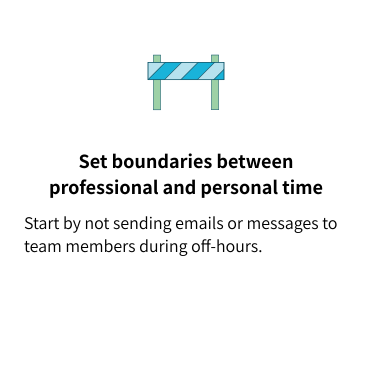
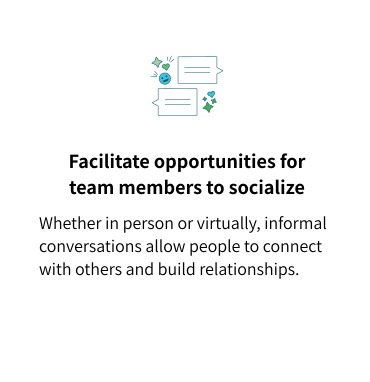
These actions show your team members that you see them as people and not just as workers. And they help you create a work environment where individuals feel respected, valued, and supported. Cultivating a positive employee experience helps you attract, retain, and develop talented people. It is a vital part of your company’s success and ability to thrive!

第 7 节

30-Second Takeaway

  • Create a positive employee experience to engage your team, improve productivity, and retain key employees.

  • Connect team members’ sense of purpose and their daily responsibilities to the organizational mission.

  • Cultivate a team culture that generates a sense of inclusion and belonging.

  • Embrace flexibility and consider ways to give your team members autonomy about where, when, and how they work.

  • Model work-life balance through your own efforts to set boundaries between personal and professional time.

第 8 节

Review Test

Try it Out

1. An employee appears reluctant to share ideas in meetings and has mentioned that they don’t feel like they belong on the team. Which of the following is the best step you can take to help them feel more included?
答案与解析

A. Share your personal sense of purpose and how your work contributes to the company’s important mission.
While having a sense of purpose brings meaning to daily work and motivates employees to be productive, sharing your purpose may not be the best step toward helping employees feel included. A good manager takes time to get to know each employee, listens to what’s important to them, and makes sure they feel seen and heard.

B. Get to know the team member better by asking what’s important to them. Make a point of praising good work and responding to any concerns they have.(正确)
With this approach, you make the person feel valued and included. Taking the time to learn about what’s important to team members helps you understand the unique perspective they have to offer. And when you praise team members’ work and address any concerns they have, you make them feel seen and heard.

C. Offer opportunities for employees to work from home, in the office, or a combination of both.
While team members may want more choices in where and when they work, offering flexibility doesn’t necessarily help people feel included. A good manager takes time to get to know each employee, listens to what’s important to them, and makes sure they feel seen and heard.

第 9 节

REFLECT

Reflecting on your learning helps you apply relevant concepts to your job.

Take a Moment

1. 1. What new insights do you have that could benefit you or others in your workplace?
2. 2. What are your biggest opportunities for applying concepts from this Lesson in your workplace?

Further reading

你需要了解员工的照护责任
员工们经常需要在工作和照顾家庭成员的责任之间进行平衡,无论是照看孩子、赡养老人,还是照顾其他家庭成员。然而,许多组织并不…
无形工作,正在耗尽你最优秀的员工
大多数领导者评估工作量时,关注的往往是工时、截止日期和产出,但这些衡量标准忽略了员工所承担的心理负荷—&md…
你的招聘信息是否正在让创意人才望而却步?
许多组织声称他们渴望吸引创新型人才,但却因为招聘语言使用不当而自我设限。对一万份创意岗位招聘启事的分析,以及与两千名求职…

Top 3 in the source platform's original order